
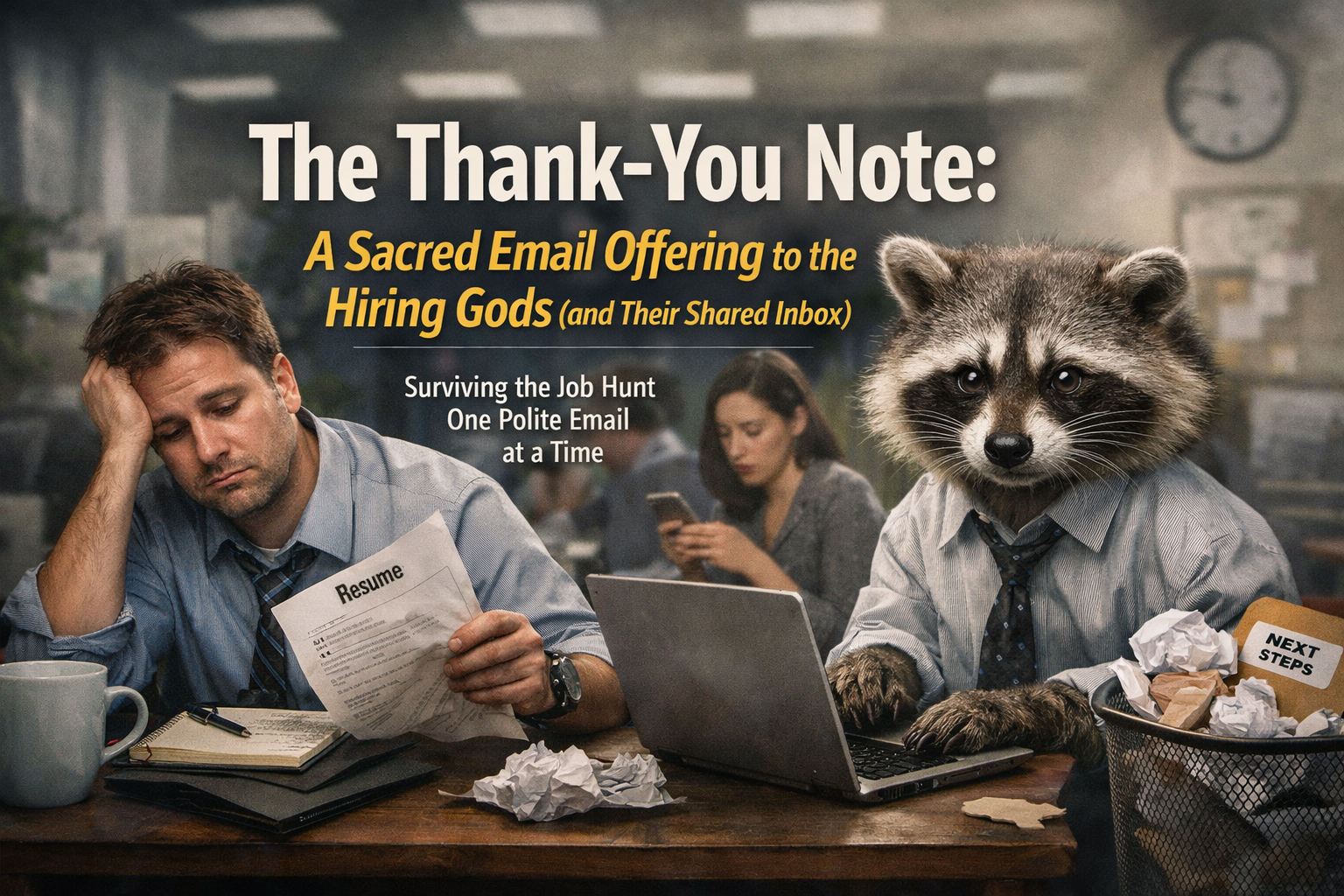
The other day I saw a post confidently announce that the easiest way to stand out in today’s job market is to send a thank you note after your interview, and I felt my spirit leave my body in a slow, professional manner, like it was trying not to make a scene in the lobby. Because there are few things more modern than being told the secret to success is a polite email you send after you’ve already sprinted through an obstacle course designed by someone who hates joy, hates time, and definitely hates the concept of a person needing rent money.
And immediately, my inner corporate raccoon sat up on his hind legs, clutching a half-crumpled resume like it’s a napkin he found near a dumpster that still smells faintly of hope, and whispered, “Ah yes. The ancient ritual.” Not because he believes in the ritual, but because he recognizes it the way a veteran recognizes a siren in the distance. He has seen this before. He has survived this before. He has watched good candidates evaporate into the ether because they forgot to perform the ceremonial gesture that proves you are both qualified and housebroken.
Because if you’ve been job hunting long enough, you know exactly what this is.
This isn’t career advice anymore. This is folklore. It’s a story passed down through LinkedIn posts with confident spacing and solemn line breaks, whispered in comment sections by people who use the phrase “lean in” like it’s a harmless suggestion and not a threat, repeated like a spell meant to keep recruiters from forgetting your name entirely, and framed as a “simple step” as if you haven’t already completed a psychological triathlon just to earn the right to be perceived for forty-five minutes on a video call.
Somewhere along the way, we collectively decided that after enduring five interview rounds, a personality assessment that asked whether you’d rather be a dolphin or a stapler, and a “casual conversation” that felt suspiciously like a trial where the judge is also the witness and the court reporter is your self-esteem, the final deciding factor would be… a polite email.
Not skills.
Not experience.
Not the fact that you answered every question without crying.
No.
It’s the thank you note.
And of course it is, because the thank you note has everything modern hiring loves: it’s invisible labor, it’s emotional performance, it’s unpaid, and it gives everyone the comforting illusion that the process is still human. That there is still etiquette. That there are still rules. That you are not being sorted by a spreadsheet with the personality of a damp paper towel.
So there you are after the interview, emotionally dehydrated, nervous system vibrating like a phone on silent, staring at your laptop like it’s about to either change your life or email you back in three weeks with “We were very impressed” and no other meaningful information. You sit down to write your thank you note like it’s a college admissions essay that will determine whether you get to eat or simply continue surviving on free trials and spite.
“Thank you so much for taking the time to meet with me.”
You delete it. Too generic. Too safe. Too much like you were generated by an algorithm designed specifically to disappoint you.
“Thank you for the engaging conversation.”
Delete. Sounds like a LinkedIn ghost wrote it and then immediately tried to sell you a course.
You rewrite it eight times trying to sound appreciative but not desperate, confident but not cocky, enthusiastic but not like you’re about to camp outside the building and form a small community around their parking lot. You mention something specific from the interview so they know you were present and not dissociating while nodding. You proofread it twelve times because one typo could apparently undo your entire professional identity, and because nothing says “ready for leadership” like fear-sweating over whether you used “its” correctly.
Then you send it.
And you wait.
And nothing happens.
Because here’s the quiet part no one says out loud: the thank you note is rarely read with reverence. It’s skimmed between meetings. It’s opened while someone’s Slack is exploding. It’s mentally acknowledged with, “Nice,” before being immediately overtaken by a calendar alert titled “URGENT: ALIGNMENT,” which is not about your career, but somehow still controls it.
The raccoon knows this.
The raccoon does not believe the thank you note gets you the job.
The raccoon believes it simply prevents you from being ruled out for failing to perform the ceremonial gesture.
It’s not about standing out.
It’s about not disappearing.
And in today’s job market, candidates aren’t competing to shine. They’re competing to remain visible long enough to be remembered as a real human being and not “that one person from Tuesday.”
So yes. Send the thank you note.
Not because it’s magical.
But because modern hiring has become a survival game, and sometimes the raccoon survives by waving politely from the trash pile and reminding everyone, gently, respectfully, grammatically…
“I am still here.”
The Ritual of Gratitude and the Performance of Not Being a Problem
The thank you note is not an email. The thank you note is a costume you put on after the interview, like a second outfit change in a play where the audience insists the best actors are the ones who can do emotional gymnastics without wrinkling their shirt. It is a small performance designed to reassure the company that you are the kind of person who knows how to smile while being evaluated, the kind of person who will apologize when someone else bumps into you, the kind of person who will handle rejection gracefully and then quietly spiral in your kitchen like a professional adult.
Because that’s what the thank you note really is: a signal.
Not a signal of competence. You already demonstrated competence when you answered questions about stakeholder alignment while pretending you haven’t been living in a state of constant stakeholder misalignment for two years. Not a signal of passion. You already pretended to be passionate about “this mission” even though the mission was clearly “increase quarterly performance while asking everyone to do more with less.” Not a signal of culture fit. You already laughed politely at the joke that was not funny because the interviewer needed you to.
No, the thank you note is a signal that you understand the unwritten rules, the ones that exist in the same shadowy realm as “don’t bring up salary too early” and “be yourself, but not like that.”
It’s the corporate equivalent of leaving a small offering at a shrine. A little dish of polite gratitude set out under the fluorescent lights in the hope that the hiring gods will see it and think, yes, this one is trainable. This one understands hierarchy. This one will not disrupt the ecosystem by acknowledging reality out loud.
And the most exhausting part is that the thank you note is framed as optional when it’s not. It’s like being told, “You don’t have to wear pants,” while everyone around you is wearing pants and the minute you show up without them, you’re suddenly “not aligned with expectations.” Nobody wants to say it’s required because required sounds unfair, and unfair sounds like we might have to examine the entire system, and we cannot do that because we have a meeting in five minutes about the meeting we just had.
So candidates play along, because candidates do not have the luxury of refusing ritual. Candidates are not trying to win a purity contest. Candidates are trying to survive. Candidates are trying to avoid stepping on the invisible landmines that exist solely to justify why a decision “didn’t feel right.”
And sometimes “didn’t feel right” doesn’t mean you were wrong for the role. It means you didn’t say thank you fast enough.
The raccoon understands urgency. The raccoon understands timing. The raccoon knows that in the wild, you don’t wait three days to show gratitude. In the wild, you show gratitude immediately, with your whole body, because if you hesitate, the opportunity gets eaten by someone else who is already in the trash.
So the raccoon insists you send it. Not because it’s noble. Not because it’s romantic. But because it is the closest thing hiring has to a receipt. Proof that you were there. Proof that you are still interested. Proof that you can follow a rule you were never told, which is essentially the entire job.
The Waiting Period, Also Known as the Haunted House of “Next Steps”
After you send the thank you note, you enter the part of the process that is truly unique to modern employment: the waiting. The quiet. The limbo. The spacious, echoing hallway where your application sits like an abandoned suitcase while you stand there wondering if you should pick it up, leave it, or set it on fire and start a new life selling handmade candles shaped like corporate disappointment.
Because the waiting is where logic goes to die.
You were told there would be next steps. You were told you were a strong candidate. You were told they’d be moving quickly. You were told they were excited. You were told this role is a priority. You were told so many things in the same tone people use when they say, “We should definitely get coffee soon,” which is not a plan, it’s a farewell.
And then you hear nothing.
Your thank you note sits there like a tiny flare fired into a foggy sky. You can almost imagine it, drifting through the corporate atmosphere, passing through spam filters, landing gently in an inbox where it is immediately pinned beneath fifteen internal threads titled “RE: RE: RE:” and a calendar reminder that says “FOLLOW UP?” and then, inevitably, sinking to the bottom like a polite pebble.
You refresh your email because your brain has been trained to believe refreshing is an action. You check your spam folder like you’re searching for meaning. You convince yourself that silence means deliberation. You tell yourself they’re busy. You tell yourself it’s a holiday. You tell yourself maybe someone is out sick. You tell yourself maybe they’re coordinating schedules. You tell yourself anything that allows you to remain hopeful without feeling foolish, which is a delicate emotional balancing act best performed by professionals and circus performers.
Meanwhile, somewhere inside the company, the process is not moving quickly. It is moving in circles. It is moving sideways. It is moving in the way a shopping cart moves when one wheel is possessed. Someone went on vacation. Someone else is waiting for budget approval. Someone else is rethinking the job title because they saw a TikTok about “title inflation.” Someone else decided to pause hiring until “Q2 clarity,” which is a phrase that translates to “we are afraid and we would like you to be afraid too.”
And you, the candidate, are expected to remain available, calm, and grateful through all of it, as if you are not a person with bills, responsibilities, and a fragile relationship with optimism.
This is where the raccoon thrives, because the raccoon is built for uncertainty. The raccoon does not need a timeline. The raccoon does not need closure. The raccoon lives in a world where the next meal may be five minutes away or never, and yet he persists, because he has learned that survival is not about certainty. It’s about adaptability. It’s about continuing to show up even when the world pretends not to see you.
So the raccoon sits beside you in the waiting period, gnawing on the corner of your confidence, whispering strategies like a small consultant who has seen too much. He tells you to follow up, but not too soon. He tells you to be patient, but not passive. He tells you to remain enthusiastic without becoming a nuisance, which is basically asking you to do emotional math with no numbers.
Because that’s the real job market skill now. Not communicating. Not negotiating. Not leading cross-functional teams. The real skill is knowing how to exist in someone else’s indecision without losing your mind.
And yes, sometimes the thank you note is acknowledged. Sometimes you get a reply that says, “Thank you, great meeting you too,” which is the corporate equivalent of being patted gently on the head before being released into the forest again.
But most of the time, the thank you note is not a bridge. It’s a message in a bottle. It’s a small reminder to the world that you are still floating out here, still trying, still polite, still pretending this process is normal.
The Raccoon’s Hiring Strategy, or How to Stay Human in a System That Treats You Like a File Name
Here’s the thing about the thank you note: it’s not useless. It’s just misunderstood. People talk about it like it’s a secret weapon, like you can charm your way into employment with two paragraphs and a carefully placed sentence about “aligned values.” But the truth is less romantic and more practical: the thank you note is a visibility tool.
It doesn’t make you special. It makes you present.
And in a system that constantly threatens to erase you, presence matters.
Because the real enemy is not another candidate who is “more qualified.” The real enemy is the machine. The layers. The delays. The internal chaos. The moving targets. The fact that hiring is often treated like an inconvenience happening to the company rather than a decision that affects someone’s actual life. The fact that you can do everything right and still be passed over because the hiring manager’s cousin suddenly became “very interested” in a “career pivot.”
So what does the raccoon do?
The raccoon plays smart. The raccoon does not rely on one ritual. The raccoon builds an ecosystem of survival. The raccoon understands that modern hiring is not a straight line. It’s a maze. It’s a reality show where the rules change mid-season. It’s a group project where nobody is responding and you’re still expected to deliver results.
So the raccoon uses the thank you note as one move in a larger strategy of staying visible without losing dignity, which is not easy, because dignity is fragile and hiring platforms are built to sand it down into dust.
The raccoon keeps receipts. He keeps notes. He remembers names. He writes down details from the interview that might matter later, not because he’s trying to impress anyone, but because he knows the process will loop back around and someone will ask, “Remind me who this person is,” and he wants to be ready to say, calmly, “I am the person who spoke with you about the role where you said you needed someone who could stabilize the team without setting the office on fire.”
The raccoon follows up, but with intention, because flailing is not a strategy. He asks questions that force reality into the conversation. He doesn’t beg. He doesn’t perform desperation. He simply shows up again like a polite creature tapping the glass, reminding them that time is passing and that you are still a living participant in this process.
And the raccoon, above all, protects his energy. He does not let one company’s silence become his identity. He does not let one hiring process define his worth. He understands that hiring is chaotic because companies are chaotic, and chaos is not a verdict. Chaos is just chaos.
This is the part nobody says in their confident posts: the thank you note doesn’t stand out because it’s brilliant. It stands out because everything else in the process is impersonal. It is one of the only moments where you get to reassert your humanity without being interrupted by a template.
So yes, send it. Mention something specific. Keep it short enough to be read by a person who is already behind schedule. Make it warm without being syrupy. Professional without sounding like a robot. Human without being vulnerable in a way the system will punish. That balance is hard. It is unfairly hard. But it is the game.
And if the thank you note does nothing, you have still done what the raccoon always does. You have left a mark. You have made yourself harder to erase. You have, at the very least, reminded the universe that you exist, and that you are capable of showing up with grace even when the world refuses to meet you halfway.
Final Thoughts: Send the Note, Keep Your Soul
So here’s where I land, standing beside my corporate raccoon as he brushes crumbs off his tiny paws and looks at the job market with the tired wisdom of someone who has eaten cold pizza behind a conference center: send the thank you note.
Not because it will magically transform the hiring manager into a benevolent fairy godparent who rewards etiquette with benefits and a salary that keeps up with inflation.
Send it because the process is strange and the rules are mostly invisible, and the thank you note is one of the few moves you can make that costs nothing but a small portion of your remaining emotional bandwidth.
Send it because it’s a flag in the ground. A quiet declaration. A gentle reminder that you are not just a candidate ID or a PDF attached to an email thread titled “Applicants.” You are a human being who showed up, answered questions, tried your best, and now deserves the basic courtesy of being remembered as more than a calendar slot.
And then, after you send it, do what the raccoon does best.
Stop staring at the inbox like it owes you a future.
Go live your life.
Apply elsewhere.
Drink water.
Let your nervous system unclench.
Because the thank you note may be folklore, but you are not a character in a myth meant to entertain the algorithm.
You are a person.
And if modern hiring demands a ceremonial gesture to prove that, fine. Wave politely from the trash pile, grammar intact, hope slightly dented, and let the world know, with calm confidence and one clean sentence:
“I am still here.”