
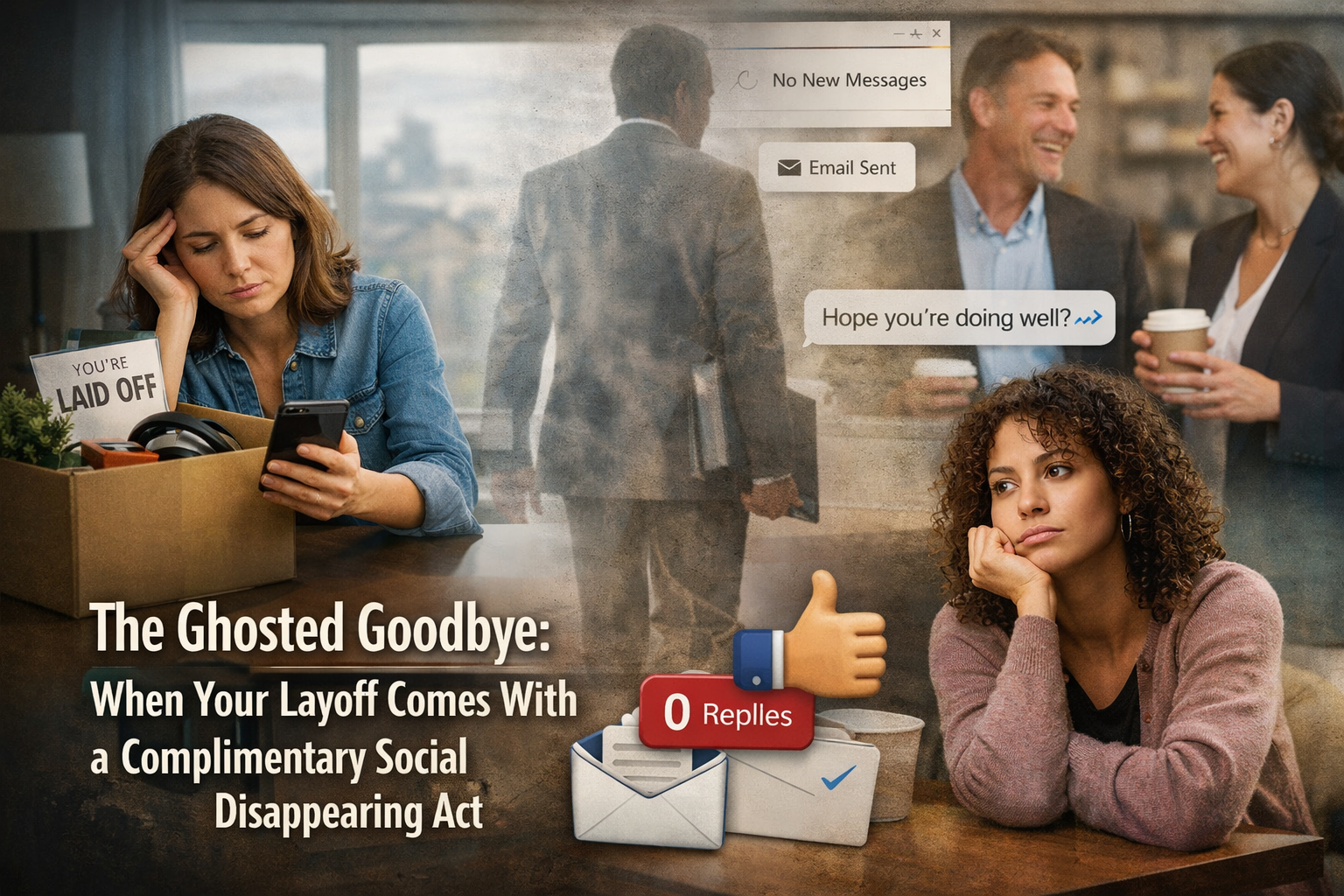
There’s a moment after a layoff that doesn’t make it into the “transition resources” packet, the one with the smiling stock photo hikers and the list of websites that all want you to create an account before they’ll tell you you’re not qualified. It’s not the moment you hand in your laptop or the moment you realize your calendar has gone from “double-booked” to “wide open like a haunted mall.” It’s the moment you send a kind message into the world and discover that kindness, in corporate America, is sometimes treated like an out-of-office request: seen, ignored, and then quietly archived until further notice.
Because you don’t just lose a job. You lose the daily proof that you exist in the system. You lose the meeting invites that made you feel needed, the Slack pings that made you feel included, and the casual drive-by compliments that said, “You’re crushing it,” right up until the company decided crushing it was no longer part of the budget. And then you do the mature thing. The healthy thing. The emotionally intelligent thing. You send a gracious note. You send a holiday message. You send the kind of line that says, I appreciated working with you, I learned a lot, I hope you’re doing well, and if you ever want to connect, I’m here.
And then you get what can only be described as corporate silence, the kind of silence that isn’t neutral, because your brain refuses to interpret it as neutral, because your brain is a loyal employee and it immediately starts working overtime, unpaid, in the Department of Catastrophic Interpretation.
It runs audits. It pulls receipts. It replays every conversation you’ve ever had with that person like a Netflix documentary series called What Did I Do Wrong: Limited Season, Unlimited Anxiety. It zooms in on that one time you didn’t laugh hard enough at their joke. It highlights the email you sent three months ago where you wrote “Thanks” instead of “Thank you,” because apparently that’s how enemies are born. It becomes convinced that HR has installed some kind of empathy firewall where messages from former employees are automatically filtered into a folder labeled: People We Are Not Allowed to Acknowledge Because Then It Gets Real.
Meanwhile, you’re just trying to be human. You’re trying to stay connected. You’re trying to do what everyone tells you to do. Network. Maintain relationships. Build your community. Keep doors open. And the door, it turns out, doesn’t slam. It simply stops responding. It becomes a wall with a polite company logo on it.
So let’s talk about that silence. Let’s talk about what it does to people who are already carrying enough. And let’s do it with humor, because if we don’t laugh, we’re going to start sending follow-up emails like, “Just circling back on whether I still existed to you as a person or if I was exclusively a payroll event.”
The Invisible Badge Effect
The first thing you learn after a layoff is that your identity has been partially outsourced to access credentials. You thought your name was your name, but no, your name was also your email address, your login, your little profile photo in the directory, your ability to appear in search results when someone typed three letters and hoped you’d solve their problem. When those things vanish, you don’t just lose a job. You lose your proof-of-life within the corporate ecosystem.
It’s like you were a fully rendered character in the workplace universe, with dialogue and side plots and a recurring role, and then the writers decided to write you off-screen. Not with closure, not with a farewell episode, but with a quick line: “They moved away.” And then everyone carries on as if you were always optional.
That’s why the silence hits so hard. Because you’re already dealing with the emotional whiplash of being called valuable right before being treated as removable. You’re already reconciling the fact that the same people who praised your work also attended a meeting where your role became a line item. You’re already trying to hold the contradiction that you can be excellent and still be eliminated, competent and still be cut, loyal and still be let go like a subscription the company forgot it was paying for.
Then you reach out, and you expect something small. Not a job offer. Not a rescue plan. Just acknowledgement. A sentence. A nod. The tiniest human signal that says, “I saw you, and I don’t want to pretend you evaporated.”
But corporate culture has trained many people to treat former coworkers like an expired badge: once it doesn’t scan, it’s safer not to touch it. They don’t know what the rules are anymore. Are they allowed to respond? Will it look like they’re admitting something? Will it make them feel something? Will it remind them, for half a second, that the line between them and you is thinner than they want to believe?
And here’s the part no one says out loud: for some managers, replying feels like stepping into a room they’ve been trained to avoid. Because if they respond warmly, they might have to confront the discomfort of how it ended. They might have to look directly at the human consequence of a “strategic decision.” They might have to acknowledge that you weren’t just headcount, you were a person with bills and pride and routines and a brain that now wakes up at 3:00 a.m. to rehearse a conversation that will never happen again.
So instead they do what corporate conditioning teaches them to do. They go quiet. They keep it clean. They keep it professional. They keep it distant. They tell themselves they’ll respond later, when they have the right words, and the right time, and the right emotional bandwidth, and the right permission slip from whatever internal committee manages their discomfort.
And later becomes never, because never is the easiest meeting to attend.
Meanwhile, you’re standing there with a message you meant sincerely, and the lack of response starts to feel like a verdict. You start wondering if your relationship with them was only real when you were useful. You start questioning whether the praise was genuine or just performance. You start replaying every “You’re doing great” like it was written in disappearing ink.
But the truth is uglier and simpler: a lot of people don’t know how to be kind without a context that benefits them. A lot of people don’t know how to maintain connection without proximity and shared deadlines and the ritual of mutual stress. A lot of people confuse professional closeness with actual closeness, because it feels similar right up until it’s tested.
And the layoff is the test.
The Guilt Olympics and the Art of Avoiding Eye Contact Digitally
Let’s be honest. Some of the silence isn’t cruelty. It’s guilt. It’s awkwardness. It’s fear. It’s the emotional equivalent of spotting someone you know in a grocery store and suddenly becoming intensely committed to the cereal aisle because you’re not prepared for a real conversation in public. Except now the grocery store is LinkedIn, and the cereal aisle is “I’ll just like their post later to show support,” and later never arrives because your manager is busy pretending productivity is a moral virtue.
A layoff creates a strange power imbalance after the fact, even when no one asked for it. One person is suddenly on the outside looking in. The other person is still inside, surrounded by the routines and the perks and the fragile illusion that employment is stability. And the employed person often doesn’t know how to talk to the unemployed person without feeling like they’re walking through a museum exhibit titled: This Could Be You.
So what do they do? They avoid. They disappear. They go silent because silence lets them stay comfortable.
Because replying means acknowledging something uncomfortable: you were good at your job and it still happened. Replying means admitting that “people first” has footnotes. Replying means confronting the fact that the company can say “family” while also changing the locks. Replying means holding space for grief, and corporate America does not train people to hold space; it trains people to hold meetings.
And the manager, to be fair, might be in survival mode too. They might be drowning in extra work. They might be afraid they’re next. They might be juggling their own anxiety while trying to sound upbeat in standups like someone who’s been told the building is on fire but still needs to deliver the quarterly update.
But here’s where the comedy gets dark, because in many organizations, the manager also becomes the unofficial ambassador of a decision they didn’t make, and they’re expected to act like it was thoughtful and fair and necessary, even if it felt cruel. They’re supposed to keep morale up. They’re supposed to keep the team focused. They’re supposed to say words like “realignment” without vomiting in their mouth.
So when a laid-off employee reaches out with kindness, it forces a moment of truth. It forces the manager to remember you as a person, not an event. It forces them to confront the story they’ve been telling themselves to keep functioning.
And if they respond, they might have to say something real, like: I’m sorry. I hated this. You didn’t deserve it. This system is broken. You mattered. It was unfair.
Those are dangerous words in corporate culture, not because they’re wrong, but because they’re honest. And honesty is often treated like a liability, the way some companies treat overtime: possible, but discouraged, and definitely not to be done without prior approval.
So instead, silence becomes the safe option. Silence becomes the approved script.
And you feel that silence like a second layoff.
Because the first layoff took your role. The second layoff takes your connection. The first one says, “We’re moving in a different direction.” The second one says, without words, “We don’t know what to do with you now that you’re not attached to a title.”
That’s why it stings. Not because you need validation from every person you ever worked with, but because you’re already carrying so much invisible weight. You’re already trying to stay proud while feeling discarded. You’re already trying to keep your confidence intact while being repeatedly asked, in the job market, to prove your worth like you’re auditioning for your own adulthood.
And then silence shows up and whispers the worst possible interpretation: Maybe you didn’t matter.
But here’s the twist: their silence often says more about their capacity than your value. It says they don’t know how to navigate discomfort. It says they’re afraid of emotion without structure. It says they’ve been trained to prioritize safety over sincerity. It says they can celebrate you loudly when you’re winning, but they don’t know how to stand beside you when you’re hurting.
That isn’t a reflection of your worth. It’s a reflection of the limits of their humanity in a system that rewards performance over presence.
Networking, But Make It Haunted
We need to talk about the way “networking” is sold to people, because it’s often presented like a cheerful hobby, like scrapbooking or gardening, when in reality it’s more like building a lifeboat while someone actively drills holes in your ship.
We’re told to “keep in touch,” and the advice is always delivered with the confidence of someone who has never had to send a message that begins with, “Hi, I hope you’re well,” while their stomach is doing acrobatics and their brain is rehearsing rejection in advance. We’re told to “reach out to your former manager,” as if that isn’t emotionally complicated, as if there isn’t a part of you that still hears their voice during the layoff call, as if their name doesn’t live in the same mental folder as grief.
And we’re told, repeatedly, that relationships matter, that community matters, that you should invest in people, because people are your greatest asset.
Which is a beautiful concept, until you discover some workplaces treat people like rentals.
What makes post-layoff networking especially haunted is that you’re not reaching out from a place of abundance. You’re reaching out from the emotional rubble of an identity shift. You’re reaching out while trying to maintain dignity. You’re reaching out while balancing hope and shame, because the world has done a great job making unemployment feel like a personal failure, even when it is clearly a systemic mess.
So you craft the message. You do it carefully. You do it with warmth. You do it without bitterness, because you’re still trying to be “professional,” which in this context often means “pleasant while bleeding.” You say something kind and grateful. You make it easy for them. You give them an opening. You offer a connection without making a demand.
And then the silence arrives.
At this point, your brain does something fascinating and unhelpful: it starts treating non-response like information. It starts turning a missing reply into a character judgment. It starts building a narrative where silence equals rejection, where silence equals dislike, where silence equals proof that you were never actually appreciated.
But silence is a tricky data point. Sometimes it means they didn’t see it. Sometimes it means they meant to respond and didn’t. Sometimes it means they’re overwhelmed and barely holding their own life together. Sometimes it means they’re anxious, and your message triggered their fear of being next, so they avoided you like you were a mirror.
And sometimes, yes, it means they were never the person you thought they were outside of the workplace context.
That last one hurts, because it forces you to separate what was real from what was situational. It forces you to see that some relationships are built on proximity, not care. Some connections are built on shared projects, not shared humanity. Some praise is real, but shallow, the kind of praise that belongs to a job well done rather than a person well valued.
This is where the humor comes in, because the absurdity is almost impressive. We live in a world where people will write a 900-word LinkedIn post about “authentic leadership” and “showing up for your people,” and then ignore a kind message from someone they worked with for years, as if replying would trigger a compliance investigation.
We live in a world where managers will say, “My door is always open,” and then once you’re laid off, the door becomes decorative, the kind of door you see in a hallway that leads nowhere, installed purely for aesthetic.
We live in a world where companies encourage “bringing your whole self to work,” and then as soon as work ends, they prefer you take your whole self elsewhere and never mention that you once existed among them, like you were an embarrassing ex they’re trying to pretend was just a phase.
So what do you do with that?
You recalibrate.
You stop treating silence as a scoreboard. You stop letting non-responses rewrite your memory of yourself. You stop assuming every lack of reply is a condemnation. You start building a new understanding of relationships: who can show up without a shared org chart, who can be kind without needing a transactional reason, who can be human even when it’s uncomfortable.
And you keep reaching out anyway, not because you enjoy it, not because it’s easy, but because you’re building a life that isn’t dependent on being employed by the same system that discarded you. You’re building a network that is actually a network, not just a list of people who once benefited from your labor.
Because here’s the thing: networking can feel haunted, but it can also become liberating when you realize you’re not auditioning for their approval. You’re gathering evidence of who is capable of connection.
And that is valuable information, even when it hurts.
Final Thoughts: Your Kindness Was Not Misplaced
If you’ve sent a thoughtful message after a layoff and been met with silence, you’re not alone, and you’re not foolish, and you’re not “bad at networking.” You did what a grounded person does. You acknowledged people. You expressed gratitude. You kept the bridge intact. That is not weakness. That is character.
Their silence does not retroactively erase your value. It does not invalidate the work you did or the relationships you built. It does not prove the connection was fake, even if it proves the connection had limits. It simply reveals something that layoffs reveal with brutal efficiency: many people are comfortable with you when you are part of the system, but they don’t know how to hold you when you are outside of it.
That’s not your failure. That’s the system’s shallow training. That’s the culture that treats empathy like an optional benefit, something offered only to active employees, and even then, with restrictions.
So keep being kind. Keep being the person who can send the gracious note even when your heart is bruised. Keep reaching out when it feels right, not because you need their response to validate you, but because you refuse to become smaller just because someone else got awkward.
And if silence answers back, let it be information, not judgment. Let it teach you who can show up without the convenience of titles. Let it clarify where your real connections live. Let it push you toward people who don’t require an org chart to remember you’re human.
Because you didn’t lose your value when you lost your job. You lost access to a system that confuses employment with worth. And if that system can only care while you still have a badge, then it was never equipped to hold the best parts of you anyway.