
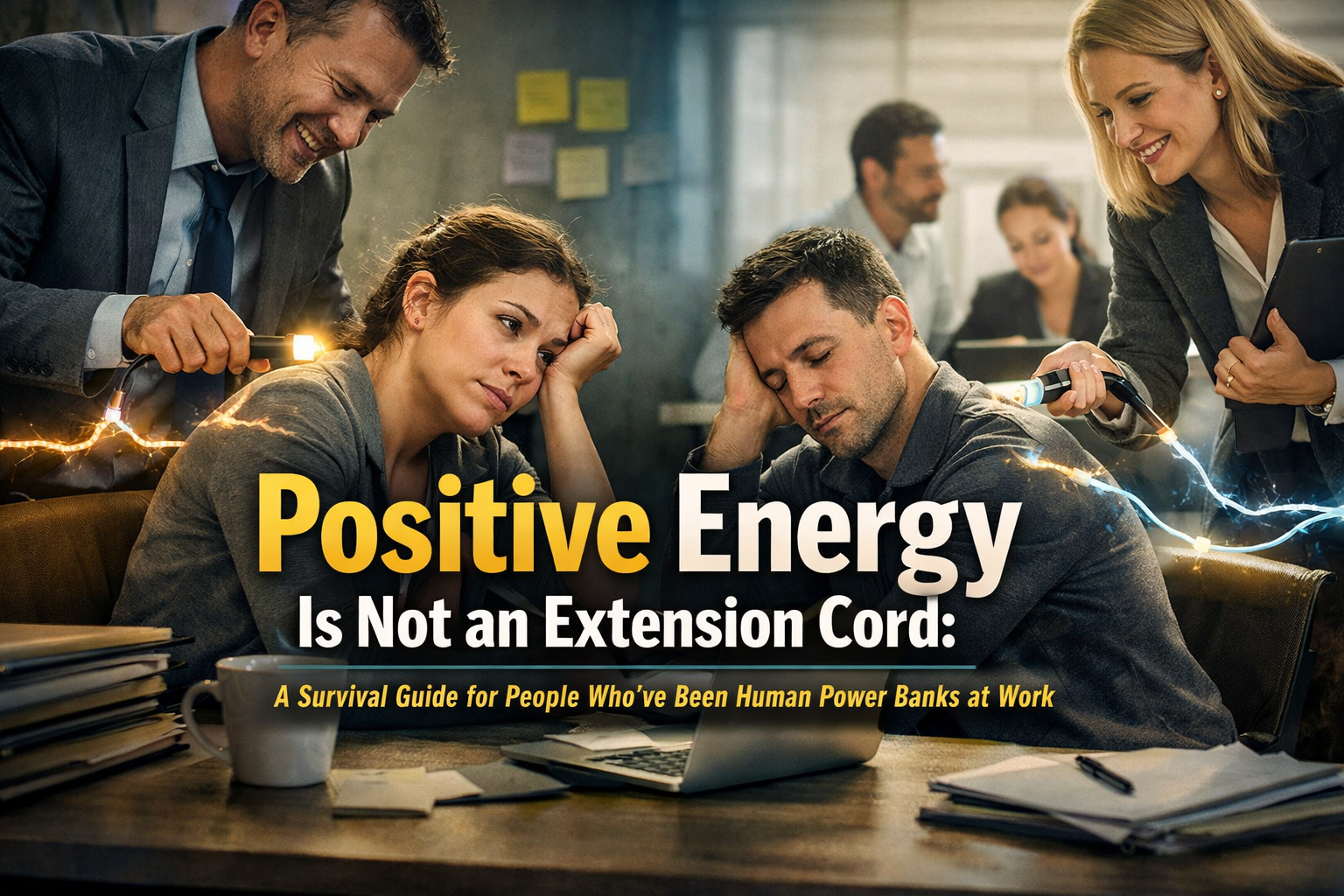
We talk about “positive energy” like it’s a light switch you can flip the second your calendar invite loads. Like your nervous system is supposed to see “Quick Sync (15 min)” and go, Ah yes, my favorite hobby: inner peace.
We’ve turned optimism into an unpaid job requirement. Not in the inspirational way either. In the way where you’re expected to show up smiling while your inbox is actively trying to fistfight you, your boss is using the phrase “circle back” like it’s a religious sacrament, and HR is floating around like a haunted Roomba that only activates when someone uses the word “accountability.”
And sure, I love a motivational podcast. I love a wellness influencer telling me to “breathe through it.” But there is a special kind of delusion in thinking a reusable water bottle and a gratitude journal can undo years of burnout and one deeply cursed workplace where the leadership culture was basically emotional vampire cosplay.
Because here’s the problem: not all energy is good energy. And some energy doesn’t need to be reframed. Some energy needs to be quarantined. Some energy needs to be blocked, muted, and spiritually unfollowed.
If you’ve ever had a boss who didn’t manage people so much as consume them, you know exactly what I mean. The kind of boss who arrives empty and leaves full, like he plugged himself directly into the nearest competent adult and siphoned off their patience, confidence, and will to live.
The meeting doesn’t start. It feeds.
And the worst part is how polite it all looks. No screaming. No chaos. Just a steady drip of confusion, micro-criticism, and quiet dread that slowly turns your personality into a neutral-colored office chair.
So let’s talk about it. Let’s talk about the bosses who drain you with a smile. The workplaces that call it “growth.” The environments that take your calm, your humor, your stability, and then label you “resilient” as you dissolve into dust.
Let’s talk about how to stop being the office charger.
Emotional Vampires and the Fine Art of Corporate Feeding
Not all toxic bosses are loud. Some are subtle. Some are strategic. Some are so calm you don’t realize you’re being dismantled until you’re crying in a Target parking lot because the self-checkout asked you to “place item in bagging area” and it was simply the final betrayal.
This boss doesn’t explode. He erodes.
He schedules meetings that feel less like collaboration and more like donating plasma. You walk in with ideas, enthusiasm, maybe even a personality. You walk out like someone unplugged your soul mid-sentence.
And he’s always “just checking in.” Always “aligning.” Always “making sure we’re on the same page,” even though you were on the same page yesterday, and the day before, and the page is now torn, crumpled, and set on fire for “continuous improvement.”
He speaks in soft, concerned phrases that sound supportive until you translate them properly:
- “Just want to challenge your thinking.” = I didn’t like that you sounded confident.
- “Can you walk me through your decision-making?” = I’m going to interrogate you until you regret having free will.
- “Let’s tighten this up.” = I feel powerful when you redo things for no reason.
- “I’m just holding you to a high standard.” = My personality is anxiety with a title.
And the wild part? You start believing it’s you.
Because he’s not overtly cruel. He’s plausibly cruel. He’s cruelty with a professional font. He’s manipulation in business casual. You can’t point to one dramatic incident. You can only point to the way your body reacts when his name pops up on your screen, like your nervous system has its own employee handbook and it’s been highlighting the section called Threat Detected.
This is emotional vampirism with a calendar invite. A polite draining. A slow siphoning that leaves no marks except exhaustion, self-doubt, and the sudden inability to relax on Sundays because your brain starts pre-loading dread like it’s buffering a trauma documentary.
And somehow, he’s always fine.
You’re the one unraveling. He’s the one “concerned about your bandwidth.”
Which brings us to the next chapter: the way they convince you your depletion is a personal branding issue.
“Coaching” Is Just Criticism Wearing a Lanyard
The most aggressive workplace gaslighting doesn’t come with yelling. It comes with “feedback.”
Not feedback like, “Hey, here’s a clear expectation, here’s what success looks like, here’s support.” No. This is the kind of feedback that exists purely to keep you off balance, like you’re an employee and also a contestant on a reality show called Guess What I’m Mad About Today.
One day you’re “too direct.” The next day you’re “not assertive enough.” One day you’re “doing great,” the next day you’re “missing the mark,” and somehow the mark is never described, only implied, like a mythological creature you’re expected to hunt using vibes.
And you start adjusting everything. Not because you’re growing. Because you’re trying to survive.
You rewrite emails eight times. You add exclamation points like you’re trying to prove you still have a pulse. You soften your tone until you sound like a customer service chatbot apologizing for existing.
You change your facial expressions. You change your timing. You change the volume of your personality. You become a human algorithm optimizing for approval in an environment that offers none.
You don’t realize you’re being trained into smallness.
Because that’s what this “coaching” does. It doesn’t build you. It shrinks you. It teaches you that confidence is dangerous, clarity is risky, and having needs is “not being a team player.”
And your exhaustion becomes framed as a character flaw.
If you’re tired, it’s because you “need to manage stress better.”
If you’re overwhelmed, it’s because you “need to prioritize.”
If you’re struggling, it’s because you “need to be more resilient.”
Meanwhile, the system is a malfunctioning machine chewing through people and calling it productivity.
But don’t worry. They’ll praise you for “handling it well” while they keep loading more weight onto your shoulders like you’re an emotional forklift with legs.
And you’ll start calling depletion “strength.” You’ll start calling survival “success.” You’ll start thinking the goal is to endure.
Which is exactly what benefits them.
Because the best employees for dysfunctional environments are the ones who can carry chaos quietly.
You Are Not a Renewable Resource (And Your Job Is Not a Charging Station)
Here’s the harsh truth: some people don’t want positive energy. They want your energy.
They want your calm when everything’s on fire.
They want your humor when morale is dead.
They want your steady competence to stabilize their unstable leadership.
They want your ability to absorb dysfunction without making it anyone else’s problem.
They want you to be the battery.
And they will take and take until you’re running on fumes, then tell you they’re “concerned you’re burning out,” as if burnout is weather. As if it simply arrived one day, mysterious and unavoidable, like a fog rolling in off the ocean.
No. Burnout is theft with a meeting agenda.
Protecting your energy isn’t selfish. It’s survival. It’s recognizing patterns before you normalize them. It’s noticing that you laugh less around certain people. It’s realizing that your stomach drops before certain meetings. It’s understanding that your body is keeping receipts your brain keeps trying to shred.
And it’s learning that boundaries are not rude.
They’re not “attitude.”
They’re not “resistance.”
They’re not “not being flexible.”
They are the line between your life and someone else’s dysfunction.
This is where you stop giving away your peace to prove you’re strong. This is where you stop treating endurance like a moral virtue. This is where you stop being proud of how much you can tolerate.
Because the ability to endure a harmful environment is not a flex.
It’s a symptom.
And you do not have to keep offering your nervous system as a sacrifice to a workplace that runs on quiet extraction. You do not have to keep being “the stable one” in rooms that only stay stable because you’re quietly bleeding.
Sometimes the bravest thing you can do is stop being useful to people who only value you when you’re available for consumption.
Sometimes healing is not fixing yourself.
It’s removing yourself.
Final Thoughts: Unplugging Is Not Quitting, It’s Reclaiming
Not all negativity is loud. Not all toxicity announces itself. Some drain you politely, with smiles and calendars and “quick check-ins” that cost you hours of peace.
But you are allowed to notice. You are allowed to name it. You are allowed to stop playing the role of Human Power Bank in a workplace that treats your spirit like office supplies.
Some energy isn’t yours to heal. Some people aren’t entitled to your recharge. You are not a renewable resource for dysfunction.
And the moment you stop letting them plug into you is the moment you start feeling like yourself again. Not the “productive” version. Not the “polished” version. The real version. The one who laughs without flinching. The one who sleeps without bracing for Monday. The one who remembers that work is something you do, not something that gets to feed on you.
So if you needed permission today, here it is:
Unplug.
Set the boundary.
Choose the environment that gives back.
And if anyone calls that a bad attitude, let them. They’re just mad their charger walked away.