
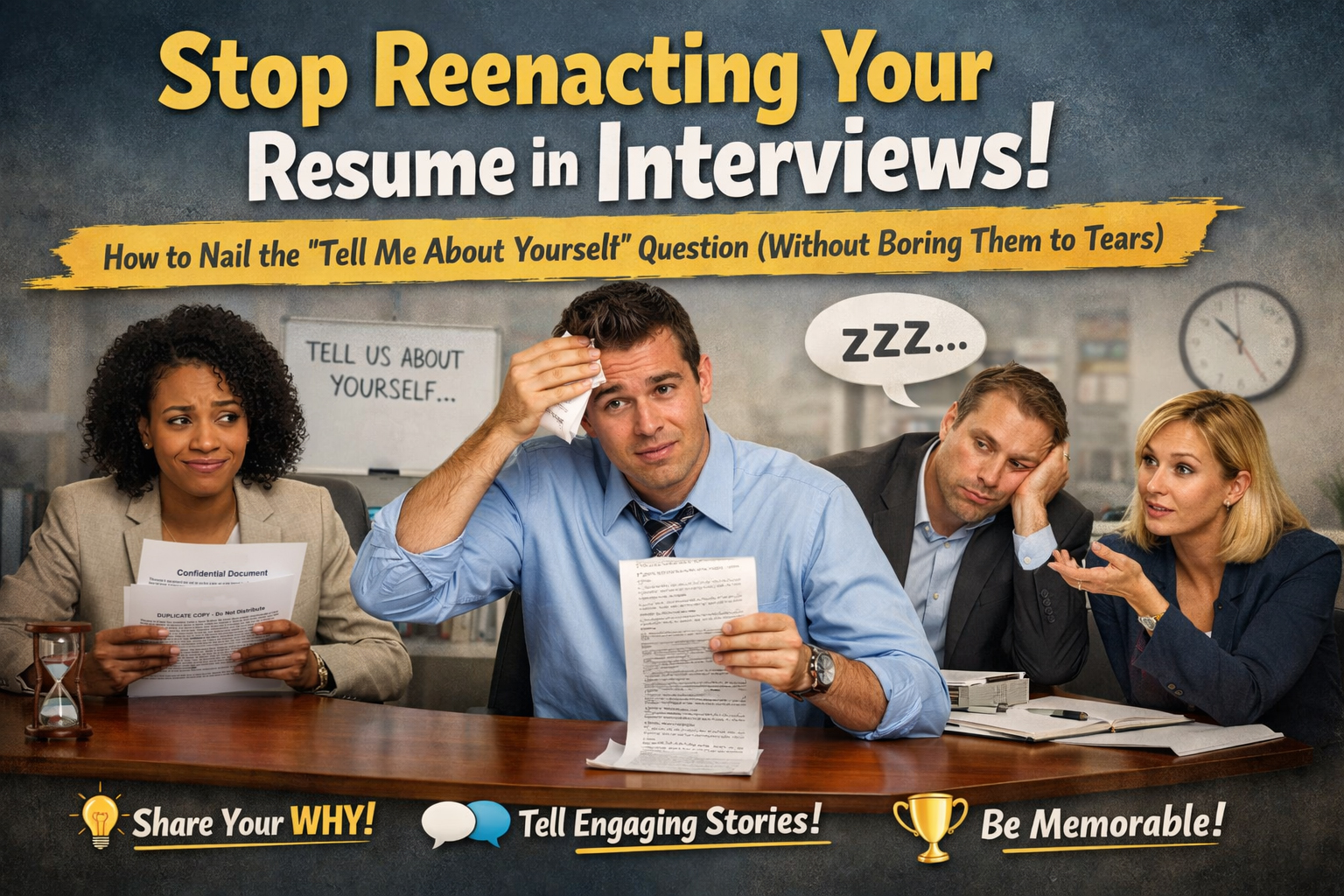
There’s a particular kind of interview moment that should be studied by historians, therapists, and anyone who has ever watched a grown adult confidently walk into a meeting room and immediately narrate their own LinkedIn profile like it’s a campfire ghost story.
It starts innocently enough.
An interviewer leans back in their chair with the calm confidence of someone who has never been ghosted by an ATS, never had to upload a resume and then type the resume back into a resume shaped form, and never once whispered “please don’t ask me my biggest weakness” into the void like a prayer.
Then they say it.
“So… tell us about yourself.”
And suddenly, the candidate panics and goes full audiobook. They begin at childhood. They mention a high school group project that “really taught them teamwork.” They read job titles like they’re announcing a royal lineage. They speak in date ranges. They name software that no longer exists. They say “fast paced environment” like it’s a compliment and not a warning label.
Meanwhile, the interviewer’s eyes glaze over because, plot twist, they already have your resume. It is literally in front of them. It’s open on a second monitor. It’s printed out. It’s tattooed onto their soul. They did not ask this so you could recite it back to them like you’re trying to unlock the next level of the interview by saying the magic words in the correct order.
They asked because they want the trailer, not the director’s cut.
They want the high level version of you: who you are, what you do, what you’re great at, and why you’re sitting in front of them today instead of living a quiet, peaceful life where nobody asks you about your leadership style.
So if you’ve been treating “Tell me about yourself” like a command to perform a chronological reenactment of your employment history, let’s fix that. Not with stiff scripts and robotic phrases that sound like they were written by an HR printer, but with something more powerful.
A story.
Not a saga. Not a census record. A story.
And yes, it can be funny. Because if the hiring process is going to be absurd, you might as well be excellent and entertaining while you survive it.
The Resume Reading Olympics (and Why You Keep Losing)
There are two types of people in interviews:
- People who answer “Tell me about yourself” with a crisp, human summary that makes you want to hear more.
- People who immediately become a narrator for their own paperwork.
The second group is not bad. They are not unqualified. They are not doomed. They are simply suffering from the same interview anxiety that has convinced millions of intelligent adults that the correct response to a broad question is to start listing years like they’re reading a tombstone.
“Sure. So in 2014 I was at Company A, and then in 2016 I moved to Company B, and then in 2018…”
Congratulations, you have invented the least thrilling podcast genre: “A Person’s Work History, In Order.”
Here’s the problem: chronological is not compelling.
Chronological is how you explain a traffic accident to your insurance company. Chronological is how you describe a medical episode. Chronological is not how you sell a story, a brand, a capability, or a reason to hire you.
When they ask about you, they’re not requesting proof that time has passed.
They’re trying to answer four questions in their head:
- What do you actually do well?
- What kind of problems do you love solving?
- Why this role, why this company, why now?
- Are you a person we can talk to for eight hours without needing to take a “quick walk” that lasts forever?
And the “resume reenactment” answer fails because it doesn’t give them anything to grab onto. It’s a list of places you’ve been, not a narrative about what you’ve built, improved, fixed, led, or transformed.
Also, it has a hidden side effect: it steals your own suspense.
If you tell them everything upfront, you leave no room for curiosity. You turn your interview into a book report where you already spoiled the ending. You want them leaning forward thinking, “Wait, how did you do that?” not leaning back thinking, “Wait, how much longer is this?”
So what do you do instead?
You give them the headline version of you. The “I’m this kind of professional, I solve this kind of mess, and I’m excited about this role because…” version.
A human summary.
Not a timeline.
You’re not applying to be a museum exhibit.
The Three Part Answer That Makes You Sound Like a Person (Not a Corporate Terms & Conditions Page)
Let’s build the kind of answer that makes interviewers actually want to ask follow-up questions.
Because follow-up questions are where you win.
Follow-ups are where you tell the story that proves you’re not just fluent in buzzwords. Follow-ups are where you turn “I’m good at leadership” into “Here’s the time I walked into chaos, listened, triaged the problem, and got people aligned without setting the building on fire.”
So here’s the structure that works without sounding scripted:
Part A: Who you are professionally (in one sentence)
Not your full job title history. Not the last seven companies. One sentence.
“I’m a customer obsessed operations leader who loves turning messy processes into systems people actually want to use.”
Or:
“I’m a data driven marketer who’s best when I’m translating ambiguity into campaigns that move numbers, not just feelings.”
Or:
“I’m an engineer who enjoys building products that don’t make users feel like they’re being punished.”
Part B: What you’re known for (two strengths that match the role)
This is where people usually say something vague like “hardworking” and “team player,” which is adorable, but also describes every golden retriever in America.
Instead, name two strengths that map directly to the job you want.
“I’m known for simplifying complicated workflows and for coaching teams through change without making everyone miserable.”
Or:
“I’m strongest at stakeholder management and at building repeatable reporting that executives actually understand.”
Part C: Why you’re here (your why, not their mission statement)
This is the part people forget. Or they replace it with a compliment that sounds like it came from a brand campaign.
“I’m here because this role sits at the intersection of process improvement and team leadership, and that’s exactly where I do my best work.”
That’s it.
That’s the whole answer.
It’s brief. It’s human. It gives the interviewer hooks. It invites curiosity. It makes them ask questions like “Tell me about a time you simplified a workflow” or “What do you mean by coaching through change?” which is you quietly winning without looking like you’re trying to win.
And yes, you can still use STAR. You can use any method you want. The method is not the magic.
The magic is making the interviewer want the next sentence.
The interview is not a data dump. It’s a guided tour. You are the tour guide. You decide what they see first.
Storytelling That Wins Jobs (and How Not to Sound Like a Robot Reading a Leadership Fortune Cookie)
Now we get to the part where most candidates either shine or disappear into a fog of “We really worked cross functionally to drive synergy.”
Storytelling is the difference between:
“I’m good under pressure.”
and
“Two days before launch, a vendor change broke our timeline. The team was panicking. I pulled the stakeholders into a 15 minute triage, stripped the plan down to critical deliverables, reassigned owners, and we shipped on time. Then we documented the failure point so it wouldn’t happen again.”
One is a claim. The other is proof.
When you answer follow-up questions, you’re not just filling time. You’re building trust. You’re showing them how you think, how you respond to obstacles, how you communicate, and whether you’ll be the person who solves problems or the person who forwards problems with a note that says, “Circling back.”
Here’s how to tell stories that land:
1) Pick stories with friction
Nobody learns anything from “and then everything went great.” Real stories have tension.
- something broke
- someone disagreed
- a deadline threatened
- expectations were unclear
- the plan was bad
- the process was nonexistent
- the client changed their mind with the confidence of a toddler ordering dinner
Friction reveals skill. Smooth sailing reveals luck.
2) Make your role unmistakable
A lot of candidates accidentally describe the team’s work like they were a friendly bystander holding a clipboard.
Use “I” where it’s appropriate. You are allowed. This is literally your audition.
“I led.” “I decided.” “I escalated.” “I built.” “I changed.” “I negotiated.” “I fixed.”
Not because you’re trying to take credit for the universe, but because the interviewer needs to understand what you can do in their environment.
3) End with impact, not vibes
“I learned a lot” is not an ending. That’s how you end a summer camp reflection journal.
End with a measurable change, a concrete improvement, or a result that ties back to the role.
“We cut turnaround time by 30 percent.” “We reduced customer complaints by half.” “We improved on-time delivery.” “We got adoption up.” “We stopped the recurring issue.” “We built a process that didn’t rely on heroics.”
4) Keep it human
You can be professional without sounding like a corporate spell.
You can say:
“The moment I realized the process was broken was when everyone had a different answer to the same question.”
That’s human. That’s memorable. That makes people nod.
You do not need to say:
“I leveraged cross functional alignment to maximize operational excellence.”
That is not memorable. That is a fog machine.
And here’s the part recruiters don’t always say out loud: interviewers remember the candidate who made them feel something. Relief. Confidence. Clarity. Trust. Even a laugh.
Not because comedy is required, but because humanity is.
A great recruiter can prep you for the question patterns. But your storytelling is what turns “qualified” into “I want that person on my team.”
Final Thoughts
“Tell me about yourself” is not a trap, but it is a test.
Not a test of whether you can recite your history.
A test of whether you understand your value.
A test of whether you can communicate like a clear, capable adult instead of a walking PDF.
Give them the headline, not the autobiography. Give them hooks, not chapters. Leave space so they can ask questions. And when they do, tell stories that prove you can handle real work in the real world where things break, priorities shift, and nobody has time for a 12-minute resume recital.
You’re not there to perform your timeline.
You’re there to make them believe the next chapter would be better with you in it.
If you want, paste the job description and your current “tell me about yourself” answer, and I’ll rewrite it into a version that sounds like you, not a corporate voicemail greeting.