
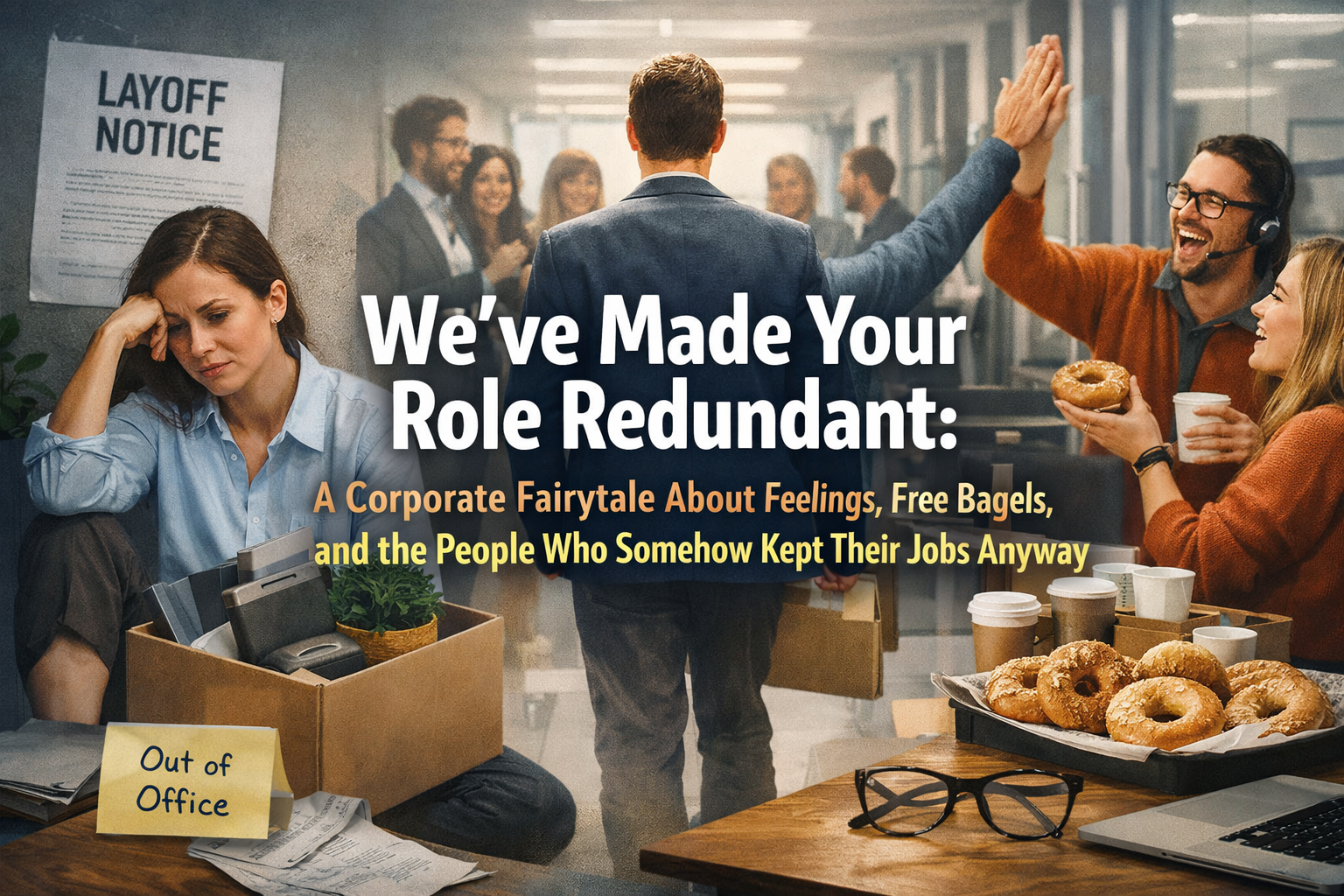
There’s a sentence floating around corporate America that sounds harmless until it hits you square in the chest: “We’ve made your role redundant.”
Redundant.
As if your rent, groceries, identity, and nervous system all politely agreed to be downsized for efficiency. As if your entire life is a duplicate file someone finally deleted because they needed more storage for “Q1 Synergy Roadmap_FINAL_v19.”
It’s always delivered calmly. Professionally. Usually by someone who practiced it in the mirror like they were auditioning for the role of Empathy Manager, Level II.
And here’s what makes it so sinister: it’s framed like math. Like logic. Like a clean business decision. Like a spreadsheet sighed and said, “Nothing personal,” before swinging a bat at your stability.
But you don’t just lose a job.
You lose gravity.
The quiet force that kept your days anchored. Your effort meaningful. Your existence validated by routines, paychecks, Slack pings, and the sacred corporate ritual of pretending a Monday morning meeting is “energizing.”
One day you’re useful. Trusted. Quietly fixing problems. Carrying context. Holding things together with duct tape, calendar invites, and the rare superpower known as actually following through.
The next day you’re watching someone whose work you’ve been covering for keep their role while you’re walked out by a script and a promise to “stay connected.” Which is corporate for: I will never speak to you again unless you become famous.
Suddenly the rules stop making sense. Merit becomes optional. Performance becomes vibes. Logic clocks out early. Decisions feel random. Effort goes unrewarded. And you’re left wondering when results stopped mattering and who exactly rewrote the rulebook without telling anyone.
People say things like, “It wasn’t personal.” Or, “Everything happens for a reason.” Or my favorite, “At least you’re resilient.”
That’s a bold thing to say to someone whose brain is running disaster simulations at three in the morning while their chest panics over absolutely nothing—replaying conversations, calculating timelines, trying to solve a future that suddenly feels fragile, uncertain, and far heavier than it ever should have been.
Panic attacks don’t ask permission. Grief doesn’t respect business hours. And some days, being human feels like a job you’re barely qualified for, where showing up at all takes effort, small tasks feel enormous, and simply getting through the day counts as real work.
So yes. We’re going to use humor here. Not because the pain is funny. But because laughter is sometimes the only thing that fits between the cracks—the thin layer of relief that lets you breathe again, even briefly, when everything feels too heavy, too unfair, too overwhelming to carry in silence.
Let’s talk about what “redundant” really means in corporate America.
Spoiler: it rarely means what they claim it means.
The Redundancy Ceremony (Featuring a Script, a Smile, and a Calendar Invite Called “Quick Sync”)
It always begins with the most innocent looking calendar invite you’ve ever seen.
“Quick chat.”
“Touch base.”
“15-min sync.”
And you’re like, Oh nice, a short meeting. Maybe this is the day they finally acknowledge I’ve been holding this department together with caffeine and trauma-informed professionalism.
No.
It’s the day you learn that “15-min sync” is corporate code for: We’re about to rearrange your life like furniture.
You join the call and instantly know something is wrong because:
- your manager’s face has the emotional warmth of a printer error message,
- HR is present, which is never a good sign unless someone stole a chair,
- everyone is speaking like they’re trying not to wake a sleeping bear.
Then it happens.
“We’ve made your role redundant.”
And they say it like they’re reading the weather.
Not even a dramatic pause. No buildup. No “how are you doing today?” Just straight to the part where your nervous system exits your body and moves into a small cabin in the woods.
You ask the obvious question:
“So… why me?”
And you get the classic corporate answers:
- “It’s a business decision.”
- “This is about restructuring.”
- “It’s not performance-related.”
- “Your contributions have been valuable.”
Which is fascinating, because if my contributions were valuable, why are you deleting me like an unused font?
Then the real comedy hits: they start listing the reasons with the elegance of a PowerPoint slide trying to explain heartbreak.
“This role is no longer needed.”
“This work will be absorbed.”
“We’re streamlining.”
Absorbed by who?
By the person whose main skill is surviving meetings.
By the one who says “circle back” like it’s a personality trait.
By the teammate you’ve quietly been saving for months because their output is mostly vibes and a carefully maintained aura of being “aligned.”
And you realize something important: corporate redundancy is not about duplication.
It’s about convenience.
It’s about who is easiest to remove with the least resistance. Who asks too many questions. Who has too much integrity. Who doesn’t play the game. Who knows where the bodies are buried—and also where the passwords are saved.
And that’s when it hits you: this wasn’t a decision. It was a performance.
A small play starring:
- HR reading the script,
- your manager pretending this hurts them too,
- and you, sitting there realizing your life just got split into Before and After.
You hang up and suddenly the quiet is loud.
No Slack notifications. No calendar chaos. No urgent requests. Just you and your thoughts, which are now running laps like caffeinated squirrels.
And people will tell you to “take a breath.”
Yes. Lovely suggestion. I will now calmly inhale while my chest is trying to file a restraining order against reality.
The Emotional Fallout (Or: Congratulations, You’ve Been Promoted to Full-Time Human)
Here’s what no one tells you about job loss:
It doesn’t just remove your paycheck.
It removes your structure. Your identity. Your social gravity. The small daily proof that you belong somewhere and are needed.
Suddenly, time becomes a strange open field. And you’re standing there like a person who just walked out of a building that was on fire, blinking into daylight while everyone else keeps typing.
You wake up the next morning and your brain does the thing.
The thing where it reaches for routine—then remembers routine is gone.
And people are like, “Use this time to rest.”
Rest? My brain thinks we’re being hunted.
Your nervous system doesn’t interpret layoffs as “career transitions.” It interprets them as danger. The kind of ancient danger that tells your body: Something has been taken. We must prepare to survive winter.
So you panic-clean. You doom-scroll. You update your resume like you’re trying to exorcise a demon. You stare at job boards until the words blur and everything starts to look like the same posting in a different outfit.
“Fast-paced.”
“Rockstar.”
“Must thrive in ambiguity.”
“Competitive pay.” (Translation: vibes.)
“We’re like a family.” (Translation: boundaries will be punished.)
And then the emotional whiplash begins.
One minute you’re fine, making coffee, thinking, I’m okay, I can handle this.
The next minute you’re crying because you saw someone carry a laptop bag and your body went, We used to have purpose.
Panic attacks don’t ask permission. Grief doesn’t respect business hours. And the worst part is how invisible it can be—because you can look totally normal while your insides are hosting an emergency meeting.
Meanwhile, the world expects you to bounce back immediately.
They want you to be the inspiring layoff story.
The “reinvention” post.
The LinkedIn phoenix rising from the ashes, conveniently holding a ring light and a new headshot.
But some days, you’re not a phoenix.
Some days you’re a raccoon with a headache, trying to remember how to be a person while your confidence is hiding behind a dumpster.
And this is the part where humor shows up like a friend with snacks.
Because if you don’t laugh, you’ll start emailing your former employer with subject lines like: “Quick question: what the actual hell.”
So you laugh.
You laugh at the absurdity that:
- you were laid off for “efficiency,”
- while three layers of management remain employed to schedule meetings about efficiency,
- using the same slide deck you built.
You laugh because the alternative is staring into the void until the void starts asking you to complete a personality assessment.
The Comeback Nobody Sees (Where You Rebuild Quietly While Mediocrity Enjoys the Bagels)
Here’s the truth: the comeback doesn’t look like a montage.
It looks like you eating cereal at 2pm because your appetite is confused and your sleep schedule is now interpretive dance.
It looks like you writing one cover letter, then taking a break because your nervous system has informed you we are not doing capitalism today.
It looks like you applying for roles you’re wildly qualified for, only to be told you’re not “the right fit” by someone who has never handled a crisis without asking, “Can we table this?”
And yet.
You keep going.
You do the brave thing over and over: you show up.
You apply anyway.
You reach out anyway.
You rewrite your resume anyway—even though you know the algorithm is basically a raccoon in an ATS trench coat deciding your fate based on keywords and mood.
You start realizing something important:
You weren’t left for dead.
You were released into the wild with skills, instincts, empathy, and self-awareness.
Mediocrity stayed inside. Eating free bagels. Updating status decks.
And yes, that hurts. Because it’s unfair. Because you were carrying the real work. Because you had context. Because you did the invisible labor that made everything run.
But slowly, painfully, you begin to see it:
A place that couldn’t recognize your value was never going to protect it.
A system that rewards optics over outcomes was always going to eventually punish someone who actually gets things done.
And the minute you stop asking, “What did I do wrong?” and start asking, “What kind of place does this to people?” the shame begins to loosen its grip.
Not all at once.
But enough for you to breathe.
Enough for you to remember who you were before you started measuring your worth by calendars and performance reviews.
Enough to understand: you are not broken.
You are injured.
There’s a difference.
And injuries heal.
Especially when you stop trying to prove your humanity to people who treat employees like line items.
Your comeback isn’t loud.
It’s quiet. Steady. Stubborn.
It’s you rebuilding your life with the kind of resilience nobody applauds because it happens off-camera.
And one day—maybe not today, but one day—you’ll look back and realize:
That layoff didn’t erase you.
It revealed you.
Final Thoughts
If you’re in it right now—the panic, the grief, the disorientation, the weird quiet after years of being needed—hear this clearly:
You are not alone.
You are not weak.
You are not behind.
You are not failing.
You are responding normally to something that is not normal.
You lost a job, yes. But you didn’t lose your value. You didn’t lose your intelligence. You didn’t lose your experience. You didn’t lose the parts of you that make you steady, capable, and rare.
Some days, surviving is the job.
And that is enough for now.
Be gentle with yourself. Your nervous system is doing its best to protect you in a world that pretends layoffs are “clean transitions” instead of emotional earthquakes.
You didn’t fail the system.
The system failed you.
Then it kept people whose main skill is surviving meetings.
And when you’re ready—when your lungs feel less tight, when your sleep comes back in small pieces, when your brain stops waking you up at 3am to do math—it won’t be because you “bounced back.”
It’ll be because you healed forward.
With humor. With honesty. With the kind of strength that doesn’t need permission.
You weren’t redundant.
You were just too real for a place built on pretending.