
There is a particular genre of career advice that behaves like a fireworks show in a conference room. The moment it’s delivered, it crackles with confidence, it lights up the LinkedIn sky, it makes everyone nod like they’re absorbing wisdom directly from the mountain, and for twelve glorious seconds you genuinely believe you have been handed a cheat code to the job market—until you try it in real life and discover it was never a cheat code, it was a scripted line from a movie where the protagonist always gets the job and no one ever gets ghosted by a “People Operations Experience Partner” named Skylar.
Because real interviews are not clean, logical systems where you ask the right question and the universe rewards you with an offer letter and a complimentary Yeti tumbler. Real interviews are emotionally charged theater performances conducted inside a time box while your body does its best impression of a malfunctioning appliance. Your mouth is dry. Your brain is buffering. You’ve said the word “collaborate” so many times it no longer feels like a real word. The interviewer is smiling in that polite way that says, “I am listening,” while their eyes say, “I have forty-two unread messages and a calendar invite titled ‘SYNC’ that will absolutely ruin the rest of my day.”
And then, right at the end, right when your nervous system is trying to exit through the nearest window, they ask: “Do you have any questions for us?”
This is not a question. This is a ceremonial closing statement. This is the polite handshake before everyone returns to their regularly scheduled chaos. This is the moment where you are expected to say something safe like, “What does success look like in this role?” while secretly praying you didn’t just accidentally imply you don’t know what success is.
But no. The internet has decided you’re supposed to lean forward—calm, composed, executive, possibly moisturized—and ask: “Before we wrap up, do you have any concerns about my fit for the role?”
Which is an incredible sentence, because what you’re really asking is: “Would you like to critique me directly while I sit here smiling and attempting to keep my soul from leaving my body?”
In theory, it’s bold. Strategic. Mature. It sounds like something a person with a personal brand and a morning routine would say.
In reality, it’s emotional roulette. And the wheel is always rigged.
The Bold Question That Turns You Into a Live Demo
Let’s talk about what happens when you ask the famous question.
Because the advice always sounds like a gentle life hack, like you’re simply inviting helpful feedback from a reasonable adult who is definitely not evaluating you through a mix of gut feeling, internal politics, and whatever mood they’re in after reading their third Slack message about “bandwidth.”
So you ask it.
You do it bravely. You do it with the calm voice you practiced in the mirror. You pretend you’re not aware of your own heartbeat. You deliver: “Before we wrap up, do you have any concerns about my fit for the role?”
And now the room shifts. Not dramatically. Subtly. Like the air just changed temperature. Like you just pressed a button labeled “UNPLANNED HONESTY,” and everyone inside the meeting quietly agreed not to touch it.
Best case scenario, they say: “No concerns at all.”
Which is reassuring for about half a second, until your brain pulls up the file folder labeled “Things People Have Said Right Before Disappointing Me,” and you remember that “No concerns at all” has betrayed you in multiple time zones. It sounds warm, but it’s also the kind of sentence that can mean anything from “You’re great” to “We don’t provide feedback to humans, but thank you for visiting our interview museum.”
Second option: “Not at this time.”
This one is my favorite because it’s so aggressively polite while communicating absolutely nothing. “Not at this time” is corporate for: we have concerns, we have several, they are lined up in a neat row, but we are not going to hand them to you while you’re still upright and making eye contact. It’s the HR equivalent of turning the music down at a party because the neighbors might call the cops. The concerns exist. They’re just not being aired in public.
Third option: they actually tell you a concern.
Congratulations. You have successfully turned your interview into a live performance review you did not rehearse for. You are now on stage, under fluorescent lighting, being asked to respond in the most impossible emotional posture a human can maintain: confident but not defensive, clear but not desperate, humble but not apologetic, enthusiastic but not sweaty.
They say something like: “We’re just wondering if you have enough experience with cross-functional stakeholder alignment in ambiguous environments.”
And now you have to answer that without sounding like you’re about to start bargaining with the universe. You nod thoughtfully while your internal monologue screams, why did I ask this, why did I summon critique, why did I invite this into my life like it’s an RSVP.
Because that’s the dirty secret of this question: it assumes the interviewer is in a mood to be honest and helpful, and also assumes honesty is safe, and also assumes the hiring process is designed to be transparent instead of designed to protect itself. You are trying to create a moment of truth inside a system built to avoid moments of truth.
It’s like asking the airline, mid-flight, “Before we land, do you have any concerns about the plane?”
The Follow-Up Questions That Produce Only Vibes
Then comes the second wave of advice, the classic trio of “smart questions” that allegedly separate serious candidates from mere mortals.
Ask where they are in the hiring process.
Ask when they’ll make a decision.
Ask how you’ll be notified.
This advice is always delivered like these questions unlock hidden doors. Like the interviewer will suddenly lean in, impressed by your strategic mind, and reveal the sacred timeline etched into the company’s hiring stone tablets.
But what actually happens is you ask those questions and receive answers that sound like language but behave like fog.
“Where are you in the hiring process?”
They smile. They say: “We’re still early.”
Early is not a point in time. Early is a feeling. Early is what people say when they don’t want to describe the chaotic internal reality, which could include: five more interviews, one executive who hasn’t looked at the candidate slate, a budget meeting that keeps moving, and a mysterious internal candidate who just “decided to throw their name in” because they’re bored and want a new title.
Then you ask: “When do you expect to make a decision?”
They say: “Soon.”
Soon is not a date. Soon is a lullaby. Soon is what people say when they need you to leave the meeting without panicking. Soon can mean next week, next month, after the holidays, after the org restructure, or after the universe collapses into darkness. Soon is the word used by people who do not control the process but would like to appear like they do.
Then you ask: “How will I be notified?”
They say: “We’ll be in touch.”
“We’ll be in touch” is not a method. It’s not a plan. It’s not a communication strategy. It is an emotional gesture. It is the verbal equivalent of a head pat. It’s a vibe. It’s the HR version of “Take care,” which somehow also means “This conversation never happened.”
And that’s what makes this whole segment so absurd: it suggests interviews are information exchanges, when really they’re a mix of performance, chemistry, and internal timing. You are asking for certainty inside a process that runs on soft signals and shifting priorities.
You can leave an interview feeling like you nailed it, because you did, and still lose because the job was put on hold, the role got re-scoped, or Chris from inside the company already knows where the printer is and also plays pickleball with the hiring manager.
There is no question you can ask that overrides office politics, organizational inertia, or the fact that sometimes companies post roles as a hobby.
The Part Everyone Skips—Most Decisions Are Already Forming
Here’s the part no one says out loud because it ruins the fantasy.
Most hiring decisions are not made because of your final question.
They are forming while you’re answering the second one. Sometimes before you even sit down. Sometimes the decision is half-made the moment they see your resume, your job titles, your years of experience, your location, your salary history, your vibe, and whatever random projection their brain decides to assign you within the first thirty seconds of small talk.
That’s not fair. It’s not noble. It’s not “best practice.”
It’s just reality.
The final question is the interview equivalent of adding parsley to a plate. It can elevate things. It can show polish. It can signal thoughtfulness. But it is not going to resurrect a meal that was already decided in the kitchen.
You could ask the most brilliant closing question in human history—something so profound it changes how they think about leadership forever—and still lose because:
- They had an internal candidate the whole time.
- The role is waiting on budget approval.
- Someone higher up wants a different profile.
- They’re interviewing “just to see what’s out there.”
- The hiring manager is indecisive and afraid of commitment.
- The job posting is older than some people’s houseplants.
And yet we keep telling candidates that the right question will change their fate, because it makes the process feel controllable. It makes the job hunt feel like a game with rules instead of a maze with shifting walls.
That’s why this advice spreads. It offers dignity. It offers agency. It offers the illusion that if you do the right things, the right outcome will happen.
But the job market is not a morality play. It is not always responsive to effort. It is often responsive to timing, internal needs, and whether the decision-makers are aligned or simply pretending they are.
So yes—ask thoughtful questions. Have a strong close. Show curiosity. Show clarity. Do your part.
Just don’t confuse your final question with a binding contract.
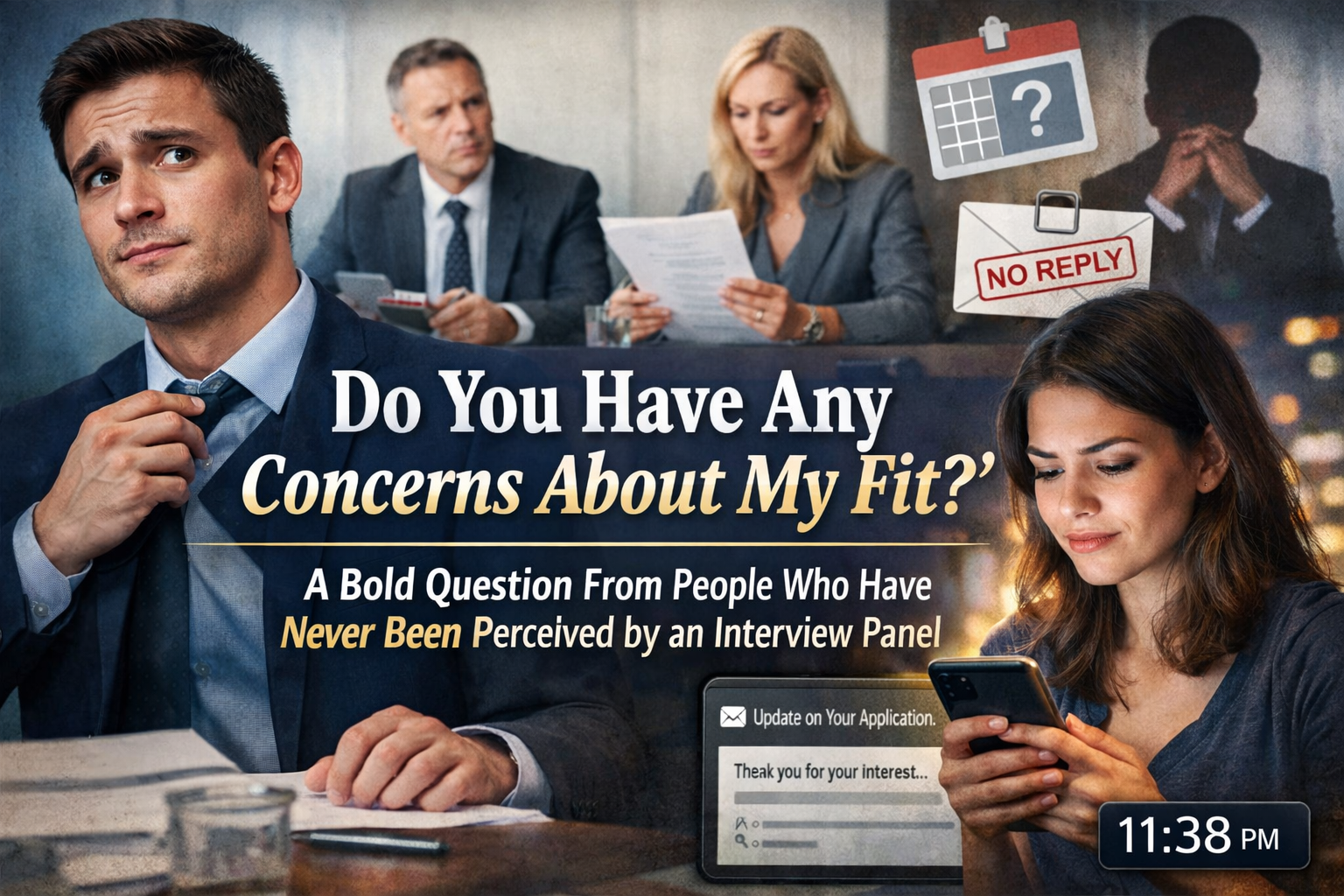
Because the only honest feedback you’ll likely receive is the one that arrives weeks later at 11:38 p.m. in an automated email titled “Update on your application,” thanking you for your interest while gently returning you to the job market once again.
Final Thoughts: Ask the Question, But Know the Game
If you want to ask, “Do you have any concerns about my fit?” go for it. Truly. Sometimes it works. Sometimes you catch a real moment. Sometimes you get a useful signal. Sometimes the interviewer is refreshingly direct, and you walk away feeling like you had an adult conversation in a world that usually communicates through vague calendar invites and passive voice.
But don’t ask it because someone on the internet told you “serious candidates do this,” like it’s a secret handshake into the employed class.
Ask it knowing what it is: a high-risk, high-awkwardness question that assumes the other person is prepared to be honest in a process built to avoid honesty.
Ask it knowing that if they say “no concerns,” it might mean “no concerns,” or it might mean “we are polite,” or it might mean “we already know who we’re hiring but we respect your effort.”
Ask it knowing that “soon” is not a timeline, “we’ll be in touch” is not a strategy, and “still early” is often the corporate version of “we have no idea what we’re doing, but we’re committed to acting like we do.”
Most of all, ask it knowing this: you are not failing because the process is unclear. The process is unclear because it was designed that way.
So be prepared. Be thoughtful. Be human.
And when you get that 11:38 p.m. email—when the algorithm thanks you warmly for your interest and sends you back into the wilderness—just remember: it wasn’t your last question.
It was never your last question.
It was always the system.