
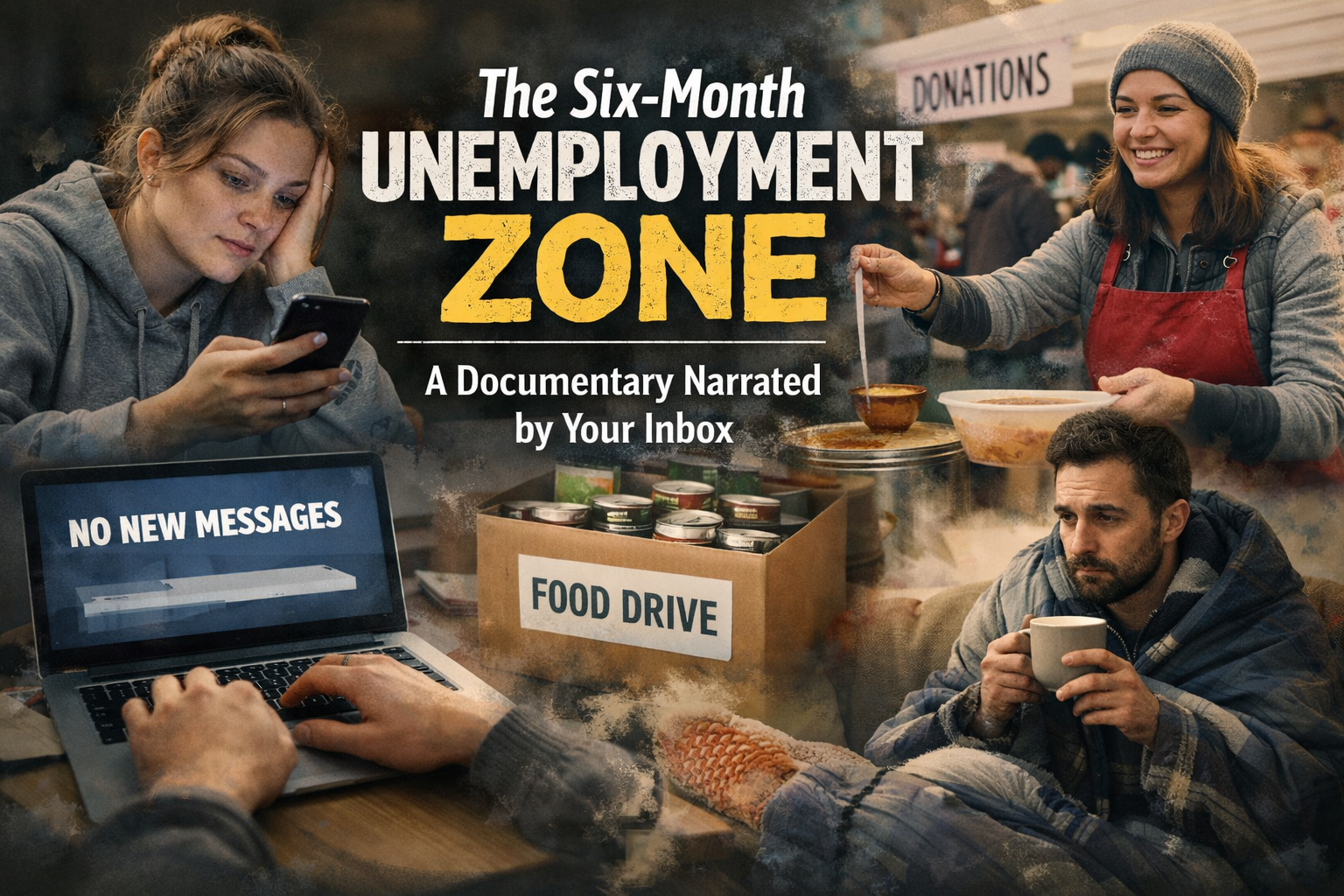
There’s a very specific kind of post that makes you stop scrolling, forget what you were doom scrolling for, and just sit there for a second thinking, “Well… that was inconveniently human.”
Not hustle content. Not “rise and grind” fan fiction. Not a carousel titled How I Landed 7 Offers Using Only Vibrations, Manifestation, and a Beige Blazer. Just a post that accidentally tells the truth while the job market pretends this is a personality test you’re failing.
That’s what Veronica Zielinska shared, and the reason it hit is simple: it didn’t try to win. It just told the truth with receipts. Six months unemployed. Volunteering anyway. Meals prepared. Sleeping bag drive organized. Donations nearly doubled. The kind of measurable good that makes your brain short circuit because it exposes how absurd the whole system is.
Because let’s talk about the six-month unemployment zone for a second. That strange limbo where time becomes fake, weekdays lose their meaning, and your confidence starts doing weird math like, “Okay but what if I AM the problem?” You apply. You wait. You refresh your inbox like it owes you money. You tell yourself you’re being patient and evolved while quietly spiraling over whether silence is now your brand.
And then, in the middle of LinkedIn refresh purgatory, someone posts a reminder that you’re still a human being. Not a candidate. Not a pipeline stage. Not a “strong maybe” who will be “kept on file.” A person. A full person. With worth that is not pending approval from HR.
Which is both beautiful and deeply annoying, because now you have feelings again.
So let’s write the article the job market refuses to publish. The one with the long intro, three long chapters, and final thoughts. The one that doesn’t pretend this is fine. The one that also doesn’t let the system convince you that you’re useless just because a calendar flipped a few times without a paycheck attached.
The Unemployment Timeline Is Made Up and the Inbox Is a Haunted House
The first month is shock.
You’re weirdly calm at first, which is how you know your brain has entered Emergency Spreadsheet Mode. You update the resume. You optimize the LinkedIn. You tell everyone, politely, that you’re “exploring new opportunities,” like you’re a travel influencer and not a person who just got shoved off the economic merry go round without a seatbelt.
Month two is discipline.
You build a routine. You make a little plan. You color code things. You apply with the confidence of someone who still believes the process is real. You start sentences with “Once I’m back in a role…” and you mean it, because of course you mean it. You’re not a quitter. You’re a professional. You’re someone who has always been able to figure it out.
Month three is where the job market starts doing psychological improv.
You begin receiving automated rejection emails that show up faster than your application could have physically traveled through the internet, like a robot saw your name and immediately screamed, “NOPE,” before your PDF even loaded. You start questioning if you’re actually applying for jobs or just feeding your information into a corporate data lake where it will one day be used to train an AI to replace you.
Month four is when time begins to warp.
You can’t tell if it’s Wednesday or simply “another day where nothing happened.” You stop making lunches because lunch is a concept designed for people who have meetings. You start measuring your week by strange milestones like, “I made a phone call today without sounding like I was underwater,” or “I didn’t refresh my email for a full hour,” or “I only cried once and it was technically during a commercial.”
Month five is identity drift.
You start wondering if your skills expired while you weren’t looking. Like yogurt. Like a coupon. Like your relevance has a date on it and it’s been quietly counting down. You look at job descriptions and they read like an alien wrote them after observing humans for thirty minutes through a conference room window: Must be a strategic visionary. Must be hands-on. Must lead cross-functionally. Must have 12 years experience in a tool released last Thursday. Must be able to lift 50 pounds and emotionally lift the entire organization.
Month six is where things get feral.
Not in a “girl boss” way. In a “my confidence is now held together by coffee and spite” way. In a “I have learned things about myself I did not ask to know” way. In a “I could survive in the woods with a pencil and a LinkedIn Premium trial” way.
And the most insulting part is the silence.
Because silence doesn’t feel neutral. It feels like judgment. It feels like the world looked at you and decided you were background. It’s hard not to turn that into meaning. It’s hard not to start treating quiet as confirmation that you were never as good as you thought you were.
Which is why Veronica’s post hits like a chair scooting loudly across a quiet room.
Because while the system is busy ghosting qualified people like it’s a sport, she chose to do something so aggressively human it becomes borderline confrontational: she went and helped other humans.
No keywords. No ATS. No “circle back.” Just direct contribution.
That’s not a gap. That’s character development.
Volunteering Is the Most Polite Form of Rebellion
Let’s be honest: volunteering while unemployed sounds like the kind of thing people recommend when they’re trying to be helpful but accidentally feel like a Pinterest quote.
“Maybe volunteer!”
Sure, Susan. And maybe the recruiter who said they “loved my background” will come back from the dead and apologize.
Except… volunteering is not “keeping busy.” It’s not a pastime. It’s not filler content for a resume, although yes, it will look nice there, and yes, you will be tempted to format it like an accomplishment bullet because that’s what the modern world demands.
But the real point isn’t optics. The real point is that unemployment tries to steal something from you that is not listed in any job description: your internal proof that you matter.
Work, for better or worse, provides feedback loops. You do a thing. Someone needs you. You deliver. You see impact. You get paid. You get thanked or you get blamed. Either way, you are part of a system that reacts to your existence.
Unemployment breaks that loop.
You do a thing—apply—and nothing reacts. No feedback. No signal. Just the endless, echoing void of “Thank you for your interest,” which is corporate for “We have fed your hopes into a machine and it made a sad beep.”
Volunteering rebuilds the loop.
Not because it fixes hiring. Not because you’ll get “discovered” mid soup ladle by a CEO who sees your servant leadership and offers you a Vice President role on the spot while violins play and your LinkedIn notifications sing.
No.
It rebuilds the loop because it creates immediate evidence that you are still useful. Still capable. Still able to move the world one inch in a better direction, even if the job market is currently pretending you are invisible.
Meals prepared. People fed. Sleeping bags collected. People warmer. Donations nearly doubled. A direct line between effort and impact.
And something else happens, sneakier and better: perspective snaps into place.
It is extremely hard to catastrophize your LinkedIn headline when you’re focused on keeping someone warm. You can’t spend six hours spiraling over whether your resume should say “stakeholder management” or “stakeholder alignment” when you’re literally aligning stakeholders with food and survival needs.
Suddenly the noise drops. The ego quiets. The brain goes, “Oh right. I’m still a person. I still have value. I just forgot because capitalism only hands out self-esteem in exchange for direct deposit.”
Volunteering doesn’t magically fix unemployment. Nobody got hired mid donation drop-off. But it does something more durable: it reminds you that your worth didn’t clock out when your paycheck did.
And in a market that keeps trying to reduce people to keywords and gaps, choosing to be human anyway is the most rebellious thing you can do.
The Feral Goblin Era Is Still a Valid Career Phase
Now, we need to address the part everyone thinks but nobody says out loud, because LinkedIn has convinced us we must perform optimism like it’s a job requirement.
Sometimes you cannot volunteer.
Sometimes you are in the “barely holding it together” chapter. Sometimes your nervous system is running a marathon every day without your consent. Sometimes you’re doing the kind of math that requires deep breathing, because you’re trying to stretch a budget the way people stretch pizza dough: carefully, desperately, hoping it doesn’t tear.
Sometimes the most you can manage is getting out of bed, taking a shower, and replying to one email without writing, “Hello, yes, I am a human who would like employment, please stop making me audition for rent.”
That counts too.
Because the internet loves a neat story: person loses job, person volunteers, person finds purpose, person gets hired, person posts a selfie holding a badge like it’s a newborn baby.
But real life is messier.
Real life looks like this:
- You apply to 47 jobs and hear back from two, and one of them is a rejection that arrives so fast you start suspecting your laptop has enemies.
- You have a “great conversation” with a hiring manager and then vanish into the Bermuda Triangle of “we’re still interviewing other candidates.”
- You wake up with optimism, then open LinkedIn, then immediately feel like a confused raccoon in a suit watching other raccoons announce promotions while you’re holding a single stale granola bar and three unanswered follow-ups.
And if, in the middle of that, you are still kind—still soft—still not turning into a full-time rage creature who hisses at recruiters and lives exclusively on caffeine and spite, that is work.
Emotional labor. Survival labor. Unpaid, unlisted, deeply real labor.
Volunteering is powerful, yes. Donating is powerful, yes. But so is staying human when the system is trying to turn you into either a statistic or a mascot.
So if you can volunteer, do it. If you can donate, do it. If you can share someone’s post and make them feel less alone, do it. If you can only manage to keep your head above water this week, do that. That is not failure. That is endurance.
And endurance is a skill set no ATS can measure, which is honestly on brand for a world that consistently ignores the most important qualifications.
Final Thoughts: Purpose Doesn’t Disappear, It Just Gets Reassigned
Posts like Veronica’s matter because they remind us that purpose doesn’t disappear when careers stall. It just shows up differently.
Sometimes it shows up holding a meal.
Sometimes it shows up holding a sleeping bag.
Sometimes it shows up as the courage to be honest out loud so someone else scrolling at 2 a.m. thinks, “Oh. It’s not just me.”
And that matters, because modern hiring has gotten so weird it can make capable people forget they’re capable. It can make good people think silence is evidence. It can make someone who has solved problems, led teams, built systems, created value, and shown up for others start wondering if they somehow evaporated when the job ended.
You didn’t.
You are still here. Still useful. Still full of skills that don’t vanish just because a recruiter didn’t hit reply. Still a person whose worth isn’t determined by a timeline you didn’t consent to.
And if the market is going to keep treating people like keywords and gaps, then choosing to be human anyway—choosing to contribute anyway, or survive anyway, or stay kind anyway—isn’t just coping.
It’s rebellion.
If you want, tell me the vibe you want (more savage, more tender, or more corporate-satire), and I’ll tune it even harder in that direction.