There should be a museum for corporate decision-making.
Not a cute one with gift shops and soft lighting where you can buy a commemorative mug that says Synergy and pretend it’s all harmless. I’m talking about a serious institution. Marble floors. Echoing halls. Security guards. Audio guides. School field trips where teenagers learn what not to do with authority before they accidentally become middle management.
And inside this museum, there’s a special wing. A permanent exhibit. A whole curated experience, complete with velvet ropes and plaques and a rotating spotlight that never stops shining on the same recurring tragedy.
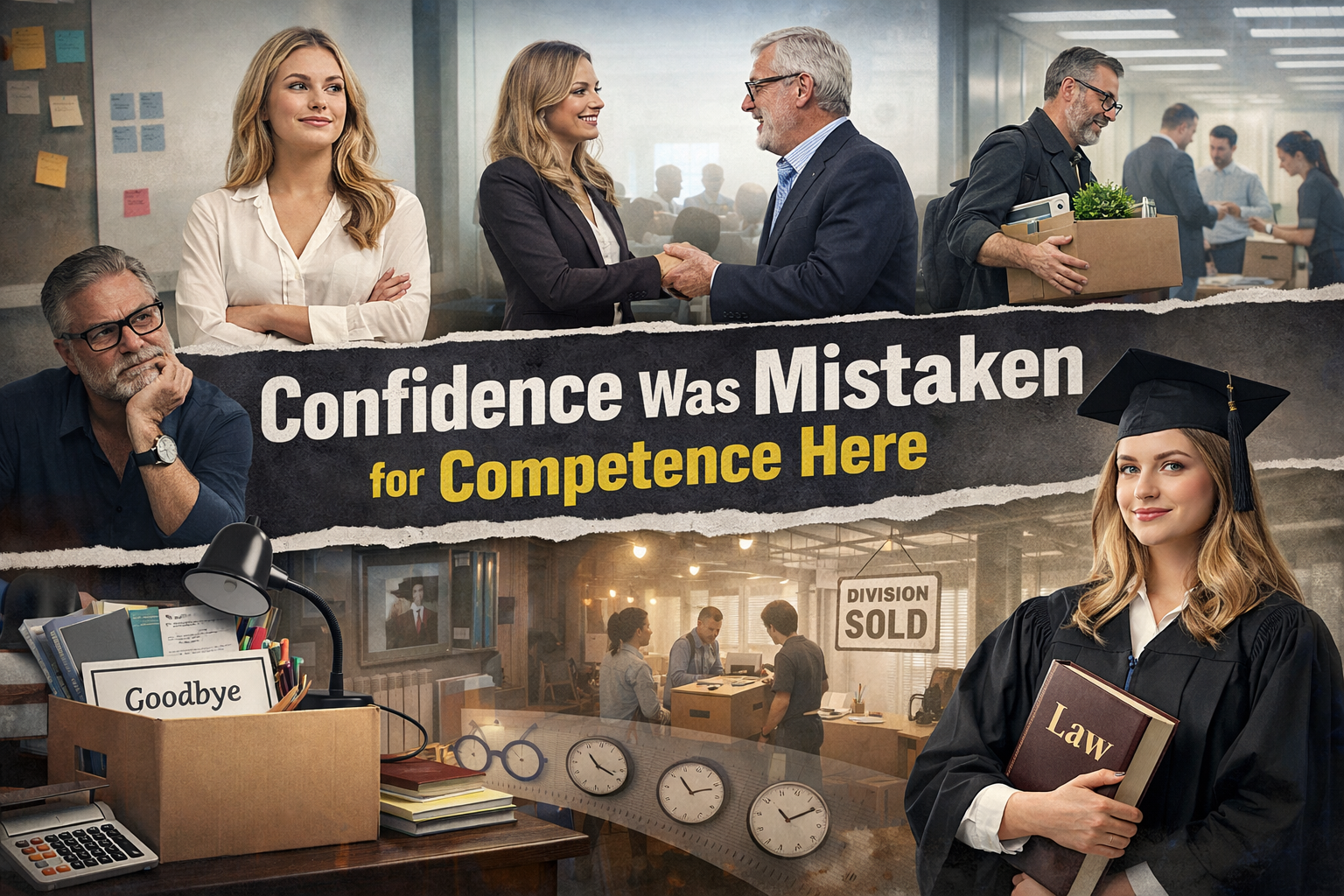
“Confidence Was Mistaken for Competence Here.”
You walk in and immediately you can feel it: the atmosphere of a room where someone said something with their whole chest and everyone nodded like it was scripture. The air smells like freshly printed organizational charts and the last dying fumes of institutional knowledge. There’s a faint sound in the background—like a PowerPoint clicker being pressed by someone who has never been wrong a day in their life.
At the entrance, a docent greets you warmly.
“Welcome,” she says. “In this wing, you will see how certainty outruns wisdom, how volume becomes a substitute for value, and how a well-timed opinion can win awards while the actual work quietly files for unemployment.”
And the best part is, none of these stories are rare.
They’re not even unusual.
They’re basically a subscription service.
Because there’s a specific type of leader—usually someone who believes “gut instinct” is a credential—who gets seduced by confidence the way moths get seduced by porch lights. They don’t want facts. Facts require patience. They don’t want experience. Experience requires acknowledging someone else might know something. They want the electric thrill of a person who speaks like they’ve already won.
Which brings us to today’s exhibit: a company that decided the problem wasn’t strategy, leadership, or long-term planning.
No, no.
The problem was… adults.
The solution? Hire only recent college grads. From top schools. Because nothing fuels innovation like a capstone project, a group chat called “Post-Grad Hustle,” and a LinkedIn headline that still smells like commencement robes.
And look—this is not an anti-youth story. Youth is fantastic. Youth is energy. Youth is possibility. Youth is the courage to apply for jobs requiring ten years of experience when you have a summer internship and a strong belief in yourself.
This is an anti-amnesia story.
Because organizations keep forgetting a simple truth: confidence is not competence. It’s just competence’s loud cousin who shows up early, talks over everyone, and leaves without cleaning up.
Now step closer.
This is one of those stories.
The Internship-to-Authority Pipeline
Every corporate downfall begins the same way: with someone pointing at a complicated problem and deciding the fix is a vibe.
In this case, the vibe was “fresh talent only.”
The logic went like this:
- Adults are expensive.
- Adults ask annoying questions like “What’s the plan?” and “Do we have data?” and “Why are we doing this?”
- Adults have memories, which are basically threats.
- Young people are hungry.
- Hungry people say yes.
- Yes is cheaper than wisdom.
So the company built a recruiting strategy that looked less like hiring and more like a casting call for America’s Next Top Executive.
“Must be recent graduate.”
“Must be from top school.”
“Must be innovative.”
“Must be bold.”
“Must be comfortable having opinions on things you have not yet touched.”
And then they found her.
The first hire.
Ten days in.
Not ten months. Not ten quarters. Ten days.
Ten days is not long enough to learn the culture. Ten days isn’t long enough to understand the product. Ten days is barely long enough to discover that Susan in Finance has a spiritual attachment to her stapler and you shouldn’t borrow it unless you want to be cursed.
But ten days is long enough to be confident.
Because confidence doesn’t need context. Confidence doesn’t require proof. Confidence can thrive on nothing but fresh energy and a belief that “I would never make the mistakes people before me made, because I am different, and also I recently took a leadership seminar.”
So she enters her first meeting.
And in that meeting sits a nationally award-winning VP Creative. The kind of person who has built brands, won recognition, and has the scars of actual outcomes. The kind of person who knows that good branding isn’t a thought—it’s a relationship with reality.
And ten-day-hire says—confidently—that she has reviewed the branding and determined the VP Creative has no idea what he’s doing.
Now, in a normal universe, this would be the moment where the room does a gentle, polite laugh. Someone would say, “Interesting. Tell us what you’ve learned so far.” Someone would ask, “Which campaigns are you referring to?” Someone would request, “Can you walk us through your analysis?”
In a normal universe, confidence is welcomed—but competence is still required to stay at the table.
But this wasn’t a normal universe.
This was Corporate Theater.
And in Corporate Theater, the audience isn’t looking for truth.
They’re looking for performance.
The room?
Enthralled.
The owner?
Impressed.
The response?
Promotion.
Not feedback. Not coaching. Not “Let’s slow down and learn.”
Promotion.
Because in that moment, the company didn’t reward insight.
It rewarded audacity.
And the building quietly shifted on its foundation—just a little—like an entire organization leaning toward the loudest voice in the room, even if it was standing on nothing but untested certainty and good posture.
The Quiet Exit of Competence
There’s a specific kind of resignation that doesn’t look dramatic from the outside.
It’s not slamming doors. It’s not shouting. It’s not a speech.
It’s just… a person with actual expertise sitting at their desk, realizing the company has decided their value is optional.
Not because they aren’t good.
But because someone newer sounded more convinced.
The VP Creative watched a ten-day employee critique his work like a Yelp reviewer who’d never eaten food before. He watched the room nod along. He watched leadership reward confidence as though it was a deliverable.
And he did what competent people eventually do in incompetent ecosystems:
He left.
Quietly. Professionally. With dignity. With the kind of calm that only comes from knowing you’re about to stop bleeding for an organization that thinks band-aids are strategy.
And the company?
The company told itself a story.
They always do.
They said, “We’re evolving.”
They said, “We’re modernizing.”
They said, “We’re embracing innovation.”
They said, “We need people who can challenge the status quo.”
What they meant was: “We need people who won’t make us feel uncomfortable with facts.”
And without the VP Creative, the company began doing what companies do when they fire or drive out the people who understand the machine:
It started selling parts of the machine.
Divisions were sold off. Teams were trimmed. Vision became a budget line item and got cut in Q2. The brand, once purposeful, became “flexible.” Strategy turned into “what can we do by Friday.” The confident critiques kept coming, but the foundation underneath them started to crack.
And here’s the funniest part—the part that would be hilarious if it weren’t such a common tragedy:
The people who pushed out competence rarely feel the consequences immediately.
It’s delayed.
Like ordering something cheap online and feeling fine until it arrives and falls apart in your hands three weeks later.
In the moment, leadership feels powerful.
They feel bold.
They feel like innovators.
And then time shows up with receipts.
Customers drift.
Quality dips.
Turnover climbs.
The product gets “refined” into mediocrity.
And the organization starts asking, quietly, in the middle of a Tuesday:
“How did we get here?”
They got there the same way most organizations do.
They mistook confidence for competence and then acted surprised when confidence didn’t build anything.
No Consequences, Only Plot Development
Meanwhile, our prodigy thrives—because of course she does.
Confidence is a powerful currency in the corporate world, and she was rich. She had the kind of certainty that makes decision-makers feel like they’ve discovered a genius. She had the fearless tone of someone who has never been humbled by an outcome.
And after a while—after the company tightened, shifted, sold off pieces, and turned visionary work into survival work—she moved back home and decided to go to law school.
Which honestly tracks with the arc so perfectly it feels scripted.
Because law is one of the few professions that actively rewards a certain type of confidence.
Courts love someone who can look at chaos and say, “Actually, here’s what happened,” with absolutely no tremor in their voice. Attorneys are trained to be persuasive. To be assertive. To make a case.
And if she brings that same fearless certainty into law, she might do really well.
But here’s the point the museum docent wants you to notice:
The person with the loudest opinions faced no long-term consequences.
The organization did.
The bill for that one moment—the moment the room chose confidence over competence—was paid by everyone else. By the employees who stayed and watched the work get harder. By the teams that absorbed the fallout. By the customers who received the diluted version of what the company used to be.
This is the corporate loophole no one talks about:
The loudest person can be wrong and still get promoted.
Because leadership doesn’t always reward outcomes.
Leadership often rewards the feeling of certainty.
It’s why companies will choose someone who “sounds like a leader” over someone who actually leads. It’s why “executive presence” can outweigh actual execution. It’s why the job market keeps pretending this is a personality test where confidence equals capability.
And then reality shows up like a bored accountant with a spreadsheet and says:
“Cool speech. Now where are the results?”
And sometimes… they aren’t there.
Sometimes the outcomes do not cooperate with the performance.
Sometimes confidence doesn’t scale.
Sometimes bravado doesn’t ship.
Sometimes the most expensive decision is the one that felt bold.
Final Thoughts: The Boldest Strategy Is Remembering
This isn’t about young people.
This is about organizations that forget what experience is.
Experience isn’t stale wisdom. Experience is wisdom with calluses.
It’s creativity that’s been tested. It’s ideas that have survived contact with reality. It’s failure turned into data, mistakes turned into pattern recognition, and confidence tempered into competence.
You want innovation? Great.
But innovation doesn’t come from replacing context with certainty.
It comes from pairing fresh perspectives with seasoned insight.
It comes from letting new voices speak without letting them override the people who built the foundation.
Because the boldest thing a company can do isn’t chasing the loudest new voice in the room.
Sometimes the boldest thing is listening to the ones who’ve already survived the last five “bold strategies.”
So yes—this story makes a great case study.
A museum exhibit.
A cautionary tale.
And, depending on how badly the organization handled the fallout, possibly a future lawsuit.
Either way, the plaque is already engraved:
Confidence was mistaken for competence here.
And the gift shop sells it on a t-shirt.