
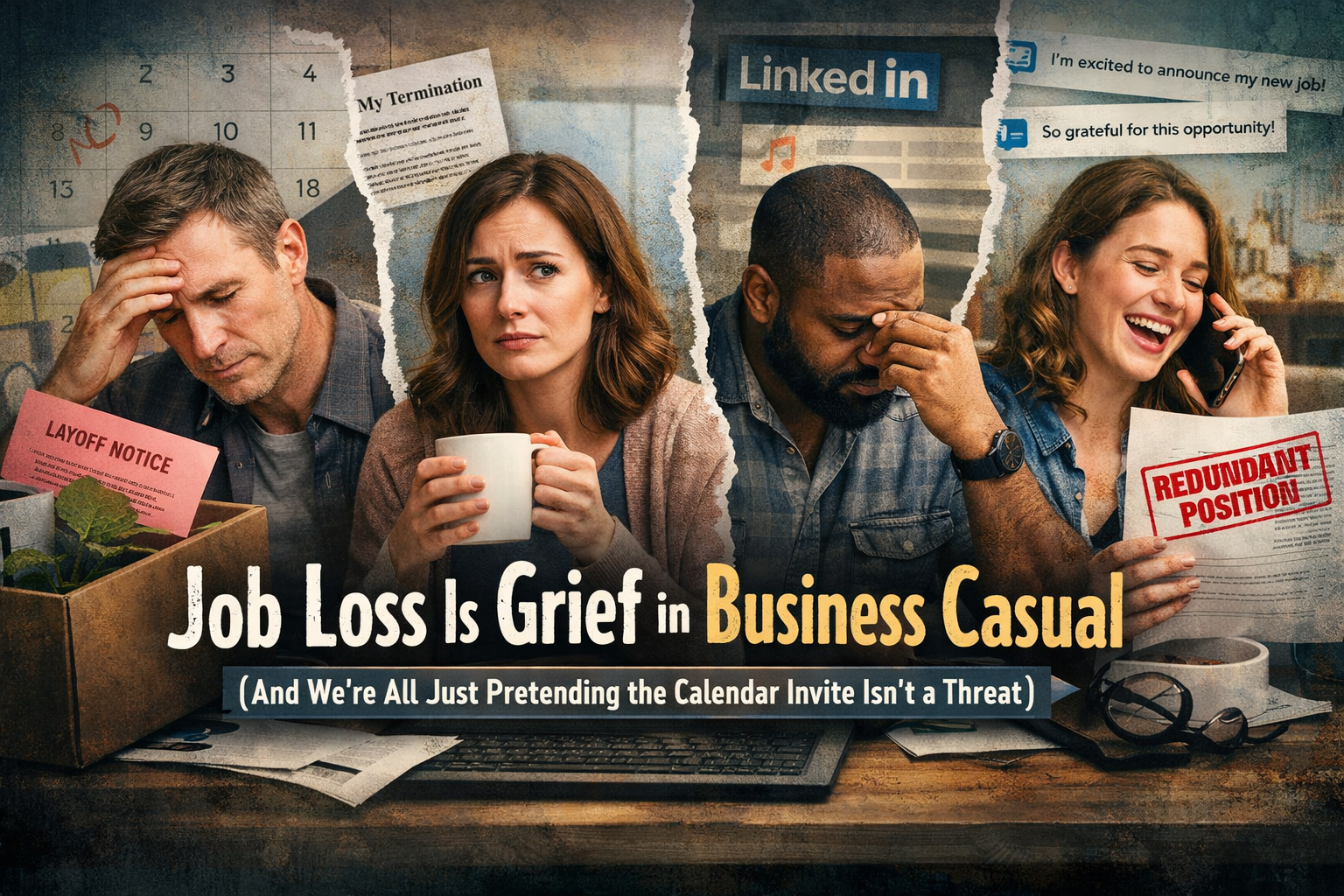
There’s a strange emotional tax that comes with being told your writing helped someone survive a week.
Not “love your content.” Not “this really resonated.” Survive. Like your words were a flashlight in a power outage and they were just trying to get to the kitchen without stepping on a Lego made of shame.
And the thing is, your first instinct isn’t pride. It’s this complicated cocktail of gratitude, concern, and the quiet realization that we are all out here emotionally freelancing with no benefits, no manager, and no PTO policy for “spiraling on a Tuesday because your severance spreadsheet looks like a horror movie.”
Over the last few weeks, messages have landed like little paper airplanes folded out of grief. People who were laid off, “restructured,” “rightsized,” or my personal least favorite corporate word: redundant. A word so sterile it sounds like it was invented to avoid acknowledging that a real person just had the floor drop out from under them. Like careers are printer cartridges. Like you can just swap someone out when the ink runs low and call it “operational alignment.”
And in these messages, people keep apologizing.
“For oversharing.”
“For being emotional.”
“For not being stronger.”
“For not being okay yet.”
Which tells me something important: the job market doesn’t just reject people. It trains them to feel guilty for bleeding.
Let me say this with my whole chest: if you’re apologizing for having feelings after being professionally body slammed by capitalism, you’ve been gaslit by LinkedIn. The same platform that will “celebrate” your layoff post with 214 likes, 63 “So sorry!” comments, and one guy named Brad telling you to “consider gratitude as a strategy.”
Job loss is grief in business casual. It’s waking up at 2 a.m. replaying meetings and noticing the exact moment your manager’s voice changed. It’s refreshing your inbox like it owes you money. It’s the humiliating math of “How many weeks can I survive if I cancel joy?” It’s pretending you’re “enjoying the break” while quietly developing a fight-or-flight response to the Outlook notification sound.
And yes, some people are landing roles. And yes, we should celebrate them. And also yes, it is absolutely possible to clap for others while privately whispering, Please let my turn come soon. That isn’t envy. That’s hope holding on by its fingernails. That’s patience under stress. That’s being human inside a system that would prefer you behave like a quarterly report.
We don’t need more hustle speeches. We need more honesty.
We need permission to admit that the middle part is messy, unglamorous, and emotionally loud. That the comeback story everyone wants to share is built on the part nobody wants to post: the waiting, the doubt, the weird limbo where confidence starts doing interpretive dance.
So here it is. The article the job market refuses to publish. The one where we don’t pretend this is fine. The one where we laugh, not because it fixes anything, but because humor is sometimes the only chair you can drag into the void so your pain doesn’t have to stand the whole time.
The Corporate Breakup Text (And the Audacity of “Nothing Personal”)
Getting laid off is a very specific kind of heartbreak, because it comes with scripts.
Nobody gets fired with honesty anymore. No one says, “We made bad decisions, chased the wrong strategy, and now the budget is on fire.”
No. You get the performance.
You get a calendar invite with a title like “Quick Sync,” scheduled for a time that’s too early to be anything other than suspicious. You open it and see HR already on the call, sitting there with the emotional warmth of a hotel lobby.
You hear phrases like:
- “This isn’t about you.”
- “It’s just the market.”
- “We had to make difficult decisions.”
- “Your role has been eliminated.”
Which is corporate for: We are breaking up with you, but we’d like you to think it’s mutual and also please return your laptop in good condition so we can give it to someone still experiencing joy.
And then comes the weirdest part: you’re expected to respond like a mature adult who definitely doesn’t have bills.
“Thank you for the opportunity.”
I’m sorry, what opportunity? The opportunity to build a career and then watch it evaporate in a twelve-minute call where the host left the meeting and you just stared at your own face in the little Zoom box like, Wow. That’s the face of someone who is about to learn a lot about themselves.
The job market loves to frame layoffs as “a chapter ending,” like you just finished a tasteful novel and not a financial cliffhanger. It wants you to treat it like a plot twist instead of what it often is: a trauma event with direct deposit consequences.
And don’t even get me started on the word redundant.
Redundant is what you call a second stapler. Redundant is when you accidentally bought three jars of peanut butter. Redundant is not a person who spent years becoming the person they needed at that job.
But corporate language has always been a magician’s cape. It’s there to distract you from the human part. It’s the same reason “layoffs” became “workforce optimization,” like people are just apps running in the background you can close to improve speed.
Here’s the truth they don’t like: you can be talented, loyal, high performing, well liked, and still get cut. Not because you weren’t enough, but because companies will sacrifice humans to keep the illusion of control.
And then you’re left holding the question that arrives later, when the shock wears off and the adrenaline stops carrying you:
If it wasn’t about me… why does it feel like it rewrote my identity?
Because work is more than work. It’s routine. It’s community. It’s structure. It’s the thing you did every day that told your brain, “You have a place.”
And when that disappears, you don’t just lose income.
You lose coordinates.
The Waiting Room Era (Where Time Gets Weird and Confidence Starts Doing Weird Math)
The middle part of unemployment has a vibe. It’s not rock bottom, exactly. It’s more like… floating.
Like you’re suspended in this strange atmosphere where weekdays don’t mean what they used to, and your relationship with time becomes fictional.
Monday used to mean meetings. Now Monday means “Refresh job boards and pretend it counts as cardio.”
Tuesday is “networking,” which is a polite word for “reaching out to people you haven’t spoken to since 2019 with the emotional energy of a raccoon approaching a picnic table.”
Wednesday is “tailor your resume,” which is code for “rearrange the same bullet points like you’re trying to unlock a secret door in a video game.”
Thursday is “maybe I’ll take a break,” which you won’t, because resting feels irresponsible when your bank account has started making passive aggressive comments.
Friday is “I should be doing something,” which spirals into “I’m doing everything,” which becomes “why is nothing happening,” which turns into “maybe I’m not good,” which becomes “okay but what if I never get hired again and I end up hosting a podcast called Formerly Employed: A Memoir?”
This is where people get quietly cruel to themselves.
Because the waiting room era doesn’t just test patience, it tests identity. You start tallying your worth like it’s a KPI.
“How many applications did I send?”
“How many responses did I get?”
“How many interviews?”
“How many times did I almost get there and then got ghosted like a Victorian child?”
And every time nothing happens, the brain starts negotiating with the universe.
Maybe I should get another certification.
Maybe I should rewrite my whole resume in the third person.
Maybe I should add more keywords.
Maybe I should remove keywords.
Maybe I should just become a lighthouse keeper and live with the sea and my regret.
And then there’s LinkedIn, that bright fluorescent waiting room where everyone is either:
- Thriving loudly,
- Hiring publicly, or
- Posting “I’m humbled to announce…” like humility is a skillset.
LinkedIn is a stage where the script is optimism, even when the cast is exhausted. And if you’re in the messy middle, it can feel like you’re watching everyone else’s highlight reel while you’re backstage trying to find your shoes.
Here’s what nobody says enough: the job search is not a reflection of your value. It’s a reflection of a system that is inefficient, overwhelmed, and often built to protect itself, not to find the best people.
Your silence isn’t proof you’re unqualified.
Sometimes it’s proof that the system is broken.
Sometimes it’s proof that the ATS didn’t like the font you used, because it is apparently a Victorian judge who hates Arial and punishes ambition.
Sometimes it’s proof that the role was never real. That it existed only as a corporate ritual so a company could say, “We tried,” before promoting someone internally.
So if you’re in the waiting room era and your confidence is doing weird math, I need you to hear this:
You are not behind. You are not broken. You are in the part that no one wants to talk about because it’s not photogenic.
But it is normal.
Humor as a Life Raft (Or: How We Laugh While the Ship Is Absolutely Still Sinking)
Let’s talk about humor, because people misunderstand it.
Humor is not denial. It’s not “staying positive.” It’s not pretending things don’t hurt.
Humor is survival architecture. It’s how you build a small structure inside the chaos so your brain has somewhere to put the pain without letting it swallow you whole.
When I write jokes about burnout, ghosting, or corporate language, I’m not minimizing what happened. I’m translating it into something we can carry.
Because if we say it plainly—if we say, “I lost my job and I’m terrified and I feel disposable and I don’t know who I am without work”—it can feel like standing in the middle of a crowded room naked, holding your own heart like a fragile glass.
But if we say, “Wow, love that my career ended via calendar invite titled ‘Quick Chat’ at 9:12 a.m.”—suddenly we’re not alone.
Suddenly the room laughs, not because it’s funny-funny, but because it’s true, and truth is relieving when you’ve been choking on polite lies.
That’s why “my writing helped me survive” hits so hard. Because it confirms what most of us already suspect:
A lot of people are not okay.
They’re functional. They’re presentable. They’re showing up to parent-teacher conferences and replying “Sounds good!” in texts and making dinner and laughing at memes, and underneath that? They’re carrying a quiet panic.
They’re looking at their calendar like it’s a threat.
They’re checking bank balances like it’s a medical test.
They’re smiling through conversations while silently thinking, I do not know how I’m going to get through this month.
And then they read something honest, something that doesn’t demand positivity, something that says, “Yeah, this is hard and also you’re not weak,” and it gives them a little air.
Not a solution. Not a miracle.
Air.
And sometimes that’s enough to make it through the week.
Also, humor has another job: it gives you back agency.
Because the job market takes agency. It turns people into applicants, numbers, “resources,” “headcount,” “pipeline,” “talent.” It makes you wait for permission to exist.
Humor is you grabbing the microphone back.
It’s you saying: You don’t get to narrate my story like I’m a line item.
It’s you refusing to let corporate language be the final word.
So if your coping mechanism right now is jokes, sarcasm, memes, long texts to friends that start with “okay so here’s the latest absurdity,” or reading posts that make you feel less alone—good.
That’s not weakness. That’s intelligence.
That’s you building a bridge across something painful with whatever materials you have.
Final Thoughts: The Middle Part Deserves a Name, Too
We love comeback stories because they let us believe the world is fair.
They make it seem like if you just “keep going,” the system will eventually reward you.
But the truth is, the middle part is where people actually live.
The messy part.
The waiting part.
The part where you celebrate someone else’s offer while privately hoping your phone rings.
The part where you’re proud of yourself for showering and also angry that showering feels like an achievement now.
The part where you can’t tell if you’re resting or dissociating.
The part where you want to be hopeful, but hope feels like lifting weights with a sprained heart.
We need more permission to admit that the middle part is loud.
If you’re there right now, I want you to know this:
You didn’t fail. You were impacted.
You didn’t become less valuable. You became less protected by a system that never truly protected anyone.
You are not a moral lesson. You are a person.
And if all you did this week was survive?
That counts.
That is the work.
That is the story.
And somehow, together, we keep going—laughing when we can, telling the truth when it’s safe, holding space for each other when the world insists we “move on.”
Not because it’s easy.
Because we’re still here.