
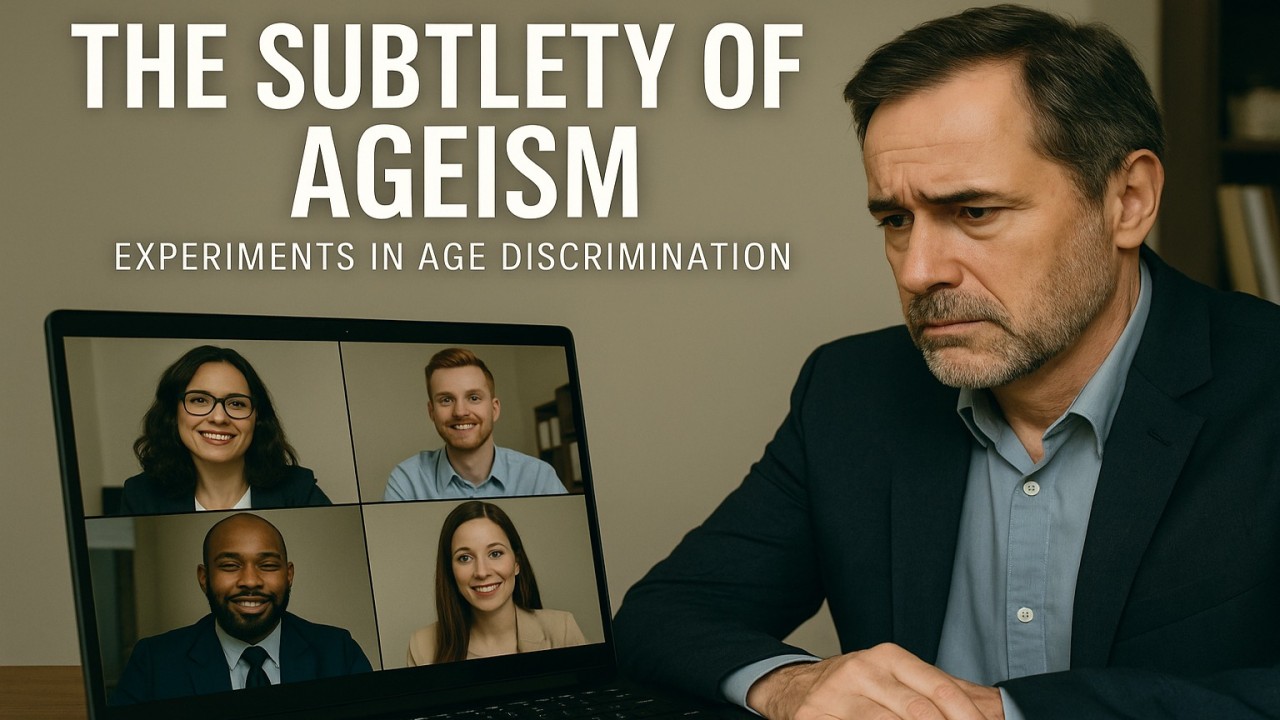
The other day, I decided to run a little social experiment. No research funding. No fancy analytics. Just a front row seat to something that plays out in silence every single day, a Zoom interview between a job candidate in his fifties and a panel of younger professionals.
I didn’t say a word. I didn’t type in the chat. I simply observed. Because I wanted to see what ageism actually looks like when it’s not a trending topic or a corporate workshop. I wanted to watch it unfold naturally, in the exact environment where it hides best: the modern “inclusive” workplace.
And within the first ten seconds, I found it.
Ageism doesn’t walk into the room wearing bias on its sleeve. It tiptoes in politely, smiling, shaking hands, thanking you for your time. It says all the right words, “We value your experience,” “We love your background,” “We’re so excited to meet you.” But tone has a way of revealing truth, and the subtext was impossible to miss: We were hoping for someone younger.
Four panelists sat before their cameras, their ring lights glowing like halos. They were warm, articulate, and professional. They also looked like they’d just graduated from a LinkedIn seminar titled “How to Sound Empathetic While Silently Judging Someone’s Age.”
The candidate smiled, poised and patient. He looked like someone who’d led teams, solved crises, built departments from scratch, because he had. He greeted them with grace. And then came the first question that betrayed the real reason we were all there.
“How do you stay current with technology?”
There it was. The polite dagger wrapped in corporate velvet.
It didn’t mean “Tell us about your adaptability.” It meant “Prove you’re not a relic.”
He answered beautifully. He talked about leading digital transformations, training younger colleagues, implementing software systems before some of the interviewers were out of middle school. But it didn’t matter. You could see the smiles freeze halfway through. The nods became mechanical. The panel had already moved on, mentally and emotionally.
The decision had been made before he finished his first sentence.
The Language of Exclusion
Here’s the thing about modern ageism: it’s fluent in corporate. It doesn’t say, “You’re too old.” It says, “We’re looking for someone who’s a better culture fit.” It doesn’t say, “You make us uncomfortable.” It says, “We want someone who brings fresh energy.” It doesn’t say, “We don’t want to pay for your experience.” It says, “We’re seeking someone who can grow with us.”
Each phrase is technically neutral — but emotionally violent. It’s discrimination with a smile.
At one point, one of the panelists, who looked barely old enough to rent a car, asked the classic question:
“Where do you see yourself in five years?”
The candidate paused, smiled gently, and replied, “Hopefully working for a company that values experience over assumptions.”
The silence that followed was biblical. The kind of stillness that happens when truth enters a room and no one knows what to do with it.
It wasn’t an outburst. It wasn’t anger. It was just honesty. The kind that can’t be processed by people who’ve only ever heard feedback through Slack channels and leadership webinars.
And that’s when I realized something deeper: ageism doesn’t reject people because they can’t adapt. It rejects them because they expose the fragility of systems built on appearance, not substance.
Older workers aren’t “out of touch.” They just know when something doesn’t make sense and they’re not afraid to say it. That kind of confidence terrifies people who’ve built their entire careers on pretending to know more than they do.
The Weight of Experience
The truth is, the job market doesn’t fear older professionals because they’re obsolete. It fears them because they’re competent.
Because they’ve seen things — real things — not just case studies and “lessons learned” slides. They’ve led teams through crises that never made the news. They’ve balanced budgets with no automation, managed people without “AI powered insights,” and survived more rebrands than the average startup has all hands meetings.
Experience doesn’t just make someone skilled. It makes them steady. And steadiness is dangerous in an age that worships chaos disguised as innovation.
The irony is painful: the same people who built the infrastructure companies now run on are told they’re not “future ready.” The same professionals who created the workflows being “reimagined” by consultants are being told they don’t “fit the new direction.”
We talk endlessly about “diversity,” yet age never makes the brochure. We celebrate mentorship, but quietly reject the mentors. We post quotes about wisdom, as long as it comes from someone under forty with a verified account.
Ageism, at its core, is the fear of perspective. Because perspective sees patterns. It spots red flags early. It recognizes recycled mistakes dressed in new jargon. And in a corporate world that thrives on illusion, perspective is dangerous.
The Dignity of Rejection
When the interview ended, the candidate thanked them sincerely. He smiled, logged off, and sat quietly for a moment. No frustration. No anger. Just an unspoken understanding that the rejection email was already written.
That’s the cruelest part of ageism — the quiet grace of those who see it coming and still choose dignity over resentment.
He didn’t lose because he lacked ability. He lost because his calm competence reminded them of everything they didn’t yet know. And nothing rattles fragile authority like unbothered expertise.
I sat there staring at my screen, realizing this wasn’t an isolated incident. It was a mirror. A reflection of an entire system terrified of its own reflection, one that confuses confidence with arrogance, maturity with stagnation, and patience with weakness.
The Corporate Paradox
The modern workplace loves to preach about “lifelong learning.” Yet it punishes those who’ve actually lived long enough to learn something.
Companies talk about “disruption” as if it’s a virtue, forgetting that someone has to rebuild the mess afterward and it’s usually the experienced ones who know how.
We romanticize the idea of being “young at heart” while dismissing those who simply have older resumes. We frame leadership as innovation, but true leadership is consistency and consistency rarely trends on LinkedIn.
This isn’t a hiring problem. It’s an identity crisis. A culture addicted to newness at the expense of wisdom.
Every generation believes it’s the one that “gets it right.” But the people who’ve been through multiple generations of getting it wrong are the ones who actually understand how progress works.
And yet, somehow, they’re the ones being asked to “prove relevance.”
The Real Fear
Ageism isn’t driven by technology or trends. It’s driven by insecurity.
You can’t intimidate experience. You can’t impress it with jargon. You can’t manipulate it with “engagement surveys.” Experience has already seen how the story ends and it’s not interested in rehearsing the same mistakes.
The reason so many hiring managers sideline older candidates isn’t that they can’t perform. It’s that they can see through the performance. They recognize when a “growth culture” is really just burnout with better branding.
That’s what the job market fears — wisdom that isn’t for sale.
Because you can teach someone how to use software, but you can’t teach them perspective. You can train for skills. You can’t train for discernment.
And you can’t fake composure when the person sitting across from you has led teams through storms you can’t yet imagine.
The Waiting
Here’s the part no one talks about: experience doesn’t disappear. It waits.
It waits for companies to burn out on “fresh energy.” It waits for leadership teams to realize that enthusiasm without strategy is chaos. It waits for industries to rediscover the value of memory — the kind that can’t be Googled or replaced with a management course.
The job market will circle back. It always does. And when it does, the very people it sidelined will still be here — wiser, calmer, and ready to clean up the mess left by “innovation.”
Because wisdom doesn’t age out. It just gets tired of explaining itself.
The Final Lesson
So yes, I ran an experiment. And the result was predictable — but necessary.
Ageism isn’t just a workplace issue. It’s a cultural blind spot. A refusal to value endurance over novelty, substance over style.
The irony is this: the same professionals being written off as “outdated” are the ones who taught the younger generation how to log in, present, negotiate, lead, and survive.
The same voices being ignored are the ones that built the foundation every modern success stands on.
And one day, the very people who perpetuate this quiet bias will find themselves on the other side of the screen, with perfect lighting and practiced smiles waiting to say,
“We’re so glad you’re here.”
And they’ll understand, finally, what that really means.
Because time has a way of humbling systems that think they’ve outgrown wisdom.
And when it does, I hope there’s someone with gray hair and grace left to teach them what they missed.






Your point of view caught my eye and was very interesting. Thanks. I have a question for you.
Thanks for sharing. I read many of your blog posts, cool, your blog is very good.
Thanks for sharing. I read many of your blog posts, cool, your blog is very good. https://www.binance.info/register?ref=QCGZMHR6