
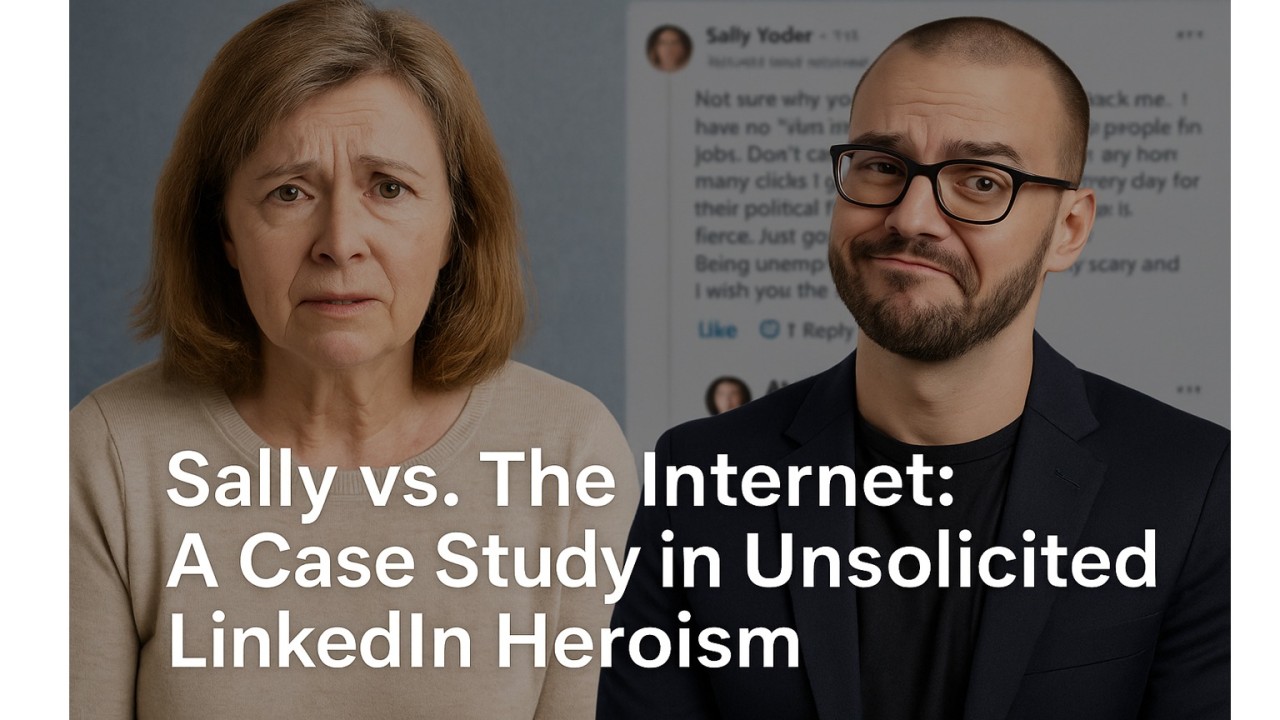
There’s a moment every creator on LinkedIn eventually faces, that sacred split second after hitting “Post” when the universe holds its breath, algorithms start calculating your fate, and somewhere out there, a retired HR manager senses a disturbance in the Force. Her fingers twitch. Her Wi-Fi hums. Her moral compass spins toward your sarcasm.
And then she arrives.
Her name is Sally.
Now, I didn’t summon Sally. I didn’t tag her, mention her, or carve her name into the post’s metadata. But somehow, she found me. Like a moth to an existential flame, she materialized in my comment section with the energy of someone who hasn’t lost an argument since 1987.
It all started with what I thought was a harmless post, a witty take on job hunting absurdities. Nothing scandalous, nothing cruel. Just a satirical nudge at the process that’s turned millions of professionals into part-time novelists (“Tell us about a time you overcame conflict using Microsoft Excel”).
The post was doing fine, gathering empathy, a few laughs, and the occasional “Preach!” until Sally landed in the comments like a philosophical meteorite.
Act I: The Sally Manifesto
Her opening line set the tone:
“Not sure why you find it necessary to attack me.”
A bold opener, considering I had no idea who she was. It’s a fascinating habit among the chronically unprovoked, they enter a conversation, deliver a monologue, and then declare themselves victims of warfare.
She assured me she had “no skin in the game,” which is precisely what people say before revealing that their entire personality is the game. She claimed she didn’t care about likes, clicks, or engagement (three things you only say if you care deeply about likes, clicks, and engagement).
Then she blessed us all with the LinkedIn equivalent of a benediction:
“Good luck to all of you. Being unemployed is really scary.”
I could almost hear the virtual pat on the head.
So, I replied — kindly, I thought. I told her no one was attacking her, that she’d rappelled into my post uninvited like a motivational hostage negotiator, dropped a speech, and declared herself under siege. I even promised I was just sipping my coffee, watching the chaos unfold like a true professional spectator.
But if LinkedIn has taught me anything, it’s that reason never stops a determined Sally.
Act II: The Whiny Post Doctrine
Minutes later, Sally returned, not with a rebuttal, but with scripture.
She began with,
“Just so you know, every whiny post of yours is lessening your chances of getting through to a recruiter who actually cares…”
It’s always “just so you know” with people who are about to explain life to you. That phrase is LinkedIn for “Sit down, I’m about to unleash wisdom no one requested.”
She proceeded to deliver a 400 word manifesto that read like a mash-up between a rejection letter and a parent teacher conference. She wanted me and by extension, the entire unemployed internet, to know that our sarcasm was self sabotage. That recruiters are sensitive creatures who can only be approached with perfect emotional neutrality and perhaps a coupon for Starbucks.
Sally described, in harrowing detail, how she had personally waded through “hundreds of resumes” in her career, battling lazy hiring managers and unreasonable applicants alike, as though she’d just returned from the front lines of the Resume Wars.
Her conclusion? We — the jobless masses — were ruining our own chances by “daily complaining about the process.” Because, you see, the system isn’t broken; we just lack the right tone of gratitude.
She ended with the ultimate mic drop:
“If you want to change a deeply flawed system, your timing really sucks.”
The phrasing alone deserved an Oscar. Not because it was profound, but because it was the verbal equivalent of a door slam followed by a “good luck out there.”
Act III: The TED Talk Response
I took a deep breath, sipped my coffee (black, no nonsense), and replied.
“Wow,” I began, “thank you for this inspiring TED Talk on how to suffer quietly for the comfort of recruiters everywhere.”
And I meant it. Truly revolutionary stuff.
I told her I’d be sure to replace my daily frustrations with interpretive dance and maybe a gratitude post about rejection emails that begin with ‘Dear Candidate.’ Because nothing screams resilience like pretending mass unemployment is a character building exercise.
Then, in the spirit of her feedback, I confessed my timing probably did suck. I should’ve waited until the economy, the algorithms, and the planetary alignment were perfect before daring to mention that maybe just maybe the hiring process was a dystopian carnival run by buzzwords.
I wrapped it up neatly:
“Next time I’ll schedule my feelings through an ATS portal, attach them as a PDF, and hope they make it past the keyword filter.”
I hit send. And reader — that was the moment the crowd went wild.
Act IV: The Comment Section Revolt
Within hours, people flooded in. Not recruiters, not corporate cheerleaders, real humans. People who’d been through it. People who’d been told to smile through layoffs and write cover letters for jobs that ghosted them anyway.
They weren’t angry. They were relieved.
Because Sally wasn’t just one person, she was a symbol. A mascot for the outdated philosophy that professionalism equals silence. That you can’t criticize a system without sounding bitter. That your pain is only valid if it’s well formatted.
The irony, of course, is that Sally thought she was protecting the job market when she was really just proving its absurdity. Her comments were a case study in everything wrong with the discourse: performative empathy, tone policing, and a fundamental misunderstanding of humor as hostility.
And honestly, I couldn’t be mad. Sally did what Sallys do, arrived uninvited, made it about her, and left behind a case file in passive aggression.
But what she accidentally inspired was far greater: a collective laugh.
Thousands of people who’d been told to “stay positive” finally exhaled and said, “Wait… so it’s not just me?”
Epilogue: The Gospel According to LinkedIn
Sally never replied after that. Maybe she blocked me. Maybe she’s still drafting a follow-up essay titled “How Negativity Destroys the Hiring Ecosystem (and Other Things I Learned in 1989).”
Either way, the moral stands.
Every platform has its Saviors of Professional Decorum — people who believe tone is more important than truth. They roam the feeds like self appointed hall monitors, making sure everyone stays “on brand” even when their careers are collapsing in real time. To them, professionalism isn’t about ethics or integrity, it’s about maintaining the illusion that everything’s fine.
They’re fluent in the language of moderation: “Be careful how that sounds,” “This might come across the wrong way,” “Try to be more positive.” Their goal isn’t conversation; it’s containment. The system works best when no one rocks the boat, even if the boat’s been on fire for years.
These are the people who hear, “The hiring process is broken,” and respond with, “Maybe you should smile more in your cover letter.” Who see a post about systemic dysfunction and say, “But what about gratitude?”
It’s not malice, it’s conditioning. Decades of being told that good employees never complain, good candidates never question, and good professionals always “reframe challenges as opportunities.”
But here’s the truth: every time someone like Sally tells you to tone it down, they’re really saying, “Don’t make me uncomfortable by being honest.”
And that’s exactly why the rest of us refuse to quiet down.
We’ll keep posting. We’ll keep laughing. We’ll keep writing the truth, not the sanitized, corporate approved version, but the messy, human, occasionally sarcastic one that actually sounds like us. Because laughter is the one form of protest that HR can’t flag as “unprofessional.”
Silence may make recruiters comfortable, but it doesn’t change anything. Silence doesn’t expose hypocrisy, it doesn’t call out double standards, and it sure as hell doesn’t help the people still fighting to get seen.
So yes, we’ll keep telling our stories, the ghostings, the fake interviews, the internal candidates who were always going to get the job, the “We’ll keep you on file” rejections that feel like emotional spam. We’ll keep joking, not because we don’t care, but because we care too much to keep pretending this is normal.
And if our honesty makes a few retired gatekeepers clutch their pearls between rounds of “helpful advice,” then so be it. Let them. Consider it emotional cardio, a workout for all that pent-up fragility.
Because for every Sally who lectures us about tone, there are thousands of people reading in silence, thinking, “Thank you. I thought it was just me.”
And that’s why we keep going.
We don’t post for clicks. We post because truth, once spoken out loud, loses its power to isolate. Because sarcasm, when wielded well, isn’t bitterness, it’s rebellion wrapped in intelligence. It’s the sound of people refusing to be erased by the polite language of compliance.
So no, we won’t stop. Not today, not tomorrow, not while there are still people being told their humor makes them “less hireable.”
Because this isn’t negativity. It’s catharsis. It’s clarity. It’s the collective sigh of everyone who’s ever been told to “be patient” while the system resets itself for another decade.
Sally can write her essays. She can defend the decorum of LinkedIn with all the Canva quotes and motivational platitudes in the world.
But the rest of us, the ones still showing up, still speaking up, we’re not waiting for permission to be real anymore.
We’ve learned that silence is just compliance in business casual.
And if truth makes the room a little uncomfortable?
Good. That means we finally said something worth hearing.






Can you be more specific about the content of your article? After reading it, I still have some doubts. Hope you can help me. https://www.binance.info/bg/register?ref=V2H9AFPY
Your article helped me a lot, is there any more related content? Thanks! https://www.binance.bh/register?ref=IXBIAFVY
Thank you for your sharing. I am worried that I lack creative ideas. It is your article that makes me full of hope. Thank you. But, I have a question, can you help me? https://accounts.binance.bh/register/person?ref=QCGZMHR6