
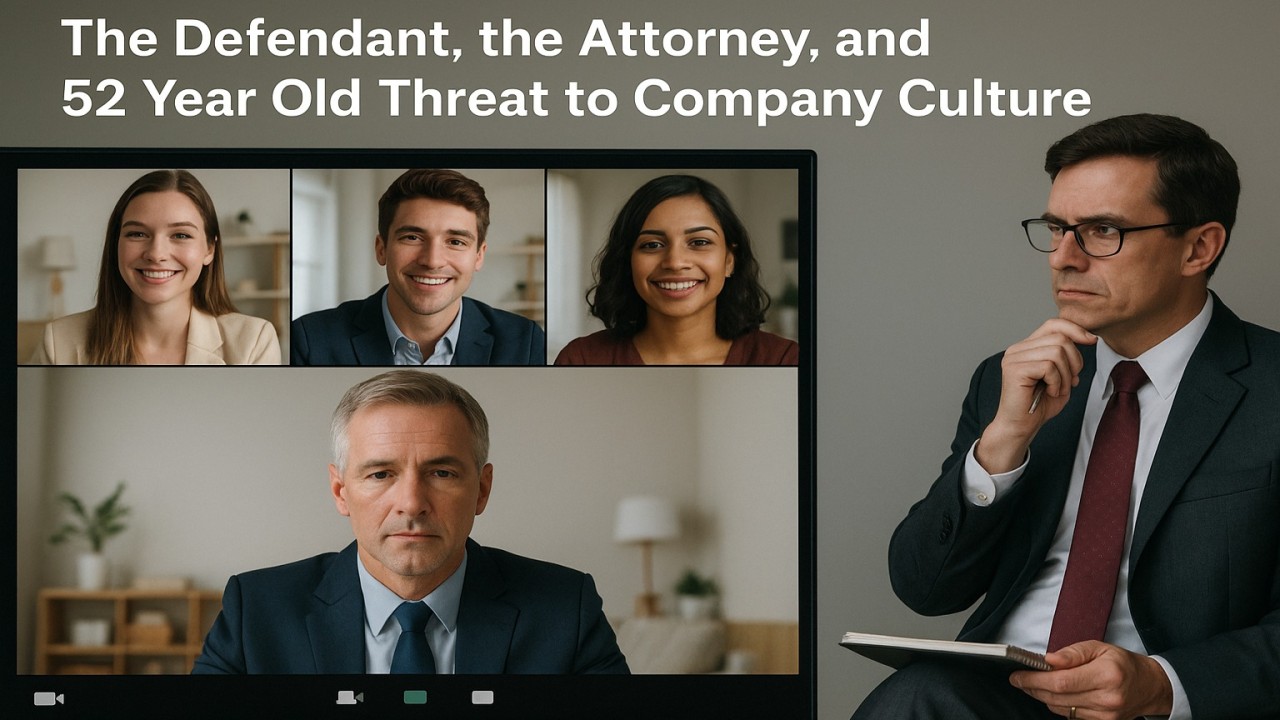
The other day, I decided to take my little social experiments to the next level. Last time, I quietly observed a Zoom interview to see what ageism looked like behind closed screens. This time, I decided to bring reinforcements, an attorney. Not because I planned to sue anyone (though it crossed my mind halfway through), but because I needed a witness. Someone objective. Someone to confirm that what I was seeing wasn’t paranoia, but a full blown corporate circus disguised as a “professional opportunity.”
His name was John. Fifty two years old. Polished, composed, and the human embodiment of competence. The kind of professional who’s seen more restructures than some panelists have seen birthdays. He’s led teams through chaos, trained new hires who are now executives, and probably survived every flavor of “strategic pivot” corporate America can invent. He’s the kind of guy who can read a room before the PowerPoint even loads. The one who can de-escalate an entire boardroom argument with a single sentence that starts with, “Let’s take a step back.”
He’s been the mentor, the coach, the manager everyone secretly called when things went sideways. The quiet type of leader who knows how to rebuild a broken team without a buzzword. He remembers when meetings had actual outcomes instead of post meeting “syncs.” When job offers were made by phone, not automated emails. When experience was currency, not a warning label.
And yet, despite all that, he can’t get a callback. Not because he’s lacking. Not because he’s rusty. But because somewhere along the way, the world decided experience made people “expensive” instead of “invaluable.” Because in the current hiring circus, being qualified has somehow become a liability.
John’s story isn’t unique, it’s just the one I happened to witness up close. But what made this one different was having someone else in the room, my attorney friend, who could see the same absurdity I’ve been shouting about for months. He wasn’t there to take notes for a lawsuit; he was there to validate what too many people over 50 already know: that in modern hiring, the playing field isn’t just uneven, it’s tilted, polished, and covered in corporate jargon that hides bias behind a smile.
By the time the Zoom camera flickered on, I already knew what we were about to witness, not an interview, but a performance. A carefully choreographed display of “company culture” where politeness replaces authenticity, and every question is really a test of whether someone looks like they’d make the team photo more “energetic.”
And as John straightened his tie, smiled into the camera, and greeted the panel of four twenty somethings armed with clipboards and ring lights, I realized this wasn’t just another interview. This was an exhibit. A case study in how quiet, legal, and devastating modern ageism really is.
The Panel of Perfect Lighting
We logged into Zoom. The familiar Brady Bunch grid appeared, four smiling panelists, each radiating that overly polished enthusiasm of people who rehearse empathy in the mirror. You know the type: eyes wide, posture perfect, voice tuned to “corporate warmth.” They all looked friendly, competent, and younger than John’s first AOL password. My attorney, who I’ll call “Mike” for legal flair, leaned over and whispered, “I can already tell who’s about to overcompensate.”
He was right. Within seconds, you could spot the hierarchy. There was the self appointed leader, the one who talks first, laughs loudest, and keeps adjusting their headset like it’s a power move. Then there was the over prepper, the one who clearly read a blog about “empathetic interviewing” last night and plans to use every line verbatim. The third was the silent observer, probably HR, watching everyone like they’re grading a group project. And finally, there was the wild card, the one whose only goal was to survive the meeting and get back to whatever DoorDash order was waiting off camera.
The lighting was perfect, their smiles synchronized, and their energy forced. It was like watching a toothpaste commercial for “diverse collaboration.” Every nod was a performance, every “thank you for joining us today” delivered with the same cadence as a weather report. You could feel the choreography, four strangers pretending to represent unity, while silently competing to prove who was the most “inclusive.”
Then came the small talk, that awkward dance companies call “icebreaking.” “How’s your day going?” “Great weather today!” “Can you hear us okay?” The usual pre-interview ritual, designed to sound human while buying time to scan your LinkedIn profile one last time. John handled it flawlessly, calm and polite, answering each question with the grace of someone who’s sat through more of these calls than some of these interviewers have been alive.
But beneath the pleasantries, the undertone was unmistakable. Their smiles never quite reached their eyes. The tone said it all — You seem too calm for someone desperate to impress us. That quiet suspicion that confidence after 50 must come from arrogance, not ability.
Mike caught it immediately. He leaned toward me and said under his breath, “They’re not interviewing him; they’re evaluating how uncomfortable his competence makes them.” I nearly laughed, because he was right. The whole room had that strange energy, not curiosity, not interest, but cautious politeness. The kind you use when someone brings a real adult to a student group project.
It was all there, the invisible tension between experience and ego, between wisdom and insecurity. And the tragic part? John could feel it too. I could see it in the slight pause before each answer, in the way he measured his tone so carefully, as if too much confidence might spook them. It wasn’t an interview anymore. It was a balancing act. One wrong word, and he’d be labeled “set in his ways.” One too modern reference, and he’d be accused of trying too hard.
By minute five, I could already tell how it would end, not with a rejection email, but with silence. That polite, rehearsed kind of silence that says, “We really enjoyed meeting you” while their decision’s already made. The interview wasn’t about his qualifications. It was about their comfort zone. And experience, unfortunately, made them profoundly uncomfortable.
The Question That Started the Trial
The first question dropped like a polite insult:
“How do you stay current with technology?”
It’s the corporate equivalent of asking your doctor if they know how to use a thermometer. The subtext was clear: Please reassure us that you’ve heard of the internet. John smiled, not the forced kind, but the quiet, knowing smile of someone who’s fielded this question since “technology” meant a fax machine. “I’ve led multiple digital transformations,” he said calmly, “trained younger staff on new systems, and recently completed a certification in analytics.”
It was a perfect answer, precise, contemporary, even a little humble. But you could see it in their eyes, that quick flicker of polite dismissal that corporate people do when they’ve already decided what box you belong in. The one panelist with the over rehearsed empathy smile nodded too quickly. Another tilted her head like she’d just heard a bedtime story. The manager gave that slow, approving smirk, the kind that says, Good for you, Grandpa, now let’s move on.
They don’t want leaders. They want “collaborators.” Translation: people who will do the work, stay quiet, and not remind management that they have less experience than the person they’re interviewing. John’s answer didn’t fail the question, it outgrew it. And that’s the problem. When your competence exceeds the comfort level of the room, you’re not impressive, you’re intimidating.
Mike, my attorney slash copilot, scribbled something in his notebook and whispered, “That answer just scared them.” I looked at him, half laughing. “Scared them? It was perfect.” He shook his head. “Exactly. Perfection reads like a red flag to people who mistake youth for innovation. They don’t want excellence, they want reassurance.”
He was right. Experience, it seems, has become a quiet threat. The more polished you are, the more they assume you’ll be “hard to manage.” The more history you bring, the more they fear you’ll question theirs. In an age where companies worship “learning agility,” it’s ironic how allergic they are to people who’ve actually learned anything.
And here’s the irony that kills me every time: the same companies that preach “lifelong learning” and “growth mindset” are the first to write someone off the moment they realize that person’s already mastered what they’re still Googling. John’s career wasn’t the problem, it was the mirror it held up.
The question wasn’t about technology at all. It was about relevance. About whether John’s experience fit their idea of “modern.” And in that moment, you could almost see the subtext playing across their faces: He’s too good for this role. He’ll get bored. He’ll make us look outdated.
By the time they moved to the next question, I already knew how this story would go. They’d praise his professionalism, thank him for his time, and tell each other afterward that he “wasn’t quite the right cultural fit.” It’s the new corporate code for “we wanted someone younger, cheaper, and less likely to make us feel like amateurs.”
John didn’t flinch. He just nodded, smiled, and carried on, because when you’ve seen the game long enough, you stop expecting fairness. You just take notes, the way Mike was doing, for the day you finally decide to tell the truth about how this system actually works.
The Culture Fit Catastrophe
Then came the infamous five year question, the one that feels less like curiosity and more like a personality test designed by someone who’s never made it past year two.
“Where do you see yourself in five years?”
John grinned, that steady, self assured grin of someone who’s heard the question since the days when resumes were printed on actual paper and interviews happened in person. “Hopefully here,” he said warmly, “mentoring younger staff, driving results, and helping the company grow.”
You could practically hear the Wi-Fi drop from the collective shock. The panel froze. Their smiles turned into statues. Somewhere in their heads, you could see the translation loading: He wants to stay? He plans to commit? He doesn’t see this as a stepping stone or passion project? How… unsettling.
Apparently, in today’s job market, loyalty is a red flag.
One panelist tilted her head with a smile that looked supportive but felt like she was mentally writing, “too experienced for growth culture.” Another gave the slow, hesitant nod, the one people use when they’re pretending to agree but are really just waiting for their turn to talk. The lead interviewer scribbled something on a notepad that I’m fairly sure wasn’t “hire immediately.”
Mike, my attorney and now part-time commentator, leaned in and whispered, “Apparently, stability is now a liability.”
And he wasn’t wrong. Somewhere along the corporate timeline, consistency became synonymous with complacency, and longevity got mistaken for lack of ambition.
From there, the interview started collapsing under its own weight. Buzzwords began flying like confetti at a marketing convention. “Culture fit.” “Fresh energy.” “Collaborative synergy.” You could practically hear the corporate thesaurus begging for mercy.
They weren’t asking questions anymore, they were searching for reasons to exclude him without saying why. One panelist even said, “My dad also works in your field!” with the same tone people use when telling someone they have a mutual dentist. It was meant to be friendly, but it landed like a soft punch of generational condescension.
John, consummate professional that he is, smiled through it all, poised, kind, graceful. Because when you’ve been in the workforce long enough, you know when an interview isn’t about potential, it’s about perception. And the perception of “too experienced” is still the most polite way to say, you don’t fit our image.
The Silent Dismissal
When it finally ended, John thanked them sincerely, the way professionals used to when interviews were genuine conversations instead of endurance tests filled with behavioral riddles and acronyms.
He logged off, took a slow breath, and said quietly, “They were done with me before I said hello.”
That line hit harder than any rejection email ever could. Because that’s what ageism really is, not loud, not overt, not stamped in writing. It’s silent dismissal. It’s that flicker of judgment that passes through someone’s eyes when they realize your resume is longer than their career. It’s when calm confidence is misinterpreted as arrogance, when experience gets mistaken for ego, and when your ability to not panic during chaos somehow makes you “not dynamic enough.”
Mike closed his notebook and sighed. “That was legal,” he said, “but barely ethical.”
And there it was, the perfect diagnosis of modern hiring. Legal, but unethical. Polite, but prejudiced. Smiling, but dismissive. Ageism today isn’t the overt rejection it used to be. It’s evolved into performance art, subtle, fluent in HR-approved phrasing, and deniable enough to make you question if it even happened.
John didn’t need me to explain it. He’d seen it before, in interviews where the tone changed after they saw his graduation year, in “casual chats” where every compliment ended with “but,” and in polite follow-up emails that always included the words “competitive candidate pool.”
The Truth No One Prints on Job Postings
Here’s the truth that never makes it into company handbooks: older professionals don’t get passed over because they’re outdated. They get passed over because they remind others what actual competence looks like.
They intimidate the ones who mistake youth for innovation, enthusiasm for expertise, and confidence for arrogance. They’ve mastered what most modern teams are still “beta testing”, how to lead without ego, how to mentor without micromanaging, and how to fix problems without scheduling twelve brainstorming sessions.
Experience doesn’t age out. It just makes people uncomfortable. Because experience asks questions like “Why are we doing it this way?” and “Didn’t we try this five years ago?” And those are dangerous questions in workplaces powered by rebranding old ideas as “new initiatives.”
The irony, of course, is thick enough to print on company letterhead. These same organizations brag about “diversity of thought” right up until that diversity includes someone who remembers when fax machines were cutting-edge. They promote mentorship programs, but quietly ghost the mentors. They post about “inclusion,” but filter out résumés with long, stable careers that don’t fit their algorithmic model of “fresh talent.”
John doesn’t need sympathy. He doesn’t even need motivation. He needs a company brave enough to recognize that wisdom doesn’t compete with innovation, it anchors it. A leader who understands that energy fades, but insight sustains. Someone willing to admit that personality might fill the office, but professionalism fills the bottom line.
The Final Verdict
As we logged off, I realized the cruelest truth of all: ageism doesn’t need villains anymore. It’s self-sustaining. It’s built into our workflows, embedded in our hiring software, disguised as “fit,” and celebrated as “fresh perspective.” It thrives in the obsession with “young energy,” in the illusion that adaptability has an expiration date, and in the quiet fear of being the oldest face in a meeting full of buzzwords.
But here’s what gives me hope, John’s still applying. Still showing up. Still believing that the right opportunity will recognize what others are too shortsighted to see. Because you can’t ghost resilience. You can’t algorithmically downgrade integrity. And you sure as hell can’t automate wisdom.
He’ll keep showing up, not because he needs validation, but because he refuses to let the system define his worth. That’s the quiet revolution happening right now, not in protests or policy changes, but in the persistence of professionals like John who keep proving that age isn’t the problem. Ignorance is.
So yes, I brought an attorney, not to file a lawsuit, but to witness history. To document the absurdity of a world that praises “experience” in theory but penalizes it in practice. Because in today’s job market, experience is on trial.
And if justice ever shows up to the hearing, I hope she’s over 50, wearing glasses, holding a cup of coffee she doesn’t apologize for, and not afraid to look the system straight in the eye and ask, “Who approved this nonsense?”






Thank you for your sharing. I am worried that I lack creative ideas. It is your article that makes me full of hope. Thank you. But, I have a question, can you help me?