
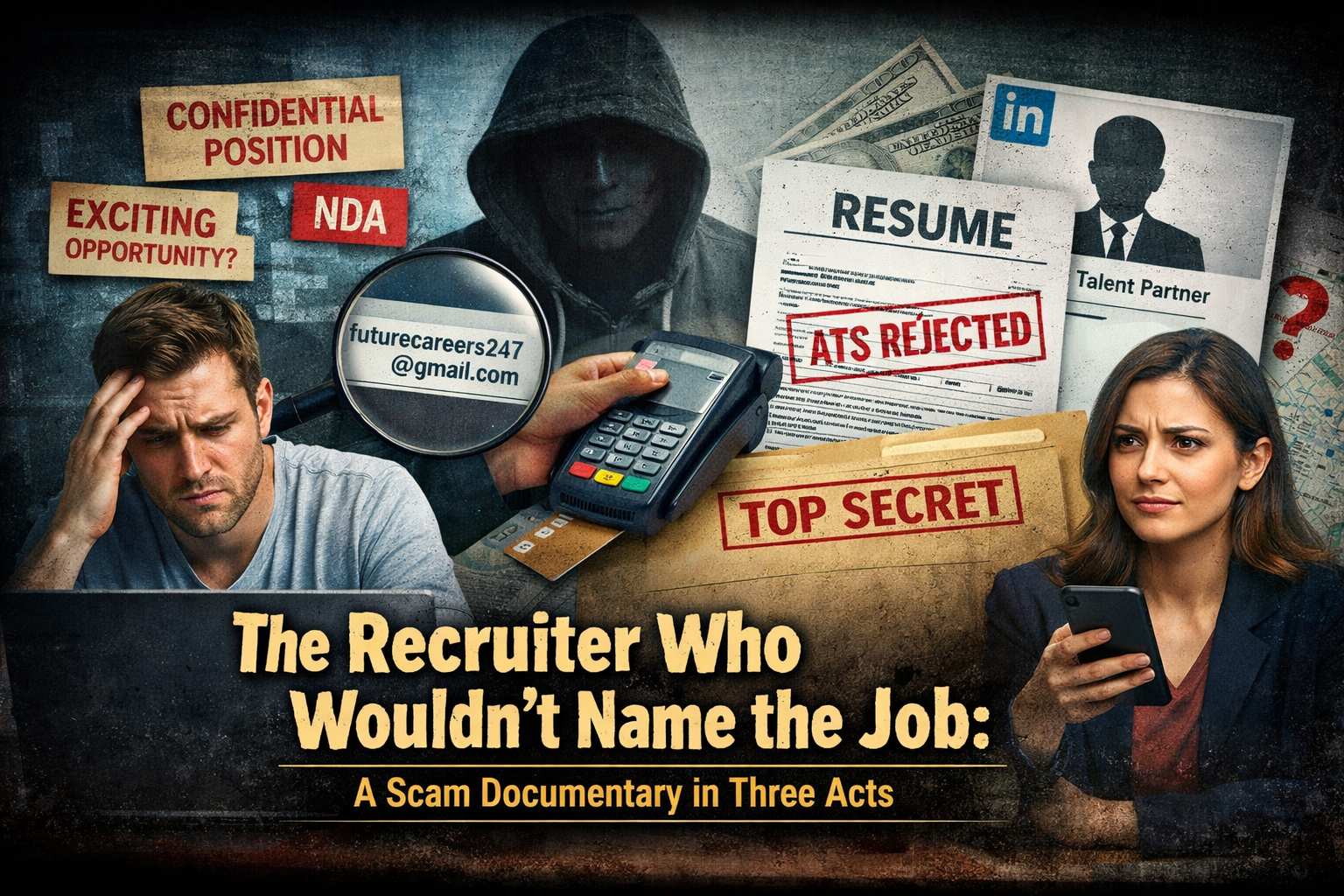
There’s a point in the job hunt where you stop feeling like a competent adult with a respectable work history and start feeling like the main character in a documentary that airs at 2:13 a.m. on a channel you didn’t know existed, the kind with ominous music, dramatic zoom-ins on email screenshots, and a narrator who speaks like every sentence ends with a warning label.
And it’s not because you’re reckless. It’s not because you’re gullible. It’s because the job market has become a haunted house where the monsters don’t jump out from behind doors anymore. They just show up in your inbox wearing a lanyard and a title like “Senior Talent Partner, Global Synergy,” and then immediately refuse to answer the first question any human being asks when they hear the words exciting opportunity.
Which is, naturally: What is it?
A normal job can handle that question. A normal job loves that question. A normal job is practically named after the answer. A normal job says, “It’s a project manager role supporting our operations team,” and then you both proceed with your day like two civilized adults.
But this isn’t that.
This is the version where the role is confidential. The details are sensitive. The title is being protected like it’s the nuclear launch codes. The company name is hinted at, vaguely, like a riddle. And suddenly you’re in a professional escape room where the clues are buzzwords and the prize is learning whether this “opportunity” is a real job or a lightly disguised attempt to sell you something called an Executive Career Branding Recalibration Package.
You begin with optimism because you are a reasonable person who still believes in things like payroll and human decency. You reply politely. You ask for details. You expect details.
Instead, you get suspense.
And that’s the first sign you’re not being recruited. You’re being hunted.
The Classified Job Description and the Art of Strategic Vagueness
It always starts with a greeting that feels a little too enthusiastic for someone who allegedly reviews hundreds of candidates a week. “Hi! I came across your impressive background and I have an exciting opportunity!”
Exciting. Great. You are thrilled. You are open. You are ready to believe.
So you ask the basic questions. Job title. Company. Salary range. Location. Requirements. You know, the things that separate employment from interpretive dance.
And then you watch the reply arrive like a fog machine.
They can’t share the details yet. They’re still finalizing the client’s needs. The role is confidential. The hiring manager is “moving quickly.” They want to set up time to “connect” and “discuss alignment” before you’re allowed to know what planet the job is on.
This is where the job hunt starts to feel like dating a person who won’t tell you their last name but keeps asking what your credit score is.
Because an actual recruiter with an actual role has details. Even if they can’t share the company name, they can tell you the function. The scope. The seniority. The general range. They can speak in nouns instead of pure vibes.
But this version is built entirely out of fog and urgency. It’s the corporate equivalent of someone waving you over to a van and saying, “I can’t tell you where we’re going, but it’s going to change your life.”
And the truly impressive part is how quickly the vagueness becomes your responsibility. If you ask too many questions, they act like you’re being difficult. Like you’re not “serious about opportunities.” Like you should be grateful for the privilege of being invited into the mystery.
Meanwhile, they are revealing absolutely nothing while asking you to provide everything. Resume. Phone number. Availability. Location. Best time to talk. What you’re currently making. Whether you’re open to relocating to a city you’ve never heard of for a job they still haven’t named.
That’s not recruiting. That’s data collection with a smile.
The Gmail Address, the Miraculous Resume Fix, and the Conversion Funnel Disguised as a Person
At some point you notice the email address.
The signature says “Global Talent Acquisition Partner.” The email says something like brightfuturejobs2026@gmail.com, and suddenly your nervous system sits up straight like it heard a twig snap in the woods.
Because listen, it’s not that Gmail is inherently evil. Plenty of legitimate people use Gmail. But the combination of a high-ranking corporate title and an email address that looks like it was created during a lunch break at a mall kiosk should at least earn a pause.
Then comes the pivot. The magical pivot. The moment the mask slips and you realize this person isn’t recruiting you for a role.
They’re recruiting you for a purchase.
“Your resume likely won’t get through ATS,” they warn, with the calm confidence of someone announcing an incoming storm. It’s delivered like a prophecy. Like a medical diagnosis. Like an ancient curse that only they can lift.
And what luck. What timing. What divine intervention that they, personally, can solve this. They know someone. They have a service. They have a trusted partner. They have a package. They have a discount if you act now.
This is where the scam documentary narrator clears their throat.
Because a recruiter’s job is to fill a role. They are measured by hires. They want submissions that convert into interviews. They don’t show up and immediately try to sell you a resume rewrite like a waiter offering you financial planning services before taking your order.
And even if you do want resume help, you deserve to choose it. You deserve to vet it. You deserve to pick a real company with a real reputation and a real process, not get ambushed by an unsolicited sales pitch from someone who also claims they “found you” but cannot tell you what they found you for.
It’s not help. It’s a funnel.
A funnel wearing a blazer.
The Remote Conversation That Becomes Relocation, and Other Signs You’re Emailing an Algorithm With a Headshot
You say one thing clearly. In writing. Like a person who still believes words mean what they mean.
“I’m looking for remote work.”
Their next email asks if you’re open to relocating.
This is a special kind of professional whiplash because it reveals something important: nobody read your message. Or they read it the way a spam filter reads meaning, which is to say, not at all.
You ask for a phone call because you are trying to restore the conversation to Earth. Adults talk. Recruiters call. Humans use voices. It’s a reasonable request.
They ignore it.
Or they respond with a paragraph that answers a question you didn’t ask, using phrases like “touch base” and “circle back” in a way that makes you feel like you’re being haunted by corporate middle management.
So you do what we all do when we sense reality slipping. You check LinkedIn.
And the profile is either brand new, empty, or aggressively confusing. No work history. No mutual connections. No details. Just a headline like “Talent Ninja | Hiring Top Performers | Disrupting the Hiring Space,” which is an impressive number of words to say absolutely nothing.
Sometimes there’s a photo, and it looks like it was taken under duress. Sometimes there’s no photo, which is its own kind of energy. Sometimes the company page exists but has three followers and a logo that looks like it was designed by someone who typed “corporate” into a free clipart generator and called it innovation.
And that’s when you realize: you are not being recruited into an opportunity.
You are being recruited into a situation.
So you disengage the way you disengage from anything that feels off. Not loudly. Not dramatically. Just quietly, slowly, like you’re backing away from something unpredictable in the wild while making calm eye contact and pretending you’re not afraid.
Because the job market is exhausting enough without adding scam radar, detective skills, and emotional personal protective equipment just to reply to an email.
Final Thoughts: If It’s Real, It Doesn’t Need Mystery
A legitimate opportunity doesn’t need secrecy as a personality trait. It doesn’t need urgency as a substitute for clarity. It doesn’t need a Gmail address dressed up in a corporate title. It doesn’t need to frighten you into buying a service you didn’t ask for.
Real jobs have details. Real recruiters answer questions. Real conversations include basic respect, basic information, and basic proof that the person contacting you is, in fact, a person who can be verified outside of an email thread.
And if you do want help with your resume, your LinkedIn, your branding, your strategy, you should seek it out intentionally. You should choose it like any other professional investment: researched, vetted, and aligned with your goals, not sold to you by a mysterious stranger who refuses to name the job but is suddenly very confident about your ATS performance.
The job hunt is already a marathon through uncertainty. You shouldn’t also have to fight off low budget documentary villains between applications.
If the opportunity is real, it won’t need mystery, pressure, or vibes to prove it.
It will just be a job. With a name. Like it’s supposed to be.