
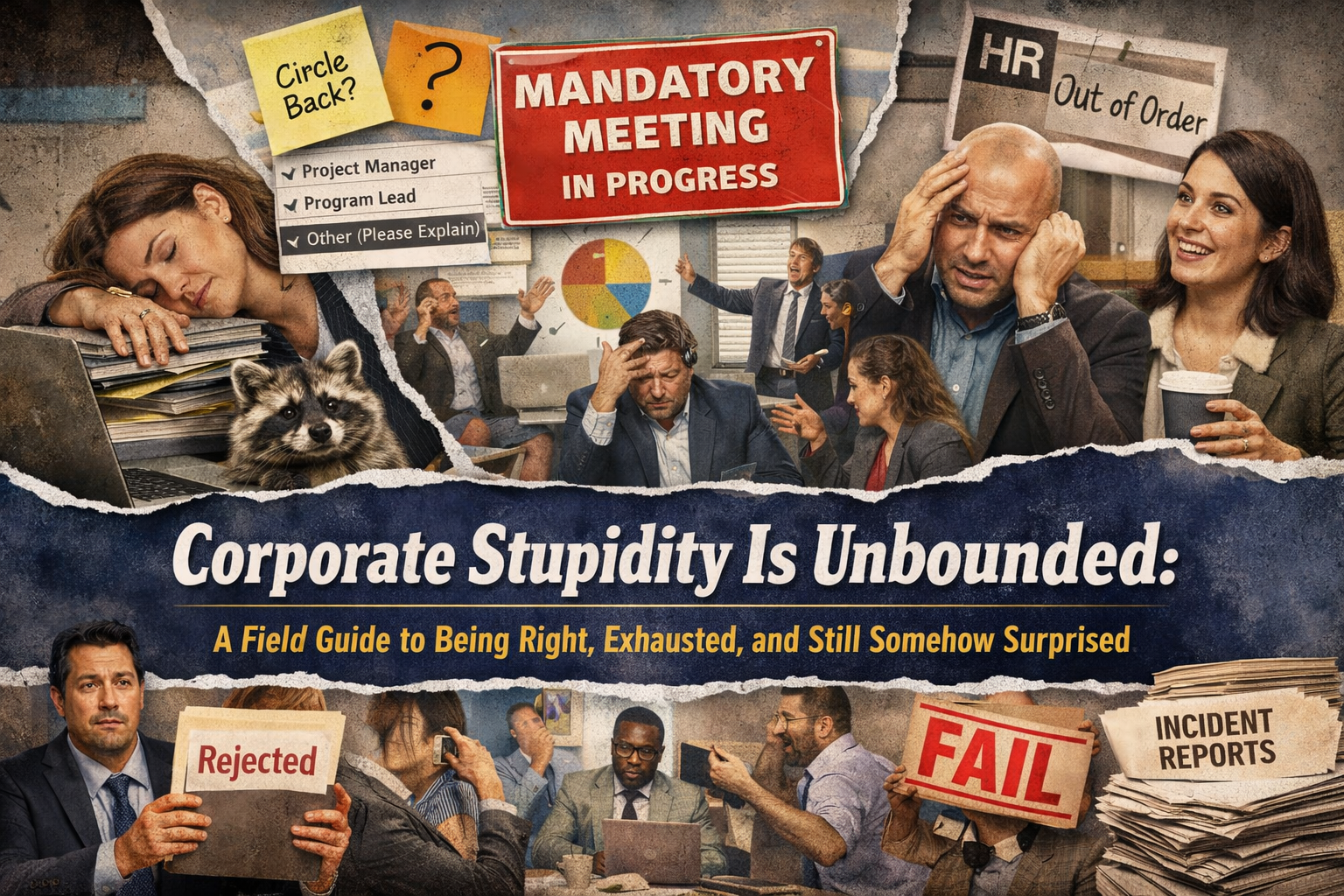
There’s a very specific kind of compliment that doesn’t land like praise so much as it lands like a wellness check.
It’s the one where someone reads your posts, chuckles, then gets quiet for half a second like they’ve just remembered a meeting from 2017 that permanently changed their posture, and then they say, with sincere warmth, “You should turn this into a book.”
And you laugh, because that’s kind.
Then you pause, because it’s familiar.
Then you laugh harder, because the real comedy isn’t the compliment, it’s the certainty behind it. The absolute confidence that what you’re describing is not only real, but repeatable. Like they aren’t reacting to an unusual story. They’re recognizing a species. They’re identifying a common bird call. They’re hearing the unmistakable rustle of a calendar invite being created for a problem nobody has defined yet, and instinctively they know the meeting will be mandatory, the agenda will be a myth, and the outcome will be “we’ll circle back” until the sun burns out or HR admits fault, whichever arrives first.
That’s the thing about corporate life: it doesn’t just produce stories. It produces shared hallucinations at scale. Entire organizations collectively participating in rituals that look like work from a distance but feel like performance art when you’re inside them. The quarterly review. The “strategic alignment” session. The department reorg that changes everyone’s title but not a single process. The “quick sync” that lasts fifty-seven minutes and ends with someone promising to “send out notes” that no one will read and everyone will reference later as if they were scripture.
And so when someone says, “You should write a book,” it hits like a compliment and a diagnosis.
Because yes. You should.
Not because the content is rare, but because the content keeps showing up like it has a key.
The funniest part is that the material doesn’t require exaggeration. It doesn’t need punchlines. Corporate life already built the joke, installed it in a conference room, labeled it “Innovation,” and assigned you as the owner.
The stories write themselves. You’re just the person taking notes while the room pretends nothing unusual is happening.
And the reason it resonates is terrifyingly simple: people aren’t reading for entertainment.
They’re reading for confirmation.
They’re reading because they thought they were the only one who ever got rejected for the job they were currently performing in the same building, by a system that had watched them do it all year.
They’re reading because they’ve been through interviews that felt like psychological experiments run by people who believe “culture fit” is a scientific concept.
They’re reading because they’ve survived meetings that should’ve been emails but somehow became careers.
They’re reading because “professionalism” has become a costume we wear to keep the circus from noticing we know it’s a circus.
So yes, thank you to everyone who’s ever said, “You should write a book.”
You were right.
And also, I’m sorry.
Because the fact that there’s still this much material says a lot about the state of work as a concept. The content just keeps volunteering itself unprompted, like a group project where chaos does all the talking and accountability never shows up.
Welcome to the trenches: unemployment, employment, underemployment, and the emotionally overqualified survival in between.
Now let’s talk about what we’re actually dealing with here.
The Algorithmic Gatekeepers and the Church of the Dropdown Menu
At some point, corporate America stopped hiring humans and started hiring formats.
Not people. Not stories. Not lived experience. Formats.
There was a time when someone could look at your resume and recognize a career. They could see patterns, growth, texture, momentum. They could interpret the weird little pivots you made after life happened. They could understand that “managed vendor relationships” and “ran interference between five departments that hated each other” are the same skill in different outfits.
Now, your professional existence enters a machine that does not believe in nuance, only compliance.
It doesn’t ask, “Can you do the job?”
It asks, “Did you type your soul into the correct box?”
And then it punishes you for being human by labeling you “incomplete.”
The modern job process begins with a ritual humiliation disguised as user experience.
You upload your resume.
The system says, “Great,” and then asks you to retype your resume.
This is not a technical limitation. This is a test of devotion.
This is corporate religion. This is the Church of the Dropdown Menu, where salvation is achieved by selecting “Project Manager” instead of “Program Lead” even though they are the same thing, and damnation arrives when you choose “Other” and the system quietly reclassifies you as “miscellaneous.”
Somewhere in a back office of existence, an ATS is making decisions about your life with the emotional intelligence of a toaster and the confidence of someone who has never been wrong because it has never been held accountable.
And if you think I’m exaggerating, I want you to remember the moment you realized you were being evaluated by something that cannot read your resume the way a person reads a resume.
It reads it the way a raccoon reads a trash bin.
Fast. Opportunistic. Looking for familiar shapes. Ignoring anything that doesn’t smell like a keyword.
You can be a decade deep into your career and still get filtered out because you didn’t say “cross-functional stakeholders” even though you spent the last ten years being a human bridge between departments that communicate exclusively through passive aggression and forwarded email chains.
You can be rejected because the job posting asked for experience in a tool that didn’t exist when you started your career, and the person who wrote the posting assumed time was optional.
You can be rejected because the role requires “seven to ten years of experience” and the system saw you had ten and decided you were too expensive, too tired, too aware, too likely to ask questions that create paperwork.
And then comes the most sacred miracle of them all: being rejected for the job you already have.
Not metaphorically. Not emotionally. Literally.
You’re in the building. You’re doing the job. You’re answering the questions. You’re handling the responsibilities. You’re solving the problems. You are, by every observable metric, employed as that role.
But the system looks at your title, looks at the job posting, and says, with calm authority, “Unfortunately, you do not meet the requirements.”
And you stare at the screen the way you stare at a dog that just spoke English.
Because you are standing inside the evidence.
Your calendar is proof. Your inbox is proof. Your stress levels are proof. Your ability to identify Slack notifications by sound alone is proof.
But none of that matters, because the dropdown menu does not recognize your existence.
The dropdown menu recognizes only what it has been told is real.
And if your title doesn’t match their taxonomy, you become a ghost in your own workplace.
That’s when you learn the real truth about corporate systems: they don’t measure reality, they define it.
They don’t document what’s happening, they document what is convenient to track.
They don’t reward competence, they reward legibility.
And legibility is not the same thing as skill.
Legibility is being easy to categorize.
Legibility is having a job title that matches someone else’s spreadsheet.
Legibility is using the correct corporate phrases so the algorithm can nod solemnly and pass you through the gates like you’ve recited the right prayer.
Which is why people who are wildly capable often feel invisible, while people who are fluent in corporate syntax move through the world like they’re coated in butter.
They don’t do more.
They translate better.
They speak the dialect of the machine.
And the rest of us are left to wonder why the job hunt feels less like a career move and more like applying for membership in an organization that actively resents applicants.
Because it does.
You’re not being rejected by a company.
You’re being rejected by a filing system.
And that’s why the stories keep coming.
Because you can’t “fix” a process that doesn’t believe you exist unless you are properly labeled.
Meetings as Theater, Emails as Evidence, and the Strategic Art of Pretending This Is Normal
If job hunting is the gatekeeping phase, employment is the part where you realize you didn’t escape the absurdity.
You simply gained access to a higher-budget version of it.
Employment is where you learn that a company can have a mission statement, five core values, and a full-time “culture leader,” and still not be able to decide who approves a purchase order without convening a council of elders.
It’s where you learn that work is not just tasks, but choreography.
And meetings are where the choreography becomes theater.
The meeting begins before the meeting begins.
Someone schedules it for thirty minutes.
It will last an hour.
You will join. The host will be late. Everyone will pretend this is fine because we’ve all agreed time is a suggestion if you’re “really busy.”
The first five minutes will be spent greeting each other in the tone of people who have already spoken three times today and will speak three more times tomorrow, but still must perform the ritual of polite recognition so we can collectively maintain the illusion that we are a functional society.
Then someone will ask, “Can everyone see my screen?”
And we will all say yes.
Even though we cannot.
Even though the screen is a tiny postage stamp.
Even though we are looking at an Excel file built by someone who has never experienced joy.
Then comes the agenda, if an agenda exists, which it often doesn’t, because agendas imply intent, and corporate life prefers the comfort of uncertainty because uncertainty provides cover.
An agenda means someone is responsible for an outcome.
No agenda means we can all leave with the same unresolved confusion we arrived with, and no one can be blamed because nothing was ever technically decided.
This is why “circling back” is a corporate love language.
It is the verbal equivalent of kissing the air near someone’s cheek.
It feels like connection without the commitment of actual contact.
“We’ll circle back” means, “I acknowledge this topic exists, but I do not consent to consequences.”
And then the meeting does what meetings always do.
It expands.
It becomes philosophical.
It becomes emotional.
It becomes a place where people share opinions like they’re contributing, when what they are actually doing is distributing anxiety so no single person has to hold all of it.
At some point, someone says, “We need alignment.”
This is the moment you should understand: alignment is not a goal.
Alignment is a symptom that nobody knows what’s happening.
Alignment is what you ask for when clarity is missing and you’re hoping consensus can replace direction.
Then someone says, “Let’s take this offline,” which is the corporate way of saying, “This conversation has become inconvenient in public.”
And then we get the summary:
“Action items.”
A phrase that sounds productive until you realize action items are often just guilt assigned as a group project.
Action items are not tasks. They are emotional obligations disguised as bullet points.
Someone volunteers to “own” something, which is a fascinating choice of word for a thing no one wants and everyone will question later.
And then, as the meeting ends, someone says, “Thanks, everyone,” the way you thank people after surviving a minor disaster together.
Then the meeting dissolves and turns into email.
Email is where corporate life becomes archaeology.
Email is the sedimentary rock of professional existence.
Every decision becomes layers of “per my last email” and “just following up” and “wanted to bubble this up” until one day you are reading a thread from eight months ago like it’s an ancient prophecy, searching for the sentence that proves you are not insane.
And this is why corporate people love documentation.
Not because documentation creates clarity.
Because documentation creates defense.
In many workplaces, an email is not communication.
It is a legal artifact.
It is a shield.
It is the thing you point to later when someone tries to rewrite history with the confidence of someone who assumes you don’t keep receipts.
And the best part is that you start doing it too, not because you want to, but because you learn the rules of survival.
You learn how to word things so they sound neutral while screaming internally.
You learn how to say, “Happy to help,” in a tone that communicates, “I am one more request away from becoming an urban legend.”
You learn how to ask a question that is technically polite but spiritually a courtroom cross-examination.
“Just to confirm, are we aligned that the deadline is Friday, and that the scope includes X, Y, and Z?”
Translation: I have been hurt before, and I will not be hurt in writing again.
You become a historian of your own life, not because you enjoy archiving, but because you’ve been in too many meetings where someone confidently states something that is untrue, and the room nods because we are all tired and it’s easier to accept a lie than start another meeting.
Employment teaches you that corporate insanity isn’t loud.
It’s quiet.
It’s people agreeing with things they don’t understand because disagreement creates friction, and friction creates work, and work creates accountability, and accountability is the one thing we do not have time for in a place supposedly built for work.
So we smile.
We nod.
We update the spreadsheet.
We attend the meeting about the meeting.
And then we tell stories online because it’s the only place we’re allowed to admit, out loud, that none of this makes sense.
The Career Trauma Bonding Economy and the Rise of Shared Professional Survival
Here’s what no one tells you about modern work: it’s not just exhausting.
It’s isolating.
It’s isolating in a very specific way, because most people don’t want to admit what’s happening while it’s happening. They don’t want to be “negative.” They don’t want to be “difficult.” They don’t want to be the person who says the quiet part out loud and triggers a culture initiative.
So they endure.
They internalize.
They assume it’s them.
Maybe they’re not resilient enough. Maybe they’re not strategic enough. Maybe they’re too sensitive. Maybe they just need to “manage up,” which is a phrase that sounds like leadership development and feels like parenting a grown adult with access to your performance review.
Then they see someone else describe the same thing with sharp humor and uncomfortable accuracy, and something breaks open.
Not in a dramatic way.
In a relief way.
In a “thank God, I’m not crazy” way.
Because that’s what the internet became for professionals: a group chat for people who have been professionally gaslit by systems that pretend dysfunction is normal and normal is a luxury.
When people respond to your writing with “I thought I was the only one,” they’re not complimenting your storytelling.
They’re confessing a reality.
They’re admitting the truth we all quietly carry: corporate life has trained us to doubt our own perceptions.
We experience absurdity daily, but because it arrives wearing business casual and speaking in calm tones, we assume it must be rational.
We assume the issue is our reaction, not the behavior.
We assume if something is this common, it must be intended.
This is how you end up in a workplace where “burnout” is treated like an individual failure instead of an organizational feature.
This is how you end up in a job hunt where ghosting is normalized as “volume,” as if basic respect becomes optional when your inbox is too busy.
This is how you end up in interviews where they ask you for examples of leadership and then penalize you for sounding confident.
This is how you end up in salary conversations where everyone pretends money is rude, while quietly building entire strategies around underpaying people who are too exhausted to negotiate.
And this is why the stories matter.
Because humor is not just entertainment.
Humor is a survival tool.
Humor is a way of naming the thing without getting crushed by it.
Humor is how you look at a system built on contradictions and say, “I see you,” without losing your mind.
And the internet is where that humor becomes community.
Not the glossy kind of community where everyone posts “Monday motivation” and pretends they woke up thrilled to answer emails.
The real kind.
The kind where someone says, “This happened to me too,” and you realize the experience that made you feel alone was actually a shared event in the corporate multiverse.
It’s a strange form of healing: we are all walking around with different job titles and the same emotional scars.
We have all been in the same meeting, just with different logos.
We have all heard the same phrases, just in different fonts.
We have all watched leadership “prioritize people” right before announcing a restructuring that somehow only impacts the humans.
So when someone tells you to turn your content into a book, what they’re really saying is: keep naming it.
Keep documenting it.
Keep describing the ridiculous parts with enough precision that people can finally stop wondering if they imagined them.
Because if corporate stupidity is unbounded, then at least we can be bounded by one thing:
the truth.
Even if we have to wrap it in jokes to get it past the security desk.
Final Thoughts: Yes, You Should Write a Book (And Yes, It’s a Red Flag That We All Need One)
If you’ve ever been told you should write a book, congratulations: your life has contained enough professional absurdity to qualify as literature.
That’s not an achievement.
It’s an incident.
But it’s also a gift, in the weird way bruises can be useful later when you’re explaining exactly where the fall happened.
The reason these stories keep resonating is not because you’re especially unlucky.
It’s because the system is designed to produce the same contradictions over and over again and then act surprised when humans react like humans.
The reason people keep asking for a book is because they’re hungry for language.
They’re hungry for someone to say, clearly, what they’ve been experiencing quietly.
They’re hungry for someone to describe the job hunt and the workplace with enough honesty that it stops feeling like a private shame and starts feeling like a shared reality.
So write it.
Post it.
Document it.
Turn it into chapters, paragraphs, scenes, and receipts.
Because corporate life will keep generating material whether you want it or not. The content will keep volunteering itself, unprompted, like chaos is on payroll and accountability is on sabbatical.
And if nothing else, at least we can do what professionals have always done in the face of nonsense:
We can take notes.
We can tell the story.
We can laugh, pause, and then laugh harder, not because it’s funny that it happened, but because it’s hilarious that anyone is still pretending it didn’t.
If you want, I can tailor the three chapter themes to match the exact vibe of your existing books (titles, recurring metaphors, “Interview Olympics” energy, ATS raccoon logic, and the specific flavor of corporate courtroom dialogue you do so well).