
There’s a particular kind of professional confusion that only happens in the modern job market, the kind where you open your resume like it’s a freshly ironed outfit for a first date, you read it top to bottom, you nod with the calm certainty of someone who has, in fact, done work in their life, and you think, “Yes. This is objectively solid. This document contains achievements, measurable outcomes, and at least one verb that implies leadership without sounding like a motivational poster.”
And then you submit it, and the job market looks back at you with the dead-eyed warmth of a hotel lobby plant.
No rejection. No update. No “we went with someone whose soul is more optimized.” Just silence.
The kind of silence that makes you question your own existence, like you waved at a coworker in public and they turned their head at the exact moment your hand went up, forcing you to commit to the wave anyway, smiling at a wall, pretending you were just stretching.
So let’s talk about why strong profiles don’t make it to interviews, because a lot of smart, capable people are quietly asking that question while pretending they’re “just being patient” when really they’re refreshing their inbox like it owes them money.
And yes, sometimes it’s you. Sometimes your resume needs tightening, your story needs clarity, your titles need translating into human language instead of internal-company hieroglyphics. But most of the time, the actual reason is far less poetic and far more insulting.
Most of the time, your resume didn’t get rejected.
It got processed.
And “processed” is a word that should come with a warning label, because it sounds neutral, but it actually means your career was fed into a machine that does not understand context, cannot recognize potential, and routinely confuses “leadership” with “having your dates aligned.”
Remote roles didn’t widen the talent pool. They turned hiring into competitive speed dating with spreadsheets.
Everyone is applying. All the time. Immediately. From everywhere. With the desperation of people trying to snag the last lifeboat on a ship labeled “Q1 Headcount.”
So your resume enters the arena, and the first thing that meets it is not a person. It’s a system. A set of filters. An algorithm that is emotionally unavailable and legally protected.
And that’s why silence doesn’t mean you weren’t good enough. Sometimes it just means your excellent resume showed up on a day when the machine was tired, distracted, and running on outdated rules, like a bouncer who decides whether you’re VIP based on the font you used on your name tag.
Now let’s walk through the three major forces at play, because once you understand what you’re actually competing against, the silence stops feeling like a verdict and starts feeling like what it is: noise, volume, and a process that often has nothing to do with your ability to do the job.
The Great Sorting Hat Is a Printer
Here’s the dirty little secret of modern hiring: a lot of “rejection” is not a judgment. It’s triage.
And triage is never romantic.
Triage is a panicked person in a messy system trying to reduce chaos into something manageable before their coffee cools and their calendar reminds them they have six meetings called “Talent Sync” that are actually just different ways of saying, “We are overwhelmed and would like the universe to stop.”
When a remote role opens, it does not receive applications the way a person receives letters. It receives them the way a website receives traffic during a flash sale.
Hundreds. Sometimes thousands. Often within hours.
So the hiring team does what humans always do under pressure: they narrow. They shortcut. They create rules to survive.
And some of those rules are reasonable, like “must have experience in this tool” or “must be eligible to work in this country.”
But a lot of those rules are just panic dressed up as process.
Because nobody wants to admit that sometimes they didn’t choose the best candidate. They chose the first ten that didn’t scare them.
That’s where the ATS comes in, the Applicant Tracking System, also known as the Digital Funnel of Unspoken Requirements, also known as the place where your career becomes a file name.
The ATS is not evil. The ATS is worse.
It is indifferent.
It doesn’t hate you. It doesn’t doubt you. It doesn’t think you’re underqualified. It doesn’t think at all.
It checks boxes.
It measures patterns.
It looks for the words it was told to look for, and if your resume expresses competence in a way that does not match the pre-approved vocabulary list, it will treat your success like it’s written in invisible ink.
You can be wildly qualified and still fail a keyword scan because you used the correct phrase in the wrong shape.
You wrote “stakeholder management” and it wanted “stakeholder engagement.” You wrote “CRM” and it wanted “Salesforce.” You wrote “people leadership” and it wanted “managed team of 6-8 direct reports,” because apparently leadership only counts if it comes with a headcount and a census.
Meanwhile, actual humans are complicated. Humans can infer. Humans can read between lines. Humans can understand that a “Coordinator” title at one company might be a “Manager” elsewhere, and that someone who built a process from scratch is probably capable of learning your internal tool without having to be born inside it.
The ATS cannot do that. The ATS is a filing cabinet with opinions.
And then there’s timing, which is the most insulting factor because it has nothing to do with you and everything to do with when you clicked.
You could apply at 9:03 a.m. and be the 47th applicant, or apply at 4:03 p.m. and be the 947th applicant, and those two scenarios do not live on the same planet.
By the time you apply, the recruiter may already have a short list. Not because you aren’t qualified, but because they found enough qualified people to stop looking.
Hiring is rarely a full, patient search for the best person. It’s often a frantic effort to find a good-enough person before the hiring manager starts emailing in all caps.
And if you’re thinking, “Surely they would still look at other great candidates,” let me introduce you to the ancient corporate law known as:
If the first batch is fine, no one opens the second batch.
The problem isn’t your resume. The problem is your resume is auditioning for a show where the casting director stops watching after the first twenty submissions because they have to go to a meeting about another meeting.
And then we add remote hiring, which includes an entire new genre of assumptions.
Time zone anxiety. Location assumptions. “Remote” that quietly means “remote, but also please be within commuting distance of our office because we like the idea of summoning you sometimes like a corporate genie.”
Companies will say remote and mean:
- Remote but in these three states because payroll is a nightmare.
- Remote but not you, because your state has rules and our HR team has a stress rash.
- Remote but you need to be near an airport because we will invent travel.
- Remote but only if you promise you won’t have a life.
And no one explains any of that in the job posting, because job postings are not communication. Job postings are wish lists written by a committee that has never met a real human.
So your application gets filtered out for a reason that has nothing to do with your ability, and you never even learn that reason, because in this process, transparency is considered a luxury item.
You weren’t rejected. You were filtered.
And filtered is not a moral evaluation. It’s a mechanical outcome.
It’s not “you’re not good.” It’s “you didn’t match the shape we were scanning for in the five minutes we had available.”
Your Career Makes Sense to Humans, Which Is the Problem
One of the cruelest things about being competent in the modern market is that competence often shows up as nuance.
And nuance is exactly what the system cannot process.
If you started working at nineteen, took on responsibility early, learned fast, grew through experience instead of titles, and built your career on adaptability, you are basically a walking case study in potential, resilience, and real-world skill.
Unfortunately, the hiring pipeline was designed by people who think careers come in neat, labeled bins.
The pipeline wants certainty. It wants symmetry. It wants a clean narrative that can be skimmed at speed.
It wants your life to read like this:
Job A: Two years, promoted, learned Tool X.
Job B: Three years, promoted, learned Tool Y.
Job C: Five years, perfect match, ready for Job D.
But real careers don’t look like that.
Real careers look like:
- You took a lateral move because you needed stability.
- You stepped up without a title because the team was drowning.
- You stayed too long because healthcare is a hostage situation.
- You pivoted industries because the old one collapsed or turned into a burnout factory.
- You did three jobs at once because “lean team” is corporate code for “we do not staff correctly.”
And you can explain that beautifully in a conversation.
But your resume is not being read in a conversation.
It’s being scanned in a high-speed environment where your story is reduced to fragments.
This is why early career candidates get trapped in that particularly absurd middle zone:
Too experienced for entry-level. Not “seasoned” enough for roles asking for five to seven years of something that has only existed for four.
You’ll see postings that require:
- 7 years of experience in a platform launched 5 years ago.
- 10 years of leadership for a role that pays “competitive” and by competitive they mean “competing with your rent.”
- Expert-level skills in a tool they don’t even use consistently, but someone heard it in a podcast and put it on the job description like seasoning.
And then recruiters, who are often decent people trapped inside chaotic systems, do what recruiters are trained to do: reduce risk.
They don’t always pick the best. They pick the least confusing.
They pick the candidate who looks like the job posting already, because that feels safer than the candidate who could become the job posting with two weeks of onboarding and a functioning brain.
This is where a lot of strong profiles die, not because they’re weak, but because they’re interesting.
Interesting is risky.
Interesting means someone has to think. Someone has to interpret. Someone has to explain to the hiring manager why your title doesn’t perfectly match their expectation.
And most people in corporate life avoid “having to explain” the way they avoid surprise meetings.
So the hiring process quietly rewards sameness.
Not because sameness is better, but because sameness is easier to justify.
If they hire the person with the exact title and it doesn’t work out, everyone shrugs and says, “Well, on paper it made sense.”
If they hire you, the person with the slightly nontraditional path, and it doesn’t work out, suddenly your entire career becomes a cautionary tale, like you were a risky stock option instead of a human being who has consistently delivered outcomes.
And that risk aversion gets amplified in remote hiring because remote is still treated, by some companies, like a suspicious privilege.
“Will they work?”
“Will they disappear?”
“Will they be responsive?”
“Will they be secretly living in the woods?”
“Will they have boundaries?”
Remote shouldn’t be mysterious, but some leaders still treat it like a spooky concept they read about in a newsletter.
So even if you’re perfectly capable, your profile may be competing against unspoken fears.
And fears are not logical. They are vibes pretending to be policy.
This is why you can have a strong resume and still not get interviews, because you’re not being evaluated only on capability. You’re being evaluated on how well your career path reassures someone who is already stressed.
A strong profile that requires interpretation can lose to a slightly weaker profile that looks familiar.
Not because you aren’t qualified.
Because the process rewards comfort.
And comfort is rarely the same as competence.
The Job Search Is Not a Meritocracy, It’s a Lottery With Homework
Let’s say the ATS passes you. The location filters don’t eliminate you. The recruiter opens your resume.
Now you enter the next arena: the human bottleneck.
This is where people like to say “networking matters,” and they are correct, but they say it like it’s a wholesome tip instead of a grim survival strategy.
Because at this stage, you’re competing not just against other candidates, but against:
- the recruiter’s workload,
- the hiring manager’s indecision,
- internal candidates no one told you about,
- shifting priorities,
- budget approvals,
- and the fact that someone’s boss may have changed their mind after a conversation that happened in a hallway.
Hiring is not a clean pipeline. It’s a living organism.
Roles pause. Roles change. Roles get reposted to appease internal politics. Roles get filled by referrals while the job posting stays up like a decorative candle.
And all of that chaos creates silence.
Silence is often not “no.” It’s “we’re not organized enough to say anything.”
The job market is noisy, and job searching is basically trying to have a meaningful conversation inside a stadium while everyone is shouting their LinkedIn headline.
That’s why you can do everything “right” and still feel like nothing is happening.
Because you are not only competing on merit. You are competing in volume.
You are losing to timing.
You are being filtered by systems that cannot measure growth, context, or potential.
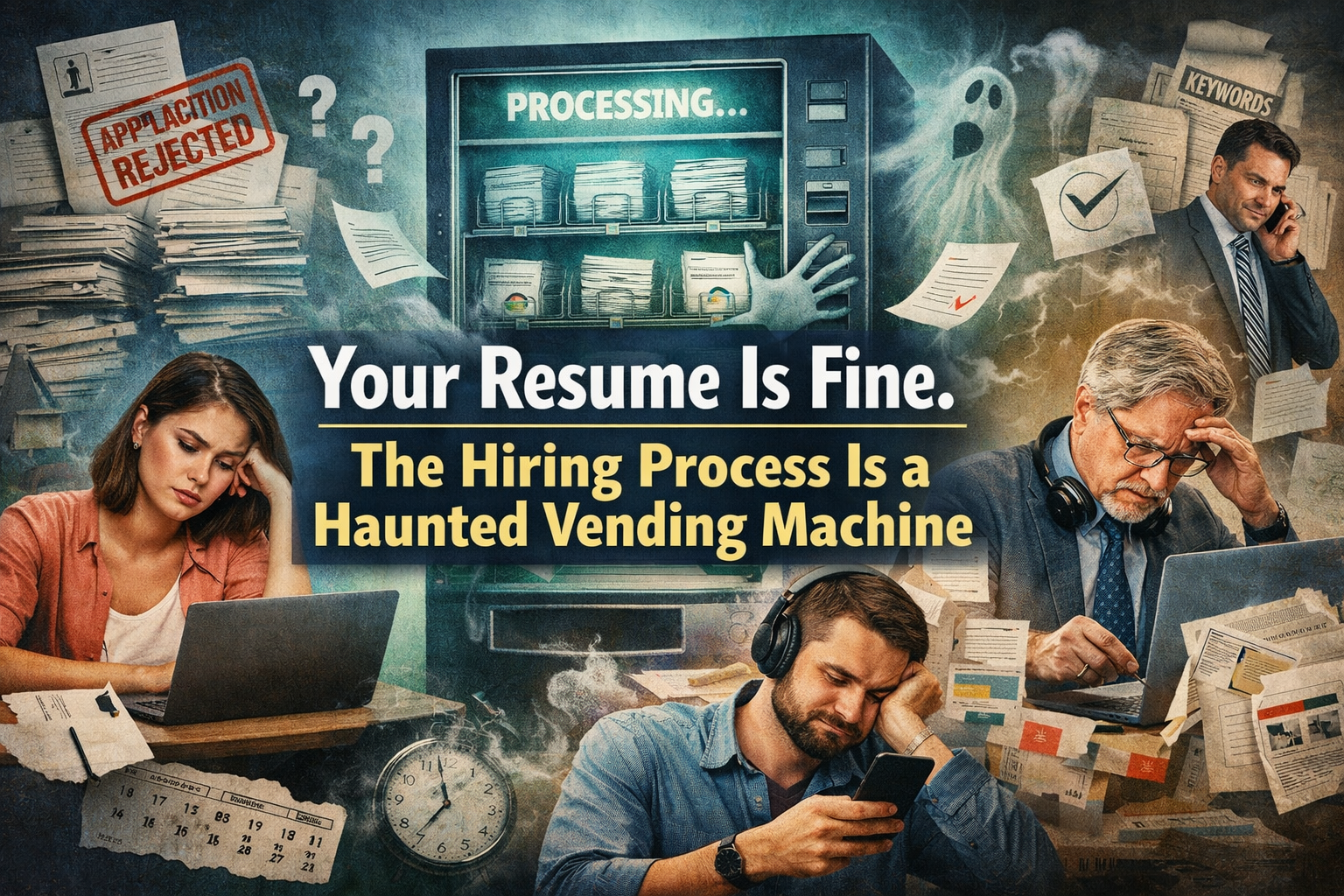
You are stuck behind a very stupid curtain, and on the other side of that curtain is a process that often resembles a haunted vending machine.
You put in your application, you hear some clunking sounds, you wait, you stare into the glass, you see your snack sitting there, you think, “It’s going to drop,” and then it just… doesn’t.
And you’re left standing there, hungry, watching your own qualifications trapped behind a pane of corporate glass, wondering if you should shake the machine or just accept that this is how it works now.
Here’s the part nobody likes to say out loud, because it’s not inspirational and it doesn’t sell coaching packages:
Sometimes the best candidate does not get the interview.
Sometimes the candidate with the most aligned keywords does.
Sometimes the candidate who applied first does.
Sometimes the candidate who knew someone does.
Sometimes the candidate whose resume matched the hiring manager’s mental template does.
Sometimes the process is fair. Often it’s not.
Which is why you have to approach this with strategy instead of self-judgment.
Not because you need to “try harder” in the shame-based sense, but because the system is imperfect, and you deserve a plan that acknowledges reality.
That plan usually looks like this:
You refine your resume to be readable by machines and humans, which is a depressing sentence but true. You translate your experience into the language the market recognizes, not because your experience isn’t real, but because the system is literal.
You network like a human, which means not collecting connections like Pokémon cards, but building actual relationships, having conversations, being visible, being referred, being remembered.
You apply intentionally, because mass applying is basically feeding your sanity into the haunted vending machine repeatedly and expecting a different snack.
And you keep going, not because you’re chasing validation, but because you understand what’s actually happening.
You’re not invisible.
You’re in a process that is not built to see you properly.
And if that makes you angry, good. It should.
Because you are not a keyword list. You’re a person with a track record.
The system is the one that’s underqualified.
Final Thoughts: Stop Letting Silence Rewrite the Story
If you take nothing else from this, take this:
Silence is not a measure of your worth.
Silence is often a measure of their noise.
It means the role had too many applicants. It means the hiring team is overwhelmed. It means the posting was vague. It means the requirements were unrealistic. It means the ATS did what it does. It means timing didn’t favor you. It means the company’s internal process is held together by hope and calendar invites.
It does not automatically mean you weren’t good enough.
So yes, refine strategically. Make your resume easier to parse. Add the terms that match your actual work. Tighten your bullets. Translate your titles. Make the first half of page one do more heavy lifting than it should ever have to do.
But please stop assuming the quiet is a verdict.
Sometimes it just means your resume was excellent on a day when the algorithm was tired, distracted, and running on outdated rules.
A day when it skimmed instead of understood, filtered instead of judged fairly, and moved on without ever knowing who you actually are.
And that is not a reflection of your competence.
That is a reflection of a hiring system that has mistaken speed for accuracy, volume for truth, and process for wisdom.
You are not failing.
You are navigating.
And if you keep going with clarity, strategy, and a refusal to let the machine define you, you will eventually land somewhere that recognizes what the algorithm missed.
Not because the system suddenly became smart.
Because you stayed human long enough to outlast it.