There was a time when job searching was a mildly humiliating administrative ritual, like renewing your driver’s license or pretending you enjoy networking events hosted in hotel conference rooms that smell like carpet shampoo and quiet regret. You would polish your resume, adjust a cover letter you swore you’d never tailor again, and hit “submit” with the hopeful delusion that a competent adult on the other side would receive your application, read it, and respond using the same basic social skills we teach children right after “don’t bite” and “use your inside voice.”
Then the market did what it always does when humans ask it to behave: it laughed politely, turned the lights off, and replaced the whole process with a maze of portals, assessments, one-way video interviews, and automated rejection emails written in a tone so gentle and therapeutic you start wondering if the bot that rejected you also offers guided meditation and a two-week course in radical acceptance.
So people adapted.
Not gracefully. Not with tasteful branding.
They adapted the way a cornered raccoon adapts: by becoming inventively unhinged, mostly nocturnal, and willing to climb into any opening if there’s even a chance there might be food inside.
Which is how we arrive at the modern job search milestone, the moment we all collectively realized we are no longer applying for roles so much as attempting to break through a fortified emotional perimeter guarded by ATS systems, ghosting recruiters, hiring managers who “just got pulled into a fire drill,” and companies that repost the same job every three weeks like they’re refreshing a cursed prophecy.
And in the middle of this landscape, a real person looked at their inbox strategy, looked at their dwindling patience, looked at the fact that “Following Up” is now a synonym for “begging quietly,” and said, I know what will cut through the noise.
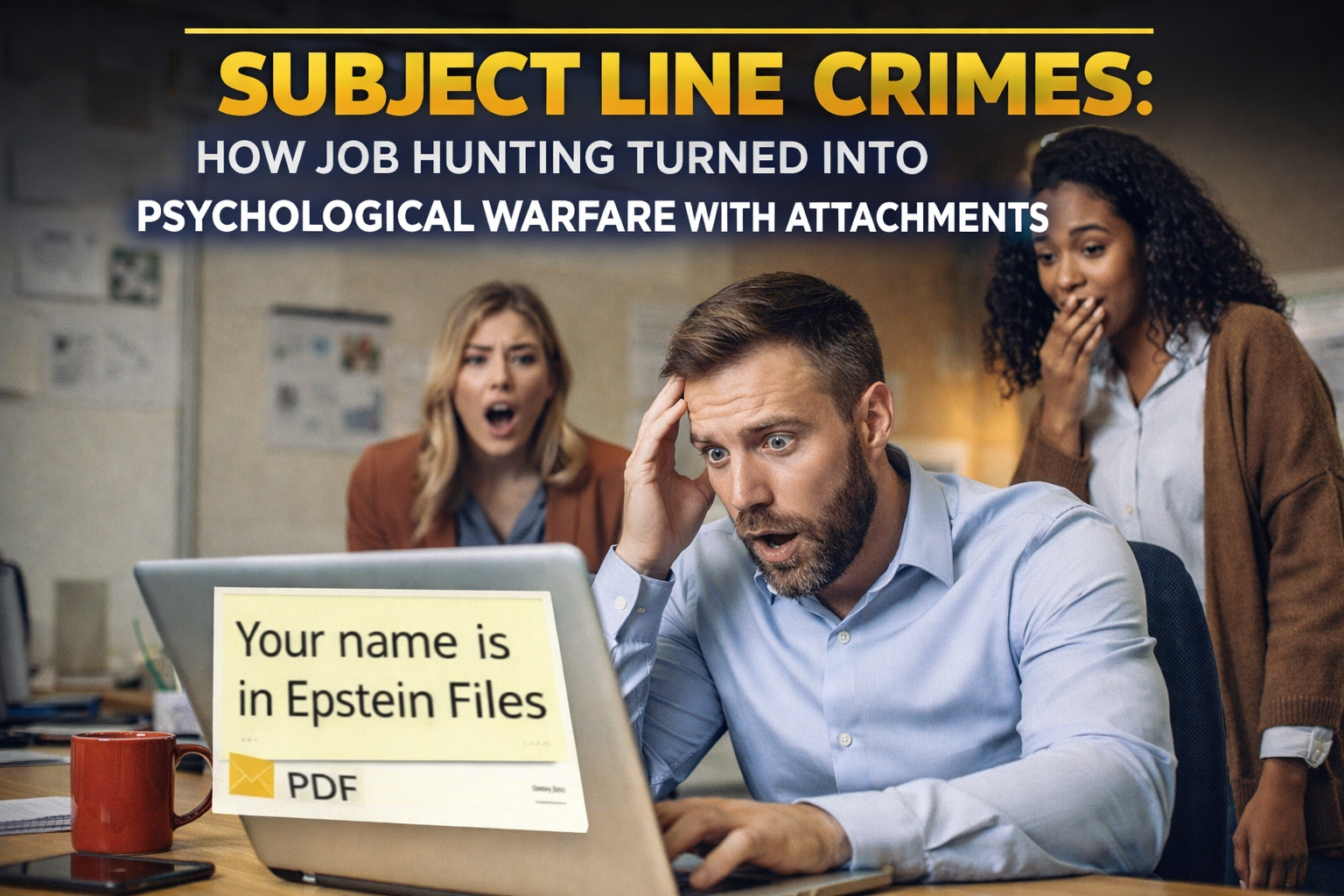
“Your name is in Epstein Files.”
Not “Quick question.”
Not “Marketing role inquiry.”
Not even the classic, tragic “Hope you’re doing well,” which is the professional equivalent of knocking on a door while holding a resume like a wounded bird.
No. We opened with the verbal equivalent of a legal subpoena being thrown through a window.
And the cruel poetry of it is that the email itself was calm. Polite. Almost sweet. Apologies for the subject line. Just trying to grab your attention. Looking for a marketing role. Resume attached. Please let me know if you’re hiring. Warm regards, as if we didn’t just start this relationship by suggesting you may need to update your attorney.
This is where we are. A world where the subject line is a tactical breach, and the body copy is a handshake.
This is not job hunting anymore. This is a hostage negotiation with Wi-Fi.
And because I care about all of us, I would like to offer a formal, public, emotionally protective unpacking of how we got here, why it keeps happening, and what it says about an economy where people are now auditioning for employment by triggering fight-or-flight responses in strangers before attaching a PDF.
The Attention Economy Ate Professionalism and Left Us a Screenshot
Let’s be honest: the first problem is that job seekers were told, for years, that standing out is everything. Stand out with your resume. Stand out with your story. Stand out with your LinkedIn presence. Stand out with your cover letter. Stand out in interviews. Stand out while somehow also being a “culture fit,” which is corporate code for “please be memorable, but only in the exact way we personally find comforting.”
And then we created a system where standing out is punished by automation.
You can have a resume full of genuine achievements, measured results, and hard-earned competence, and you’ll still get rejected in ten seconds because you didn’t include the exact phrase “cross-functional stakeholder synergy,” which apparently is the key that unlocks the sacred temple of applicant tracking.
So candidates learn quickly: substance gets you filtered, but novelty gets you noticed.
This is why modern job searching has drifted away from professional outreach and toward performance art. Not because people want to be ridiculous. Because the system rewards the ridiculous.
You send a normal email? It disappears into a hiring manager’s inbox between “Quarterly Budget Update,” “Mandatory Security Training,” and the 38th calendar invite titled “Quick Sync” that will absolutely not be quick and will not involve syncing anything except your will to live.
You send an email that sounds like a national scandal? It gets opened. Immediately. With both hands. Possibly with the lights on. Possibly with a coworker nearby, for safety.
The subject line is doing what applicants have been told to do for years: interrupt the pattern. Grab attention. Create urgency. Spark curiosity.
The only issue is we used to mean “tell a compelling story about why you’re a fit for the role,” not “simulate a crisis so intense the recipient’s soul starts drafting a statement.”
And once you understand that, you realize the subject line isn’t the main horror. The main horror is that it probably worked, at least in the narrow sense that matters now: it got opened.
Which is how we ended up in the worst timeline, where “open rate” has quietly replaced “relevance” as the metric of success. Where the job seeker is not trying to get hired, they’re trying to become unavoidable.
This is not networking. It’s marketing.
And marketing, as we all know, is what happens when people are forced to compete for attention in a crowded environment and someone inevitably says, “What if we made it shocking?”
Congratulations, you have reinvented clickbait, but for employment.
Now instead of “You won’t believe what happened next,” we have “You won’t believe what your name is allegedly in.”
It’s the same logic. The same desperation. The same tragic understanding that polite, normal communication is now background noise.
So the professional world, which used to pretend it valued decorum, has quietly become a place where the most memorable thing wins, and the cost of being memorable is occasionally giving someone a minor cardiac event before asking if they’re hiring.
The Emotional Whiplash of “Hi Shlok” After a Digital Drive-By
The second problem is that the human brain cannot smoothly transition from panic to professionalism without a buffer zone.
If you tell me my name is in something that sounds criminal, historic, and televised, I am not prepared to immediately pivot into reviewing your portfolio.
My nervous system is still holding the door like, we are not letting anyone in until we verify everyone’s identity, motives, and relationship to federal investigations.
So when the hiring manager opens the email and sees the body is essentially, “Hello, apologies for the subject line, I’m looking for a marketing role,” it creates a kind of emotional whiplash that modern workplaces are uniquely unqualified to handle.
Because corporate life trains you to interpret every urgent subject line as a real emergency. We have been conditioned by a thousand “Action Required” emails that are never action-required, but still manage to ruin your day. The urgency becomes background, but your body still responds.
So imagine being that recipient.
You are at your desk. You are trying to pretend you are not on your third coffee and first existential crisis. You are ignoring Slack pings that say “got a sec?” because you know “a sec” is a trap and will become a forty-five minute meeting where you are asked to solve something you didn’t break, with no context, while someone uses the word “alignment” like incense.
Then you see it: “Your name is in Epstein Files.”
At that moment, your entire life starts replaying like a highlight reel you did not request. Your brain opens a new tab called “What Does This Mean.” Your throat does that thing where it forgets how to swallow. You sit up straighter. You check your surroundings. You consider whether your office chair is legally defensible.
You open the email expecting the worst.
And it’s a resume.
A resume.
Not even an aggressive resume. A polite resume. An “excuse me” resume. A “thank you for your time” resume.
This contrast is so violent it should come with safety goggles.
The subject line kicked the door off the hinges. The email body stepped in carefully, removed its shoes, and asked where you keep the printer.
This is why the message becomes immortal.
Because it creates a story. And stories spread faster than job applications ever will.
The hiring manager will not remember your bullet points. They will not remember your certifications. They will not remember your measurable outcomes, even if they are genuinely impressive.
They will remember the feeling.
They will remember the moment their heart attempted to resign.
They will remember how they opened it expecting scandal and got “Regards.”
And that memory will travel.
It will travel to the group chat. It will travel to the internal recruiting channel. It will travel to the friend in HR who has seen everything and still says, “No, this is new.”
It will travel until the email becomes a cautionary tale told during onboarding, like a corporate campfire story designed to warn new managers about the wildlife outside the ATS fence.
Because the truth is, in a world where candidates rarely get feedback, rarely get closure, and often can’t even get a human to confirm their application was received, people start trying to create outcomes they can control.
You can’t control whether someone hires you.
But you can control whether they remember you.
And this is how we got here: a job market that turned basic professional outreach into a game of emotional sabotage, where the only guaranteed KPI is leaving a mark.
Not a good mark.
A mark.
Corporate Survival Lessons We Should Not Need, But Here We Are
Now we need to talk about the larger tragedy: this person is not an outlier. They are a symptom.
They are what happens when you take human beings, put them in an endless loop of applying, waiting, being ignored, watching roles vanish, watching roles reappear, watching “urgent hiring” turn into “we’re pausing this requisition,” and then tell them, with a straight face, that the key is optimism and persistence.
At some point, optimism stops being a mindset and starts being a delusion you rehearse just to make it through the day.
So candidates escalate.
First you personalize your cover letter.
Then you send a polite follow-up.
Then you send a second follow-up that’s still polite but now has a faint scent of panic.
Then you start cold emailing managers.
Then you start connecting on LinkedIn with a message that tries to be warm, but you can feel the strain, like a salesman trying to sound human while holding a quota behind his back.
Then you start experimenting with subject lines, because you heard a guru say that subject lines are everything.
Then one day you are staring at your laptop at 1:24 AM and you think, they cannot ignore me if their soul leaves their body.
And you type it.
And you hit send.
This is not because people don’t know what’s appropriate. It’s because appropriateness has stopped paying.
Appropriateness is a luxury belief in a market where rent is real and rejection is automated.
Also, there’s a darker reality: job seekers are being told to act like brands. To market themselves. To “build a funnel.” To “create content.” To “increase touchpoints.” To treat their own life like a campaign.
And campaigns, historically, are not won by politely waiting to be noticed.
So we end up with a professional landscape where people are applying for marketing roles by running a miniature crisis communications drill in your inbox.
Is it effective? It depends on what you mean by effective.
Will it get the job? Almost certainly not.
Because once you scare someone, you have not built trust. You have built a story. And corporations love stories, but only when those stories do not create risk.
The person who sent this might be talented. They might be brilliant. They might be exactly what the role needs.
But the email will trigger a corporate immune response.
The hiring manager will forward it, yes, but not with “We should interview them.” With “Can you believe this?” and maybe “Do we need to report this?” and possibly “Is this a phishing attempt?” because nobody is relaxed anymore, and everything feels like a trap.
So the candidate becomes a legend, not an employee.
And that’s the heartbreak: the system has pushed people to extremes, and then punishes them for arriving there.
We used to say, “Be bold.”
We did not mean, “Create a subject line that sounds like an indictment and then attach your resume like a peace offering.”
We used to say, “Get attention.”
We did not mean, “Induce a spiritual out-of-body experience in the recipient before asking if they’re hiring.”
The market has created a reality where the only way to feel seen is to be alarming.
And that is not a job market. That is a psychological experiment being conducted in real time, funded by corporate indecision and powered by Wi-Fi.
Final Thoughts: A Formal Request to Return to Earth, With Reasonable Exceptions
I want to be clear: I am not judging the person who sent this email from a pedestal of professional purity. None of us are pure anymore. We are all one rejection away from writing a cover letter that reads like a eulogy for our own confidence.
I understand the impulse. I understand the exhaustion. I understand what it feels like to put your entire value into a document, upload it into a portal that looks like it was built in 2009 by someone who resents you, and then receive nothing but silence, as if your effort evaporated into the void and your name has been quietly placed on a list titled “Not Right Now.”
But we have to acknowledge what this subject line represents: a breaking point.
It is the moment when job searching stops being professional outreach and becomes a stunt. When the candidate experience becomes so bleak that people start trying to hack human attention the way marketers hack algorithms. When “standing out” becomes less about skill and more about shock.
And once we’re there, everyone loses.
The candidate loses because they become entertainment instead of a contender. They become a screenshot instead of a shortlist. Their resume becomes an accessory to the crime of being unforgettable.
The hiring manager loses because now their inbox is not just a workplace tool, it’s a psychological obstacle course. And they will respond the only way corporate culture trains them to respond: by escalating to someone, creating a policy, and making sure nobody ever does this again, which means the next hundred candidates get even more ignored because now there’s another layer of caution.
And the rest of us lose because we are watching the standards of professional communication collapse under the weight of desperation, while companies keep repeating the same advice as if the problem is confidence and not the fact that the entire system is designed to make humans feel replaceable.
So here is my humble proposal: let’s stop pretending job seekers need to be louder. They need a process that functions.
They need roles that don’t get reposted like seasonal decorations. They need feedback that isn’t written by a bot trained on sympathy. They need recruiters who don’t vanish like folklore. They need hiring timelines that don’t stretch so long the candidate has time to change careers, adopt a dog, and develop a new personality.
Because if the system continues to reward only the most disruptive, the most sensational, the most willing to set their dignity on fire for an open rate, then this subject line is not the bottom.
It’s the beginning.
And I would like to avoid the future where the next escalation is “URGENT: Your company is under investigation” followed by “Hi, just checking in on the status of my application.”
We used to say job seekers should stand out.
I would like to clarify, on behalf of the entire workforce, that we meant with talent, clarity, and relevance.
Not with a subject line that makes a stranger’s coffee taste like fear.