
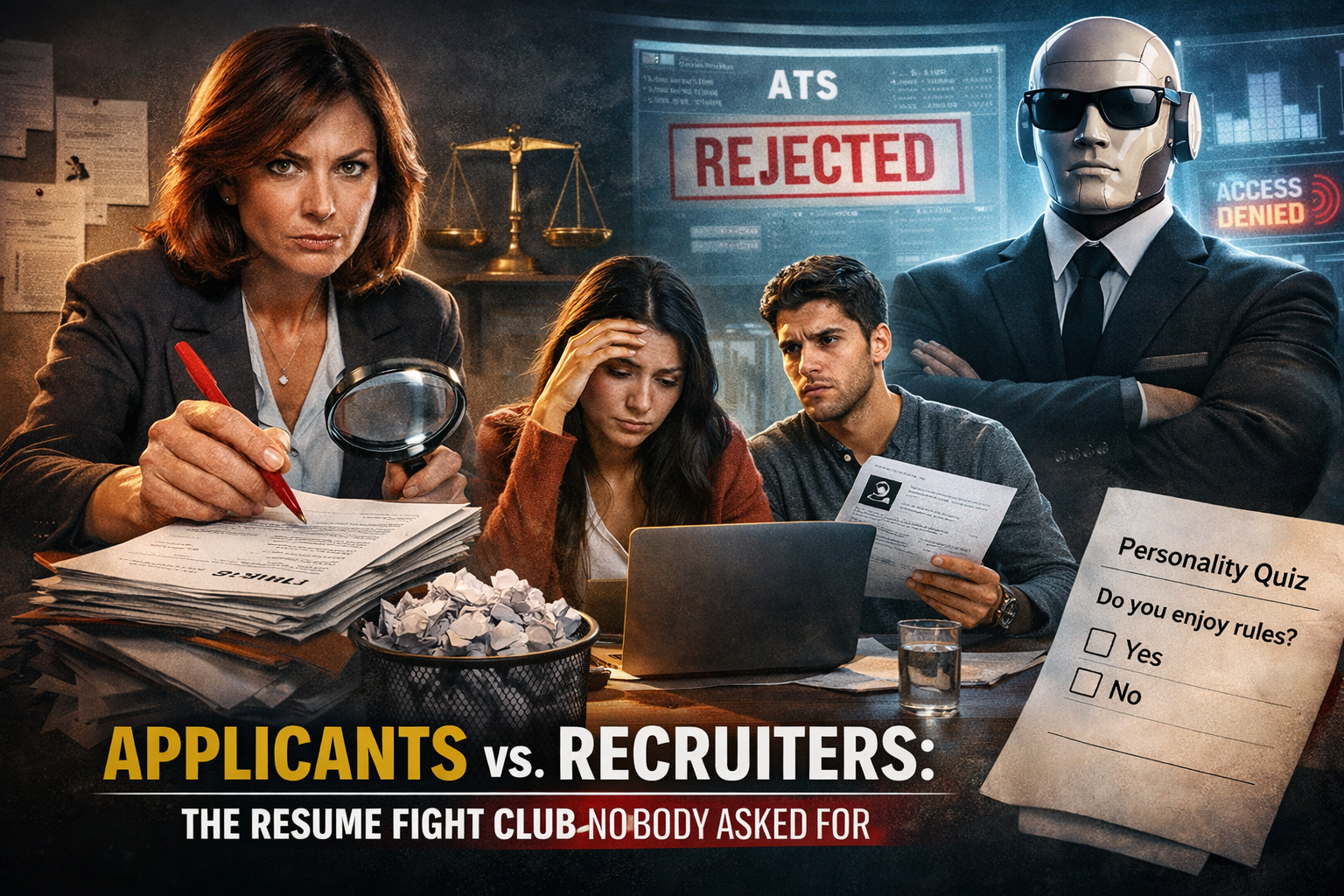
There’s a specific kind of LinkedIn morning where you open the app expecting the usual motivational oatmeal—someone celebrating a promotion, someone “honored and humbled” to announce they have accepted a role they absolutely had three months ago but are only now telling us, someone sharing a photo of a laptop balanced on a beach chair like Microsoft Teams is a tropical hobby—and instead you’re greeted by a post that starts like a public safety announcement.
“Applicants, you cannot bull💩 a recruiter — end of!”
Not “Hello network.” Not “Hope everyone’s doing well.” Not even a gentle, corporate-adjacent “Let’s talk about hiring.” No. This was a siren. A flare gun. A courtroom door being kicked open by someone wearing a blazer made of certainty.
And right away you know: we’re not doing career advice today. We’re doing drama. We’re doing a monologue delivered straight into the camera like it’s the season finale and the recruiter has decided they will no longer be bound by the constraints of punctuation, empathy, or the general idea that adults can communicate without threatening one another.
Then came the line that truly turned the post from “helpful” into “I am auditioning for a procedural television show set inside an ATS.”
“I will pick your CV apart until I have that understanding.”
Which is such a fascinating thing to say, because it implies the main obstacle to successful hiring is not unclear job descriptions, not inconsistent interview panels, not salary ranges that are “competitive” in the same way a raccoon is “well-dressed,” but rather your resume—your one-page document—sitting there smugly, hiding its secrets like a suspect in an interrogation room.
And look, nobody’s arguing that lying is good. Lying is dumb. Lying is taking a job you cannot do and spending your first week “learning fast” in the same way a fish “learns fast” when you put it in a bicycle shop. Lying is saying “advanced Excel” and then discovering—live, on a shared screen—that you do not know what a pivot table is, which is the professional equivalent of walking into a bakery and whispering, “What is bread.”
We can all agree: do not cosplay competence.
But the part that makes this whole thing hilarious is the way some people treat AI like it’s a fraud factory by default, like anyone who used it to refine a sentence must also be secretly running a counterfeit diploma ring out of their laundry room.
Most people aren’t using AI to invent experience. Most people are using it because the hiring process is no longer a conversation. It’s a decoding exercise. It’s translating the ancient language of Job Posting—an alphabet made of “stakeholders,” “cross-functional,” “fast-paced,” “wears many hats,” and “must thrive in ambiguity”—into something a human can read without developing a stress twitch.
Because here is the reality: a perfectly honest resume can be rejected in ten seconds by an algorithm that doesn’t “pick it apart” so much as glance at it like a nightclub bouncer who has decided, spiritually, that your shoes are wrong. No keyword. No entry. Not tonight.
So you rewrite. You adjust. You add the words. You sprinkle “strategic” like seasoning. You don’t become a liar. You become a translator trying to survive an automated moat full of rejection emails that begin with “Although your background is impressive…” and end with “we have decided to pursue candidates whose background more closely aligns with our needs,” which is recruiter-speak for “the system blinked at your PDF and felt nothing.”
And in the middle of that reality, someone posts: “Applicants, you cannot bull💩 a recruiter — end of!”
Which is how you know we’re about to do three chapters of chaos.
The Recruiter as Interrogator (And the Resume as a Suspect)
There’s a certain personality type that doesn’t just want to recruit. They want to win. They want to enter the hiring process like it’s a competitive sport where the candidate is the opponent and the prize is the satisfaction of catching someone using the word “synergy” without a permit.
This is the same energy as a restaurant server announcing, “Just so you know, I can tell when people are lying about being allergic to gluten.” Like… okay. Congratulations on your vigilance. But why are you threatening the table before you’ve taken a drink order?
When a recruiter says, “I will pick your CV apart,” they’re not describing a professional practice. They’re describing a hobby. They’re describing a personal interest that involves disassembly. They’re basically telling you they approach resumes the way a raccoon approaches a dumpster: with intensity, curiosity, and the unshakable belief that there is a hidden treasure somewhere under the third layer of trash.
And yes, verifying skills matters. Yes, asking real questions matters. Yes, the hiring world is full of people who oversell. We know. We’ve all met the guy who lists “leadership” as a skill but cannot lead himself to a meeting on time without three reminders and a prayer.
But the funniest part is the announcement itself. A truly strong recruiter doesn’t need to declare they can spot nonsense. They ask one calm question and the nonsense collapses politely on its own, like a folding chair in a strong breeze.
Because “I can tell if you’re lying” is not a flex. It’s basically saying, “I have been lied to so often I now live in a permanent defensive crouch.” Which is sad, and also a sign that the hiring process has evolved into a kind of emotional warfare where everyone is braced for impact and nobody is allowed to just… talk.
And what’s wild is that half the time candidates aren’t lying. They’re compressing. They’re cleaning up. They’re using the accepted language because the system punishes plain English.
A candidate writes: “Helped stores improve performance.”
The algorithm hears: “Cute. But did you optimize cross-functional stakeholder alignment through strategic operational excellence?”
So they rewrite: “Drove cross-functional operational improvements resulting in measurable performance outcomes.”
The recruiter sees it and goes, “Aha! Corporate nonsense! I will pick your CV apart!”
And now we are no longer hiring. We are performing. The recruiter is the detective. The candidate is the suspect. The resume is evidence. The interview is a deposition. And the job offer—if it exists—is the plot twist where everyone realizes the candidate was qualified the whole time but got stuck in the wrong genre.
AI Is Not a Lie Machine, It’s a Translation Device for a Broken System
Let’s just say it plainly: the modern hiring pipeline is a machine that demands you sound like a machine and then punishes you for sounding like a machine.
“Be authentic,” it says, while asking you to submit your most authentic self through an ATS portal that only accepts PDFs under a specific file size, then auto-rejects you because you wrote “customer success” instead of “client retention.”
This is not a personality test. This is a keyword obstacle course.
So when candidates use AI, most aren’t asking it to create a fake life. They’re asking it to take their real experience and present it in the dialect that hiring systems actually respond to.
If you’ve ever tried to apply for a job and watched your resume get rejected like it was personally offensive to the platform, you already understand. You’re not trying to become someone else. You’re trying to make sure the system doesn’t drop-kick your honest resume into the void because you didn’t use the sacred phrase “stakeholder management.”
AI becomes the interpreter between “human who did work” and “corporate process that only respects work if it’s described with the correct ceremonial vocabulary.”
And the recruiters who get angry about that are often skipping the obvious question: why has the process become so hostile that people need a translator just to be seen?
Because if recruiters truly believe candidates are using AI to “waste my and your time,” we should zoom out and look at what wastes time the most.
Not a sentence that got polished.
Not a bullet point that became clearer.
But the endless rounds.
The “casual chat” that is not casual because your rent is involved.
The “final final” that isn’t final because there’s always a new stakeholder who “just wants to meet you.”
The personality quiz that asks if you “enjoy rules,” as if anyone who says no is immediately escorted out of society.
The take-home assignment that quietly demands free consulting work and then disappears without feedback like it was abducted by aliens.
This is the system. This is the environment. This is the reason candidates are rewriting everything: because honesty, unformatted, is not rewarded. It’s filtered.
So when someone shouts “AI equals fake,” what they’re really doing is defending a process that already pressures people into performance, while pretending they’re protecting truth.
Truth doesn’t need protecting from a spell-check with ambition. Truth needs protecting from a system that rejects qualified people for being insufficiently fluent in corporate theater.
The Real “Bull💩” Is the Performance We’re All Required to Do
Here’s where it gets beautiful in a tragic way: both sides are exhausted, both sides are defensive, and both sides are performing for the algorithm.
Candidates perform competence because they’ve learned that being straightforward gets you punished.
Recruiters perform toughness because they’ve learned that appearing soft makes people test boundaries.
And the result is a hiring culture where everyone talks like they’re delivering a warning, a pitch, or a verdict.
The recruiter says, “I will pick your CV apart.”
The candidate says, “I’m a dynamic, results-driven self-starter who thrives in fast-paced environments.”
And somewhere in the distance, the job itself—the actual work—sits alone in a chair like a kid watching their parents argue in a restaurant.
Because if the recruiter wants honesty, the process has to allow honesty.
Honesty sounds like: “I led a team, it was messy, here’s what I learned.”
But the process wants: “Executed strategic leadership initiatives with measurable deliverables.”
Honesty sounds like: “I’m good at Excel, but I still Google things sometimes.”
But the process wants: “Advanced Excel expertise, pivot tables, macros, VBA, and the ability to build a dashboard that also provides emotional support.”
Honesty sounds like: “I’m leaving because the culture was rough.”
But the process wants: “Seeking new opportunities for growth and alignment.”
We are not lying. We are complying with the ritual.
And when someone pops up on LinkedIn yelling “Applicants!” like they’re addressing a crowd outside the courthouse, it doesn’t make people more honest. It makes people more careful. It makes them more polished. More guarded. More likely to sound like they swallowed a consultant.
Which is the opposite of the stated goal.
Because if you want truth, you don’t lead with a threat. You lead with curiosity. You lead with questions. You create conditions where someone can explain the real story without fear that one imperfect phrase will be treated like a felony.
A good recruiter doesn’t need to brag about disassembly. They don’t need to announce they’re coming with tweezers and a magnifying glass. They can simply do the job: listen, probe, verify, and connect people to roles they can actually do.
And a good candidate doesn’t need to invent a persona. They just need the process to stop punishing them for being human.
Final Thoughts: We’re All Just Trying to Survive Monday Without Filing a Formal Complaint Against “Culture Fit”
So yes, applicants: don’t bull anyone.
But recruiters: don’t posture like you’re hosting Resume Fight Club and the only rule is you must announce the fight club first. If your brand is “I will pick your CV apart,” you might be confusing “thorough” with “hostile,” and confusing “confidence” with “I have decided to treat this interaction like a power struggle.”
The funniest part is that the nonsense you’re worried about doesn’t require intimidation to uncover. It requires one or two calm, well-placed questions, asked with a tone that suggests you are trying to understand a person, not defeat an opponent.
Because the truth is, the hiring world already has plenty of waste-my-time energy. Candidates are out here doing rounds like they’re training for an endurance event. Recruiters are juggling unrealistic requirements, shifting priorities, and hiring managers who want a unicorn, a ninja, and a golden retriever all rolled into one person who will accept “competitive pay” and start yesterday.
In that environment, AI isn’t the villain. It’s the captioning system for a conversation that got too noisy.
So when I read a recruiter post written like a threat, I’m not scared. I’m entertained. I’m imagining the voiceover.
“Our hero interrogates a bullet point until it confesses to being ‘results driven.’ Plot twist: the candidate was qualified the whole time.”
And honestly, if we’re going to keep doing hiring like it’s a reality show, can we at least admit it?
Because some of us are just trying to get through Monday without updating our resume like it’s a subscription service, without taking a personality quiz that asks if we “enjoy rules,” and without having to explain to a grown adult why rewriting a sentence for clarity is not the same thing as forging a life.
Also, if anyone needs me, I’ll be over here drafting a cease-and-desist letter to the phrase “fast-paced environment,” because I’ve seen enough, your honor, and I would like the record to reflect that we are all tired.