
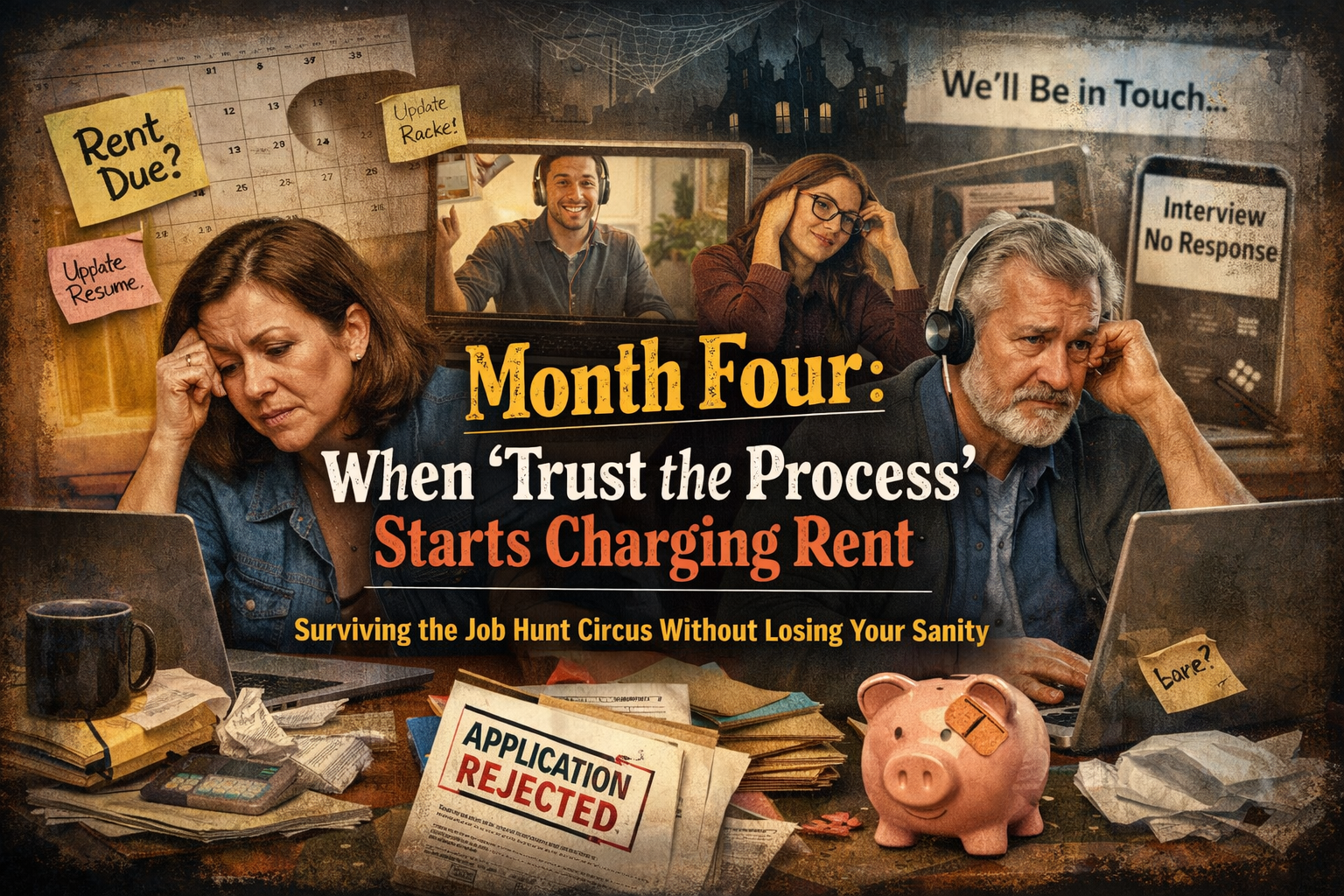
There’s a special kind of adulting that kicks in around month four of unemployment—the part where optimism stops being a mindset and becomes a recurring expense you keep trying to cancel, but customer service keeps saying, “We’ll circle back.”
Because in the beginning, unemployment has a weird little honeymoon phase. People send you motivational quotes. Your aunt becomes a recruiter overnight. Everyone says the classics with the confidence of someone who has not opened a job portal since the Obama administration: keep networking, tailor the resume, trust the process. And you nod like a sane person while quietly realizing “the process” is just a haunted maze designed by a committee that hates closure and loves the phrase “strong candidate.”
Then the calendar keeps flipping like a petty little magician. Weeks vanish. Savings shrink. And one day you wake up and understand you’re not job hunting anymore—you’re performing a one-person Broadway show called Please Hire Me Before My Retirement Account Files a Missing Persons Report. Matinee and evening shows. No intermission. Tickets are free, but you pay in cortisol.
And when you’re the sole earner? When there’s no spouse, no second income, no safety net politely embroidered with “You’ve Got This”? Every “next week” lands differently. Next week isn’t a vibe. Next week is groceries. Next week is rent. Next week is your utility bill pulling up a chair like, “So… how’s networking going?”
The cruelest plot twist is the phone interview. On the phone, you are a phenomenon. You’re charming. You’re warm. You’re connecting. You’re both laughing at the same joke like two humans who might build a future together, or at least split a Microsoft Teams license in peace. Then the video interview starts, the camera clicks on, and suddenly the room temperature drops because someone opened a window labeled Bias. Ten minutes later it’s “We’ll be in touch,” and then you get introduced to the company’s most consistent value: silence.
And the applications? Oh, the applications. “What years did you attend college?” Translation: please provide your age, but make it legal. Then the form gets bold and asks your age outright like it’s ordering coffee. What is going on? Are we hiring talent, or casting the reboot of The Intern but with less pay and more spreadsheets?
So yes, the theory is cute. But reality is this: people aren’t losing hope because they’re weak. They’re losing hope because the process is built like a haunted house—doors that slam, lights that flicker, and a guide who disappears the second you ask where the exit is.
And if you’re still showing up after months of this? You’re not disheartened. You’re durable. Which is a skill, by the way, even if no ATS has a checkbox for “survived emotional whiplash with a polite smile.”
The Phone Interview — Where You’re a Star Until the Camera Turns On
Phone interviews are the last safe place left on Earth. On the phone, you’re a smooth-talking professional with a steady voice and a convincing laugh. You sound like someone who has never cried in a laundry aisle while calculating the cost per sock. You’re confident. You’re articulate. You’re basically a TED Talk wearing a headset.
You connect. They connect. You both say things like “I love cross-functional collaboration,” and somehow it doesn’t feel like a lie. It feels like the beginning of something. Like maybe—just maybe—your adult life is about to re-enter the chat.
Then they say, “Great! Next step is a Teams call.”
And you’re like, “Awesome.”
But your nervous system hears: WELCOME TO THE LIVE JUDGING PORTION OF THE COMPETITION.
Because the Teams call is where your qualifications enter a new arena: the arena of vibes. The arena of facial angles. The arena of lighting that makes you look either “energetic and fresh” or “experienced and therefore suspicious.” Suddenly you’re not just answering questions—you’re managing the entire production: camera placement, background selection, microphone levels, and the existential dread that your WiFi will freeze you mid-sentence with your mouth open like a museum exhibit called Candidate Attempting Confidence.
And let’s talk about the moment it shifts. You can feel it. It’s not always obvious. Sometimes it’s subtle, like a tiny delay that wasn’t there five minutes ago. Sometimes it’s a smile that gets smaller. Sometimes it’s the tone change when they stop asking “Tell me more” and start asking “So… what would you say your weaknesses are?” in the same voice you’d use to ask someone if they’ve ever committed arson.
You’ll never know what happened. They won’t tell you. They’ll just “move forward with other candidates,” which is corporate for “We liked you until we saw you.”
And the worst part? You still have to end the call politely. You still say, “Thanks so much for your time!” like you didn’t just watch someone mentally place your resume into the “no” pile in real time. You still send the thank-you email afterwards, because you’re a professional, and also because you’ve been psychologically trained to believe that if you don’t, you’ll be punished by the gods of hiring with another twelve weeks of silence.
So yes—on the phone, you’re brilliant. On Teams, you’re suddenly a risk. And the biggest insult is how normal everyone acts about it. Like it’s totally reasonable that your ability to do the job depends on whether your face fits the brand guidelines.
Applications — The Most Expensive Free Form You’ll Ever Fill Out
Job applications are the only place in modern society where you can spend two hours proving you exist and still be treated like a rumor.
They’ll ask for your resume. Then they’ll ask you to type your resume into forty-five little boxes like you’re feeding an ancient machine that only accepts sacrifices. Then they’ll ask for a cover letter. Then they’ll ask for a second cover letter, but “shorter.” Then they’ll ask if you’re willing to take a personality assessment that was clearly written by someone who thinks humans come in three settings: “Leader,” “Supporter,” and “Unsubscribe.”
And then they ask the questions that aren’t questions. They’re traps wearing business casual.
“What year did you graduate?”
“What years did you attend college?”
“How many years of experience do you have?”
Somehow they need all of this data even though your resume is right there, politely formatted, begging to be read like a book in a library where no one has eyes.
And sometimes they’ll just go fully unhinged and ask your age outright, like it’s a normal thing to request from a stranger. Like, “Hi! Before we discuss this role, I just need to know if you were alive when pagers were a thing.”
It’s all so theatrical. Companies will swear they’re about merit, but they still design the process like a bouncer deciding who gets into the club based on jawline, graduation date, and whether you used the phrase “fast-paced environment” without flinching.
Meanwhile, you’re doing everything “right.” You tailor your resume like you’re writing a love letter to a job you haven’t met. You match keywords like you’re summoning a demon named ATS. You take your perfectly normal work history and rewrite it in a dialect called Corporate Ancient Greek:
- “Answered emails” becomes “Spearheaded stakeholder communications.”
- “Did the job” becomes “Drove strategic outcomes.”
- “Survived” becomes “Demonstrated resilience in dynamic environments.”
And the payoff for all this? Maybe an automated email thirty seconds later saying, “We appreciate your interest,” which is corporate for “We do not know you, but we will still break your heart efficiently.”
It’s not that candidates are asking for special treatment. They’re asking for basic human behavior. They’re asking not to be forced into a digital obstacle course that collects personal data like a hobby and then vanishes like a magic trick.
Ghosting — The Corporate Superpower Nobody Wants to Admit They Practice
Rejection hurts. But ghosting is a different category of pain. Rejection is an ending. Ghosting is being left in the lobby of a building that claims to value people, while the lights slowly turn off and the receptionist keeps saying, “They’re just in a meeting.”
Ghosting is when:
- You do the phone screen.
- You do the recruiter call.
- You do the hiring manager call.
- You do the panel interview where someone asks you a question they could’ve answered by reading your resume.
- You send the thank-you email.
- You follow up a week later.
- You follow up again the next week.
- You start to wonder if you hallucinated the entire company.
Ghosting is the most insulting because it’s so avoidable. This is not a mom-and-pop shop with one person doing payroll and also making sandwiches. This is an organization with a legal department, a calendar system, an HR team, and enough automated workflows to send you five reminder emails about a webinar you never signed up for.
They can automate marketing. They can automate onboarding. They can automate employee engagement surveys every seventeen minutes. But when it comes to a two-sentence “We’ve decided to move forward,” suddenly it’s like they’re sending a message by carrier pigeon from 1843.
And here’s what ghosting does: it turns a person into a waiting room. It makes you pause your life for a decision that may have already been made. It keeps you emotionally suspended, refreshing your inbox like it owes you money. It’s not just rude—it’s destabilizing, especially when you’re the sole earner and time is not philosophical. Time is bills.
The worst part is how normalized it’s become. People talk about being ghosted like it’s weather. Like, “Yeah, it happens.” Like the human brain was built to be ignored by multinational companies as a routine part of survival.
Ghosting doesn’t just break hearts. It breaks confidence. It makes you second-guess your voice, your face, your entire existence. It’s psychological whiplash wrapped in a corporate logo.
And the tragedy is this: companies think they’re protecting themselves, but they’re actually building reputations. Candidates talk. Communities remember. And nothing says “culture” like disappearing on people who showed up.
Final Thoughts: Durable Isn’t a Personality Trait — It’s a Qualification
If I could staple one message to every hiring portal, it would be this:
Candidates are not infinite. Patience is not free. Dignity matters.
The job search is already hard without turning it into a slow-moving endurance sport where the prize is the chance to afford dental care and maybe stop doing math at the grocery store.
Most unemployed people aren’t sitting around “waiting for the perfect role.” They’re working. They’re applying. They’re learning. They’re rewriting their resumes like it’s a thesis defense. They’re upgrading skills, chasing certifications, networking with strangers, and showing up to interviews with a smile that deserves its own award category.
And when they’re the sole earner, the stakes aren’t abstract. This isn’t about “finding purpose.” This is about survival. This is about rent, food, medicine, and the quiet panic of watching your savings drop while someone with a corporate email address tells you they’ll “circle back.”
So if you’re reading this and you’re in month four (or five, or nine, or any month where hope starts to feel like a luxury item), I want you to hear this clearly:
You are not behind. You are not broken. You are not failing because you’re tired.
You’re tired because the system is exhausting.
And the fact that you’re still showing up—still applying, still learning, still trying—means you have a kind of durability that companies claim they want and then mysteriously ignore when it’s sitting right in front of them on a Teams call with bad WiFi.
Somebody out there needs exactly that kind of durable.
Preferably a somebody who actually replies.