
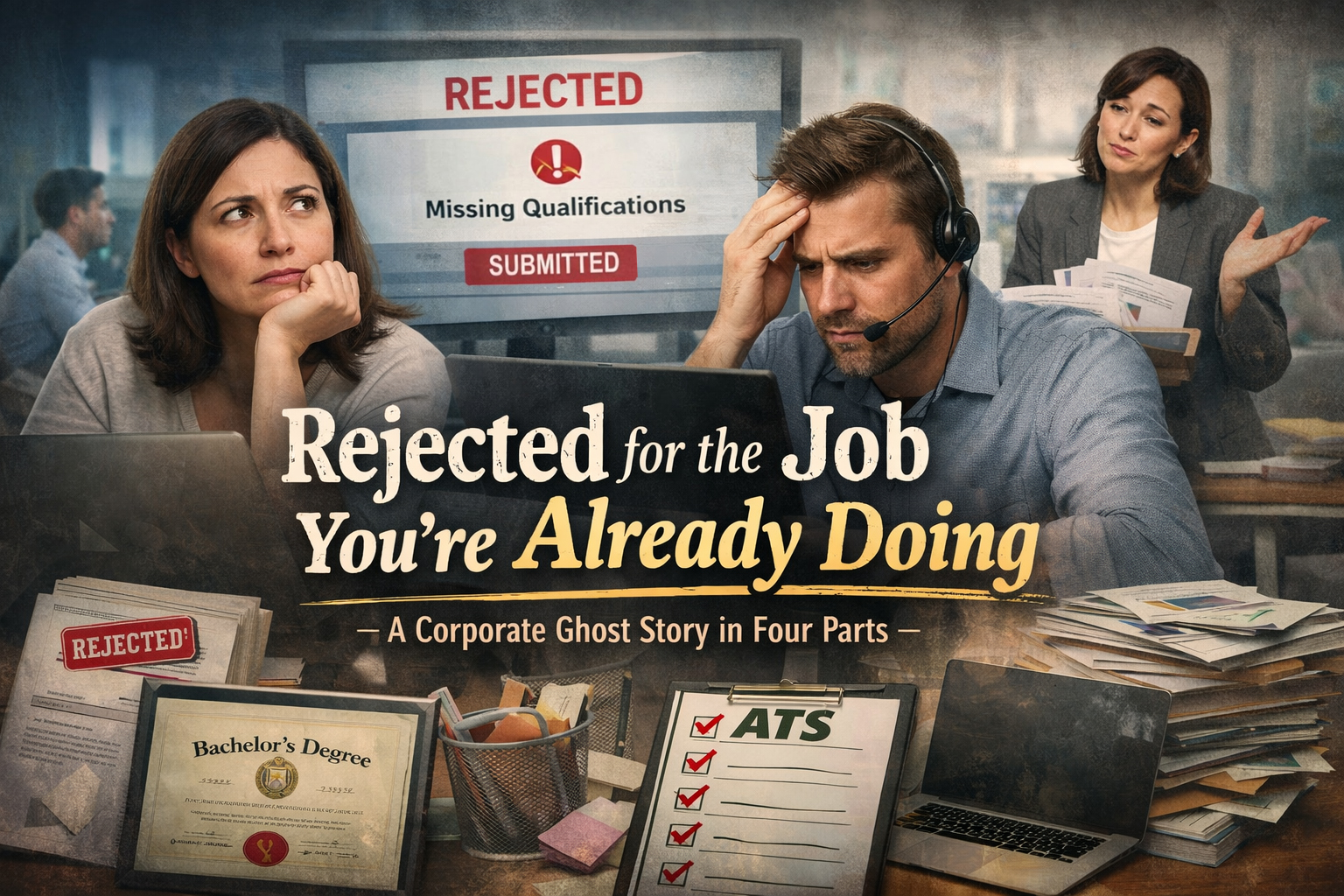
There’s a particular kind of corporate moment that doesn’t sting so much as it causes you to stare into the middle distance and quietly reassess reality.
Not a layoff. Not a bad performance review. Not even an awkward “per my last email.” No. This is something rarer. More refined. A higher form of absurdity.
Being rejected for the job you already have. Not metaphorically. Not emotionally. Literally.
It’s the email that arrives with the gentle tone of a customer service rep explaining your return can’t be processed because the receipt is “too folded,” except the return is your career trajectory and the receipt is your entire lived experience.
You click an internal posting, or a promoted role that suspiciously looks identical to what you’ve been doing since Tuesday, and the system informs you with confidence, clarity, and absolutely no shame that you do not meet the required qualifications.
You read it twice. Slowly. Like maybe the words will rearrange themselves into something sane.
They do not.
Because here’s the part that makes your soul do a somersault: you are actively performing the work. Your meetings are attended. Your tasks are completed. Your inbox is proof of labor. Your calendar looks like a crime scene. People message you questions that assume competence. You are, by all observable human metrics, doing the job.
But unfortunately… not in the dropdown menu.
And that’s when you realize your actual job performance and your digital profile live in entirely separate universes, governed by different laws of physics. One values outcomes, relationships, and experience. The other worships form fields, exact phrasing, and whether you selected “advanced” instead of “expert” in 2019 like it was a legally binding vow.
The system is calm about it too, which is the most impressive part. It doesn’t say, “This seems odd.” It doesn’t say, “Maybe we should ask a human.” It doesn’t even hesitate. It just smiles politely and says, “Your profile is missing required qualifications.”
Missing.
As if they fell out somewhere between your fourth meeting and your fifth cup of coffee, like keys slipping out of your pocket while you run through the parking lot holding a laptop, a protein bar, and the last shred of your dignity.
So you do what modern professionals do when confronted with bureaucratic nonsense: you comply harder.
You scroll. You review. You update. You add words you already live. You upload proof of work you are actively doing. You consider adding your own job description to your resume like a hostage note. You briefly wonder if you should list “currently employed here” as a skill.
And still, the system remains unmoved.
Because this isn’t about capability. It’s about compatibility. It’s about forcing a living, breathing professional into a structure designed by people who panic when reality doesn’t align with a spreadsheet.
So yes. Thoughts and prayers to whoever built this system. Not out of anger.
Out of awe.
Because it takes real confidence to look at someone doing the job and say, “Interesting. But have you tried being more dropdown compatible?”
The Qualification You Don’t Have (Because It Was Invented During the Interview)
The first thing you do is assume you missed something obvious. Because the system is confident, and corporate confidence is like perfume: overpowering, persistent, and usually meant to cover something up.
You click the requirements section and it reads like a wish list written by someone who once saw your job from a distance and decided that was enough context to design the role. You need eight years of experience in a tool that launched five years ago, a certification that sounds like a pharmaceutical, and “demonstrated ability to lead cross-functional stakeholder alignment” which is corporate for “you will be the one herding adults who do not want to be herded.”
Somewhere in there is a line that ruins your evening: Bachelor’s Degree required.
And you blink. Because you’ve been here. In this job. With this company. Doing this work. Without that degree. Successfully. For years.
You have solved real problems, hit real numbers, trained real people, and prevented at least three situations from becoming an HR documentary series.
But now the system has discovered a new moral truth: you are unqualified.
Not because you can’t do the work, but because your education section doesn’t match the spiritual template.
This is when you learn the difference between doing the job and qualifying for the job.
Doing the job is results. Qualifying for the job is paperwork. Doing the job is impact. Qualifying for the job is keywords. Doing the job is relationships, trust, and competence. Qualifying for the job is whether you typed “project management” or “program management” and if the system considers those interchangeable (it does not, because the system is petty).
So you try to fix it. You add the thing it wants. You don’t lie exactly, you just… expand the truth in a way that feels like it should be covered under “reasonable interpretation.”
You update your LinkedIn. You update your internal profile. You add an “equivalent experience” line like you’re negotiating with a medieval gatekeeper.
And still, the system says no.
Not aggressively. Not cruelly.
Politely.
Like a maître d’ explaining you can’t sit at the table because your shoes are the wrong type of shoe, even though you’ve eaten there every week for two years and the chef knows your name.
At this point, you start to understand the system isn’t rejecting you.
It’s rejecting the fact that you exist outside the format.
ATS Astrology and Other Corporate Spiritual Practices
Here’s the truth no one says out loud because it sounds like a joke and also a lawsuit: a lot of “requirements” are not requirements. They are vibes. They are rituals. They are symbolic offerings to the gods of compliance.
Somebody once told legal they needed to list a degree. Somebody once told HR they needed a certification. Somebody once told the system it needed a number in a field, and the system said, “Absolutely,” and turned that number into destiny.
So now, your career is being filtered the way people filter dating apps.
Not by compatibility. By whether you selected “hiking” even though you don’t hike but you once walked in a park and thought, technically, that’s hiking.
Except this is corporate, so instead of hiking it’s “stakeholder management,” and instead of a match you get a rejection email that implies you are not a real adult.
This is where the surreal starts to bloom.
Because you’ll find yourself doing performance art to satisfy a database. You’ll rewrite your experience in the exact dialect the system recognizes, like you’re trying to summon a demon using precise Latin.
You don’t say “trained new hires.” You say “developed onboarding framework.”
You don’t say “fixed the process.” You say “implemented operational efficiencies.”
You don’t say “stopped a meltdown.” You say “risk mitigation.”
You start translating your life into corporate spellwork because the system doesn’t understand humans. It understands phrasing. It understands titles. It understands whether your job history includes the sacred acronym it was programmed to worship.
And then you get the weirdest part: you’re doing all of this for a company that literally already employs you.
You are not trying to convince strangers.
You are trying to convince your own workplace that you are you.
At some point, the situation becomes existential. You start to feel like you’ve been replaced by a slightly less qualified version of yourself who is just better at filling out forms.
A shadow you.
A more dropdown-friendly you.
A you who remembered to mark “expert” instead of “advanced” and therefore qualifies for the same role you are actively carrying like a toddler with a sugar high.
And when you tell someone, they nod like this is normal.
“Oh yeah, our system is weird.”
Weird?
Weird is pineapple on pizza.
This is the corporate equivalent of being told you’re not legally allowed to be alive because you filled out the “alive” checkbox with the wrong font.
But fine. You play the game. You add the keyword. You update the profile. You attach the document.
You do everything right.
And the system still rejects you, because the system is not looking for right.
It’s looking for exact.
The Human Who Finally Opens the Door (And Immediately Apologizes)
Eventually, a human gets involved, because reality always forces its way into the room like a dog that heard a snack wrapper.
You reach out to HR, your manager, or the mystical internal recruiter who seems to exist exclusively to forward emails and schedule thirty-minute calls labeled “Quick Sync.”
You explain the situation in a tone that tries to sound professional while your soul is outside screaming into traffic.
And you get a response that starts with some version of:
“Yeah… so… that happens sometimes.”
Sometimes.
Like it’s weather.
Like the system just occasionally decides a person doing the job shouldn’t qualify for the job, as a fun little surprise for team morale.
Then the human does the thing the system refuses to do: they look at your actual experience.
They ask questions. They interpret context. They use judgment. They apply logic. You know, those quaint little concepts we used to value back when our workplaces still believed humans were part of the workflow.
And suddenly the conversation shifts.
Because now we’re not talking about whether you can do the work.
We’re talking about whether the system can handle the fact that you’re a complex professional with a non-linear path, and not a neat little stack of keywords tied with a ribbon.
And this is where the whole thing reveals itself: the system wasn’t designed to understand reality. It was designed to reduce reality.
It exists to make hiring “efficient,” which is corporate for “less human,” which is also corporate for “we are now letting software decide who deserves opportunities.”
And in that moment, you realize something that would be funny if it weren’t happening to your rent: inside the company, your value is real. Outside the company, your value is a file format.
So the human says they’ll override it. Or they’ll “push it through.” Or they’ll “fix your profile.”
And you’ll feel relief.
But also a quiet rage that has nowhere to go.
Because you should not need a workaround to be recognized for the work you’re already doing. You should not need to beg the system to acknowledge your own existence. You should not have to translate your career into keyword poetry so a machine can decide you are allowed to apply for your own job.
And yet.
Here we are.
In an era where your performance is seen by your team, measured by your outcomes, and valued by your relationships… but still invalidated by a dropdown that thinks your experience didn’t happen because it’s not formatted correctly.
Final Thoughts: You’re Not Unqualified, You’re Just Not Machine-Fluent
If you’ve ever been rejected for a job you’re already doing, let me offer you the only sane conclusion:
You are not unqualified.
You are being filtered by a system that confuses format with truth.
This is not a reflection of your ability. It’s a reflection of how many modern workplaces have built entire processes around the assumption that reality is only real if it fits inside a predefined field.
So yes—update the profile if you need to. Add the keywords. Translate your experience into the dialect of the machine. Do the corporate spellwork, because sometimes you have to play the game to get the thing you already earned.
But don’t internalize the rejection.
Because the system isn’t rejecting you as a professional.
It’s rejecting the audacity of your humanity.
It’s rejecting nuance. It’s rejecting lived experience. It’s rejecting the messy truth that people learn, grow, pivot, and become excellent without always taking the path an HR template was designed to recognize.
And if that makes you feel like staring into the middle distance again, that’s valid.
That’s your brain trying to reconcile a world where competence can be real, visible, and proven… and still not count because it wasn’t selected from a menu.
So to anyone currently doing their job while being told by a portal they can’t qualify for it:
Congratulations.
You have achieved peak corporate enlightenment.
You are excellent.
You are employed.
And you are, tragically, not dropdown compatible.