
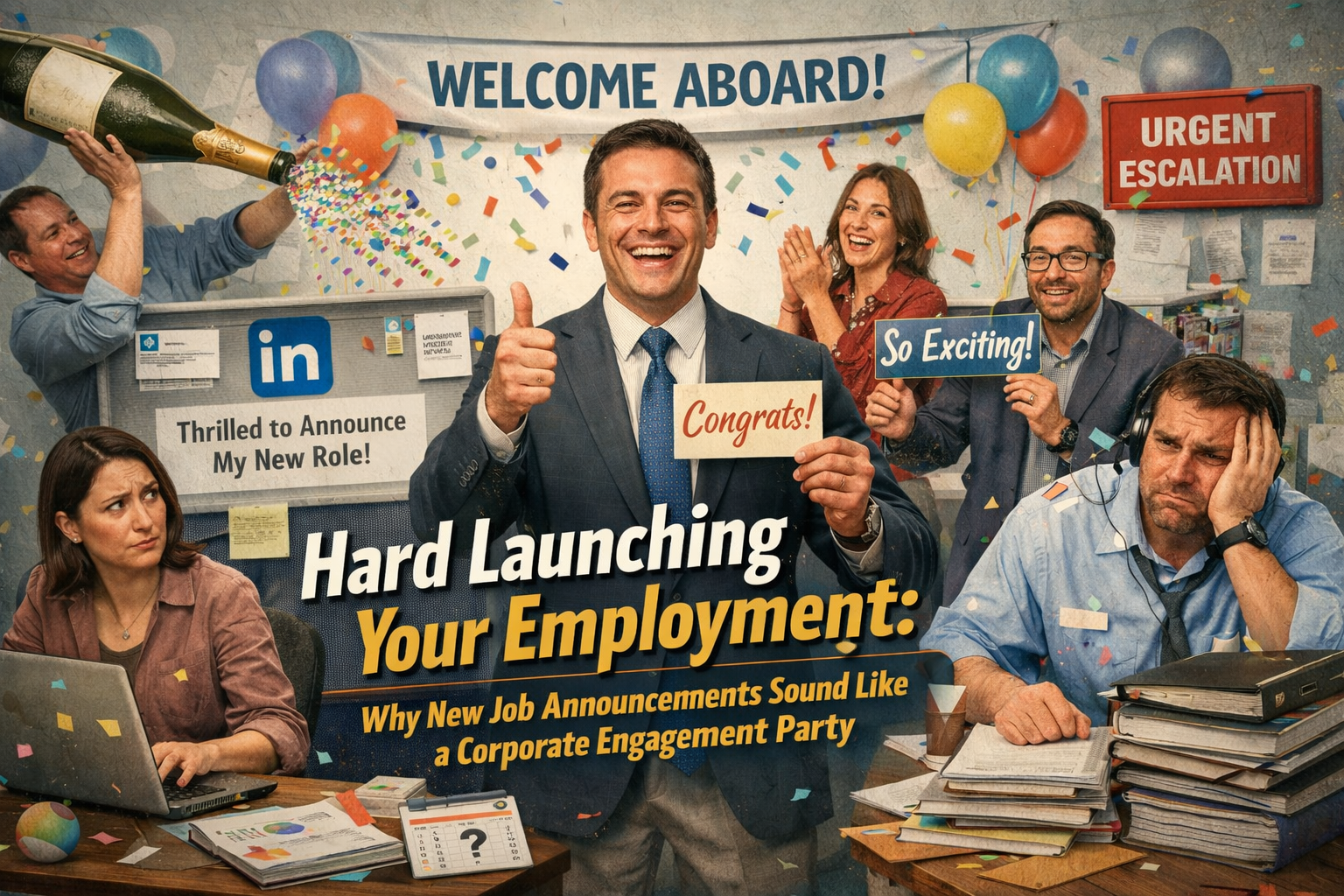
There is a very specific kind of modern workplace theater that begins before you have learned anyone’s last name, before you know whether the coffee machine is decorative or operational, before you have figured out if the person smiling warmly at you is genuinely kind or simply the office’s most gifted political predator, and it arrives with the confidence of a mandatory safety drill and the emotional tone of a publicist preparing a celebrity wedding rollout. It is the moment someone, usually with dazzling sincerity and the kind of enthusiasm that should honestly be studied in a lab, tells you that now that you have joined the company, you should really announce it on LinkedIn.
Not mention it. Not update your employment section quietly like an adult slipping a form into a folder. Not wait until you have survived enough meetings to confirm that this organization is not being held together by one overworked operations manager, a haunted spreadsheet, and a Slack channel called Urgent Final Final 2. No. You are encouraged to announce it. Formally. Publicly. Emotionally. Preferably with the tone of someone who has been chosen by destiny and lightly touched by the divine. It is not enough to have accepted an offer. You must unveil the relationship. You must hard launch the corporation.
And this is what makes it so funny, because the pressure arrives obscenely early. Day two, sometimes day three, when your badge still smells laminated, your laptop fan sounds like a helicopter warming up on a hospital roof, and you are not even fully certain which bathroom is socially acceptable for your floor. You are being gently nudged to compose a public love letter to a place that has not yet proven it can locate your monitor cable. Somewhere in human resources or employer branding or whatever committee was formed to extract joy from natural human speech, a belief has taken hold that your first professional obligation is not merely doing the job but publicly renewing your vows to it in front of the internet.
So you sit there trying to write something noble and polished, because LinkedIn does not reward honesty, it rewards ceremonial gratitude. You are expected to sound thrilled, honored, humbled, energized, and deeply inspired by the opportunity to leverage your passion in a dynamic, collaborative environment with visionary leaders and a mission-driven culture. Meanwhile, the only vision you currently have is of the Outlook inbox that has already swallowed your will to live, and the only mission you are on is determining whether the person who said “circle back” seventeen times in one meeting is your manager or your first warning sign.
Still, we all know the ritual. We have seen it. We have participated in it. We have watched otherwise intelligent adults post employment announcements with the emotional register of a coronation speech, as if taking a middle-management role in regional logistics has elevated them to keeper of the sacred flame. The comments arrive right on schedule. Congratulations. So deserved. They are lucky to have you. What a wonderful next chapter. And for one shining moment, everybody participates in the illusion that this is not a practical arrangement based on salary, healthcare, and the increasingly urgent desire to keep electricity flowing through the home, but rather a glorious merger of purpose, values, and destiny.
And then, of course, life happens. The role reveals itself. The beautiful onboarding deck gives way to the actual job, which often looks like twelve inherited problems wearing a company polo. The collaborative culture turns out to be four people in a Teams chat asking whether anyone has ownership of a process no one has documented since 2019. The innovative environment turns out to mean the printer only works if threatened. The people-first organization begins every sentence with “we care deeply about our employees” and ends every week by adding three new responsibilities and a weekend rotation.
But your post remains. Bright. Hopeful. Permanent. A glossy digital monument to optimism written at a time when you did not yet know enough to be afraid.
That, to me, is one of the funniest customs in professional life. Not the update itself, but the expectation that your employment must be introduced to the public like a romantic partner, celebrated before trust has been established, and framed as a triumph before the facts have had any chance to file a rebuttal. It is corporate debutante culture. It is a workplace engagement announcement. It is adults in business casual smiling into the void and saying, with tremendous poise, “I am pleased to report that this company and I have decided to see each other exclusively,” while privately hoping the chair does not squeak and the benefits packet contains something medically useful.
The Corporate Red Carpet Before You’ve Even Found the Bathroom
The first truly absurd part of the new-job LinkedIn announcement is the timing, because no other relationship in adult life is expected to go public with such speed and such blind optimism. Imagine if this logic were applied anywhere else. Imagine going on two dates with a person, still not knowing their middle name or whether they chew with the intensity of a wood chipper, and then being told by friends, family, and a branding committee that it is time to issue a heartfelt public statement declaring your excitement for this next chapter. You would flee. You would change your number. You would move towns if necessary. But in the workplace, this exact energy is considered not only normal but healthy.
You have barely arrived. Your system access is incomplete. The new-hire portal still lists training modules from employees who left during the Obama administration. Somebody from payroll has emailed you three times asking for a document you definitely submitted, and someone else from IT has spoken to you in the exhausted tone of a man trying to disarm a bomb because you accidentally opened a ticket marked high priority instead of medium. You are not integrated into a functioning professional ecosystem. You are a newborn giraffe in loafers. Yet there is this immediate expectation that you should emerge into the digital savannah and declare to the world that you are thrilled beyond words to begin this exciting journey.
And the language always has to be ridiculous, because ordinary speech is apparently too honest for LinkedIn. You cannot say, “Happy to report I found something before my savings account started making eye contact with me.” You cannot say, “This role seemed stable, the salary was reasonable, and after six months of interviews I was willing to legally commit to almost anyone with dental.” No, you must write in the tone of a man accepting a humanitarian award. You must be humbled. You must be grateful. You must be energized by the chance to collaborate with incredible humans doing impactful work at scale.
At scale is one of my favorite phrases in these posts because it means nothing and sounds important, which is the perfect summary of most professional vocabulary. People say they are thrilled to drive value at scale, build relationships at scale, foster transformation at scale, and occasionally, if the full moon is out and the comments section is especially ceremonial, empower innovation at scale. What this usually means is that Carol from operations is going to send you a spreadsheet with 14 tabs and no instructions, and by Thursday you will be whispering “what is this file” like you found a cursed manuscript in a basement.
And yet the announcement must go on. The company wants the ribbon-cutting ceremony. They want the internet to know they have acquired a talented individual who is excited to contribute. You become less an employee and more a press release with a pulse. It is not enough that you accepted the offer. The acceptance must be witnessed. Publicly. Preferably with a headshot where you look approachable, competent, and only mildly aware that the role may eat you alive.
This is why these posts often read like arranged marriages being marketed by a PR team. You thank everyone. The recruiter. The leadership team. Your mentors. The team for making you feel so welcome. This is especially bold when you have met two of these people, one of whom forgot your name and the other who introduced himself while walking away. Still, etiquette demands that you act as though you have been lovingly folded into an ecosystem of support and vision. To do otherwise would be to break the spell.
And the spell is important because early employment is built almost entirely on projection. You do not know what the job really is yet. They do not know who you really are yet. Both parties are standing across from each other in business-casual costumes, projecting confidence and alignment while secretly wondering whether a terrible mistake has been made. The LinkedIn announcement is simply the public version of that mutual hallucination. It is the official photograph taken before the set starts burning.
The Comment Section as a Corporate Bridal Shower
If the announcement itself is the engagement photo, the comment section is the bridal shower, complete with people arriving in coordinated emotional tones and pretending not to know that everyone here is mostly improvising. This is where the true pageantry begins, because once the post goes live, the supporting cast enters with astonishing discipline. Former coworkers, current acquaintances, recruiters, vague professional orbiters, and at least one person you met at a conference six years ago all sweep into the comments with the same curated excitement reserved for births, weddings, and public tax amnesty.
Congratulations. So excited for you. What an incredible opportunity. They are lucky to have you. You are going to do amazing things. This next chapter is so well deserved.
It is beautiful, really, the way we all collectively agree to keep the mood uplifting even when everyone involved knows the actual subtext is something closer to, “Thank God one of us escaped.” There is a generosity to it. There is also a hysteria to it. Because many of the people typing “They are lucky to have you” know for a fact you accepted the role after months of interviewing, escalating levels of emotional fatigue, and at least one moment in which you seriously considered becoming a park ranger, furniture restorer, or person who lives in a lighthouse writing mysterious letters.
What makes the comment section especially funny is that it creates instant historical revisionism. Suddenly, every career move looks intentional, triumphant, and spiritually aligned. Nobody says, “I remember when you called me after the fourth interview and said if one more hiring manager asked where you saw yourself in five years you were going to bite a lamp.” Nobody writes, “Happy for you, and also I know you took this because Cobra coverage feels like organized extortion.” The internet does not permit such naked honesty. Everything must be reframed as destiny. Every offer becomes a calling. Every survival move gets dressed up as fulfillment.
And then there is always at least one executive or senior leader who comments with polished warmth, something like, “We are thrilled to have you join the team,” which gives the whole post the energy of a royal seal being pressed into wax. This can be deeply flattering until you realize that in your actual day-to-day existence this same organization may take four days to answer a basic question about expense reimbursement. Public warmth and private confusion have always made a lovely corporate pairing. The LinkedIn thread simply allows both realities to coexist without ever having to acknowledge each other directly.
The funniest people in these comments, though, are the ones who speak like you have won a scholarship to the moon. “Amazing move.” “Powerful decision.” “Can’t wait to watch you thrive.” Thrive is another one of those words that deserves a federal investigation. Thrive is what professionals say when they want to imply joy without guaranteeing conditions under which joy could reasonably occur. No one says, “Can’t wait to watch you receive contradictory feedback from three stakeholders and then eat almonds over your keyboard at 7:40 p.m.” That would be specific. Specificity ruins the fairy tale. Thrive keeps everything soft and vague, like a candlelit hallway leading directly to burnout.
And still, we all understand why it happens. These comments are not just performance. They are also little acts of communal optimism. People want to believe good things are happening for one another because professional life is brutal enough without publicly narrating every development as a hostage exchange. The issue is not that people are kind. The issue is that the format demands such immediate devotion from circumstances that have not yet earned it. We throw confetti at chapter one before checking whether the plot is stable.
Then the post sits there. For weeks. Months. Sometimes years. And if the role turns disastrous, your comment section becomes a preserved museum exhibit from the brief, tender period before the smoke alarm started going off. You can revisit it anytime you want and see dozens of people celebrating the beginning of what later turned out to be a highly compensated group project with a panic soundtrack. There is something almost poetic about that. Not uplifting, exactly. But poetic in the way old wedding photos are poetic when you know the groom later opened a juice bar in Phoenix and started talking about masculine energy online.
When the Hard Launch Ages Like Milk
The real comedy begins once time enters the picture, because time is what turns the LinkedIn announcement from a cheerful update into a historical artifact. On the day you post it, everything still glows. The laptop is inconvenient but symbolic. The awkward onboarding is forgivable. The unfamiliarity of the systems feels temporary and even a little charming, like the early misunderstandings in a romantic comedy before one person inevitably discovers the other has been hiding massive debt or a second family. But then the role starts revealing itself, and that is when your beautiful public statement begins its transformation from optimistic milestone into evidence.
First comes the mild confusion. A few responsibilities appear that were not fully emphasized in the interview, which is normal enough if you squint hard and have a positive attitude. Then come the extra meetings. Then the inherited processes. Then the phrase “we’re still building structure around this” appears, which is corporate for “there is no map, the bridge is theoretical, and you are now partly responsible for both.” Before long, you are being copied on escalation emails involving departments you did not know existed, sitting in meetings where people casually refer to ancient crises by first name, and learning that the role you announced with such glowing sincerity is actually three roles in a trench coat.
This is the point where your LinkedIn post becomes hilarious in a way that only delayed reality can make something hilarious. There it is, still public, still polished, still confidently declaring your excitement to join an innovative and collaborative environment. Meanwhile, in real life, innovation has revealed itself as one shared Excel file that nobody should touch but everyone touches, and collaboration appears to mean six people forwarding the same issue until it becomes your issue. The people-first culture turns out to be very committed to people, especially when those people are willing to stay late and absorb undefined responsibilities with grace.
And because the internet remembers the original announcement, you are trapped by your own ceremonial language. You cannot exactly go back into the comments and post updates like a war correspondent. “Quick note for everyone who wished me well. We have entered week seven. Supplies are low. My manager says we need to remain agile, which I now understand means accepting fresh nonsense at a high metabolic rate.” You cannot edit the post to add, “Minor correction: the exciting journey involves three dashboards, two passive-aggressive directors, and an emergency hotline that lights up every Sunday like an ominous Christmas tree.” Professional culture insists that your original declaration remain untouched, like an engagement announcement after the honeymoon has produced several very educational arguments about money and the in-laws.
This is why I think the honest version would be so much better. Imagine a world where people posted employment updates with the same cautious realism they use when buying a used car. Proud to share that I have accepted a new role. Early signs are mixed but encouraging. The direct manager has made eye contact, the onboarding packet contains complete sentences, and no one has yet described the culture as family in a tone that sounded vaguely criminal. I remain hopeful but committed to ongoing observation. More details will emerge once I gain access to the shared drive and determine whether the weekly meeting is strategic or spiritual in nature.
That would be useful. That would be human. That would sound like an actual adult describing an employment arrangement instead of a duchess announcing a summer wedding. But of course, that is not how the genre works. The genre is built on premature certainty. It rewards polished optimism and punishes realism, because realism reminds everyone that jobs are often just highly accessorized transactions. You are giving labor. They are giving money. If both parties behave well enough, maybe it becomes meaningful. If not, it becomes a story you tell later with a strange smile and a stronger password.
So yes, every time I see one of those announcements, especially the very early ones, I laugh a little. Not because people should not celebrate good news. They should. Lord knows the professional world does not hand out enough moments worth celebrating. I laugh because of the choreography of it all, the speed of the emotional commitment, the way modern work has somehow decided that employment must be publicly soft-launched, hard-launched, and blessed by a comment section before the employee has even confirmed where the stapler lives. It is a beautiful, bizarre ritual. Part hope. Part branding. Part hostage video filmed under excellent lighting.
Final Thoughts: Cautiously Optimistic, Pending Further Investigation
I think that is what fascinates me most about these new-job announcements. Beneath all the polished language and ceremonial gratitude, they reveal how desperately professional culture wants work to feel romantic. Not stable. Not contractual. Not merely functional. Romantic. We do not just want a paycheck; we want a narrative. We want the move to mean something. We want the new title to sound like a turning point. We want to believe the chapter beginning is not simply another exchange of labor for money under fluorescent lighting, but a meaningful alignment of gifts, mission, values, and ergonomic desk accessories.
And honestly, I understand it. We spend too much of our lives working not to crave some emotional architecture around it. People want hope. They want momentum. They want witnesses to the moments that feel like rescue, reinvention, or reward. After enough rejection, enough ghosting, enough interviews where someone asks you to explain a gap from 2017 like you were on the run from Interpol, getting a job can feel worthy of fireworks. Of course people want to celebrate it. Of course they want to write the glowing version. Sometimes the glowing version is the only thing keeping the whole machine from collapsing into a communal shrug.
But the ritual is still funny, because it asks for devotion before evidence. It asks you to speak with anniversary energy about a relationship that is still in its opening credits. It asks you to pose in business casual and publicly declare your excitement while privately wondering whether your new boss uses phrases like “quick sync” as a threat. It asks you to crown the experience before the experience has had the decency to introduce itself properly.
That is why I will always have affection for the honest internal version people are probably thinking while they write the polished public one. The version that says: I am hopeful. I am relieved. I would love for this to be good. I would love for the people to be sane, the systems to function, the expectations to be truthful, and the chair to support my lower back with something resembling dignity. I am excited, yes, but not spiritually. Let’s not get carried away. I have been alive long enough to know that every “amazing opportunity” should be allowed a probationary period.
Maybe that is the real adult form of optimism anyway. Not the loud, glitter-covered certainty of LinkedIn theater, but the quieter kind. The kind that says I am willing to believe this might be a good thing, even though I know jobs, like people, often arrive overdressed and under-explained. The kind that leaves room for delight without surrendering all judgment. The kind that smiles for the announcement photo while keeping one hand near the exit and the other on the laptop charger just in case.
So yes, post the update if you want. Celebrate the role. Thank the recruiter. Thank the moon if the mood strikes. Let the comments roll in. Let everyone tell you this next chapter is going to be incredible. There is nothing wrong with wanting a little confetti in a world that often hands out paperwork instead.
But deep down, I will always respect the version that says: proud to share I accepted a new position. At this time, I remain cautiously optimistic. One manager appears normal. The badge works on most doors. No one has said “work hard, play hard” with dead eyes. I have not yet been added to any mysterious weekend escalation threads. The dental plan remains under review. I will keep the public informed as facts develop.
That is the announcement I trust.
That is the announcement of a grown adult.
And frankly, that is the kind of hard launch modern employment has earned.