
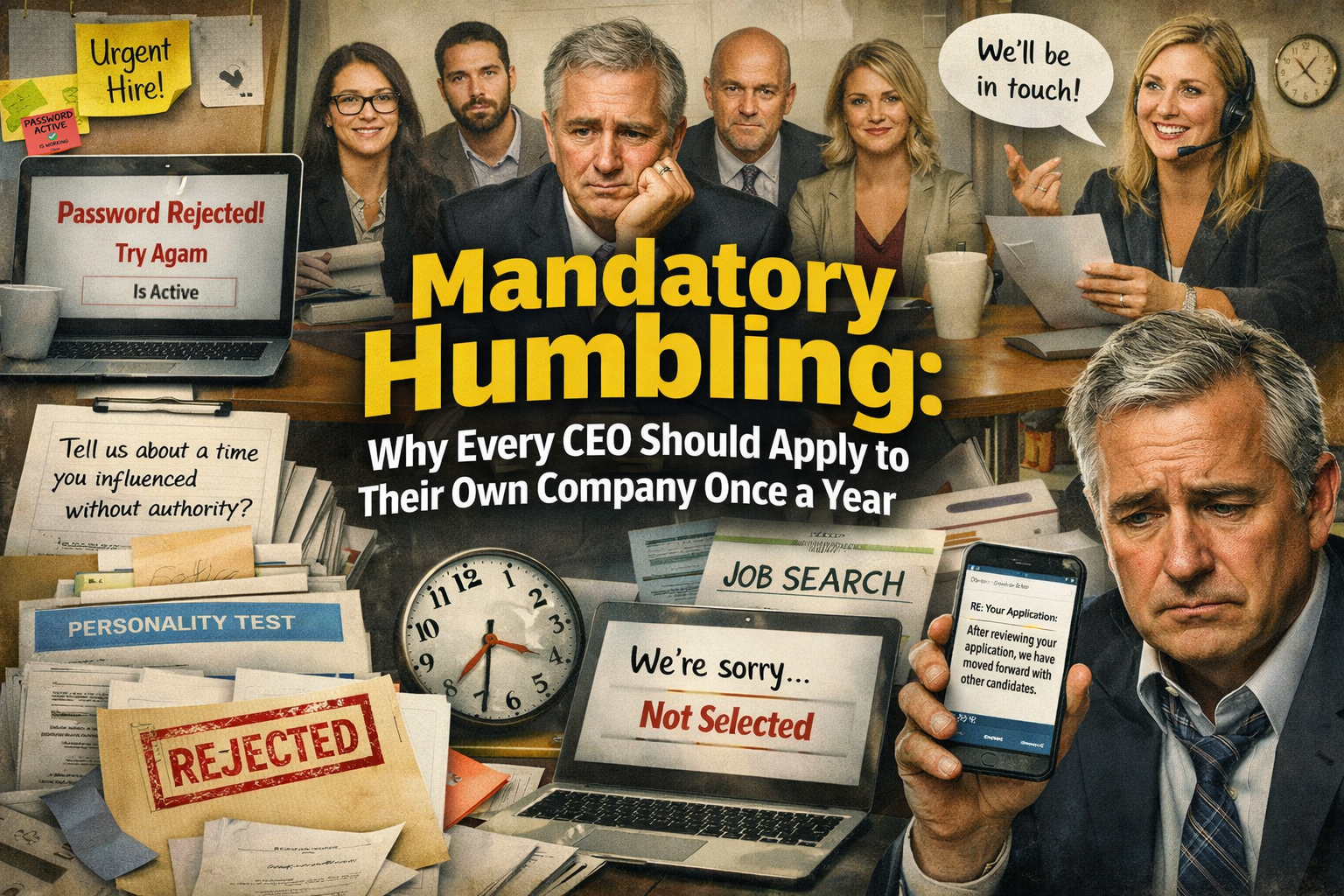
I would like to propose a bold new leadership initiative, one that does not involve a summit in Arizona, a laminated workbook called Leading with Purpose, or a keynote speaker who uses the word disruption like he is trying to summon a demon.
I am talking about a real test. A cleansing ritual. A national act of corporate repentance.
Once a year, every CEO should be required to apply for a job at their own company and go through the entire process exactly the way normal people do, meaning without a handler, without a shortcut, without a discreet email to Human Resources that says, “Please take care of this,” and certainly without some trembling recruiter moving them to the final round because the org chart has spoken.
No. I want the full civilian experience.
I want the chief executive officer of a multinational corporation sitting at his kitchen table at 9:47 p.m. on a Tuesday, in the bluish sadness of laptop light, trying to create a candidate profile on the company website while muttering language that would make an old pirate reach for church. I want him entering a password that is rejected three times despite meeting every visible requirement and several that appear to have been invented privately by a software engineer going through a divorce. I want him selecting one uppercase letter, one lowercase letter, one number, one symbol, one mythical beast, one blood oath, and one emotional callback to his childhood, only for the system to flash back in red, Invalid format.
That is where empathy begins. Not in a town hall. Not in a LinkedIn post about people being our greatest asset. Not in one of those internal videos where everyone is smiling too hard near a whiteboard. No, empathy begins when the man who says “we need better applicants” is suddenly locked out of Workday because he answered his own security question incorrectly and apparently can no longer remember the name of his first pet, because adulthood has replaced every childhood memory with low-grade panic and subscription renewals.
Then comes the resume.
Ah yes, the sacred corporate rite in which a person uploads a document containing their entire professional history and is then instructed to manually type every word of that same document into a series of tiny digital boxes like a medieval monk transcribing his own suffering onto grains of rice. I want the CEO to feel that moment. That holy, irreversible break in the human spirit when the website says, Resume successfully uploaded, and then immediately demands he prove it by re-entering the same information line by line as if both he and the file are currently under investigation.
This is not just a thought experiment. This is justice with a login portal.
Because for too long, the modern hiring process has been designed by people who have clearly never had to survive it. It has all the warmth of airport security and all the efficiency of a haunted fax machine. Executives speak of talent shortages, candidate quality, employer branding, and pipeline health, while outside their offices millions of people are crawling through application systems designed like escape rooms for the clinically exhausted.
And the only way to fix it, really fix it, is to force the architects to walk barefoot through the Lego kingdom they built.
Let them answer the nonsense questions. Let them upload the cover letter separately. Let them be told that a role is urgent and then hear absolutely nothing for six weeks. Let them sit through a panel interview with six strangers drinking iced coffee and asking, “Tell us about a time you influenced without authority,” as though speaking to a man whose entire title is authority with a benefits package.
Let them be ghosted by Tiffany.
Let them wonder whether they should send a thank-you note.
Let them stare into the fluorescent void and finally understand that the candidates were never the problem. The maze was.
And so, with the full seriousness this ridiculous nation can tolerate, I am launching the movement: Apply, Richard.
Welcome to the Portal, Sir
Every CEO should begin his annual pilgrimage the same way every applicant does: with optimism that will soon be rearranged into confusion, irritation, and eventually the kind of spiritual numbness usually associated with long DMV visits and family group chats.
He should visit his company’s careers page, that polished digital shrine to possibility, where the first thing he sees is a smiling stock-photo employee pointing at a laptop as if to say, Look at all the opportunities waiting for you, you sweet, employable fool. There will be slogans, of course. Join our mission. Build the future. Bring your whole self to work. That last one is especially funny because the application itself will immediately demand he reduce his whole self into dropdown menus, keyword clusters, and a yes-or-no box about whether he has ever been convicted of anything more serious than hope.
Then he clicks Apply Now and enters the tunnel.
The portal is always fascinating because it combines the visual design of a wellness app with the emotional atmosphere of a tax audit. Suddenly the CEO is not a visionary leader. He is Applicant #8742, and the system has exactly the same level of respect for him that it has for anyone else, which is to say none whatsoever. It does not care that he gives keynote speeches about innovation. It does not care that he signs off on budgets or appears in quarterly earnings calls wearing a navy blazer and confidence. It wants him to verify his email, create a password, confirm the password, answer a CAPTCHA that somehow mistakes him for a tractor, and then start over because the session timed out while he was trying to remember whether he used a special character.
This is where I want him to really sit with the experience.
I want him to upload his resume, watch the system parse it incorrectly, and then spend twenty-three minutes fixing a job history that has somehow transformed three executive roles into one internship and a part-time cashier position in Tulsa. I want his city to disappear. I want his dates to shift by a year. I want the software to take “Chief Executive Officer” and turn it into “Customer Happiness Associate,” because if ordinary people have had to endure the algorithmic hallucinations of resume parsing, then Richard can join the choir.
And then, because corporate comedy is at its finest when it is cruelly repetitive, I want him to manually re-enter every detail.
Company name. Title. Start date. End date. Responsibilities.
Again.
Again.
Again.
Every promotion. Every accomplishment. Every year of his life fed into narrow little fields that look like they were designed by someone who hates both typography and mankind. I want him to feel his soul leaving his body when he realizes there is also a separate section for certifications, another for skills, another for education, and another optional field labeled Additional Information, which is corporate for Tell us one more thing so we can ignore it with maximum completeness.
Then come the knockout questions, which are never content to merely gather information. No, these questions exist to make a person question reality itself.
Do you have ten years of experience in a platform the company adopted eight months ago?
Are you comfortable working in a fast-paced environment?
Are you willing to relocate, commute, travel 40%, be on call, lift fifty pounds, and maintain a positive attitude while living in a market where rent costs the same as a ceremonial horse?
Have you led enterprise transformation initiatives across cross-functional stakeholder environments while remaining hands-on and humble?
Sir, you run the company. But the checkbox does not care.
That is the beauty of this proposed movement. It strips away title and replaces it with procedure. Suddenly the CEO is no longer the voice of the brand. He is just another exhausted mammal trying to understand why the application will not proceed unless he enters a LinkedIn URL formatted with or without the protocol, depending on which mood the website woke up in that morning.
And when he finally reaches the end, when his eyes are dry and his shoulders have the posture of a defeated gargoyle, the system should reward him exactly as it rewards everyone else: with a bland little confirmation message that feels less like possibility and more like a hostage note from software.
Thank you for your interest.
We will review your qualifications.
No one will be in touch.
The Interview Process, Now Featuring Brandon and Six Other Delays
Once the application has been submitted into the abyss, the CEO enters the second phase of the educational experience: waiting in a state of low-level emotional dehydration.
This is an essential part of the program because executive waiting is not real waiting. Executive waiting is being updated. Executive waiting is an assistant saying, “They are circling back next week.” Executive waiting is a calendar hold. What applicants experience is something else entirely. It is a psychological sport. It is maritime grief. It is checking your email with the same solemn desperation of a nineteenth-century widow watching the sea for a ship that may never return.
I want the CEO to know that life.
I want him waking up, checking his inbox, and seeing nothing but a receipt, three newsletters he never subscribed to, and a discount code from a company he once bought socks from in 2022. I want him feeling a flicker of adrenaline every time his phone lights up, only to discover it is a fraud alert, a grocery coupon, or LinkedIn inviting him to congratulate a stranger on becoming Vice President of Strategic Impressions at a startup that sells software to other software companies.
Then, finally, after enough silence to make a monastery look chatty, the interview invitation arrives.
Joy.
Movement.
Hope wearing business casual.
The interview is scheduled for 2:00 p.m. Thursday.
Then moved to 2:30.
Then moved again because Brandon has a conflict.
I insist on Brandon specifically because every hiring process has a Brandon. He is always somehow central, somehow unavailable, and somehow attached to an urgent hiring need that has moved at the pace of continental drift. Brandon is the patron saint of scheduling chaos. Brandon is why applicants know the phrase “thanks for your flexibility” in the same tone hostages recognize the phrase “remain calm.”
So now the CEO must reshuffle his day. He must re-open the calendar invite. He must pretend not to mind. He must answer with grace because candidates are expected to absorb inconvenience the way office carpets absorb sadness.
Then comes the interview itself, that strange little theater production where everyone pretends a conversation is happening while clearly following a script approved by Legal, Culture, and at least one person who has never met a human in natural conditions.
I want the panel to be large. Not helpful large. Intimidating large. The kind of panel where the candidate joins the call and sees so many silent squares on the screen that it looks like he accidentally logged into a city council hearing. Six people minimum. One asks the questions. Two stare silently as if evaluating him for military intelligence. One is eating. One has camera issues but remains spiritually present. And one introduces herself with such vague authority that no one knows what she actually does, only that she is “supporting the process.”
Then let the questions begin.
Tell us about a time you had to influence without authority.
Describe a challenge and how you overcame it.
How do you prioritize competing deadlines?
Why do you want to work here?
That last one should hit especially hard. Why do you want to work here? Sir, because it is your company. Because your face is in the annual report. Because somewhere in the building there is probably a framed quote from you about resilience. But now he must answer like everybody else, smiling with the brittle enthusiasm of a person trying to sound inspired while also wondering whether this role is actually three jobs wearing one blazer.
And then, because hiring has become incapable of ending when it should, there must be more rounds.
A second interview.
A third interview.
A writing sample.
An assessment.
A presentation no one should be asked to do for free unless the role is literally “person who gives presentations for a living.”
I want the CEO spending his weekend assembling unpaid strategy slides for a team that keeps describing itself as lean, dynamic, and scrappy, which is corporate language for underfunded and running on cold brew. I want him practicing answers in the bathroom mirror. I want him googling whether it is okay to follow up after five business days. I want him discussing with loved ones whether “We’re still finalizing next steps” is good news, neutral news, or the verbal equivalent of hearing rustling in the bushes right before the bear appears.
Because this is the chapter where the transformation happens.
This is where a leader becomes an applicant.
This is where confidence gets sanded down by process.
This is where all those beautiful executive phrases like talent ecosystem and candidate journey finally stand trial before lived experience and are found guilty of being nonsense.
After Careful Consideration, We Have Chosen Violence
And then, after the forms, the waiting, the rescheduling, the panel, the assessment, the free labor disguised as enthusiasm, comes the final sacred document of modern employment: the rejection email.
No social institution has mastered the art of sounding polite while delivering psychic damage quite like corporate recruiting. It is extraordinary, really. These messages read as though they were written by a sympathy card factory owned by robots. They arrive with the emotional warmth of refrigerated yogurt and the precision of a dart thrown directly at a person’s remaining sense of self.
I want the CEO to receive it on a Wednesday at 6:14 p.m.
Not during business hours, when questions could be asked and dignity might still be salvageable. No, I want it to arrive in that special evening window when dinner is half-started, defenses are low, and the body can fully absorb betrayal.
The subject line should be gentle. Coy, even. Update on your application.
Then he opens it.
After careful consideration, we have decided to move forward with candidates whose experience more closely aligns with the role.
There it is. The sentence. The little corporate guillotine dressed up in professionalism. The phrase that has ended more hope than bad weather and weak wifi combined. And in this case it would be especially beautiful, because the man being informed that his experience does not align with the role is the man currently leading the company offering the role.
Imagine that. Imagine being rejected by your own organization because the algorithm did not detect sufficient keyword density. Imagine learning that you, the chief executive officer, are not quite what the team is looking for at this time. Imagine staring at a message written in such neutral language that it somehow manages to sound both apologetic and smug.
This is the moment I want broadcast internally as a training video.
Not to shame him. To heal us.
Because only then might leaders understand what candidates have been trying to say for years. That hiring is no longer merely a process. It is a labyrinth built out of delay, jargon, false urgency, and emotional leakage. It is a machine that demands sincerity while offering none in return. It tells people to be authentic, proactive, and grateful while subjecting them to an experience that would make a casino seem morally grounded.
And naturally, after the rejection, the CEO should not be allowed closure.
No feedback.
No explanation.
No thoughtful note.
Just a generic message and silence.
If he dares to reply, it vanishes into an unattended inbox like a flare shot into fog. If he follows up with Tiffany from recruiting, who once said, “We’ll definitely be in touch soon,” he should receive either no response at all or one of those airy little notes thanking him again for his time and encouraging him to keep an eye on future opportunities, which is corporate for Please continue donating your hope to our broken machinery.
I want him wondering whether he should send a thank-you note anyway.
I want him asking friends, “Do you think it would help if I followed up again?”
I want him rereading the interview invite for clues like a detective on the world’s saddest case.
I want him questioning whether he came across strongly enough, warmly enough, strategically enough, humbly enough, visionary enough, or perhaps too visionary, which is also somehow a risk now.
Because this is the emotional geography applicants live in. Not one rejection, but an entire afterlife of second-guessing. A haunted house of interpretation. A long, private conversation with uncertainty wearing the voice of every recruiter who has ever said, “You’re a really strong candidate,” moments before disappearing into mist.
And I truly believe society would improve if more executives had to spend even one full week in that weather.
Not because suffering is noble. Not because humiliation builds character. But because exposure to absurdity is clarifying. When people with real power are finally forced to confront the systems they praise from conference stages, miracles become possible. Suddenly the application takes fewer steps. Suddenly the panel gets smaller. Suddenly the unpaid assignment disappears. Suddenly recruiters communicate like adults. Suddenly the phrase urgent hire starts meaning something other than eventually, probably, after Brandon gets back from Aspen.
Final Thoughts: Apply, Richard
That is why I stand by this movement with the kind of conviction usually reserved for labor laws and good soup.
Every CEO, once a year, should be required to apply for a job at their own company and survive the entire process without revealing who they are. Let them enter through the same portal. Let them answer the same recycled questions. Let them schedule around the same avoidable chaos. Let them taste the same silence. Let them meet the same system they have been describing in investor language as efficient, scalable, and candidate-centric while normal people have been describing it more accurately as exhausting, dehumanizing, and powered by ghosts.
Because we have spent too long pretending the problems in hiring are mysterious. They are not mysterious. They are visible from space. The reason they continue is not because nobody knows. It is because too many of the people with authority have been protected from consequences by title, distance, and assistants named Lauren.
But once Richard has spent forty-two minutes trying to upload a PDF under the size limit only to be told the format is invalid, revelation begins.
Once Richard has manually retyped his own resume while wondering whether this is punishment for something he did in a previous life, reform begins.
Once Richard has sat in a panel interview being asked whether he can thrive in ambiguity by six people who collectively introduced three scheduling conflicts and one broken microphone, reform accelerates.
And once Richard receives a generic rejection from his own company after completing enough unpaid tasks to qualify as seasonal labor, then at last, at long last, we may hear a different kind of leadership language emerge.
Not “the talent market is challenging.”
Not “we are focused on attracting top candidates.”
Not “the pipeline requires optimization.”
No. We might finally hear the most revolutionary sentence in corporate history:
This process is ridiculous. Fix it.
That is the dream. Not revenge. Not chaos. Illumination.
I do not want CEOs publicly flogged with rejected resumes. I just want them to meet their own maze without bodyguards. I want them to stand where ordinary applicants stand, holding the same hope, enduring the same nonsense, and realizing that what looked like procedure from the boardroom feels a lot like psychological warfare from a laptop at home.
Let them feel the silence after the interview.
Let them refresh the inbox.
Let them debate whether two business days is too soon to follow up.
Let them receive the cheerful survey asking them to rate their candidate experience after being professionally ignored for three consecutive lunar cycles.
Let them discover that the mission statement on the wall does not, in fact, help when Tiffany evaporates.
Then maybe, just maybe, the next time they stand on a stage and speak confidently about people, culture, and hiring excellence, they will do so with the haunted thousand-yard stare of a man who has uploaded a cover letter twice and still been told the attachment was missing.
That is not cruelty.
That is education.
Go apply, Richard.
Meet your process.
Survive your maze.
And when your own system rejects you with “after careful consideration,” do what millions of candidates have done before you: stare into the middle distance, laugh the laugh of the spiritually overprocessed, and whisper the four words that built modern corporate America:
What an absolute circus.