
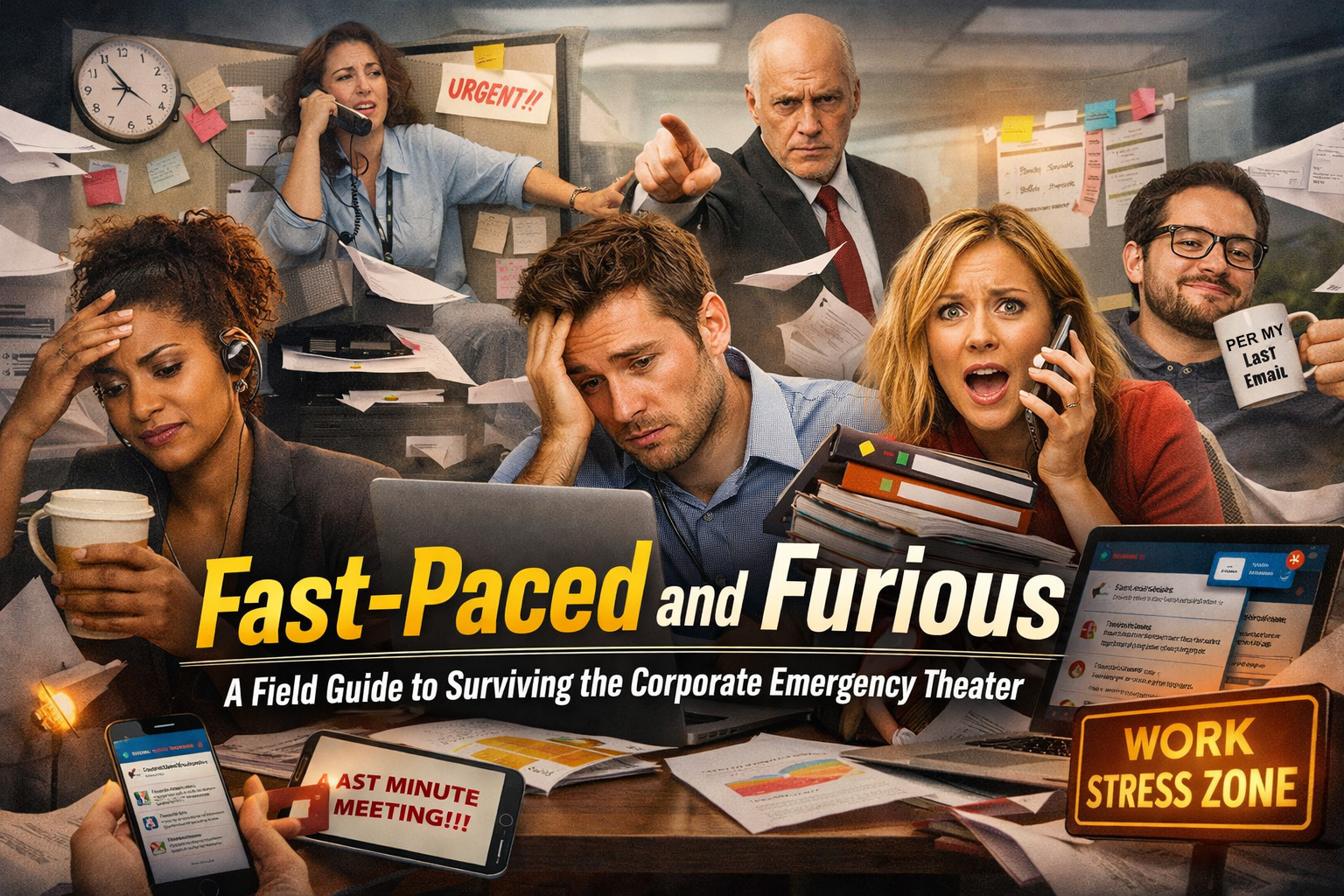
There is a special kind of betrayal that does not arrive dramatically, with thunder or a string quartet or a formal notice from destiny stamped in red ink. It arrives quietly, almost politely, disguised as a sentence in a job description. Three innocent-looking words. Fast-paced environment. A phrase that, in theory, should suggest energy, momentum, maybe even excellence. A place where talented people move quickly because they are efficient, sharp, and united by a common purpose. A place where ideas become action and action becomes progress. A place where things hum.
What it actually means, in many modern workplaces, is that everyone is running through the halls emotionally barefoot while at least two department heads are on fire and somebody in leadership has mistaken panic for standards.
You discover this gradually, because no company says it plainly. No recruiter leans forward during the interview and says, “Just to be transparent, we are one delayed email away from spiritual collapse, and our senior management team communicates primarily through vague urgency and calendar invites sent at criminal hours.” No. They say things like dynamic, collaborative, agile, high-energy, entrepreneurial. Words that sound inspiring until you realize they are simply decorative napkins laid over the open sinkhole of organizational dysfunction.
So you arrive on your first day with hope in your chest and a lunch packed like someone who still believes they will have time to eat it. You walk in with that rare and beautiful innocence only new employees possess, where you still think questions will be welcomed, processes will exist, and the phrase “we’re excited to have you” is not a warning. You are smiling. You are prepared. Your laptop has not yet become an enemy object. You do not yet know that within three weeks you will be reading a message marked urgent while brushing your teeth and wondering whether this is what historians meant when they wrote about the fall of civilizations.
Because the modern workplace, especially the one that advertises itself as fast-paced, is not merely a place of employment. It is an immersive theater production where everyone is pretending the chaos is intentional. It is a haunted house for salaried professionals. A beautifully lit obstacle course made of dashboards, passive aggression, unnecessary status meetings, and a management philosophy that seems to have been assembled from half-remembered TED Talks and pure adrenaline. It is less a company than a live-action exercise in emotional cardio.
And the strange part, the part that makes it almost funny if you do not stare at it too long, is how quickly human beings adapt to nonsense. How fast a person can normalize the absurd. The first time a vice president sends a “gentle reminder” at 9:43 p.m., you blink. The fifth time, you just move your phone farther away from your face like it is radioactive and continue eating pretzels in silence. The first time someone schedules over your lunch, you feel disrespected. By month four, you are consuming yogurt over a spreadsheet like a prisoner with a performance review. Eventually you stop distinguishing between inconvenience and psychological warfare. It all becomes part of the ecosystem.
This is the story of that ecosystem. Of the office that moves quickly not because it is well-run, but because it is perpetually late to itself. Of the people who confuse busyness with brilliance and urgency with meaning. Of the employees who develop emotional sonar, interpret punctuation as threat levels, and learn to tell the difference between a harmless Slack ping and the kind that means somebody, somewhere, has discovered a problem they are about to make your personality.
Because surviving this environment does, in fact, teach you things. Not always the things LinkedIn likes to celebrate, such as strategic thinking or executive presence or stakeholder alignment. No. It teaches you much more useful skills. It teaches you how to keep your voice calm while everything around you behaves like a regional weather event. It teaches you how to decode corporate dialects that sound friendly but smell faintly of blame. It teaches you that professionalism is sometimes nothing more than maintaining eye contact while absolute nonsense introduces itself as policy.
And if you stay long enough, it even gives you a dark little gift: the ability to laugh. Not because it is healthy. Not because it is fair. But because at a certain point, when a grown adult labels a printer malfunction as a mission-critical escalation, laughter becomes less a reaction and more a survival tool. A flare fired from the soul. A final dignified act of resistance against the kingdom of unnecessary urgency.
Welcome to the Emergency Carnival
Every chaotic workplace has an opening act, and it is almost always deceptively mild. No one throws the full madness at you immediately because even dysfunction understands pacing. First, it wants to seduce you. It lets you believe the disorganization is temporary, the confusion is transitional, and the people saying “we’re still ironing a few things out” are referring to a normal amount of operational wrinkling rather than the total absence of coordinated life.
At first, it is little things. A missing login. A training schedule that appears to have been assembled through rumor. Two people giving you opposite instructions with the same confidence level. Someone saying, “We usually don’t do it this way,” followed immediately by someone else saying, “This is how we’ve always done it.” These are your first clues that consistency is not a value here. It is a folklore creature. People speak of it with reverence, but no one has actually seen it.
Then the meetings begin.
There is an art to the chaotic workplace meeting. It is never merely a meeting. It is a sudden atmospheric event. It appears without warning, often late in the day, usually with a title so vague it could describe either a budget review or a hostage situation. Touch base. Quick sync. Alignment. Realignment. Follow-up discussion. Next steps. These titles reveal nothing because the point is not clarity. The point is to gather as many people as possible into one digital room and then watch the responsibility diffuse into a fine invisible mist.
And there is always one person, usually smiling too much, who says, “This should only take five minutes.”
This is one of the great lies of organized labor.
Nothing that begins with that sentence takes five minutes. A true five-minute conversation is simply called a conversation. The phrase “this should only take five minutes” is corporate code for “I have underestimated both the complexity of this topic and my own appetite for hearing myself talk.” Twenty-eight minutes later, someone is screen-sharing the wrong deck, another person is apologizing for joining late from another call, and a manager who has contributed nothing meaningful is saying, “Let’s take this offline,” as if he himself is not the human embodiment of why it should never have come online.
Then come the workplace emergency people, those magnificent curators of unnecessary panic who treat each inconvenience like an asteroid has entered the building.
These people do not walk toward a problem. They announce a problem. They elevate it. They decorate it with drama. They do not say, “The client had a question.” They say, “We have an issue.” Not issue singular in the practical sense, but Issue, capital I, as though the company has entered a chapter title. They do not say, “The file didn’t save correctly.” They say, “We may have a major problem.” They do not say, “Could someone resend that?” They say, “I need all hands on deck.” Sir, the deck in question is a mislabeled PDF and your inability to locate it in the attachments.
What makes them fascinating is not just the panic but the performance. Their urgency is theatrical. Their stress has a costume. They type in fragments. They begin messages with “Need eyes immediately” as though you are all in a submarine and someone has spotted movement through the glass. They create tension where none exists and then position themselves at the center of it like broadcasters during a thunderstorm. They have never solved a situation without first making it sound like it belongs in a documentary narrated by a British man with an expensive voice.
And yet, astonishingly, organizations often reward this behavior. The person who stays calm, thinks clearly, and resolves the matter quietly is seen as helpful. The person who flings open the doors shouting “This is getting critical” before anyone has even assessed what happened is seen as engaged. Somewhere along the way, composure became suspicious and panic became leadership-adjacent.
That is how the carnival starts. You enter expecting work and instead find performance. Every normal task is wrapped in false urgency, every basic inconvenience is introduced like breaking news, and every day has the tone of an evacuation without the decency of an actual fire drill. The workplace is no longer a place where competent adults do jobs. It is now an arena where adrenaline cosplays as operational excellence.
And the worst part is that, in the beginning, you take it seriously. You think perhaps you are the underreacting one. Perhaps this printer really is a strategic threat. Perhaps the 6:12 p.m. message marked high priority truly could not have waited until morning. Perhaps Cheryl’s failure to reply all does, in fact, have implications for the quarter. You do not yet understand that the emergency carnival runs on borrowed seriousness, that half its power comes from convincing reasonable people to suspend their own judgment and join the parade.
Once you understand that, the whole thing becomes less intimidating and more absurd. Not harmless, because absurdity with authority still ruins afternoons. But visible. And once nonsense becomes visible, it loses some of its magic.
The Language of Polite Hostility
Every bad workplace has its own dialect, but the fast-paced chaotic one speaks a particularly rich form of emotional nonsense. It is a language built entirely from smiling threats, diplomatic blame, and phrases that look harmless on paper but hit your nervous system like a folding chair.
This is where real professional development begins, because you are not merely learning to do your job. You are learning to translate. You are becoming a cultural linguist in a country where “just circling back” means “I have decided your timing is now my grievance,” and “friendly reminder” lands with the emotional energy of a sheriff nailing something to your door.
At first, you read these messages literally, which is adorable.
You see “per my last email” and assume someone is helpfully referencing previous correspondence. Later, after exposure and damage, you understand that “per my last email” can carry at least seventeen tones, ranging from mild exasperation to the kind of restrained fury usually associated with monarchs before a beheading. It is not a phrase. It is a weather system.
Then there is “quick question,” possibly the most manipulative arrangement of two words in the professional English language. There is never a quick question. A quick question is the decoy. The decoy arrives first, light-footed and innocent, just to get the door open. Once you answer, the full convoy rolls in behind it: context, attachments, side issues, hidden expectations, a deadline no one mentioned, and somehow a spreadsheet tab you are now morally responsible for understanding. “Quick question” is not the beginning of a question. It is the first sip of a poison served in a tiny paper cup.
You also learn the hierarchy of punctuation, because punctuation in these environments is not grammar. It is emotional weaponry. A period can feel icy. An exclamation point can feel aggressive. Ellipses can carry the weight of disappointment, confusion, suspicion, or a deeply passive-aggressive spiritual shrug. “Thanks.” means one thing. “Thanks!” means another. “Thanks…” means a body has been found. People claim text is tone-neutral. Those people have never received a “Please see below.” from a director who makes bonuses disappear.
And then there are the corporate pet names, those glittery little insults management uses when they want labor from you without the inconvenience of respect. Rockstar. Ninja. Superstar. Wizard. Champion. These words are never used in connection with a raise. Nobody says, “You’ve been such a rockstar, so we adjusted your salary to reflect the value you bring.” No. These terms appear exclusively when someone wants extra output, immediate availability, or cheerful sacrifice. They are stage makeup for exploitation. A manager calling you a rockstar while asking you to clean up a mess caused by leadership is like a pirate calling you captain while handing you a bucket and pointing to the leak.
The most sinister phrase, however, remains “We’re like family here.”
Every employee over the age of twenty-seven hears this and immediately feels their spirit leave the room, because by now we know what this usually means. It does not mean loyalty, warmth, protection, or mutual care. It means porous boundaries, emotional guilt, and a very casual relationship with your time. It means someone will ask for a last-minute miracle and frame your hesitation as a character issue. It means the workplace intends to borrow the language of intimacy without offering the obligations of actual human closeness. Families, at least in theory, show up for you when things fall apart. These workplaces simply cc you.
And this is where the emotional exhaustion really begins, not only in the work itself but in the constant translation. You are no longer just answering emails, attending meetings, and updating documents. You are decoding tone, forecasting intent, and running an internal subtitle system every hour of the day. When someone says, “Would love to see this by end of day,” you know it means they will become spiritually visible in your inbox at 4:49. When someone says, “No pressure,” you know pressure has already entered the building and is now drinking from the office Keurig. When someone says, “As discussed,” but nothing was actually discussed, you realize you are dealing with one of the high priests of revisionist management.
It wears you down in ways that are hard to explain to people outside the system. Not because the phrases are catastrophic on their own, but because each one carries the accumulated weight of everything beneath it. The vagueness. The power imbalance. The plausible deniability. The way people can be deeply unreasonable while maintaining the posture of professionalism. The workplace rarely screams outright. It insinuates. It suggests. It implies. It leaves emotional fingerprints on your day and then insists it was only following up.
And yet, somewhere in the middle of this linguistic swamp, you develop powers. Dark powers, yes, but powers nonetheless. You can identify blame-transfer language from fifty paces. You can detect a trap hidden inside a “just wanted to connect.” You can tell which manager is writing from an airport, which one is pretending not to be angry, and which one has delegated something upward and is now hoping you won’t notice. You become less employee and more codebreaker, standing in the ruins of another unnecessary thread and whispering, “Ah. I see what happened here. Susan used ‘gentle reminder’ with a smiley face. This is now a hostage exchange.”
That is not the skill they promised you in onboarding, but it may be the most valuable one you leave with.
Adaptation, Side Chats, and the Nobel Prize for Not Snapping
The most astonishing feature of the chaotic workplace is not the chaos itself. Human institutions have always been messy, vain, disorganized, and capable of turning simple tasks into ceremonial suffering. No, the truly astonishing part is how efficiently people adapt to environments that should, by all rights, make them stand in a parking lot and whisper, “This cannot be how adults live.”
Adaptation begins physically.
Your body starts participating in the job before your mind has consented. You hear the Teams notification and your shoulders rise like a drawbridge under attack. Outlook becomes less an email platform and more a haunted mirror. Sunday evenings acquire a cinematic sadness, the kind usually reserved for train stations and wartime letters. You open your laptop with the same emotional posture one might use to inspect a basement noise. Carefully. Respectfully. Prepared for badness, but still faintly hoping it is just plumbing.
You stop measuring time normally. There is before the calendar invite and after the calendar invite. There is early morning optimism and the 2:17 p.m. collapse, when everyone has now remembered three more things and wants them by “close of business,” a phrase so cruelly elegant it deserves its own war crimes tribunal. Lunch becomes theoretical. Breaks become folklore. Water is something you encounter by accident while passing through the kitchen like a ghost with dental benefits.
And then something happens that may be the only reason any of us survive these places: side chats.
Side chats are the underground railroad of modern employment. They are where sanity goes to hide. They are the whispered chapel of shared perception. In the official meeting, everyone nods with their cameras off while someone explains a process that appears to have been invented ten minutes earlier by a frightened committee. In the side chat, truth lives. Tiny, exhausted, glorious truth.
“Are you hearing this?”
“Did he just contradict the deck?”
“I think this is the fourth version of this file.”
“If she says ‘alignment’ one more time I’m applying to a lighthouse.”
These messages do not merely entertain. They restore reality. They reassure you that you are not overly sensitive, underperforming, or uniquely incapable of enduring the nonsense. They remind you that another adult, somewhere in the building or on another call, also heard the absurdity clang to the floor and thought, with tenderness and alarm, surely not.
Coworker laughter in bad workplaces is one of the purest forms of human bonding. Not the fake laughter offered upward in meetings, that brittle professional chuckle people release when a leader makes a joke that sounds like it was found in an airport vending machine. No. I mean the real laughter. The off-camera laughter. The two-people-on-chat laughter. The laughter of mutual recognition when a grown executive says, “Let’s be proactive,” about a problem leadership personally raised from birth.
You cling to those moments because they give shape to endurance. They turn suffering into narrative. They help you survive the daily assault of preventable confusion by converting it into something almost artistic. A farce. A workplace opera. A clerical fever dream with quarterly goals.
And in surviving it, you become strange in useful ways.
You become harder to rattle, because after you have seen five people treat a formatting issue like an extinction-level event, true urgency reveals itself more honestly. You become funnier, because humor is what happens when the mind notices a gap between what is happening and what anyone should reasonably accept. You become suspicious, yes, but productively so. You read agendas. You save receipts. You ask clarifying questions in writing. You no longer trust phrases like “small ask” or “simple update” because you know these are the bait fish of labor extraction.
You also become excellent at celebrating microscopic victories. A canceled meeting feels like parole. A functioning printer inspires genuine gratitude. Someone saying, “Actually, that can wait until tomorrow,” nearly brings tears to your eyes because restraint has become a rare and sacred art. Your standards change. Not downward, exactly. More like sideways. You stop waiting for ideal conditions and start honoring every flicker of normalcy like villagers thanking the sun.
This is perhaps the most human thing about office survival: not that people endure, but that they keep finding ways to be alive inside the endurance. Someone brings a dumb meme into the group chat. Someone makes coffee for the team. Someone quietly helps fix a file without turning it into a sermon about accountability. Someone says, “That was ridiculous,” and in those three words gives you back half your nervous system.
The chaotic workplace never intends to make people resilient in this way. It thinks it is producing urgency, output, commitment, grit. What it is often producing is a group of emotionally advanced comedians with excellent documentation habits and the thousand-yard stare of people who have attended too many meetings titled Next Steps.
And frankly, that deserves recognition. Not the glossy recognition of employee appreciation month, with its stale sheet cake and a downloadable badge that says you are valued. Real recognition. Medals. Statues. A small parade. Because there should be national honors for the professionals who manage to remain polite while total nonsense puts on a name tag and asks for a revised forecast by noon.
Final Thoughts: The Skill No One Puts on a Resume
Maybe that is the cruelest joke of all. So much of what the modern workplace actually teaches you never appears in the formal language of career growth. Nobody updates their resume to say, “Maintained composure while organizational absurdity reached sentient levels.” Nobody writes, “Developed advanced pattern recognition for identifying fake urgency, blame migration, and executive emotional weather.” Nobody lists, “Became spiritually immune to the phrase ‘circle back’ after prolonged exposure.”
And yet those are real skills. Hard-earned ones.
Because surviving a workplace that confuses chaos with importance requires a level of emotional discipline that no leadership webinar ever properly acknowledges. It takes restraint to answer calmly when someone else is behaving like a fax machine has endangered civilization. It takes perception to understand when the panic is performative, when the confusion is structural, and when the burden is quietly being rolled downhill toward the nearest competent person. It takes humor to remain recognizably human in an environment where the calendar keeps trying to replace your pulse.
There is dignity in that survival, even when it does not feel glamorous. Even when it looks, from the outside, like answering emails and attending calls and fixing things that should not have broken in the first place. Inside that routine is a whole invisible athletic event. You are balancing expectations, managing personalities, absorbing nonsense, protecting your sanity, and trying not to become the very species of dramatic office creature that once ruined your afternoon with the words “Need this ASAP” attached to something no historian would classify as urgent.
And perhaps that is the real professional development no one talks about. Not the software. Not the certification. Not the leadership framework presented in a hotel ballroom by a man named Brent who keeps saying things like leverage and unlock. The real development is learning discernment. Learning which fires are real and which ones are simply emotional lanterns waved by people who need witnesses. Learning how to be cooperative without becoming available for ritual sacrifice. Learning how to stay generous without becoming gullible. Learning how to keep a straight face while nonsense, dressed in business casual, asks whether you can stay on for just a few more minutes.
Because those minutes are never a few. The spreadsheet is never final. The process is never streamlined. The emergency is rarely an emergency. And the phrase “fast-paced environment” will continue roaming job boards like a charming little liar in polished shoes.
But the people who survive it develop a kind of x-ray vision. They begin to see the machinery. They hear the subtext. They know that “We’re all moving quickly” can mean nobody planned, that “high visibility” can mean high blame potential, and that “family” should never be used by anyone who also controls payroll. They become difficult to fool, which is not cynicism. It is experience with better posture.
And still, somehow, they keep going. They laugh in side chats. They save each other seats in meetings. They translate nonsense for new hires with the solemn tenderness of veterans. They celebrate escaped disasters and tiny mercies. They keep a little piece of themselves separate from the machinery. Enough to notice when something is ridiculous. Enough to laugh when they can. Enough to remember that not every urgent email deserves their bloodstream.
So if you have ever found yourself staring at a laptop on a Sunday evening like it personally betrayed you, if you have ever heard “quick question” and felt your soul pack a bag, if you have ever watched leadership describe preventable disorder as agility, then congratulations. You are not weak. You are not failing. You are simply overqualified in one of the least acknowledged disciplines of modern adulthood.
You have learned how to survive a long-running improv show where the prompt is always the same: pretend this is sustainable.
And maybe the greatest accomplishment is not that you survived it.
Maybe it is that absolute nonsense wore a lanyard, asked for an update by noon, called you a rockstar, and somehow you still managed not to laugh directly in its face.