
There are a few universal truths in life that bind us together as a species: gravity is undefeated, printers sense fear, and every adult eventually becomes the person who says, “I’m not mad, I’m just disappointed,” while holding a piece of evidence like it’s a courtroom drama on TNT.
So when my son came home from an intern interview looking like he’d been emotionally clotheslined by a man in khakis, I did what any loving parent would do: I offered snacks, I asked questions in the calm voice that suggests I am definitely calm, and I stared into the middle distance while my brain quietly drafted the kind of email that ends with “Per my last message” and ruins someone’s entire quarter.
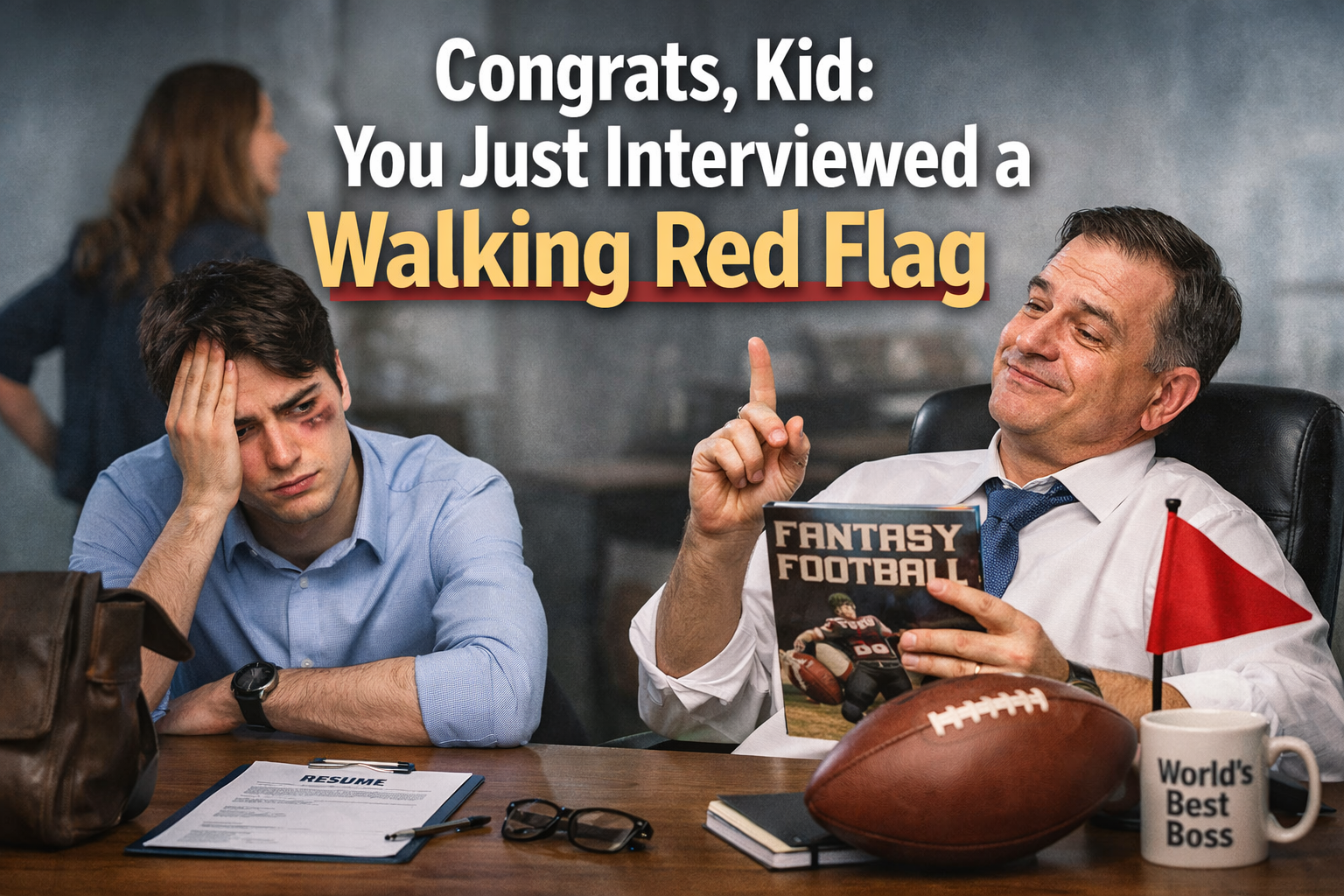
He told me the interviewer opened with: “Honestly, it’s a waste of time to talk to you. You’re just a junior and I’m too busy.”
Which is a bold strategy. Not “bold” like leadership. Bold like wearing flip-flops in a snowstorm. Bold like announcing you don’t wash your hands and expecting applause. And then—because apparently we weren’t fully committed to the “professional development as a contact sport” theme—the conversation drifted into the interviewer’s fantasy football league and how his lineup was shaping up, as if my son had shown up to discuss an internship and instead got seated at a one-man podcast called I’m the Main Character: Season 7.
My son walked out feeling unworthy, injured, and vaguely confused about whether he’d applied for a role or accidentally wandered into a man’s personal diary.
And I was human in that moment, which means I said the thing I wish someone had said to me earlier, before I spent years confusing disrespect with “tough culture” and arrogance with “high standards”:
An unfortunate interview can be a blessing. He just dodged a bullet. Not a metaphorical one either—more like a full corporate cannonball aimed directly at your self-esteem.
Because interviews are supposed to be a two-way evaluation. They’re not a hazing ritual. They’re not a mood swing with a calendar invite. They’re a window into what your life could look like on the inside. And what my son experienced wasn’t “one rude person.” It was a culture preview. It was the trailer. And the trailer said: Coming this fall: a team that talks about how busy they are instead of how they treat people.
The Interviewer Who Thinks Rudeness Is a Personality
Let’s translate what happened, because corporate nonsense always hides behind “just being honest” the way toddlers hide behind curtains with their feet sticking out.
When someone opens with, “This is a waste of time,” they’re not giving feedback. They’re giving a forecast.
They are showing you how they behave when they have power, when they feel rushed, when they’re mildly inconvenienced by having to interact with another human being who does not share their exact résumé length, and—most importantly—when they believe there will be no consequences.
And then we get the fantasy football detour, which is not small talk. It’s not rapport-building. It’s the conversational equivalent of watching someone light your time on fire, then complain about the smoke.
Some people interview like it’s an obligation they didn’t agree to, even though they are literally in the interview. They act like the candidate forced their way into the room, locked the door behind them, and demanded a job at stapler-point.
But here’s the thing: if you’re “too busy” to speak to a junior, you’re not too busy. You’re too fragile.
Because juniors are not threats. Juniors are learning. Juniors are questions with legs. Juniors are the future version of someone you will desperately need when half your team quits after you announce you’re “a family” while cutting benefits. Treating them like inconveniences isn’t a time management issue—it’s a character flaw.
So yes, my son felt punched. Not because he’s weak. Because the interview was a cheap shot disguised as “being direct.” And directness without dignity is just cruelty with an email signature.
The Secret Metric Everyone Ignores—How You Feel In The Room
We spend a lot of time telling candidates to “read the room,” but we never say what that actually means, so people assume it means “endure the weirdness and keep smiling like a customer service rep at a theme park during a thunderstorm.”
Here’s what it actually means:
Pay attention to how you feel in interviews.
Not your nerves. Nerves are normal. Your brain thinks rejection is a bear. It’s fine.
I mean the deeper stuff. The bodily signals. The internal weather report.
Do you feel respected?
Do you feel rushed like an annoying pop-up ad?
Do you feel like you’re being measured, or like you’re being minimized?
Do you feel curious and engaged, or like you’re being tolerated?
Because interviews are a preview of the job. And if the preview makes you feel small, the full movie is going to be three hours long with no intermission and one guy behind you narrating every scene.
This is why “dodging a bullet” is not just a comforting phrase parents say to make their kid feel better. It’s practical career strategy. If someone dismisses you when they’re supposed to be impressed by you, imagine how they’ll treat you when you need help, have a question, make a mistake, or—God forbid—need time to learn.
And let’s be honest: if the interviewer’s biggest flex is fantasy football, you weren’t applying for an internship—you were auditioning to be a supporting character in his weekly monologue.
So yes: there will be a few terrible ones along the way. That’s not failure. That’s sorting. That’s you collecting data. That’s you learning to spot arrogance early, before it moves into your calendar and starts requesting “quick syncs.”
Behavior Gets You The Job—And Also Reveals Who You’d Be Working For
I’ve probably done several thousand interviews, and I’ll tell you what I’ve learned after all those conversations, all those nervous laughs, all those “great question” moments that were clearly not great questions:
Experience and interest get you in the door. Behavior gets you the job.
And that rule applies to both sides of the table.
Candidates get evaluated on how they communicate, how they think, how they respond when they don’t know something, and whether they can explain complex work in plain language without sounding like a textbook had a personality crisis.
But interviewers? They’re being evaluated too—by the candidate, and by every person that candidate tells afterward, including the parents who are suddenly Googling “how to politely set fire to a company’s reputation.”
A good interviewer can do a few deceptively simple things:
They adjust their language based on the audience.
They ask thoughtful questions instead of performing intellectual dominance.
They can tell a real story about being confidently wrong and what they learned, because that’s what mature professionals do: they admit reality happened and they adapted.
They show interest and energy, not because they’re “selling,” but because they actually understand that interviews are conversations, not coronations.
A bad interviewer, meanwhile, treats the room like a stage and the candidate like a prop.
And if you’re a company: candidate experience isn’t fluff. It’s brand. It’s reputation. It’s future hires, future referrals, and yes—future customers. Because the people you interview go back out into the world and talk, and their families talk, and their friends talk, and the story becomes part of your public identity whether you like it or not.
Which means if you’re letting someone run interviews like a bored bouncer at a nightclub that only serves disappointment, you’re not just losing candidates—you’re teaching the market exactly who you are.
Final Thoughts: Congratulations—They Saved You Time
So here’s what I told my son, and what I’d tell anyone who walks out of an interview feeling smaller than when they walked in:
You don’t want to work for a manager who makes you feel unimportant.
You don’t want to work for a company that signals arrogance.
You don’t want to spend your limited days on Earth begging for basic respect from someone who thinks “busy” is a personality and “dismissive” is leadership.
Your goal is to earn more opportunities, meet more people, and decide where you will do your best work. It’s a two-way process. If an interviewer dismisses you, congratulations: they just did you a favor in the rudest possible way. They revealed the culture before you signed the paperwork. They showed you the behind-the-scenes tour where everyone is exhausted and nobody is kind and the biggest conversation topic is a fantasy lineup that no one asked about.
The right team won’t talk about how busy they are.
They’ll be genuinely interested in what you’re learning, how you think, and who you’re becoming.
And if you ever forget that, just remember: you can learn a lot about a workplace by how they treat someone with less power in the room.
Especially when that someone is a junior… and the person across the table is still emotionally living in Week 7 of his league standings.