
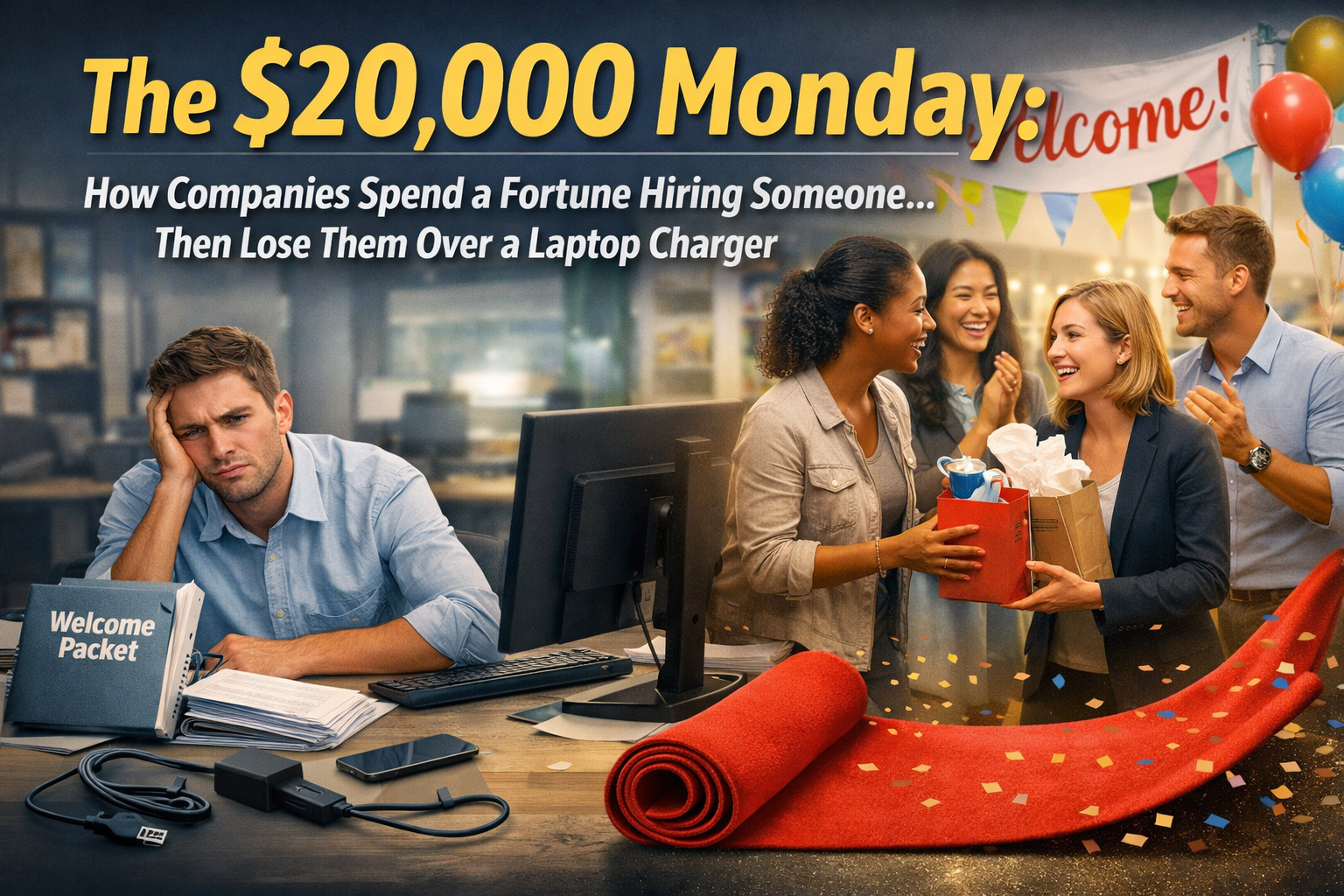
There’s a special kind of corporate magic trick that happens every single week, in offices everywhere, and it’s so consistent it should come with a soundtrack and a waiver.
We will spend months recruiting a new hire like we’re casting the lead role in a billion-dollar film franchise. We’ll conduct five rounds of interviews, two take-home assignments, a “culture chat,” a “values alignment conversation,” and one mysterious final meeting with a person who introduces themselves as “a stakeholder” and then speaks exclusively in metaphors about “rowing in the same direction.”
We’ll debate compensation like it’s a geopolitical summit. We’ll pay recruiters. We’ll pay for job ads. We’ll pay for background checks. We’ll pay for the time of eight employees who each spent an hour asking the candidate if they’re “comfortable with ambiguity,” which is corporate code for: “Do you panic quietly or loudly?”
And then, after all that… after the offer letter is signed and everyone congratulates themselves in Slack with confetti emojis and phrases like “great hire!” and “excited to have you!”… we welcome this person on Day 1 with the enthusiasm and preparation of a gas station burrito.
Laptop not ready.
Email not set up.
Badge doesn’t work.
Manager is “heads down today.”
Nobody knows where they’re supposed to sit.
Someone tells them, “Just read these PDFs,” and hands them a folder so large it should have its own retirement plan.
So the new hire sits. Alone. For eight hours. Scrolling through documents titled things like “Company Values_FINAL_FINAL2.pdf” and “Onboarding Overview (Updated 2021).pptx,” while every passing coworker does that polite half-smile that says, “I don’t know who you are, but I hope you’re not my problem.”
And that night, the new hire goes home and has the first real thought of their employment:
“I made a huge mistake.”
Not because the work is hard. Not because they’re unqualified. Not because they’re fragile. But because humans read signals. And the loudest signal a company can send is this: We wanted you so badly… until you got here.
The most expensive day in your company’s history is not the day you run payroll. It’s not the day you sign a lease. It’s not the day you buy software nobody uses.
It’s the day a new hire shows up ready to give you their best… and you hand them nothing but silence and a dead laptop.
The Day-One Whisper Campaign (Also Known as “The Vibes Are Telling On You”)
Day 1 isn’t orientation. It’s emotional math.
Your new hire is doing calculations you will never see. They’re measuring your competence and your care in tiny moments that feel insignificant to you, but to them are basically a first date with commitment papers.
Is there a plan?
Did anyone expect me?
Do people seem happy I’m here?
Do I feel safe asking questions?
Does my manager look like they want me to succeed… or like they’re surprised I exist?
When the laptop isn’t ready, that’s not just a laptop. That’s a message: “We didn’t think ahead.”
When the email isn’t set up, that’s not just IT. That’s a message: “You’re not integrated.”
When nobody blocks time to meet them, that’s not just scheduling. That’s a message: “You are not a priority.”
And when they spend their first day reading PDFs alone, that’s not training. That’s isolation disguised as onboarding.
Companies love to talk about retention like it’s some mysterious force of nature, like employee loyalty is something you can attract only by burning sage in the break room and posting motivational quotes on the intranet.
But the truth is brutal and simple: people don’t leave jobs, they leave signals. They leave the feeling that they are stepping into chaos, neglect, or indifference.
Day 1 is when the whisper campaign starts, and it’s not gossip, it’s their brain protecting them.
“Maybe this place is disorganized.”
“Maybe they don’t communicate.”
“Maybe I’m on my own here.”
“Maybe they loved me as a candidate but don’t care about me as a person.”
You can spend four years trying to fix a culture problem that was formed in four hours.
The Corporate Red Carpet (It’s Not Extra. It’s Insurance.)
If you want to know what “rolling out the red carpet” actually looks like, it’s not balloons and forced fun and a welcome sign written in a font that screams “we have a committee.”
It’s basic operational respect.
It’s the boring stuff done beautifully.
Laptop ready, logged in, tested.
Email active.
Calendar invites already sent.
A schedule for the first week that looks like someone spent more than nine minutes thinking about it.
A human being assigned to be their point person so they’re not wandering the office like an exchange student.
It’s a manager who blocks time like it’s sacred, because it is.
Not a five-minute “welcome” between meetings. Not a drive-by “glad you’re here” while half-reading a Teams notification. Actual time. A real conversation. A tour. Context. Expectations. How success is measured. What to prioritize. Who to lean on. What the team dynamics are. What the landmines are. Where the bathroom is without needing to ask three strangers and accidentally ending up in the supply closet.
It’s lunch. With people. Not because lunch is a perk, but because lunch is belonging.
A welcome gift doesn’t need to be expensive. It needs to be thoughtful enough to communicate: “We expected you. We planned for you. We’re glad you’re here.”
Because the red carpet isn’t about impressing them. It’s about stabilizing them.
When a new hire feels grounded, they learn faster. They ask more questions. They contribute sooner. They make fewer mistakes. They build relationships earlier. They stop spending mental energy trying to decode whether they’re welcome.
And here’s the part nobody says out loud: the first 48 hours determine whether they will be emotionally committed, or emotionally cautious.
If they start cautious, you will spend months trying to win back trust you didn’t even know you lost.
PDFs Don’t Onboard People. People Onboard People.
Reading PDFs is not onboarding. It’s compliance cosplay.
A new hire doesn’t need a library. They need a map.
They need a story of where they fit and why they matter.
They need to see the work in motion, not just described in a document written by someone who left three reorganizations ago.
They need moments where they can contribute early, even in small ways, because contribution creates confidence, and confidence creates momentum.
They need a manager who can answer questions without acting like questions are interruptions.
They need a team that understands that “being busy” is not a personality trait, and it’s definitely not a leadership strategy.
The fastest way to turn a high-energy new hire into a quiet, cautious, risk-avoidant employee is to teach them on Day 1 that they are inconvenient.
They will adapt. Humans always adapt. They’ll stop asking. They’ll stop offering ideas. They’ll stop reaching out. They’ll become “easy,” which is another word for “disconnected,” and three months later you’ll be sitting in a meeting wondering why they’re not integrating faster.
They’re integrating perfectly. Into the version of your culture you showed them.
Onboarding is not an HR process. It’s a leadership reveal.
It’s you proving, in concrete actions, whether you mean what you said during the interviews.
Final Thoughts: You Don’t Get a Second First Day
Companies love to measure everything except the thing that costs them the most: preventable disappointment.
You can’t “culture” your way out of sloppy onboarding. You can’t “engagement survey” your way out of a first week that felt like abandonment. You can’t fix a bad Day 1 with a good pizza party on Day 30.
The first two days are when your new hire decides whether they made a smart move… or whether they should quietly reopen LinkedIn while pretending to be “excited to learn.”
So treat Day 1 like the financial event it is.
Because you didn’t spend $20,000 to recruit someone just to greet them with a broken laptop, an empty calendar, and the warm human connection of a PDF.
Roll out the red carpet. Not for show. For survival.
The cheapest retention strategy you will ever have is simply proving, immediately, that you meant it when you said: “We’re excited to have you.”