
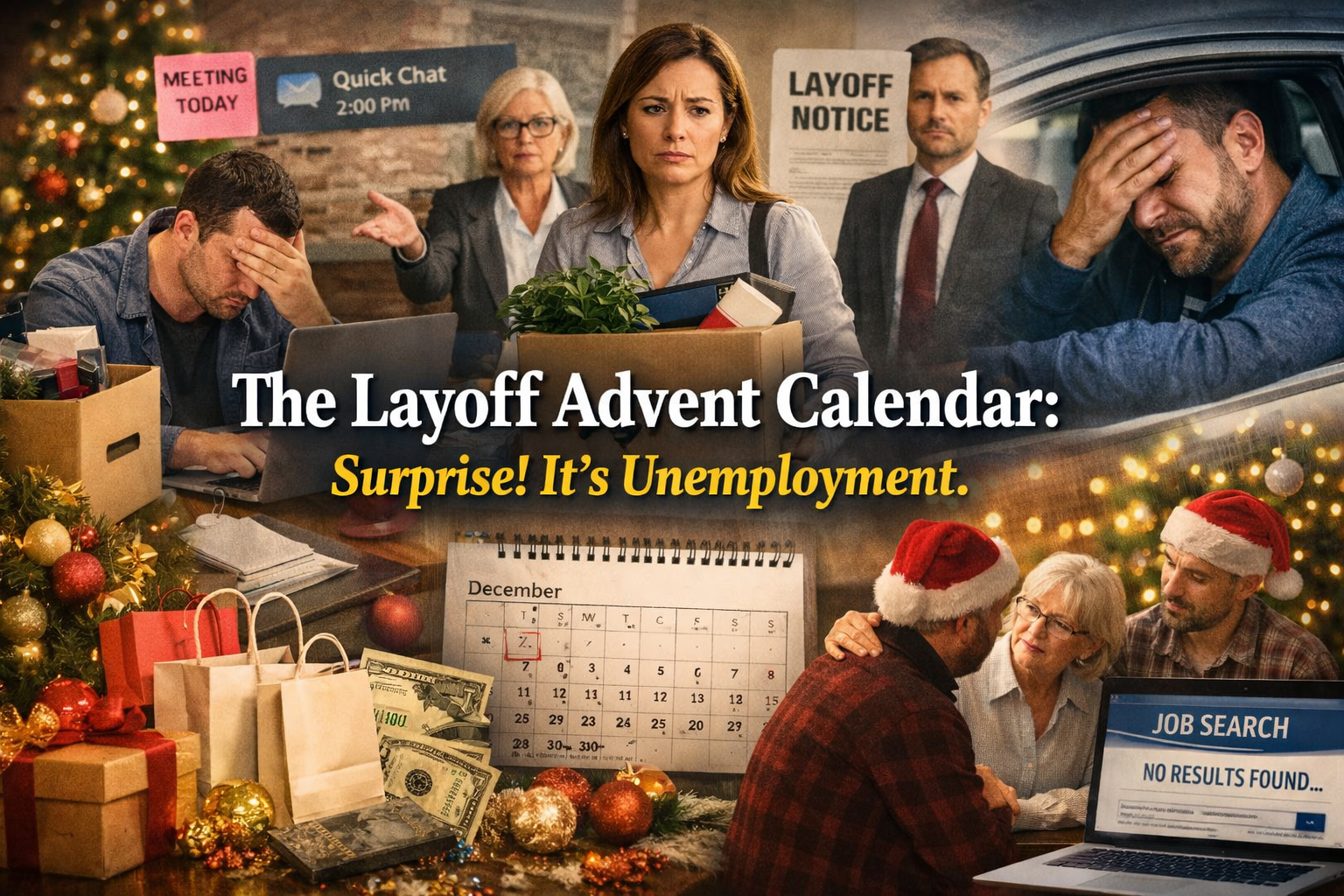
There’s a special kind of corporate magic trick that happens every year around the holidays, and it’s not the “we hit our targets” speech or the catered cookie tray that tastes faintly like printer paper and desperation—it’s the sudden, solemn calendar invite that appears out of nowhere like an unwanted carol singer at your front door, except instead of a song you get a meeting titled “Quick Chat” and a participant list that includes your manager, HR, and a third person whose job title sounds like a medieval punishment, like Director of Workforce Optimization.
And yes, I get it. Every company has timelines. Budgets close. Forecasts shift. Shareholders demand their quarterly sacrificial offering. Some executive somewhere is staring at a spreadsheet with the emotional range of a stapler, and the spreadsheet is saying “cut costs,” and the stapler-executive is nodding like the spreadsheet just delivered a TED Talk. I understand the mechanics. I understand that businesses don’t run on vibes, and that payroll is a line item, and that the phrase “headcount reduction” is a fancy way of saying “we have decided you are now an email forwarding problem.”
But you can understand something and still call it what it is when it happens on December 18th, right after you just bought wrapping paper, right after your kid made you a wish list, right after you finally let your shoulders drop because you thought, for a brief sparkling moment, that you had survived another year of chaos: laying people off right before the holidays still feels like a real dick move.
Because the holidays are already emotionally expensive, even when your bank account isn’t actively trying to file for bankruptcy. It’s the season of “we should get together!” and “can’t wait to see you!” and “what’s new with work?” which is a perfectly innocent question until your answer is, “Well, technically I’m now available for immediate start, and my hobbies include doom-scrolling job boards and pretending this is fine.”
So if you’re someone who got hit in the past few weeks, or if you love someone who did, or if you’re watching it happen across your feed like a slow-motion corporate snow globe where the glitter is just people’s livelihoods, I’m thinking of you—because this isn’t just an HR process. This is someone’s rent. Someone’s medication. Someone’s childcare. Someone’s identity. Someone’s holiday.
And the worst part is that you’re expected to absorb it quietly, politely, professionally, like it’s a minor scheduling inconvenience and not a full-blown life event delivered via Zoom.
So let’s talk about it.
The “Quick Call” That Turns Into a Lifestyle Change
The first thing they take is your sense of time, because layoffs never happen at a normal human hour—they happen at 9:12 AM, or 4:47 PM, or right after you’ve answered three emails and started believing, foolishly, that today might be a day where nothing dramatic occurs. Then the meeting invite arrives with no agenda, no context, no warning, just a vague title like “Touch Base” that reads like a friendly check-in but feels like a trap door disguised as carpet.
You join the call with that weird employee optimism that has been trained into you over years of performance reviews and “growth opportunities,” and for half a second you think, maybe this is good news, maybe it’s a promotion, maybe they’re finally recognizing your work, maybe someone saw you quietly holding the department together with duct tape and sarcasm.
And then you see HR.
HR is smiling the way people smile when they’re about to read a script they didn’t write, but they also didn’t fight, and your stomach drops because you realize this is not a conversation—it’s a ceremony. A ritual. A corporate performance where everyone has lines and the ending is already decided.
They say things like “this wasn’t an easy decision” and “we want to be respectful of your time” which is an incredible thing to say when you are actively detonating someone’s income right before they’re supposed to buy gifts for people they love. They say “position eliminated,” as if your job was an unfortunate typo they just noticed, and they say “impacted,” which is a funny word because it makes it sound like your employment was gently bumped by a bicycle instead of launched off a cliff.
And you nod, because you’re trying to stay composed, because you’re trying to be dignified, because you’re trying not to cry on a Microsoft Teams call where your face is now frozen in the most unflattering expression possible, because of course the internet chooses this moment to lag.
Then comes the surreal stuff: the severance explanation delivered in the tone of someone explaining a return policy, the benefits timeline that turns your healthcare into a countdown clock, the part where they tell you you can “reach out with questions” even though your main question is “are you kidding me,” and the part where they thank you for your contributions as if your contributions were a seasonal decoration they’re now putting back in a box.
And when the call ends, you’re not just unemployed—you’re disoriented, because the world didn’t stop. Your email still pings. The sun is still out. Someone on another team is still asking if you can “quickly take a look” at a document, and you’re sitting there like a person who was just shoved off a moving train, expected to land gracefully and then update their LinkedIn headline.
The Holiday Season, Now With Extra Shame Sprinkles
People don’t talk enough about how layoffs don’t just remove your paycheck, they also remove your social script. Because the holidays are built on scripts. You go to gatherings. You see relatives. You run into people you haven’t seen since last year. You do the small talk dance. And small talk, in the winter, always includes the same cheerful question delivered like a snowball: “How’s work?”
And if you were laid off recently, you have to decide, in real time, how much truth the room can handle.
Option A: you lie and say “it’s good,” and then you feel like you’re wearing someone else’s skin for the rest of the evening.
Option B: you tell the truth, and you watch the room shift into that awkward sympathy silence where people start speaking more softly, like you’re a startled animal, and suddenly everyone wants to give you advice even though you didn’t ask for a TED Talk from Uncle Todd who once “networked his way” into a job in 1997 by handing a résumé to a guy named Mike at a deli.
Option C: you try to joke about it, because humor is a survival strategy, but then someone tells you “everything happens for a reason,” and you have to physically resist the urge to start flipping tables like it’s the end of a reality show episode.
Because here’s the thing: layoffs carry this weird shadow of shame, even when you did nothing wrong, even when your performance was strong, even when your team loved you, even when your manager is texting you apologetically like a person whose hands are tied by a corporation that moves like an avalanche.
You start wondering what you missed. You replay conversations. You reread old feedback. You scroll through Slack messages like you’re searching for the exact moment the universe decided you weren’t “critical” anymore. You look at your calendar and realize you had goals for next year, and now next year is just a big blank space where you’re supposed to magically reinvent yourself in time for Q1.
And all of this happens while the world is telling you to be festive.
The world wants you to sip cocoa and feel grateful and post photos of twinkly lights, while your brain is doing mental math on severance and rent and insurance and whether you can stretch your savings like a piece of gum that’s already lost its flavor. The holiday music in stores becomes less “cozy nostalgia” and more “soundtrack to an emotional hostage situation.”
And yet you still show up. You still buy gifts if you can. You still smile for pictures. You still try. Which is why I’m thinking of you, because the strength it takes to keep functioning through that kind of uncertainty is the kind of strength nobody applauds, because it doesn’t come with a certificate, it just comes with you getting out of bed again.
Corporate Timing and the Art of Pretending It’s Not Cruel
Some companies act like layoffs are weather, like they’re just a thing that happens, like “a storm came through” and unfortunately your job got struck by lightning, and nobody could have predicted this, except for the part where leadership absolutely predicted it because they planned it, scheduled it, legal-reviewed it, and then chose the exact date.
That’s the part that stings, because while leaders say “it’s just business,” timing is also business, and choosing the holidays is a choice. It’s not accidental. It’s not unavoidable. It’s a strategic decision wrapped in soft language so nobody has to sit with how harsh it looks.
And the reason it happens is usually some combination of:
- end-of-year financial optics,
- reorganizations that need to “start fresh” in January,
- a desire to wrap the “messy stuff” before people go out of office,
- and the classic corporate belief that if you schedule something quietly enough, it becomes less real.
But people aren’t line items, and they don’t experience timelines like Excel does.
A budget doesn’t feel panic. A quarterly report doesn’t feel humiliation. A shareholder deck doesn’t feel the moment someone sits in their car in the driveway so their kids won’t see them cry. A spreadsheet doesn’t feel the dread of opening job boards when half the companies are on holiday break and the other half are “pausing hiring until after the new year,” which is corporate for “good luck, see you in February.”
And to be clear, this isn’t about pretending layoffs never happen. Companies will restructure. Markets shift. Sometimes the math doesn’t work. Fine. But what people can’t stomach is the performance of compassion layered over a decision that lands like a brick.
It’s the “we’re family” companies that suddenly act like your badge is a rental. It’s the “people-first” slogans that dissolve the moment the numbers get tense. It’s the leadership posts on LinkedIn about gratitude and resilience while their employees are privately refreshing their bank apps like it’s a game show.
And if you’re the person who just got cut, it can make you feel crazy, because you’re grieving while the company is celebrating. You’re unraveling while they’re posting holiday photos. You’re dealing with the most personal kind of disruption while they’re calling it “alignment.”
So yes—call it what it feels like. It’s not unprofessional to name the truth. It’s not bitterness to say the timing was cruel. It’s not weakness to be angry. It’s your brain correctly identifying that you deserved better handling than a cold calendar invite and a scripted goodbye.
Final Thoughts: If This Happened to You, You’re Not the Problem
If you were laid off in the past few weeks, please hear this as clearly as possible: your worth did not evaporate because a company chose a date. You did not become less talented because a budget changed. You are not suddenly “less valuable” because someone decided your role was “non-essential,” especially when you were essential enough to carry responsibilities right up until the moment they disconnected your access like flipping a light switch.
You’re allowed to be mad. You’re allowed to feel embarrassed. You’re allowed to feel numb. You’re allowed to feel all of it, because this is not just an operational change—it’s a human hit.
And if you’re someone watching it happen to others, thinking of them quietly but not sure what to say, say something simple and real: “I’m sorry. I’m here. I see you.” Because the most painful part of layoffs isn’t always the paycheck—it’s the sudden feeling that you disappeared from a place you gave your time, your energy, your skills, your brain.
So yes, every company has a timeline.
But people have lives.
And laying people off right before the holidays will always feel like a real dick move, because the timing tells you exactly how much space the company made for your humanity.
Thinking of everyone impacted these past few weeks—seriously.