
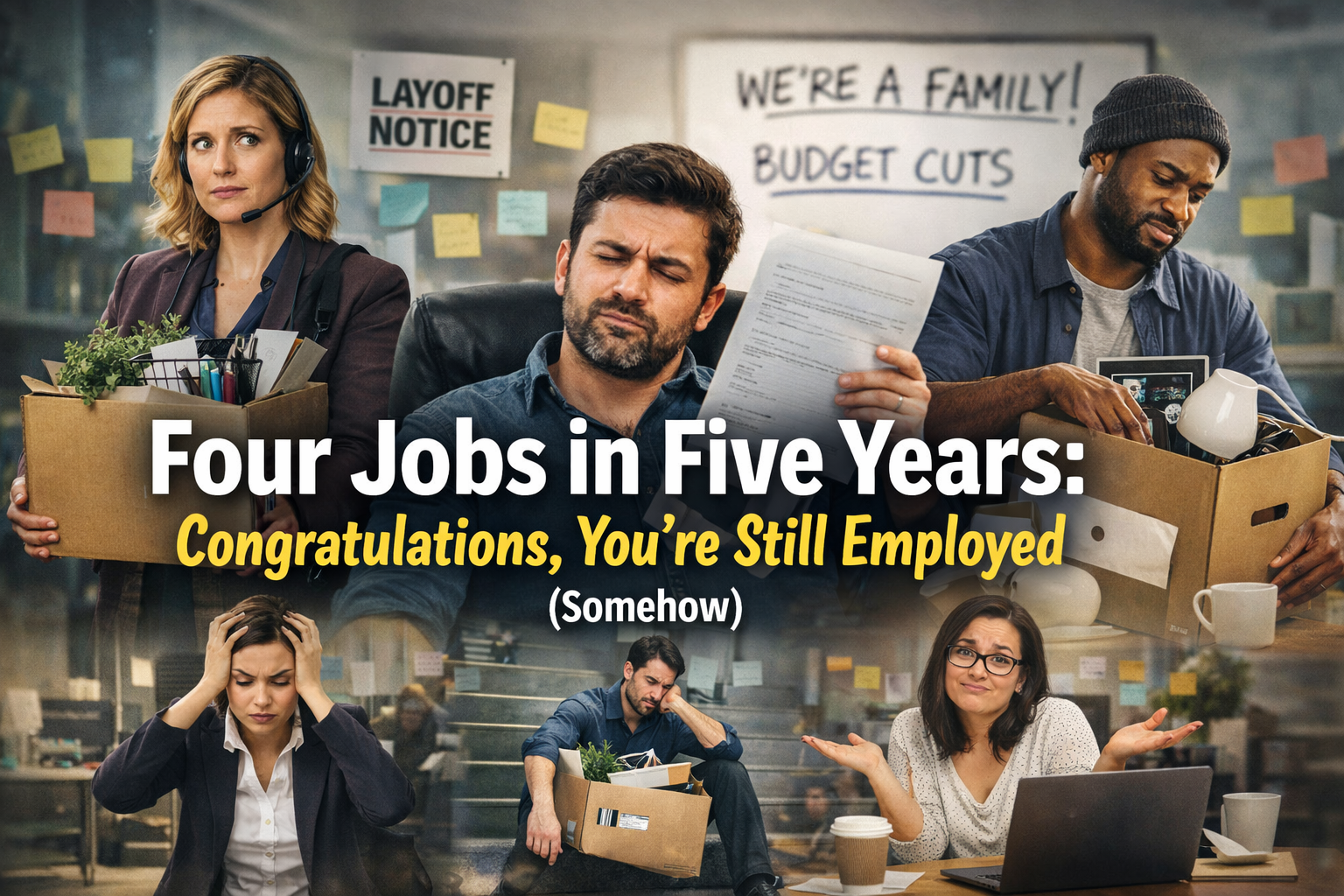
There’s a very specific moment in modern hiring where a person with a lanyard and a strong opinion about “culture fit” leans back in their chair, squints at your resume like it’s a blurry license plate from a crime scene, and says, “Hmm. Four jobs in five years.”
Not as a question.
As a verdict.
As if they just found a hidden watermark that reads: UNRELIABLE, MAY FLEE AT LOUD NOISES, DO NOT FEED AFTER MIDNIGHT.
And I need you to understand: this is not curiosity. This is not concern. This is not the thoughtful, human instinct to ask, “Hey, what happened?” This is suspicion—delivered with the same energy people use when they see a neighbor carrying a shovel at night. Recruiting has somehow decided that longevity equals loyalty, and movement equals instability, as if the last decade didn’t happen to all of us at the same time. As if layoffs didn’t turn into a seasonal tradition. As if startups didn’t vanish overnight like a magician’s assistant. As if “reorg” didn’t quietly become corporate for “you should start updating your resume while smiling in meetings.”
We are judging modern careers using rules written for a world that still had office phones and managers who knew your kid’s name because you worked there long enough to have one. A world where you stayed, they rewarded you, and your biggest threat was accidentally hitting “reply all” on a bake sale email. A world where stability was real and not just a phrase leadership used right before taking away your budget, your team, and your will to live.
But here’s the thing nobody wants to say out loud in the hiring process, because it would ruin the vibe of pretending the system is rational:
In tech, four jobs in five years isn’t job hopping.
It’s attendance.
It’s showing up to the chaos every day with a clean shirt and a brave little heart, pretending you’re not one Slack notification away from becoming a cautionary LinkedIn post.
So let’s stop acting like the resume is a moral document. It’s not a confession. It’s not a criminal record. It’s a timeline—one that often reads like a disaster film where the hero keeps surviving the collapse of yet another shiny new corporate city made entirely of buzzwords and venture capital.
This is that story.
The Career Syllabus, Taught by Chaos
If you’ve had four jobs in five years, congratulations: you have completed the modern career curriculum, which is less of a degree program and more of an obstacle course sponsored by optimism and caffeine.
You didn’t “bounce.” You didn’t “get restless.” You didn’t “struggle to commit.”
You got enrolled.
Startup runs out of money? That’s not instability—that’s a corporate meteor strike. It’s not your fault the company treated a runway like a suggestion and tried to fuel a spaceship with vibes, ambition, and one investor who stopped answering emails. One day you’re “moving fast and breaking things,” and the next day you’re watching the CEO type “unfortunately” with the intensity of someone attempting to un-invent the concept of payroll.
Toxic manager slowly drains your will to live? That’s not flight risk, that’s self-preservation. That’s your nervous system filing a complaint. That’s your soul quietly packing a suitcase while you nod along on Zoom, wondering when “high standards” became a synonym for “public humiliation with a calendar invite.”
Contract role ends because the project ends? That’s literally the entire point of contract work, but hiring managers still look at it like you personally chose to end the project out of boredom. “Why did you leave?” Because the work ended, Brenda. The thing I was hired to do stopped existing. Should I have stayed and haunted the building until they gave me a permanent desk?
Layoff wipes out an entire department? Sorry you didn’t personally save the budget with vibes. Sorry you didn’t outmaneuver the quarterly earnings report with sheer grit and a well-timed motivational quote. You were not laid off because you lacked loyalty. You were laid off because someone several layers above you discovered numbers, panicked, and decided your team was “no longer aligned” with the company’s “exciting direction,” which is corporate for “we’re going to keep doing the same thing but with fewer people and more pressure.”
None of these are red flags.
They’re required electives.
They’re the classes you take because the system forces you into them. “Surviving Reorg 101.” “Advanced Pivoting Without Getting Whiplash.” “How to Smile While Your Role Is Quietly Being Rewritten.” “Capstone Project: Getting Laid Off on a Tuesday and Interviewing on Thursday Without Crying in the Shower.”
And if you’ve lived through it, you know: resilience rarely looks tidy on a timeline.
It looks like motion.
It looks like adaptation.
It looks like you refusing to become a ghost in a place that no longer has room for you to grow, breathe, or exist without being measured like a KPI with feelings.
The Myth of the One-Company Fairy Tale
There’s a special kind of nostalgia hiring teams cling to: the 1987 pension brochure fantasy.
One company. Twenty years. A gold watch. A handshake. A slow fade into retirement with a sense of calm that can only exist when the org chart hasn’t been reorganized since the fax machine.
And look, if that worked for someone—great. Love that for them. No notes. Enjoy your stability and your matching set of desk accessories you’ve had since Clinton.
But the rest of us have been living inside a corporate hurricane where “stability” is a word leadership uses right before the floor drops out.
We’ve navigated:
- Reorgs that happen so often you start introducing yourself with your previous title, just in case.
- Mergers where the two companies claim they’re “stronger together,” but somehow only one side keeps their jobs.
- Budget freezes that appear immediately after leadership announces a record quarter.
- “Exciting new directions” that mainly involve doing the same work with fewer resources and more motivational emails.
- Managers who say “we’re a family” right before deleting your calendar access.
So when someone stares at a resume like it’s an indictment, what they’re really doing is applying a stability standard to an unstable world. They’re looking for proof you could survive in a system that doesn’t exist anymore—and then penalizing you for surviving the one we have now.
The wildest part is how moral this gets, fast.
“Four jobs in five years” isn’t just treated like a pattern—it’s treated like a character flaw. Like you lack discipline. Like you’re impulsive. Like you can’t be trusted near a long-term project or a 401(k).
But what if the pattern is simply… reality?
What if the timeline isn’t chaos because you’re unreliable—what if it’s chaos because industries built on constant change create constant displacement?
What if the resume is doing the honest work of documenting a world where loyalty is constantly demanded but rarely returned?
Because here’s the truth no one wants to put in the job description: most companies do not reward commitment the way they claim they do. They reward convenience. They reward timing. They reward you right up until they don’t. And when the numbers shift, the story changes, and suddenly your loyalty becomes a “cost center.”
So the question isn’t “Why did you move?”
The question is “How did you keep going?”
Because if you’ve had four jobs in five years, you likely have stronger professional muscles than someone who’s never had to leave a place that felt safe. You’ve learned how to ramp quickly, build trust fast, deliver under ambiguity, and keep functioning while everything around you changes.
That’s not instability.
That’s capability.
Astrology for Recruiters and Other Lazy Filters
Calling someone a job hopper without asking why is the laziest filter in hiring.
It’s astrology for recruiters.
“Oh, you’re a Capricorn with four jobs in five years? Interesting. That suggests you’re ‘avoidant’ and ‘flighty.’ Also your aura says you’re going to ask for a salary.”
It’s counting roles instead of listening to stories. Assuming instability instead of recognizing adaptability. It replaces curiosity with shortcuts, and it ignores the fact that resilience rarely comes with clean edges or a neat timeline.
Some people didn’t leave because they were bored.
They left because the company folded.
Because the culture imploded.
Because the role ended.
Because survival required motion.
Because staying would have meant burning out, breaking down, or slowly disappearing in a place that no longer had room for them to be human.
And yes, there are people who bounce for reasons that matter in a hiring context. Of course. Sometimes someone really is chasing novelty. Sometimes they’re leaving messes behind. Sometimes they don’t stick around long enough to finish what they start.
But you don’t learn any of that by counting jobs.
You learn it by asking questions.
By treating the resume like a timeline, not a criminal record.
By understanding that a career isn’t a straight line anymore—it’s a series of strategic decisions made inside a system that keeps changing the rules mid-game and then blaming you for adjusting.
If anything, the real red flag isn’t movement.
It’s never having had to move at all—never having been tested by uncertainty, never having been forced to adapt, never having had to rebuild, never having had to walk into a new environment and earn credibility again from scratch.
Because the person with four jobs in five years has likely done what every company claims they want:
They’ve adapted fast.
They’ve learned quickly.
They’ve navigated chaos without becoming it.
They’ve landed on their feet without needing to be rescued.
They’ve rebuilt their confidence multiple times in a world that keeps trying to turn professionals into disposable parts.
That’s not a problem to solve.
That’s a skill set.
Final Thoughts: The Resume Isn’t a Red Flag. It’s a Survival Story.
Four jobs in five years doesn’t mean someone can’t commit.
Sometimes it means they’ve had to commit repeatedly—to new teams, new tools, new expectations, new managers, new cultures, new political landscapes—while still delivering, still learning, still getting up when the floor collapses again.
So maybe we stop treating movement like evidence of instability and start recognizing it as evidence of endurance.
Maybe we stop worshiping the illusion of loyalty that only exists when the environment is safe.
Maybe we stop hiring with shortcuts and start hiring with curiosity.
Ask what happened.
Ask what they learned.
Ask how they navigated chaos without turning bitter.
Ask how they kept their professionalism intact while the world kept shifting under them.
Because the truth is: in modern hiring, “four jobs in five years” isn’t a confession.
It’s a receipt.
And the only thing it proves, beyond any doubt, is that the person in front of you knows how to survive—and still show up ready to work.