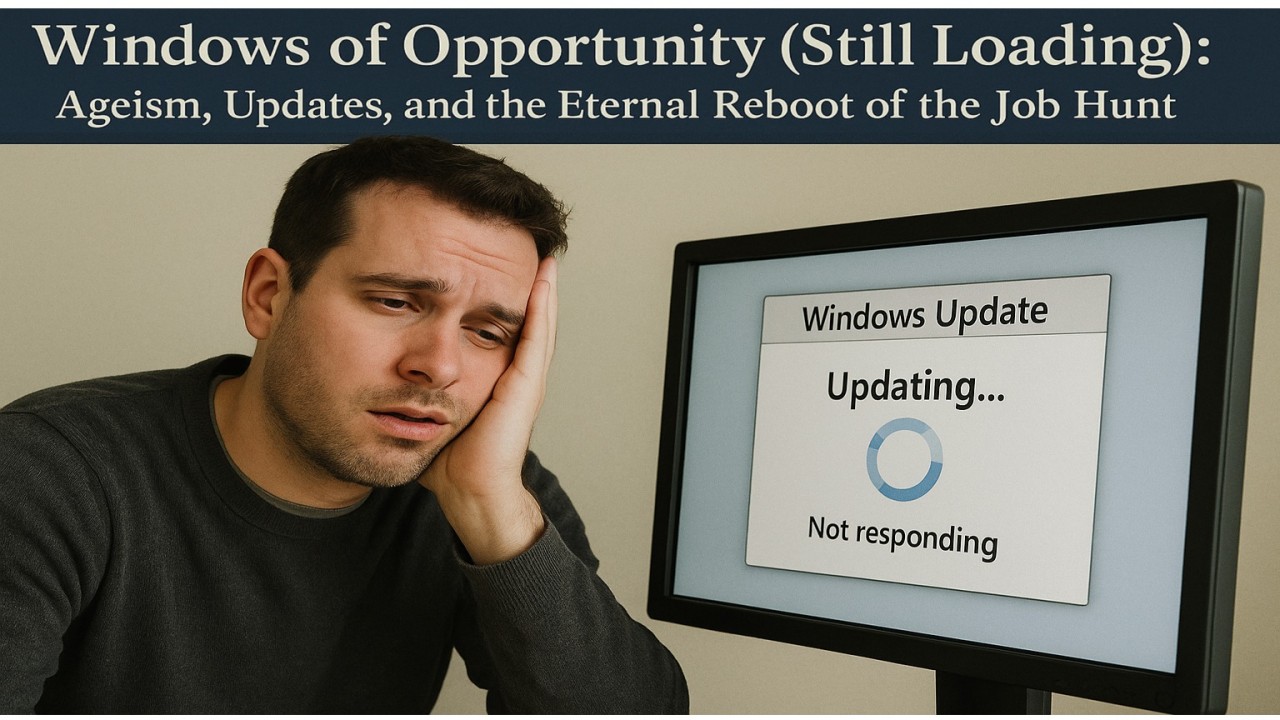
There’s a strange poetry in watching your screen freeze during a job application. The little blue circle spins endlessly, hypnotically, whispering, “Not responding.” You stare back, muttering, “Same, buddy. Same.” Because at some point, job hunting after 40 starts to feel less like a career move and more like troubleshooting an operating system that keeps insisting you are the problem.
I remember a time when “experience required” actually meant something. Now it’s corporate code for “but not too much experience, please.” Apparently, the sweet spot is somewhere between being born during a software update and having no memory of dial-up. The moment you list more than two decades of experience, the algorithm flags you like an old file extension it doesn’t recognize. “Error: applicant no longer compatible with system requirements.”
That’s when it hits you, modern recruiting is basically Windows Update, but for humans. There’s always a new version coming out, full of glitches disguised as progress. Every time you adjust to the latest trend, remote interviews, video resumes, personality tests that determine your “vibe compatibility” they move the goalposts again. “We’re using AI now,” they say proudly, as if the machines haven’t already decided you’re a threat to their energy efficient workflow.
Let’s talk about that for a second. Artificial Intelligence. The same technology that can write a poem, drive a car, and analyze DNA somehow can’t tell the difference between a seasoned professional and a retired password. You spend hours tailoring your resume, adjusting every line to match the job description like it’s a dating profile: “Energetic. Adaptable. Willing to relocate. Excellent with systems younger than me.” And what do you get? Silence. No rejection, no interview, just the quiet dignity of being ghosted by software.
And when you do make it past the algorithm, you enter the next level: the “culture fit” conversation. That’s where they smile and say things like, “We love your experience! We’re just not sure you’d thrive in our fast paced, youthful environment.” Translation: “You remind us of our dad, and that’s uncomfortable.” Apparently, wisdom, stability, and a track record of results are now liabilities in the land of kombucha and casual Fridays.
It’s wild, isn’t it? Companies claim they want innovation, leadership, and mentorship, then panic when someone walks in who actually has all three. They say they’re seeking diversity of thought, but not that kind of diversity. They want fresh ideas from people who haven’t yet had time to test any. And so, here we are, updating our resumes like system patches, removing dates, softening titles, deleting history to appear more “agile.” Because in today’s job market, relevance is less about skill and more about aesthetics.
I once sat through a group interview where the hiring manager used phrases like “hyper collaborative ecosystem” and “digital synergy alignment.” I’m pretty sure those words mean nothing, but everyone else nodded like they’d just been baptized in jargon. When I finally asked, “So… what does that actually look like day to day?” she blinked twice, then said, “We’re still figuring that out.” Ah yes, the Windows Vista approach to leadership, shiny on the outside, complete chaos underneath.
But here’s the part they don’t tell you: ageism doesn’t just sting because of rejection. It stings because it underestimates everything you’ve already overcome. The deadlines, the layoffs, the bosses who couldn’t lead a team out of a paper bag. The projects you saved, the fires you put out, the wisdom you built by showing up long before Wi-Fi was stable. They act like time is a weakness when, in reality, it’s your greatest credential. You didn’t just learn the system, you helped build it.
Still, you adapt. You learn to smile during interviews when someone half your age says, “Tell me about a time you dealt with change.” You nod respectfully, resisting the urge to say, “The entire internet was born during my career, kiddo.” You take courses, add certifications, polish your LinkedIn banner, and pretend you’re thrilled about “disruption.” Because deep down, you know that behind every start-up buzzword, someone still needs a grown-up who can actually fix things.
And fix things we do. Because we’ve been rebooting long before it was trendy. We survived Windows 95 crashes, dial-up tones, corporate mergers, and managers named Chad who thought “mentorship” meant forwarding memes. We’ve rebuilt careers, industries, and ourselves, over and over again. Age doesn’t make you obsolete. It makes you durable. It gives you perspective, humor, patience, and the rare ability to know when a system’s about to crash long before the warning pops up.
So no, we’re not outdated software. We’re vintage, tested, stable, reliable, and impossible to replace. Let the new generation chase speed; we’ll bring wisdom, calm, and the ability to troubleshoot when their cloud goes down. Because when chaos hits, they won’t need influencers, they’ll need problem solvers. And those of us who’ve rebooted our lives more times than Windows itself? We’ll still be here, sipping our coffee, smiling knowingly, and whispering, “Don’t worry. I’ve seen this bug before.”
Because we may be older, but we’re still running. Smoothly. Silently. Efficiently. The only thing we’re waiting on now, like that stubborn loading circle, is for the world to finally update its mindset.






Your article helped me a lot, is there any more related content? Thanks!