
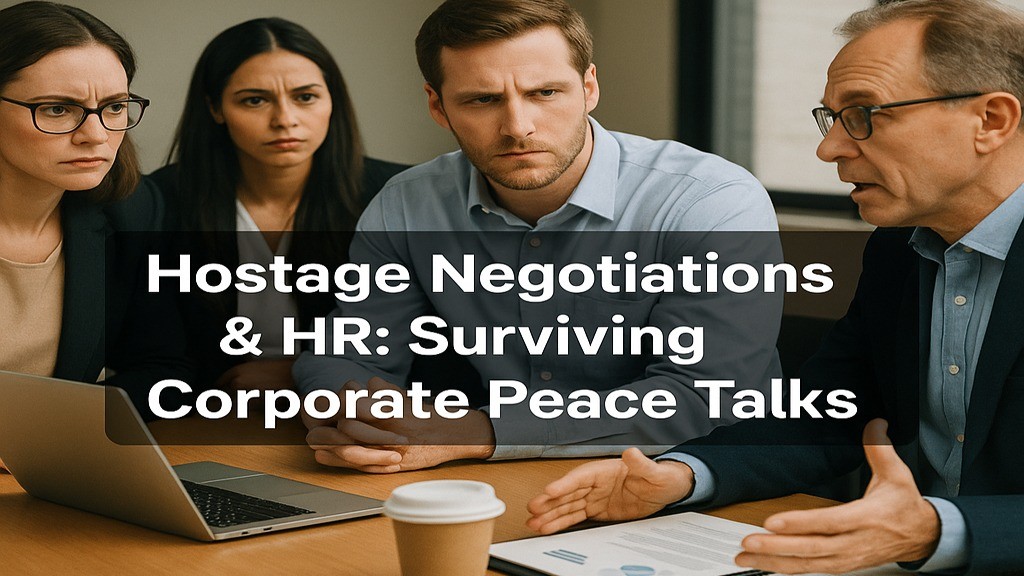
You ever find yourself in one of those conversations that start off like a casual coffee chat, but slowly, almost imperceptibly, morph into a hostage negotiation? You’re sipping your latte, laughing politely, and then boom you realize you’ve walked straight into the HR Twilight Zone. The air shifts. The smiles tighten. Someone says “company values,” and suddenly you’re surrounded by people armed with buzzwords, flowcharts, and PowerPoint confidence.
That was me last week. I thought I was about to have a light, constructive discussion about hiring trends. You know, how companies could make interviews feel a little less like psychological endurance tests and a little more like, oh I don’t know, conversations between human beings. But the moment I said, “Maybe the hiring process is a little… broken?” it was as if I’d insulted their entire lineage.
Three HR managers. One of me. A caffeine fueled optimist against the polished calm of corporate diplomacy.
The temperature dropped ten degrees. Laptops opened. Pens clicked. I could practically hear the Law & Order intro music playing in the background. One leaned forward, elbows on the table, eyes narrowed in that polite but deadly HR stare, the kind that says, we’re about to ruin your argument with procedure.
Within minutes, I realized this wasn’t a discussion. It was an intervention. And I was the heretic daring to suggest that maybe just maybe ghosting qualified candidates and asking for 15 years of experience for an entry-level role wasn’t the best look.
The Debate — Best Practices and Other Corporate Myths
Here’s the thing about HR debates: they start calm, but the jargon always comes first. “We follow best practices,” one of them said, with the serene confidence of a yoga instructor explaining enlightenment. “We value all applicants equally,” said another, which is HR for “We’ll ghost you politely after round three.”
I nodded. I smiled. I even sipped my coffee slowly, the way you do when you’re deciding whether to engage or just fake a Wi-Fi disconnection. But curiosity won.
I said, “You can’t keep posting jobs that require 10+ years of experience for positions that barely pay rent. You can’t call it ‘junior-level’ and then demand leadership experience, six software proficiencies, and the ability to walk on water.”
They didn’t flinch. One calmly replied, “But alignment with company culture is essential.”
Ah yes, culture fit, the eternal loophole. The all purpose corporate justification. It’s the professional version of “It’s not you, it’s us,” except this time, it’s definitely you. Culture fit is how companies explain hiring the intern’s cousin over the qualified professional. It’s how “alignment” becomes code for “we didn’t like your tone when you breathed.”
As the conversation went on, it became clear that I wasn’t talking to people, I was talking to a philosophy. HR’s version of religion. They were defending “best practices” like sacred scripture, quoting job descriptions as gospel. “We’re committed to improving candidate experience,” they said. Translation: “We updated the font on our rejection emails.”
I tried to keep my cool, but it felt like debating the entire ideology of modern corporate denial, one where logic takes a backseat to liability.
The Crack — Where Communication Goes to Vanish
Just when I thought I’d made a dent, one of them smiled (too kindly, always a bad sign) and said, “We don’t ghost candidates. Sometimes communication just falls through the cracks.”
The cracks.
Let me tell you something about those cracks. They’re not small. They’re vast, echoing canyons where thousands of job applications go to die slow, bureaucratic deaths. Resumes, cover letters, portfolios, gone. Swallowed whole. Candidates don’t fall through them; they’re catapulted like confetti at a corporate parade celebrating “record engagement” and “successful Q4 hiring alignment.”
And the best part? HR acts like they’ve never heard of the bodies. “Oh, you didn’t hear back? That’s strange!” they say, staring into the distance like ghost hunters pretending not to see the spirits hovering behind them.
I laughed. I couldn’t help it. My coffee almost came out my nose. “Falls through the cracks?” I said. “Buddy, that’s not a crack, that’s the Grand Canyon of silence. You could fit every ghosted applicant from the last decade in there and still have room for next quarter’s batch.”
They didn’t laugh back. Of course they didn’t. I think laughter has to be cleared by Compliance first.
Then they turned the tables, HR always does and asked, “So what would you do differently?”
And that’s when I thought, this is it. My TED Talk moment. My cinematic redemption arc. Cue the inspirational background music and spotlight. I took a deep breath and said, “Maybe start by treating job seekers like people. Not numbers, not statistics, not lines in your CRM. People. Maybe stop sending rejection emails that begin with ‘Dear Applicant’ like you’re addressing a ghost. And maybe just maybe hire based on skill, not birth chart.”
Still silence. The kind of silence that makes you wonder if you accidentally said something radical like “empathy.”
One took a long sip of water, the kind that says, “I’m recalibrating my buzzword cannon.” Another adjusted her glasses, which is the universal HR signal for defensive mode activated. The third began typing notes that will almost certainly end up in a PowerPoint called “Handling Difficult Conversations with Passionate External Parties.”
Finally, one of them spoke, her tone the perfect blend of diplomacy and denial: “We appreciate your feedback.”
And there it was. The corporate period at the end of every honest sentence. “We appreciate your feedback” the soft, smiling way of saying, This conversation never happened, and if it did, no it didn’t.
I nodded, smiled, and finished my coffee, knowing full well it was over. You can’t out talk a system built to sound polite while saying nothing. You just sip, smile, and make peace with the fact that somewhere out there, your resume is still falling through the cracks, probably being used as a coaster in the breakroom of “People & Culture.”
The Escape — Surviving HR and Living to Tell the Tale
When it was finally over, I wasn’t sure if I’d changed any minds or just provided material for their next internal training module titled “Dealing with Passionate Individuals Who Ask Too Many Questions.”
They smiled, thanked me for my “valuable insights,” and left me sitting there like a man who’d just survived a polite corporate exorcism. My coffee had gone cold, my optimism slightly wilted, and I swear I could still hear the faint echo of “we appreciate your feedback” bouncing around the conference room walls like a haunted mantra.
But walking out, I realized something: you can’t reason with a system built to justify itself. It’s like arguing with a GPS that insists you make a U-turn into traffic. You can challenge it, sure. You can crack a few jokes, toss a few grenades of honesty, maybe even get someone to blink twice before returning to their “People Strategy” PowerPoint. But you won’t win. Not really. The system wasn’t designed for conversation, it was designed for containment. You just learn to navigate it, like dodging lasers in a room full of policies and employee handbooks that double as shields.
Still, it felt good to say it out loud. To call it what it is. Because behind the buzzwords, the templates, and the “Thank you for your interest” emails, there are real people out here, tired, talented, hopeful people, just trying to be heard. People rewriting resumes for the tenth time, refreshing inboxes like it’s a second job, and still showing up with humor and grace despite a system that treats silence as professionalism.
And maybe that’s the part HR forgets. That beneath every “applicant” is someone who still believes in something better. Someone who wants to work, contribute, belong. Someone who deserves more than an automated “we’ve decided to move forward with other candidates” sent at 2:14 a.m. on a Wednesday.
So if you ever find yourself outnumbered by HR professionals with clipboards and compliance smiles, remember this: stay calm, stay sarcastic, and protect your peace. Don’t let the jargon gaslight you into thinking your expectations are unreasonable. They’re not. Wanting respect, honesty, and communication isn’t radical, it’s human.
And whatever you do, don’t agree to the “follow-up chat.” That’s not a meeting, it’s a sequel. And trust me, you don’t want to star in Corporate Peace Talks: Part II — The Reckoning.






Thanks for sharing. I read many of your blog posts, cool, your blog is very good.
Your article helped me a lot, is there any more related content? Thanks!