
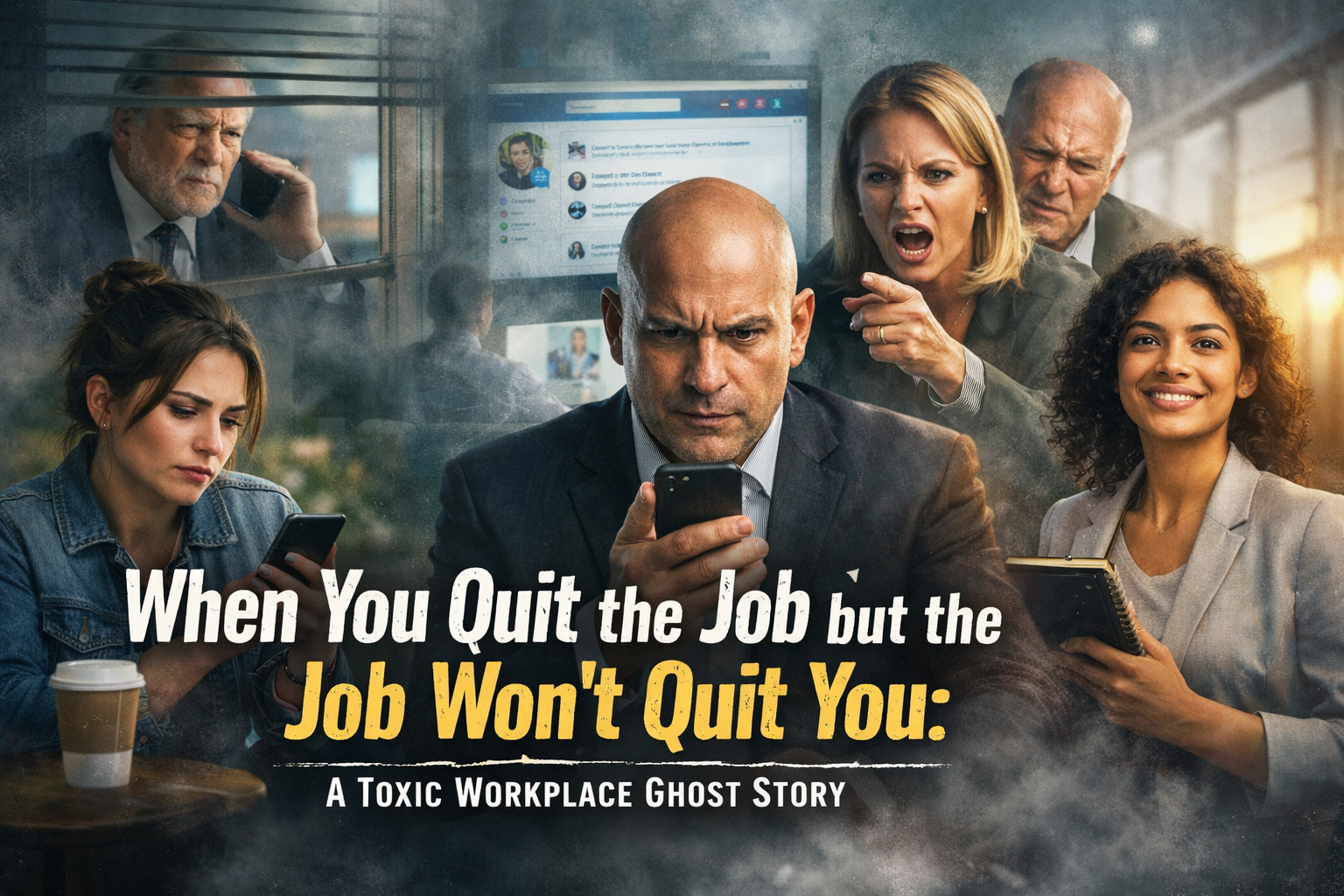
There’s a special kind of peace you expect when you leave a toxic workplace. Not “I’m immediately healed and my skin clears up” peace, but at least the baseline version—where your phone stops feeling like a landmine, your Sunday nights return from the dead, and you no longer flinch when someone says, “Quick question.”
You resign. You exit politely. You hand in your badge like an adult. You don’t flip a desk. You don’t set the breakroom Keurig on fire as a symbolic act of closure. You leave with dignity, like you’re supposed to.
And then… they keep showing up.
Suddenly your former employer is behaving like a haunted Victorian portrait that follows you with its eyes. A comment here. A strange like there. A “just checking in” message that has the tone of a polite threat wrapped in corporate frosting. Monitoring. Boundary violations. Passive-aggressive digital loitering. The kind of energy that says, “We respect your decision,” while doing everything possible to punish you for making it.
And that’s when you realize: leaving wasn’t the end of the story. It was the reveal.
Because healthy places don’t chase you after you leave. Secure leaders don’t hover. Strong cultures don’t need to lurk around former employees like they’re guarding a secret recipe. Only one kind of environment keeps trying to control a person after they’re gone.
The toxic kind.
So if you’ve ever left a workplace thinking you were done, only to discover the workplace has taken a second job as your unofficial online chaperone… welcome. You’re not imagining it. You’re not “being sensitive.” You are witnessing the clearest evidence possible that leaving was necessary.
The Exit Interview They Refuse to Stop Having
A normal resignation should function like a door: you close it, you walk away, you move on, the building continues to exist without you.
But toxic workplaces don’t do doors. They do revolving entrances. They do emotional annexation. They do “We’re done” the way a jealous ex does “We’re done,” which is to say: loudly, dramatically, and with constant follow-ups.
The problem is not that you left. The problem is that you chose yourself—and to an insecure leader, that’s an act of rebellion. Because leaving is not just departure; it’s narrative control.
Toxic leadership needs you to remain a character in their story. Preferably as “ungrateful,” “unstable,” or “not a culture fit,” because that protects the myth. It protects the illusion that nothing was wrong. That it was just you.
So when they keep watching, commenting, inserting themselves into spaces they no longer belong in, it isn’t about business. It’s about maintaining a storyline where they are the hero and you are the footnote.
And here’s the part they don’t understand: you don’t owe anyone access to you just because you used to work there.
Resigning means the contract ends. The power ends. The control ends.
Or at least… it’s supposed to.
Corporate Surveillance, Now With More Wi-Fi
Let’s talk about the uniquely unhinged phenomenon of a former employer monitoring a former employee like they’re running a true-crime podcast called The One Who Got Away (With Boundaries).
Because what is the plan here, exactly?
Are they expecting you to return? To apologize for escaping? To post a public statement like, “I regret leaving the team. I now realize screaming in meetings was just passionate leadership.”
No.
What they’re doing is far simpler and much uglier: they’re trying to punish you socially for not being punishable professionally anymore.
When they stalk your social media, attempt to discredit you, make hostile remarks, or send flying monkeys to “check the vibe,” it’s the adult workplace version of writing your name in a burn book and then insisting they’re the mature one.
This behavior is not accidental. It is not “a misunderstanding.” It is not “they’re just curious.”
It’s control. It’s ego. It’s fear of accountability.
Because nothing terrifies a toxic culture more than someone who left and didn’t implode.
You’re supposed to disappear quietly. You’re supposed to struggle. You’re supposed to regret it. You’re supposed to be a cautionary tale they can hold up like a workplace scarecrow.
But when you leave and thrive—or even just leave and regain your nervous system—they panic.
And panic makes people do weird things.
Like “monitoring” someone who no longer reports to them… as if LinkedIn is a time clock and Instagram is an internal audit.
This is not leadership.
This is not strength.
This is organizational failure happening in public.
How to Stay Professional While They Act Like a Villain Monologue
Here’s the cruel irony: when they keep coming after you, the temptation is to fight back with the same energy. To clap back. To post the receipts. To write a beautifully worded public takedown that starts with, “Since we’re all here…”
And I get it. I get it.
But the most infuriating part of dealing with toxic people is that they want your emotional engagement. That’s the fuel. That’s the proof, in their mind, that they still have access.
So the strongest move isn’t to match their chaos. It’s to become boring to them.
Not boring in your life—boring in your response.
Document everything. Screenshot everything. Save everything. Dates, times, accounts, witnesses, patterns. Not because you’re petty—because you’re prepared. Because you’re not going to let anyone rewrite reality with vibes and vague insinuations.
Do not engage emotionally. If you must respond, do it clinically. Like you’re writing an email to a printer company that keeps sending you toner you didn’t order.
And use formal channels when needed. HR, legal counsel, platform reporting tools, cease-and-desist letters if it escalates. Whatever applies to your situation. Not because you’re dramatic, but because boundaries are only boundaries when they are enforced.
Your professionalism will outlast their obsession.
Every time.
And there is a quiet justice in that. Because while they’re spending their energy stalking someone they no longer employ, you’re spending yours building a life that no longer includes them.
Final Thoughts: The Chapter Ends When You Stop Letting Them Edit It
Leaving a toxic workplace is supposed to close the chapter.
So when it doesn’t—when they keep watching, prodding, discrediting, crossing lines—it isn’t a sign you made the wrong call.
It’s the final proof you made the right one.
Healthy places don’t chase people after they leave.
Healthy leaders don’t need control to feel powerful.
Healthy cultures don’t unravel when someone walks away.
Toxic cultures do.
They expose themselves when they can’t let go.
So if you’re dealing with that aftermath—the lurking, the comments, the boundary violations—remember: you’re not witnessing “business.” You’re witnessing insecurity wearing a title.
Keep your receipts. Keep your composure. Keep your life moving forward.
Because the most satisfying ending isn’t revenge.
It’s freedom.