
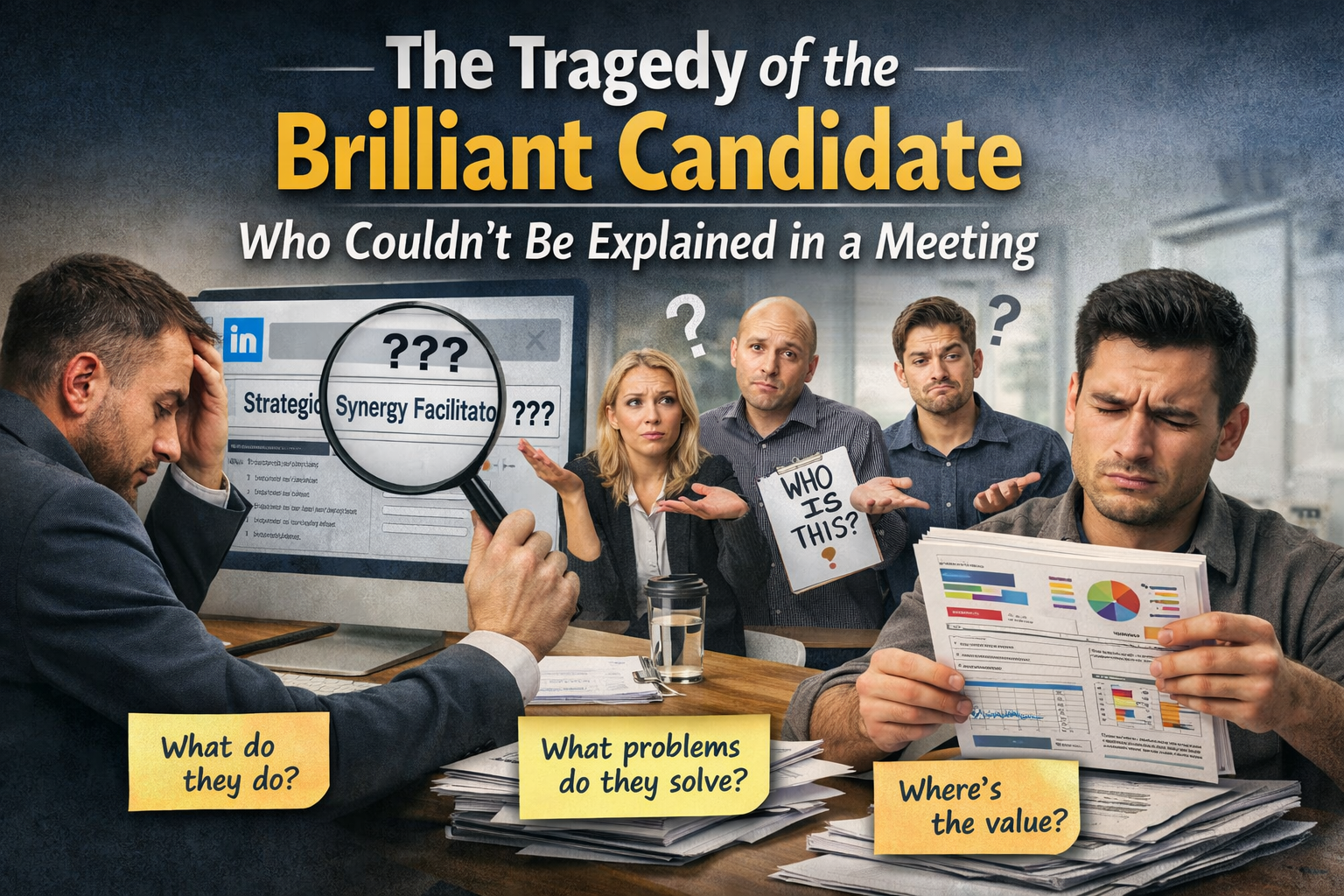
There is a specific kind of pain that only exists in the modern job market, and it’s not the rejection email, or the ghosting, or the fifth interview that feels like a hostage negotiation led by someone named “Culture Champion.”
It’s watching a wildly talented person—smart, capable, battle-tested, emotionally stable enough to use “per my last email” responsibly—lose to someone who is essentially a friendly PowerPoint slide in human form.
Because here’s the truth nobody puts on the job board: the most talented candidates don’t lose because they can’t do the work. They lose because the room can’t summarize the work.
Hiring is not only about ability. It’s about translation. It’s about your recruiter being able to walk into a hiring team sync and say, without sweating, “This is Alex. They do X. They solve Y. They’ll help us with Z.” And if the recruiter cannot do that, the candidate becomes a fog machine with a résumé attached.
And recruiters, bless them, are not sitting around with a pipe and a monocle, studying the nuance of your multi-hyphenate career like it’s a Russian novel.
They’re doing mental triage.
They’re scanning your LinkedIn while eating a granola bar that tastes like corporate despair. They’re cross-checking dates like a human audit log. They’re trying to reconcile “Strategic Transformation Lead” with “Operations Ninja” with “Customer Success Visionary” with “I also built a chatbot for fun” while 37 Slack messages arrive demanding an update on “where we are with candidates.”
So if your story requires a TED Talk, an appendix, and a family tree… congratulations, you might be incredible. Also, you might be invisible.
Because clarity scales. Talent without clarity stays hidden—like a Ferrari parked behind a wall of vague buzzwords.
The Recruiter’s Brain Has a Character Limit
Recruiters are not judging your entire soul. They are judging whether they can confidently repeat you to someone else without accidentally committing professional fraud.
They need:
- What you do
- What problems you solve
- Where you add value
That’s it. Not the entire origin story of your career, including the part where you “leveraged cross-functional synergy” and “owned stakeholder alignment” and “drove transformational outcomes.” That’s not a job description. That’s a weather report.
The recruiter’s brain is basically trying to fit you into a 1–2 sentence caption, because that’s how hiring teams function in the wild:
“Who’s next?”
“Someone strong.”
“Strong how?”
“…Strong.”
“Pass.”
And the reason less experienced candidates sometimes win is not because they’re better. It’s because they’re explainable.
They show up with a clean narrative like:
“I’m a data analyst. I turn messy data into insights that save money.”
Meanwhile, the talented candidate shows up like:
“I’m a strategic operator who bridges stakeholder ecosystems across dynamic environments to unlock scalable transformation.”
That’s not a sentence. That’s a smoke bomb.
You don’t need to sound impressive. You need to sound understandable. Impressive can come second. Understandable is how you get invited into the room in the first place.
LinkedIn Is the Recruiter’s Lie Detector and Also Their Shortcut
People love to pretend LinkedIn is just a “nice-to-have.” Like it’s optional. Like it’s a fun little digital scrapbook of your professional life.
Recruiters use LinkedIn like TSA uses the scanner: it’s not the whole story, but it’s where they verify whether the story you told them is shaped like reality.
They cross-check titles. They cross-check timelines. They cross-check whether your résumé says “Director” but LinkedIn says “Assistant to the Regional Director (Unofficial).” They’re not being mean. They’re trying to avoid sending a hiring manager a candidate who turns into a surprise later.
And yes—this is where “optimized LinkedIn profile” stops being a buzzphrase and becomes basic survival.
Because LinkedIn is the reference point. The second screen. The “quick glance” that determines whether your narrative is coherent or confusing.
If your profile reads like a treasure hunt, recruiters will not feel intrigued. They will feel tired.
If your headline says:
“Visionary | Thought Leader | Growth Hacker | People-First Innovator | Former Human”
…then you have not helped anyone. You have created a riddle.
What works is brutally simple:
- Title that matches what you’re targeting (not what you want to be someday in a perfect universe)
- One clear line on what you do
- A few specific outcomes (numbers if possible, but even plain English wins)
- Consistency between résumé and LinkedIn so nobody feels like they’re solving a cold case
Because recruiters don’t “deep dive” until you’ve made it past the quick scan. You earn depth by being clear at the surface.
Your Story Is Not Your Biography—It’s Your Trailer
A lot of talented people treat career storytelling like a documentary: comprehensive, nuanced, full of context, emotionally layered, featuring three different eras and a surprising amount of foreshadowing.
Hiring teams want a trailer.
A hiring manager wants to know:
“What’s the plot?”
“What’s the conflict?”
“How do you win?”
“Can I picture you in this role without doing emotional labor?”
If your story sounds like:
“I’ve done a bit of everything”
“I’m a generalist”
“I can adapt”
“I wear many hats”
…then you are asking the recruiter to do the hard work of turning that into something useful. And they will not. Not because they’re lazy—because they have 84 other candidates and one of them has a story that lands in a single breath.
Here’s the difference:
Unclear:
“I support initiatives across teams and drive outcomes.”
Clear:
“I help companies fix messy operations—process, tools, and handoffs—so projects stop stalling and teams hit deadlines.”
That second one gives the hiring team something to hold onto. It gives them a reason to remember you. It gives them language.
And that’s the whole game: if they can’t say what you do, they can’t sell what you do.
Final Thoughts: Talent Isn’t the Problem—Translation Is
The job market doesn’t reward the best candidate. It rewards the candidate whose value can be repeated accurately by someone who is half-paying attention while trying to schedule a panel interview across four time zones.
If a recruiter can’t explain you in 1–2 sentences to a hiring team, you won’t be remembered. Not because you aren’t impressive, but because you aren’t portable.
Clarity scales. It moves through meetings. It survives handoffs. It travels from recruiter to hiring manager to panel to “the person who actually decides” without being distorted into “seems good, kind of.”
So don’t hide behind complexity. Don’t bury your strongest work under a blizzard of titles, buzzwords, and “various responsibilities.”
Make it easy to understand you.
Because the most talented candidate shouldn’t lose to the most explainable candidate.
But if you let confusion speak louder than your results, it will.