
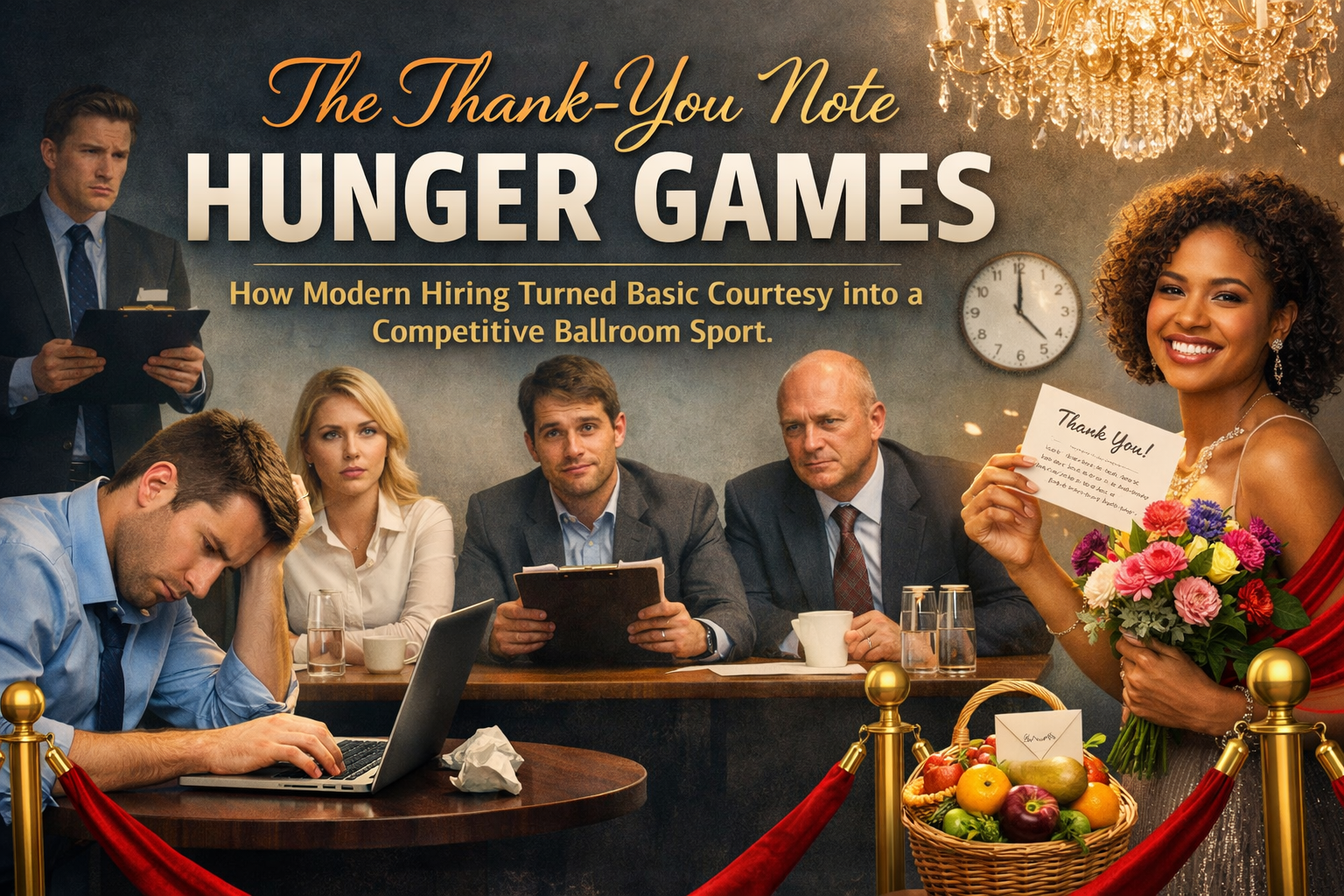
Or, How Modern Hiring Turned Basic Courtesy Into a Competitive Ballroom Sport
The other day I saw a recruiter post declaring, with the kind of confidence usually reserved for airline pilots and people who misuse the phrase “low-hanging fruit,” that if a candidate does not send a thank-you note after the interview, they are automatically out.
Automatically out.
Not “less memorable.” Not “perhaps at a disadvantage.” Not even the more corporate and cowardly version, “it may impact the overall impression.” No. Out. Eliminated. Banished from consideration as though they had failed an invisible etiquette obstacle course hidden somewhere between “Tell me about yourself” and “Do you have any questions for us?”
And I have to admit, I admired the statement immediately, not because it made sense, but because it was such a flawless specimen of professional absurdity. It had the polished irrationality of a hotel lobby chandelier collapsing in slow motion while everyone nearby continues eating shrimp as if this is a totally normal feature of the guest experience. It was beautiful in the way nonsense becomes beautiful when delivered with enough executive posture.
Because let us consider what is already required of a candidate before we apparently even reach the handwritten-curtsy portion of the process.
First, they submit an application through a website designed by someone who clearly hates human beings. Then they upload a resume. Then they manually type the exact same resume into forty-seven separate fields because systems engineering, like so many modern faiths, demands ritual suffering. Then they complete a screening call. Then a hiring manager interview. Then a panel interview. Then perhaps another panel interview, because the organization has not yet fully drained the applicant of all basic self-respect and wants one more opportunity to ask what animal they would be in a collaborative environment.
Then comes the culture fit interview, which is a lovely rebrand for “we already know whether you can do the job, now we are just checking whether you can smile through nonsense without visibly blinking.” Then maybe a case study. Then a presentation. Then a personality assessment designed by a man who once read half a psychology article in an airport lounge. Then references. Then silence. Then a surprise rescheduling. Then silence again. Then, after all that, someone emerges from the digital fog to announce that none of this was actually the deciding factor. No, the true line between employable and unworthy was whether you sent a tasteful little gratitude memo within twenty-four hours of being interrogated over Zoom by three strangers named Brittany, Kyle, and Steve.
That, apparently, is excellence now.
We no longer hire the person with judgment, capability, resilience, relevant experience, or the ability to improve revenue without accidentally setting Slack on fire. We hire the person who can perform the cleanest post-interview bow. We are not staffing departments anymore. We are selecting finalists for a pageant sponsored by anxiety and Outlook calendar invites.
And what makes this rule so deliciously ridiculous is that it transforms a pleasant gesture into a compulsory loyalty demonstration. A thank-you note, in its natural habitat, is fine. It is courteous. Civilized. Even charming. But the second you convert it from “nice touch” into “mandatory ritual or perish,” you are no longer evaluating professionalism. You are running a finishing school for exhausted adults in business casual.
Which is how we arrived here, in an economy where candidates must be accomplished but humble, strategic but warm, polished but authentic, ambitious but not threatening, and now also sufficiently handwritten in spirit. The hiring process no longer resembles recruitment so much as a talent show for emotional obedience, where the winner is the person best able to make rejection feel like an honor.
So let us discuss the thank-you note. Not as correspondence. Not as courtesy. But as what it has become: one more theatrical requirement in the increasingly unhinged live action role play known as modern hiring.
The Interview Is Not Enough Because Nothing Is Ever Enough
There was once a time, at least in theory, when an interview existed to answer a fairly straightforward question: can this person do the job? It was an imperfect system, certainly, but at least it maintained the charming illusion that competence mattered. You would present your experience, discuss your accomplishments, explain how you solve problems, and ideally leave having demonstrated that you were capable of performing the role without needing to be supervised like a raccoon near a vending machine.
Now, however, the interview is merely the appetizer in a larger tasting menu of emotional gymnastics.
It is no longer sufficient that a candidate prepared thoroughly, arrived on time, researched the company, answered questions thoughtfully, navigated the awkward chemistry of panel dynamics, maintained eye contact without looking deranged, asked intelligent questions at the end, and somehow remained composed while one interviewer described the workplace as “like a family,” which in corporate terms usually means “boundary violations with birthday sheet cake.” No, all of that is merely your qualifying lap. The real event begins after the interview, when you must prove that you are not simply interested in employment, but grateful for the privilege of being considered by a company whose Glassdoor reviews read like witness statements.
And this is what fascinates me most about the thank-you-note obsession. It reveals, with accidental honesty, that many hiring processes are no longer about skill at all. Skill is messy. Skill requires evaluation. Skill demands that interviewers know what good looks like. Ritual, on the other hand, is wonderfully convenient. Ritual is easy. Ritual allows mediocre evaluators to feel like they are preserving standards when in fact they are merely rewarding performance in a completely different category.
Anyone can say, “I just didn’t feel enough follow-through.” That sounds respectable. Refined. Mature. It sounds far better than, “I wasn’t entirely sure how to assess the actual substance of the interview, so I defaulted to whether the candidate sent me a digital thank-you arrangement like I was a retiring state senator.”
Because let us be honest. If a candidate can articulate strategy, solve problems, manage teams, improve systems, lead under pressure, communicate clearly, and demonstrate a strong track record, but loses the role because they failed to send a note saying, “Thank you again for the opportunity to discuss the position,” then the company is not selecting for excellence. It is selecting for ceremonial compliance.
Which is fine, I suppose, if the role itself is “Executive Assistant to an 1890s Railway Baron.” But if the job involves actual work in the year 2026, one would think performance indicators might carry a bit more weight than whether a person composed the correct amount of gratitude before dinner.
And the weirdest part is that the burden is entirely one-directional. Candidates are expected to radiate reverence after interviews that are often chaotic, disorganized, and occasionally indistinguishable from an escape room designed by middle management. Interviewers can show up late. They can forget to turn their camera on. They can ask questions already answered on the resume. They can skim the LinkedIn profile in real time like students cramming in the hallway before an exam. They can admit, casually and without shame, that they are “still trying to figure out what this role really needs.” They can mispronounce the candidate’s name after having said it wrong twice already. They can spend fifteen minutes describing a team environment so clearly dysfunctional that OSHA should probably be copied on the follow-up. But if the candidate does not send a note afterward expressing appreciation for the magical experience of enduring all this, suddenly professionalism is on trial.
Imagine applying this logic anywhere else.
A restaurant burns your meal, forgets your drink, and brings you the wrong entrée, but afterward demands a handwritten card thanking the chef for the opportunity to participate in the dining journey. A mechanic misquotes the repair, loses your keys for twenty minutes, and still expects a warm email praising the collaborative diagnostics experience. A dentist keeps you waiting forty-five minutes under fluorescent misery, then sends a survey asking whether you sufficiently valued the privilege of being near their scheduling process.
That is what this feels like.
The modern interview has already become an endurance event. Adding a mandatory thank-you note does not elevate it. It simply confirms that the process is now less about identifying talent and more about locating the person most willing to continue tap dancing after the music has obviously stopped.
The Thank-You Note Is a Trap Designed by Tone Police
The thank-you note, in theory, sounds harmless. It is a brief message. A polite follow-up. A small professional courtesy. Something elegant and low-stakes. But that illusion vanishes the moment people start using it as a deciding factor, because then it stops being a note and starts becoming a trap built entirely out of tone.
Too short and you are dismissive.
Too long and you are alarming.
Too formal and you sound robotic, like a legal intern writing from a bunker.
Too casual and you are unserious.
Too warm and you lack executive presence.
Too polished and perhaps it sounds “inauthentic.”
Too enthusiastic and you are trying too hard.
Not enthusiastic enough and you clearly do not want it badly enough.
You must, somehow, locate the exact linguistic midpoint between grateful professional and emotionally regulated hostage. Your note must communicate appreciation, competence, interest, confidence, warmth, and restraint, all while never once suggesting that you are a human being whose rent exists.
This is where hiring truly becomes performance art.
Because by this point the candidate is not writing a thank-you note. The candidate is diffusing a social bomb. Every sentence feels like it could be entered into evidence. “Thank you for your time” is standard, but perhaps too generic. “I appreciated learning more about the role” is safe, though possibly forgettable. “I especially enjoyed our discussion about team collaboration” is nice, unless no one actually seemed to enjoy anything, in which case it becomes fiction. “I remain very excited about the opportunity” sounds good, unless excitement is interpreted as desperation, which in some hiring ecosystems it absolutely will be by a woman named Dana who considers emotional neutrality a leadership trait.
And all of this happens after an interview in which the company itself may have shown the conversational charisma of a jury summons.
That is what makes the thank-you-note discourse so funny. It pretends to be about professionalism when it is actually about aesthetic preference. The note becomes a Rorschach test for interviewer bias. One person loves brevity. Another sees brevity as laziness. One person values warmth. Another sees warmth as immaturity. One person wants polish. Another says polish feels rehearsed. By the time your email passes through three interviewers and one internal recruiter, it is no longer being judged as communication. It is being judged as fragrance. Vibes. Texture. A mood board in paragraph form.
And let us talk about timing, because timing is another glorious piece of nonsense in this pageant.
You are told to send it within twenty-four hours, which means that immediately after the interview you are expected to gather your shredded nervous system, reconstruct your dignity, remember the names and titles of everyone involved, identify a few memorable talking points, and produce a note that sounds personalized rather than copied, strategic rather than manipulative, warm rather than weird. This must happen while you are also likely replaying the entire interview in your head like surveillance footage from a convenience store robbery, wondering whether your answer to “Tell me about a time you led through ambiguity” was impressive or the verbal equivalent of a shopping cart rolling downhill.
And the personalization advice is always absurdly optimistic.
“Reference something specific from the conversation.”
Wonderful. Should I mention the part where Steve’s dog barked for twelve minutes, or the section where Brittany froze mid-sentence because her Wi-Fi gave up on leadership development? Perhaps I should warmly reference Kyle’s thoughtful insight that the company is “moving fast and still building processes,” which is corporate dialect for “nothing is documented and someone cries every Thursday.”
Meanwhile, the candidate is expected to transform this chaos into graceful prose. To take the fragments of a mildly disorienting conversation and repackage them as a pleasant professional memory. It is like being asked to write a thank-you note after turbulence.
And still, despite all this, the greatest joke is that many candidates who do send the perfect note will hear nothing. Nothing. Silence. No response. No update. No courtesy returned. The candidate must perform emotional choreography on schedule, but the company remains free to disappear into the fog like a Victorian orphanage.
So the thank-you note becomes not just a trap, but a one-sided ritual of elegance. Candidates must send polished gratitude into the void, while employers reserve the right to answer with nothing at all except, perhaps, three weeks later, an automated email that begins with “After careful consideration,” which is one of the more ambitious lies in the English language.
LinkedIn Aristocrats and the Rise of Etiquette-Based Hiring
The thank-you-note absolutists are my favorite genre of hiring philosopher because they always speak as though they are defending civilization itself. They do not frame their rule as preference. They frame it as principle. As if the collapse of workforce standards can be traced directly to an insufficient number of follow-up emails with tasteful subject lines.
These are the LinkedIn aristocrats of the modern labor market, the self-appointed guardians of polished behavior, floating through the comments section in pressed blazers of the spirit, announcing that professionalism has declined because candidates no longer know how to say thank you after being interviewed for a midlevel role with a salary range hidden like classified government material.
And what they never seem to notice is how bizarrely feudal the whole thing sounds.
The candidate arrives with credentials, experience, measurable accomplishments, recommendations, and enough emotional endurance to withstand six stages of evaluation without screaming into a printer. The company, in return, offers a chance to continue being considered. Then the candidate must also send thanks for having been allowed to audition for payroll. This is not a hiring process anymore. This is courtship in a castle where the nobles post motivational leadership content between budget cuts.
You can almost hear the old-timey language drifting through the recruiting software.
“Dearest Hiring Committee, I remain deeply honored by yesterday’s audience and most appreciative of the chance to discuss how my background in operations may serve your noble initiatives in stakeholder alignment and regional synergy. Please accept my sincere gratitude for the ninety-four minutes spent evaluating whether I know Excel and can remain pleasant when interrupted.”
And again, I want to be clear. There is nothing wrong with a thank-you note. The problem begins when it is elevated from kindness to character test. The moment it becomes mandatory, it stops measuring thoughtfulness and starts rewarding familiarity with unwritten class codes. Some candidates know the ritual because they were mentored into it. Some know it because they have spent years navigating white-collar expectations that operate like invisible fencing. Some do not know it. Some are juggling multiple interviews, children, caregiving, layoffs, financial stress, or sheer mental exhaustion. Some may assume, quite reasonably, that the interview itself should speak louder than a follow-up email composed under deadline conditions.
Punishing those people does not make hiring more rigorous. It makes it more performative.
And that is really the central theme of modern recruitment, is it not? Performance everywhere. Job descriptions perform ambition. Employer branding performs warmth. Culture decks perform belonging. Interviews perform objectivity. Feedback performs care. And the thank-you note performs gratitude. Everyone is performing, and beneath all this choreography there is often a surprisingly fragile connection to the actual work being hired for.
That is why these standards always feel so silly. They are presented as if they separate excellent candidates from average ones, when in reality they often separate the comfortable from the overwhelmed, the coached from the uncoached, the ritual fluent from the ritual indifferent. They do not tell you who can solve the hardest problems. They tell you who knows how to decorate the process.
It is the human resources equivalent of awarding a marathon medal based on penmanship at the finish line.
And maybe that is why these posts always hit such a nerve. Because job seekers are already doing so much. They are tailoring resumes, navigating ghost jobs, decoding contradictory advice, surviving interviews that require unpaid labor, and maintaining composure in a market that often treats them like inventory with feelings. So when someone pops up to declare that a missing thank-you note is the final moral failure, it feels less like guidance and more like one more velvet-rope requirement invented by people who have forgotten what vulnerability looks like from the applicant side of the table.
There is a peculiar luxury in being able to interpret etiquette as character when you are not the one worrying about bills.
And that is the thing these aristocrats of professional decorum never quite grasp. Most candidates are not skipping the thank-you note out of arrogance. They are tired. They are anxious. They are trying to survive a process that already demands more performance than many actual jobs. They are not refusing to show gratitude. They are simply hoping that the interview itself counted as evidence that they cared.
Which, in a sane world, it would.
Final Thoughts
A thank-you note is lovely when it is genuine. It is thoughtful when it is optional. It is gracious when it emerges naturally from mutual respect. But once you turn it into a pass-fail requirement, you have left the realm of professionalism and entered the grand ballroom of corporate absurdity, where etiquette is confused with excellence and ceremony keeps getting promoted above substance.
If a candidate interviews well, demonstrates skill, asks strong questions, shows preparation, communicates clearly, and seems capable of doing the work, that should matter more than whether they sent a polished little follow-up sonnet before the sun went down. Courtesy is nice. Competence is nicer.
And perhaps that is the simplest way to put it: a thank-you note should be frosting, not the entire cake.
Because if your hiring process is so spiritually delicate that it can be ruined by the absence of one email, then the real issue is not candidate professionalism. The real issue is that somewhere along the way, recruitment stopped being about finding the right person and became an elaborate costume drama staged entirely for LinkedIn.
At this rate, I fully expect the next wave of hiring advice to recommend a thank-you note, a handwritten card, a tasteful fruit basket, a five-star endorsement on the interviewer’s leadership post, and a short interpretive dance expressing alignment with cross-functional goals.
And three weeks later, after all that elegance, the candidate will still receive an automated rejection email written in the soothing language of corporate taxidermy, thanking them for their interest while confirming that the company moved forward with another applicant whose gratitude more closely matched the strategic priorities of the business.
Which is a beautiful sentence, really.
Not true. Not useful. Not remotely human.
But beautifully on brand.