There was a time, at least in theory, when getting hired meant a company had work that needed to be done, a person existed who could do that work, and the two parties met briefly under fluorescent lighting to exchange information, modest lies, and the kind of professional optimism that can only survive inside a conference room with a motivational poster on the wall. It was not perfect, but it was at least rooted in a recognizable purpose. A role existed. A human applied. Some questions were asked. A decision was made. Civilization, while fragile, remained operational.
Then at some point, quietly and without public approval, the hiring process drifted off the road and into interpretive performance. What was once a practical exercise became an endurance event wrapped in corporate ceremony, and now entire organizations behave as though choosing someone to manage inboxes, attend status calls, and politely ask for overdue updates requires the level of scrutiny normally reserved for selecting a pope, a Supreme Court justice, or the last emotionally stable person in a reality television alliance.
That is how we ended up here, in an economy where a regular job, a deeply ordinary job, a job whose daily duties include opening spreadsheets, surviving passive-aggressive Teams messages, and pretending the phrase circle back means something other than I forgot and now it is your emergency, somehow requires multiple rounds of interviews, psychological acrobatics, panel evaluations, cultural auditions, and at least one conversation with a person whose entire professional identity appears to consist of saying things like, “We move fast here,” while blinking like a hostage in a startup hoodie.
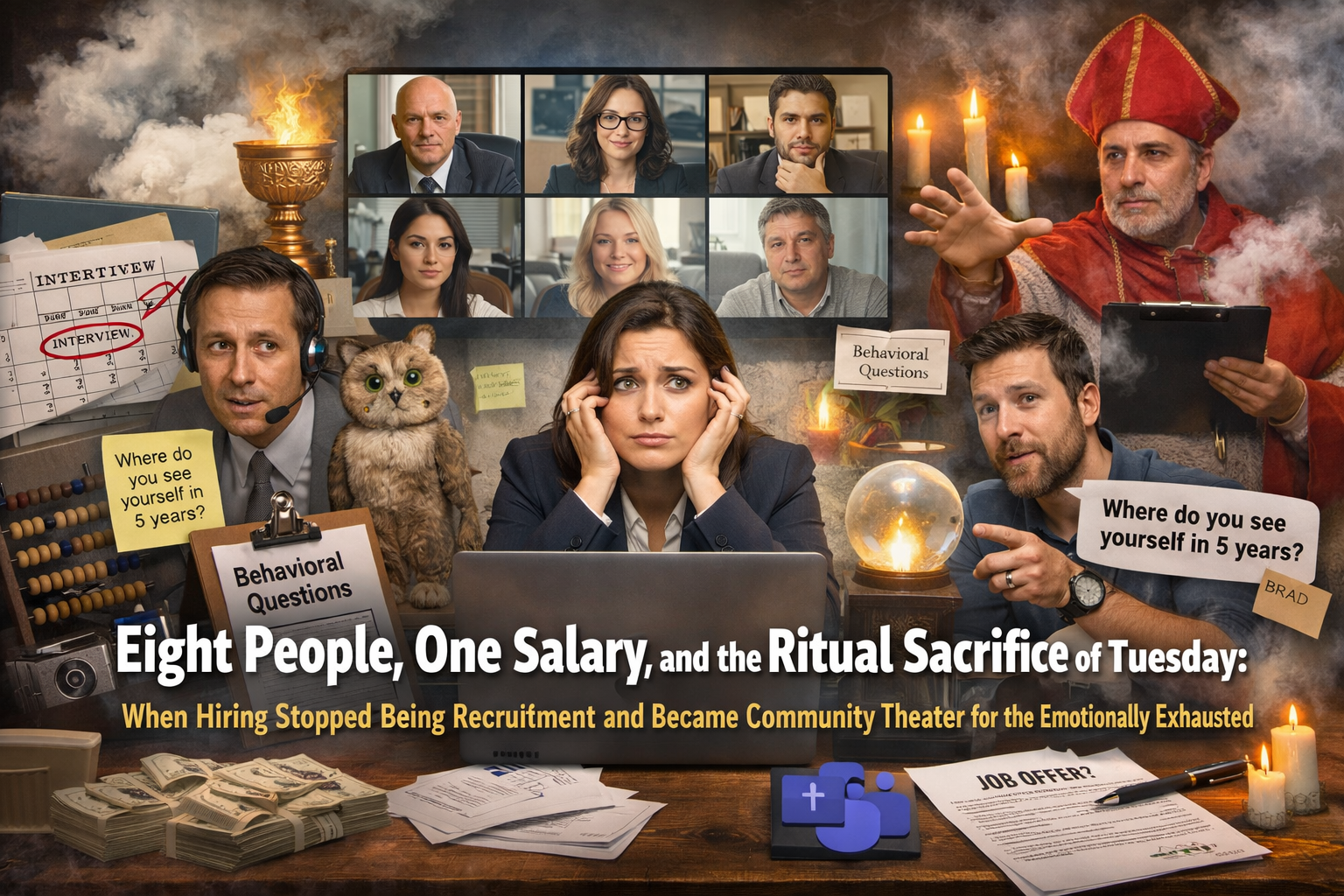
I know this because I once went through an eight-person panel interview for a role that paid just enough to keep the lights on, maintain diplomatic relations with my refrigerator, and continue the deeply American financial tradition of staring at a menu and pretending I never wanted guacamole in the first place. Eight people. Not eight interviews spread over a month like a slow-moving emotional landslide. One panel. One moment. One screen full of adult professionals looking at me with the solemn intensity of people deciding whether I should be granted access to national secrets, when in reality they were debating whether I could update trackers and use Outlook without causing a regional incident.
And the pageantry of it all was breathtaking. Everyone had a role. Everyone had a tone. Everyone carried themselves with the theatrical seriousness of a jury in a legal drama, despite the fact that the role in question would almost certainly involve writing “Happy Monday” to people who were visibly having neither happiness nor Monday. One panelist asked about leadership. One asked about conflict resolution. One asked one of those deranged modern interview questions designed to sound insightful but actually created in a conference room by someone who thinks podcasts count as wisdom. One sat in silence, nodding occasionally like a village elder evaluating whether I was worthy of crossing a mountain and gaining access to the sacred dental plan.
By the end, I did not feel like a candidate. I felt like an underfunded gladiator fighting for the right to update shared documents in a company that used the phrase work hard, play hard with the confidence of a regime that had abolished lunch. It was less a hiring process and more a ceremonial trial, a professionally managed obstacle course designed to determine whether I possessed the stamina, charm, and emotional flexibility required to survive in a place where someone named Brad might one day send a 6:42 p.m. “gentle reminder” about a spreadsheet he himself created incorrectly.
And that, I think, is the real problem with modern hiring. Companies will tell you they are trying to assess fit, alignment, communication, culture, strategic thinking, growth mindset, adaptability, and whether your soul emits the proper frequency during a second-round Zoom. But most of the time they are not evaluating your ability to do the job nearly as much as they are evaluating your willingness to endure nonsense with a calm expression and a good webcam angle. The role may involve emails, reports, meetings, and the occasional PowerPoint nobody reads, but the interview process is structured like you are negotiating peace between rival nations using only a laminated resume and your ability to pretend “Tell us about yourself” is not a deeply cursed opener.
So let us be honest. This is no longer hiring. This is theater. This is ritual. This is a corporate escape room where the final clue leads to a salary range written like a threat. And since we are apparently committed to the performance, we may as well document the spectacle properly.
The Casting Call for a Job That Barely Covers Guacamole
Every absurd modern interview process begins with the same central delusion: a company has posted a role of stunning ordinariness, but behaves as though it is recruiting the final surviving surgeon, diplomat, and battlefield poet on Earth. The job description itself usually offers the first warning signs. It will say the candidate must be agile, strategic, proactive, resilient, collaborative, innovative, solutions-oriented, metrics-driven, customer-obsessed, and able to work independently in a fast-paced environment, which is corporate language for, “We combined three jobs, fired two people, and now need someone cheerful enough to thank us for it.”
Then comes the scheduling. The choreography. The sacred procession of calendar invites arriving like small administrative threats. Recruiters speak of this process as though it reflects rigor, discipline, and thoughtfulness, but what it really reflects is an organization so terrified of making a decision that it has converted basic hiring into a group project. No one wants responsibility. Everyone wants visibility. So instead of one competent manager deciding whether a capable adult can do the work, the company assembles a tribunal.
That is how you get eight-person panels for jobs that end with you formatting a deck for someone who still says “deck.” Somewhere deep in the institutional bloodstream, a panic spreads. What if the candidate seems great, but one manager has a vague concern? What if someone from an adjacent department wants to weigh in, despite never interacting with the role in any meaningful way? What if the director would like to “meet them quickly,” which is corporate for extending the process by six business days and a fresh layer of emotional deterioration? What if, and this is the favorite corporate pastime, everyone involved would like to feel important?
And make no mistake, that is part of what these giant interview rituals are. They are not just about evaluation. They are about participation. They are workplace pageants that allow a surprising number of people to wander briefly into the glow of importance. Someone gets to ask about collaboration. Someone gets to ask about problem solving. Someone gets to stare into the camera with the facial warmth of courthouse furniture and say, “Walk me through a time you had to influence without authority,” as if they are not personally unable to influence the office printer.
The candidate, meanwhile, is expected to perform composure at an Olympic level. You must answer each question with specificity but not too much specificity, humility but not too much humility, confidence but never enough confidence to threaten the insecurities of a mid-level manager who mistakes suspicion for leadership. You must appear polished but authentic, strategic but warm, ambitious but somehow not ambitious in a way that suggests you may one day want a raise. You must be memorable while also being universally palatable, which is a difficult line to walk when you are essentially participating in a corporate talent show where the judges have no shared criteria beyond “vibe.”
And then there is the salary, floating beneath all of this like a punchline too tired to stand. After all the paneling and probing and ceremonial nodding, after all the dramatic language about excellence and fit and long-term value, the compensation often arrives looking like it was assembled by a disappointed uncle. The role that required six interviews, a presentation, a panel discussion, and your best imitation of emotional steadiness under artificial lighting ends up paying just enough to keep you technically indoors. This is the insult that gives the entire process its real artistic power. If the salary were magnificent, some of the absurdity might at least feel sponsored. But no. The prize for surviving the labyrinth is usually access to a benefits portal, a branded coffee mug, and income that still loses fistfights with rent, prescriptions, and one moderately aggressive trip to Target.
This is what makes the whole production feel so offensively sincere. Everyone acts as though the stakes are immense. They nod gravely. They ask polished questions with the cadence of a documentary narrator. They speak of alignment and business partnership and strategic contribution. But beneath the lighting and the posture and the ceremony, the role is often painfully normal. It is email. It is meetings. It is awkward Slack messages. It is receiving a “friendly reminder” from a person who has mistaken cc’ing leadership for a personality trait. The grand institution is not selecting a mythic hero. It is hiring someone to help absorb workflow in an office where the phrase “quick sync” has ruined more afternoons than weather ever could.
Inside the Panel, Where Every Face Is a Different Flavor of Concern
The panel itself deserves formal recognition as one of modern professional life’s most deranged inventions. A panel interview is what happens when a company looks at a process that is already stressful and decides the missing ingredient is witnesses. It is not enough for one person to evaluate you. No, apparently your qualifications must now be observed by a full gallery of adults arranged in little rectangles, each bringing a unique and unsettling energy to the occasion.
There is always one panelist who smiles too much, the kind of smile that feels less like encouragement and more like a flight attendant preparing the cabin for impact. There is another who has decided that their contribution to the process will be to ask one question and then spend the remainder of the meeting looking like they regret every choice that led to this hour. There is usually a person from another department who does not fully understand the role but has nevertheless been invited because modern companies love cross-functional input the way medieval courts loved random superstition. And then there is the silent one, the quiet observer, the mysterious human gargoyle whose only visible contribution is occasional nodding and the implied threat of post-interview feedback.
What makes the panel so uniquely ridiculous is the mismatch between the stakes they project and the reality they are discussing. The questions arrive with the gravity of international hearings. “Tell us about a time you led through ambiguity.” “How do you handle competing priorities?” “Describe your communication style.” These are asked with the seriousness of intelligence briefings, even when the real answer to most of them is, “I opened the email, figured out what was on fire, and tried not to cry in a calendar invite.”
Then come the nonsense questions, the ones created by people who believe traditional human conversation has become too efficient and must be replaced with abstract humiliation. “What animal best represents your work style?” is always a special favorite because it forces the candidate into a bizarre temporary hostage situation with metaphor. Nobody wins. You cannot say raccoon, even though raccoon is the only honest answer for most modern workers: resourceful, exhausted, morally flexible around leftovers, and one bad day away from screaming near a dumpster. You cannot say lion because that sounds arrogant. You cannot say owl because now you sound like you own a framed quote about wisdom. So you end up inventing some tortured response involving dolphins or ants or migratory birds while six strangers pretend this is a legitimate business exercise.
And all of this would be easier to tolerate if the panel itself projected evidence of alignment, but that is rarely the case. Panels are often magnificent showcases of organizational confusion. One person wants detail. One wants brevity. One wants strategic vision. One wants a story about teamwork with a beginning, middle, and emotional resolution. One interrupts. One zones out. One asks a question already answered twenty minutes earlier because they were either multitasking or spiritually absent. So now the candidate is not merely answering questions. The candidate is improvising balance across a committee of mismatched expectations while trying to look calm enough to suggest this is all perfectly reasonable and not, in fact, a deeply weird form of office pageantry.
This is the moment when many applicants stop feeling like professionals and start feeling like contestants on a game show produced by human resources and low blood sugar. Every answer becomes part performance, part survival strategy. You are selling competence, but also stamina. You are demonstrating experience, but also emotional regulation under mild absurdity. You are essentially being asked, “Can you do the work?” in the least direct way possible, as if the organization fears that asking plainly would make the entire system collapse into its own uselessness.
And hovering over all of it is the company’s favorite phrase: good fit. A good fit for what? For the job, ideally, but the term is rarely left alone long enough to mean something sensible. No, good fit expands into mythology. It becomes fit for the team, fit for the pace, fit for the culture, fit for the leadership style, fit for the sacred and unknowable ecosystem of recurring meetings and private jokes and passive aggression disguised as process. By the time companies finish invoking fit, they are no longer hiring for capability. They are screening for whether your personality can be folded neatly into their existing dysfunction without making noise.
And because nobody wants to admit that out loud, the panel interview remains dressed in noble language. It is collaborative. It is thorough. It is holistic. It is designed to ensure mutual alignment. That all sounds much better than the truth, which is that a room full of nervous professionals are trying to collectively avoid being blamed for a future hiring mistake, so they have created a ceremony elaborate enough to make responsibility evaporate into the wallpaper.
The Long Road to an Offer, a Rejection, or a Ghost Story
If the panel interview is the live performance, the post-interview period is the haunting. This is where the corporate theater reaches its highest artistic form, because after demanding hours of preparation, emotional energy, tactical storytelling, and an alarming amount of eye contact with strangers, companies often conclude the process by behaving like a Victorian ghost.
First comes the closing language. It is always beautiful in the way dangerous things are beautiful. “We’ll be in touch soon.” “Next steps should move quickly.” “We’re wrapping things up on our side.” “The team really enjoyed meeting you.” Every sentence is polished, warm, and structurally incapable of supporting the weight of reality. These phrases drift across the air like perfumed lies, and candidates, being decent people with hope still flickering in their bloodstream, often make the mistake of believing them.
Then the waiting begins. Days pass. Then a week. Then another. At first you remain dignified. You tell yourself they are busy. Hiring takes time. There are approvals. Perhaps the recruiter is coordinating final feedback. Perhaps leadership is traveling. Perhaps Brad, that spiritual mascot of delayed process and artificial urgency, is still “circling back internally.” Then the silence deepens and your imagination begins performing cartwheels in a parking lot.
You replay the interview. Was your answer about conflict resolution too polished? Not polished enough? Did you smile too much when discussing change management? Did one panelist misinterpret your joke? Did your internet freeze for half a second in a way that suggested weak character? Did the person who asked the animal question secretly want you to say eagle and now your entire future has been destroyed by mentioning something mammalian?
This is another hidden cruelty of overcomplicated hiring. It does not simply consume time. It colonizes thought. The longer and more ceremonial the process becomes, the more candidates are tricked into assigning it dignity. A single interview rejection stings. But multiple rounds, panel exposure, presentations, scheduling gymnastics, and repeated declarations of excitement create the emotional architecture of investment. Now the job is not merely a possibility. It has become a narrative. You have spent mental energy furnishing an imaginary desk in an organization that may already be quietly drafting a rejection email written in the tone of a deeply apologetic parking meter.
And when the decision finally comes, it often lands with all the tenderness of automated formatting. “After careful consideration…” which is corporate for, “Many adults held many meetings and still refuse to use plain language.” “We were impressed by your background…” which is professional condolences with a logo. “We have decided to move forward with other candidates…” meaning someone else survived the maze, or no one did, or the role has been paused, or your carefully cultivated hope has been sacrificed to a spreadsheet and a budget review. The point is not clarity. The point is to produce a message bland enough to be legally safe and emotionally useless.
Of course, sometimes there is no message at all. Ghosting remains one of the most infuriating final acts in the hiring pageant because it reveals, with breathtaking efficiency, that the company which required candidates to display responsiveness, preparation, professionalism, punctuality, and polished communication had no intention of modeling any of those qualities in return. The candidate was expected to confirm availability, prepare examples, research leadership, send follow-ups, demonstrate enthusiasm, and arrive camera-ready like a contestant in the Respectability Olympics. The employer, meanwhile, reserves the right to dissolve into mist.
This is the part nobody in talent acquisition likes to admit. A long hiring process does not always communicate excellence. Sometimes it communicates fear, indecision, ego, poor alignment, and an institutional inability to distinguish between due diligence and amateur dramatics. Companies say they want top talent, but the process often rewards a narrower trait: the capacity to endure administrative nonsense without openly wondering whether the entire leadership team has been trapped inside a trust fall since 2017.
And that is why so many candidates leave these experiences less convinced by the company than exhausted by its rituals. The issue is not that interviewing should be casual or careless. Of course organizations should evaluate thoughtfully. Of course they should ask real questions. Of course bad hires are costly. But somewhere between sensible evaluation and full-blown Vatican-level selection protocol, many companies lost the plot. They forgot that hiring is supposed to clarify, not perform. It is supposed to assess, not exhaust. It is supposed to help two parties determine mutual suitability, not stage a miniseries called Prestige Under Fluorescent Lighting.
Final Thoughts
So why do some companies need so many rounds of interviews just to hire one person?
Because the process stopped being about simple judgment and became a ceremonial act of collective self-importance. Because organizations terrified of accountability discovered they could divide one decision among twelve people and call it rigor. Because managers like the feeling of participation. Because departments love symbolism. Because nobody wants to be the lone adult who says, “Yes, this capable person can do the job,” when it is much safer to create a calendar-based obstacle course and pretend that complexity itself is wisdom.
And mostly because modern work has developed a strange talent for taking ordinary tasks and surrounding them with such excessive ritual that they begin to resemble sacred events. A job opening appears. The meetings begin. The panels assemble. The recruiter speaks in soft future tense. Brad appears from somewhere deep in the building. Someone asks where you see yourself in five years. Someone else writes down your answer as though civilization depends on it. And after all of that, after the scheduling and smiling and strategic storytelling and emotional gymnastics, the final reward is not a throne, a title, or economic liberation.
It is access to Microsoft Teams.
Which, if nothing else, is one of the funniest endings ever written.