There are two places in modern society where time loses meaning, identity becomes fluid, and strangers share intimate details at an alarming rate: the DMV… and Starbucks.
Because Starbucks isn’t a coffee shop. It’s a lifestyle checkpoint. A public waiting room for capitalism. A socially acceptable place to sit in a chair for three hours, stare at a laptop, and pretend you’re doing “deep work” while actually just refreshing email like it owes you money.
And the beauty of Starbucks is this: nobody is just getting coffee.
No. Everyone is auditioning. For something. For a version of themselves. For a role they haven’t been offered yet. For a personality they saw on LinkedIn once and decided to recreate in real time under fluorescent lighting.
You walk in thinking you’re buying caffeine. You leave having witnessed a full spectrum of humanity: joy, chaos, passive aggression, desperation, a mild identity crisis, and at least one person whispering into AirPods like they’re negotiating world peace from Table 7.
Starbucks is where you learn that “third place” doesn’t mean “community.” It means “where we all go to be seen trying.”
And if you listen closely, you can hear the soundtrack: espresso machines screaming, blenders doing demolition work, and the soft sob of someone who just realized they ordered an iced drink in January and now has to commit to the bit in sub-zero weather.
Welcome. Please grab a straw. You’ll need it.
The Order Olympics and the Art of Being Difficult in Public
The Starbucks line is a social experiment disguised as a queue.
It starts innocently. People shuffle forward. Everyone looks at the menu like it’s their first day on Earth. Then someone steps up and orders as if they’re reading the terms and conditions out loud.
“Hi, yes, can I get a venti, half-caf, extra-hot, oat milk, upside-down caramel macchiato, but can you do the caramel in a spiral and also—wait—can you make it less sweet but still caramel-forward? And can I get light ice but like… not watery?”
Ma’am. You are describing a personality, not a beverage.
And the barista—who has already lived three lifetimes since 6 a.m.—nods like they’re taking down a hostage negotiator’s demands. Because Starbucks employees have mastered the face of calm compliance while their soul quietly updates its resignation draft.
Behind the Order Olympian is the person who thinks ordering coffee is a moral test.
They’re not asking for a drink. They’re asking for validation.
They make long eye contact and say, “I’ll just do… a black coffee.”
And you can feel them waiting for applause.
Sir, this is not a TED Talk. You are not better than us because you enjoy burnt bean water with the confidence of a Victorian factory owner. But congratulations on your minimalist personality. I’m sure it pairs beautifully with your opinions about “kids these days.”
Then there’s the Whisperer. The person who steps up and speaks like they’re confessing sins.
“Hi… can I… um… get… a latte?”
You lean in like the barista is about to reveal state secrets. The barista leans in like they’re trying to decode a radio transmission from 1997. Everyone behind them starts aging in real time.
And somewhere in the chaos is the person who orders one thing and receives something else, then stands at the counter staring at it like it personally betrayed them.
They do not speak.
They do not move.
They simply project disappointment into the universe until someone notices, because conflict is scary but passive aggression is a hobby.
Starbucks has taught me many things, but mostly this: there are people who want coffee, and people who want control. The coffee is just the medium.
The Seating Wars, Laptop Theatre, and Public Performances of Productivity
Once you have your drink, you enter the second level of the Starbucks game: finding a seat.
This is not casual. This is competitive. This is real estate.
The coveted spots are always taken by someone who arrived at 5:12 a.m. and has been “working on a screenplay” for seven hours. Their laptop is open to a blank document titled FINAL_FINAL_REALLY_FINAL_v27. They have three empty cups, a notebook, a charger, a second charger, and a sweater draped over the chair next to them like a territorial flag.
This is not a person. This is a small nation.
You, meanwhile, are just trying to sit down long enough to answer one email without a toddler sprinting past you like a tiny caffeinated gazelle.
Ah yes, the Starbucks Toddler. The child whose parent thought, “Let’s take them somewhere calm,” and chose the place where sugar is served as a reward system and the background noise is constant chaos.
The toddler runs laps. The toddler touches everything. The toddler makes eye contact with you and smiles like a villain. The parent says, “Honey, use your inside voice,” while sipping a drink that clearly contains enough caffeine to power a small aircraft.
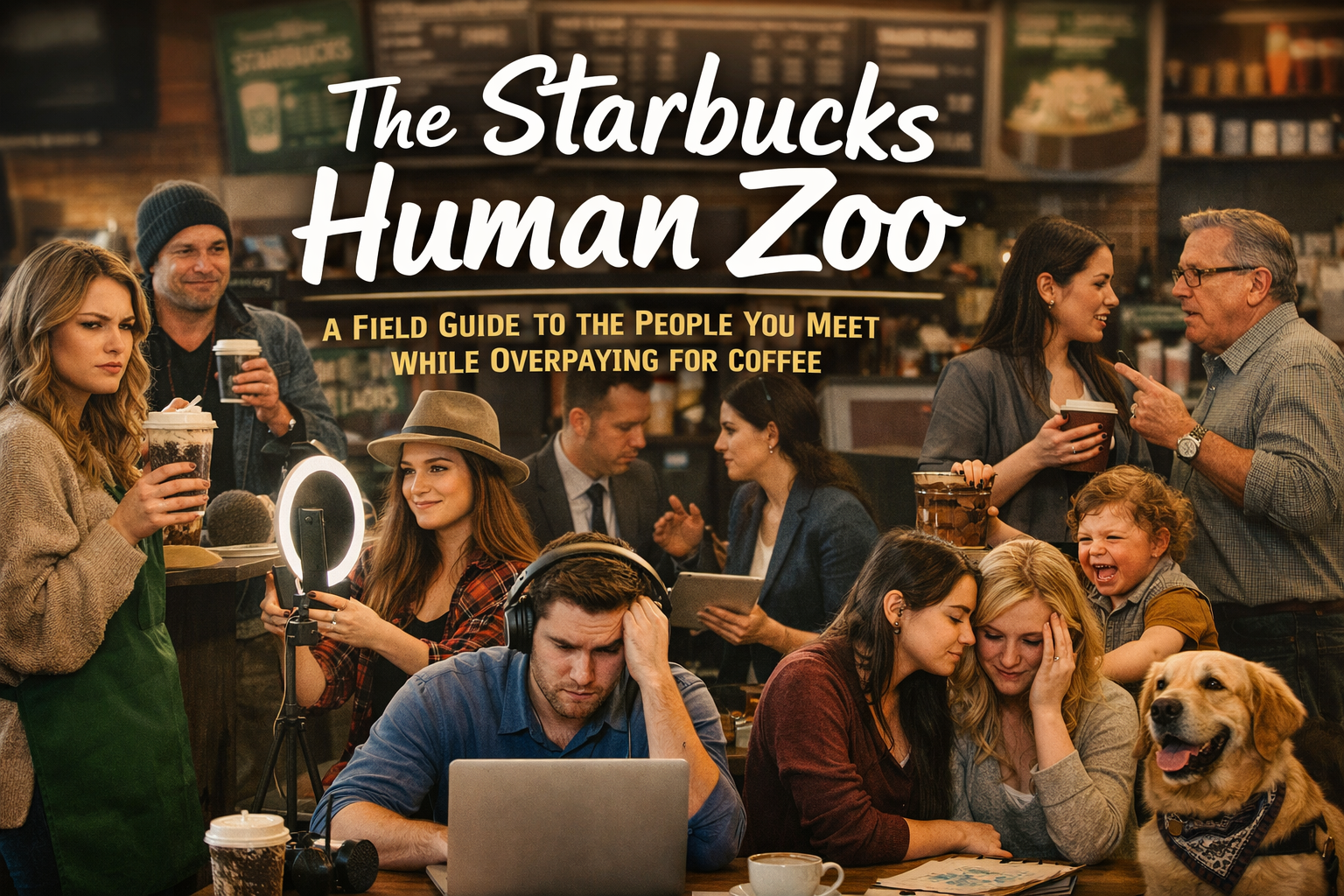
In the corner is the Remote Worker, identifiable by their headset and the way they talk louder than necessary.
“Yes, I’ll share my screen.”
They will not share their screen.
They will, however, share their entire performance review, their therapy breakthroughs, and their opinion of Steve from Finance—who is “honestly not aligned with the vision.”
The entire café now knows Steve is the villain. Steve doesn’t even know he’s the villain. Steve is somewhere else, blissfully unaware that his legacy is being destroyed between a tip jar and a display of lemon loaf.
Next to them is the LinkedIn Influencer. You can spot them because they are setting up a ring light in a Starbucks like the espresso machine is their co-host.
They take photos of their drink from seventeen angles, each one saying, today I chose myself. They type aggressively, pause dramatically, then type again like they’re crafting the next great American novel, except it’s a post about resilience and a bullet list of lessons learned from ordering a grande.
And then there’s the Student Who Is Not Studying. They have a textbook open to page one. Page one is pristine. Page one is untouched. Their screen is a battlefield of tabs: one for “research,” one for “research,” and eight for things that are absolutely not research.
You can’t judge them, because Starbucks is the temple of procrastination. A place where we all go to be surrounded by productivity without personally participating in it.
Starbucks is not a workspace. It’s a stage. And we are all playing roles: Executive. Artist. Entrepreneur. Exhausted Person Just Trying to Breathe.
The wifi is weak, but the delusion is strong.
The Conversations You Overhear That Make You Question Reality
If Starbucks had a warning label, it would be this: You will overhear things you can never unhear.
Because Starbucks is where people go to have private conversations publicly, as if the air is soundproof and strangers are NPCs.
You’ll hear someone end a relationship over a croissant.
“I just don’t think we’re aligned anymore.”
They say it while stirring foam like they’re casting a spell. Their partner nods like this is normal. The barista calls out “Megan!” and Megan grabs her drink and walks away like she didn’t just detonate someone’s heart next to the condiment station.
You’ll overhear business deals that sound like they were invented by someone trying to parody capitalism.
“So we’re pivoting into wellness. It’s a subscription-based mindfulness community, but also crypto-adjacent, and the brand voice is like… soft power.”
Soft power? Sir, you are selling anxiety with a logo.
You’ll hear someone call their mom and lie with absolute confidence.
“Yes, I ate already.”
They have not eaten. They are holding a cake pop and calling it a meal. They are living on espresso and denial.
Then there’s the Friend Therapy Session. The one where one friend is clearly processing trauma and the other friend keeps saying, “No literally,” while scrolling.
“NOLITERALLY” is not a coping strategy. It’s an interjection. But Starbucks is where we normalize being emotionally unavailable while pretending we’re supportive.
You’ll hear someone talking to their dog like the dog is their career coach.
“Okay. We’re going to be brave today.”
The dog is brave every day. The dog does not need a venti pep talk. The dog needs you to stop buying them whipped cream and calling it “a little treat,” because you’re projecting your emotional needs onto a golden retriever who would happily eat drywall if you let them.
And you will, at some point, overhear the most unhinged conflict imaginable: someone arguing about a drink.
“This doesn’t taste right.”
“What do you mean it doesn’t taste right?”
“It tastes… like someone made it wrong.”
I’ve seen international diplomacy with less tension than the moment a customer decides their beverage is a personal offense. And the barista—still calm, still dead inside—says, “We can remake it,” the way you might comfort someone who just discovered betrayal.
Starbucks is where we go to be among people, without actually being with people. We want noise, but not interaction. Community, but not commitment. Human presence, but on mute.
Which is why the conversations feel so surreal. We are all just floating around in public, broadcasting pieces of our lives into the ether, hoping the universe hears us… and also that nobody we know is listening from the table behind us.
Final Thoughts: We Don’t Go for Coffee. We Go for the Human Zoo.
Here’s the truth nobody puts on the menu: Starbucks isn’t selling caffeine. Starbucks is selling a feeling.
It’s the feeling that you’ve got your life together because you’re holding a cup with your name on it, even if your bank account is screaming and your to-do list is actively multiplying.
It’s the illusion of being out in the world doing something important, even if that something is just replying to one email and then staring into the void for fifteen minutes while your latte slowly becomes regret.
Starbucks is where the exhausted go to feel less alone, where the ambitious go to be seen, where the lost go to pretend they’re “in transition,” and where the rest of us go because making coffee at home feels like admitting defeat.
And sure, the drinks are overpriced. The music is always one acoustic cover away from emotional collapse. The line tests your patience like a spiritual practice.
But you can’t deny it: the people-watching is elite.
Because in one visit, you can witness a corporate negotiation, a breakup, a creative crisis, a toddler uprising, a LinkedIn photoshoot, and someone ordering a drink so complicated it should come with a waiver.
All while you sit there, sipping your overpriced optimism, thinking, at least I’m not the one asking for caramel in a spiral.
And that, honestly, is worth the extra two dollars.