
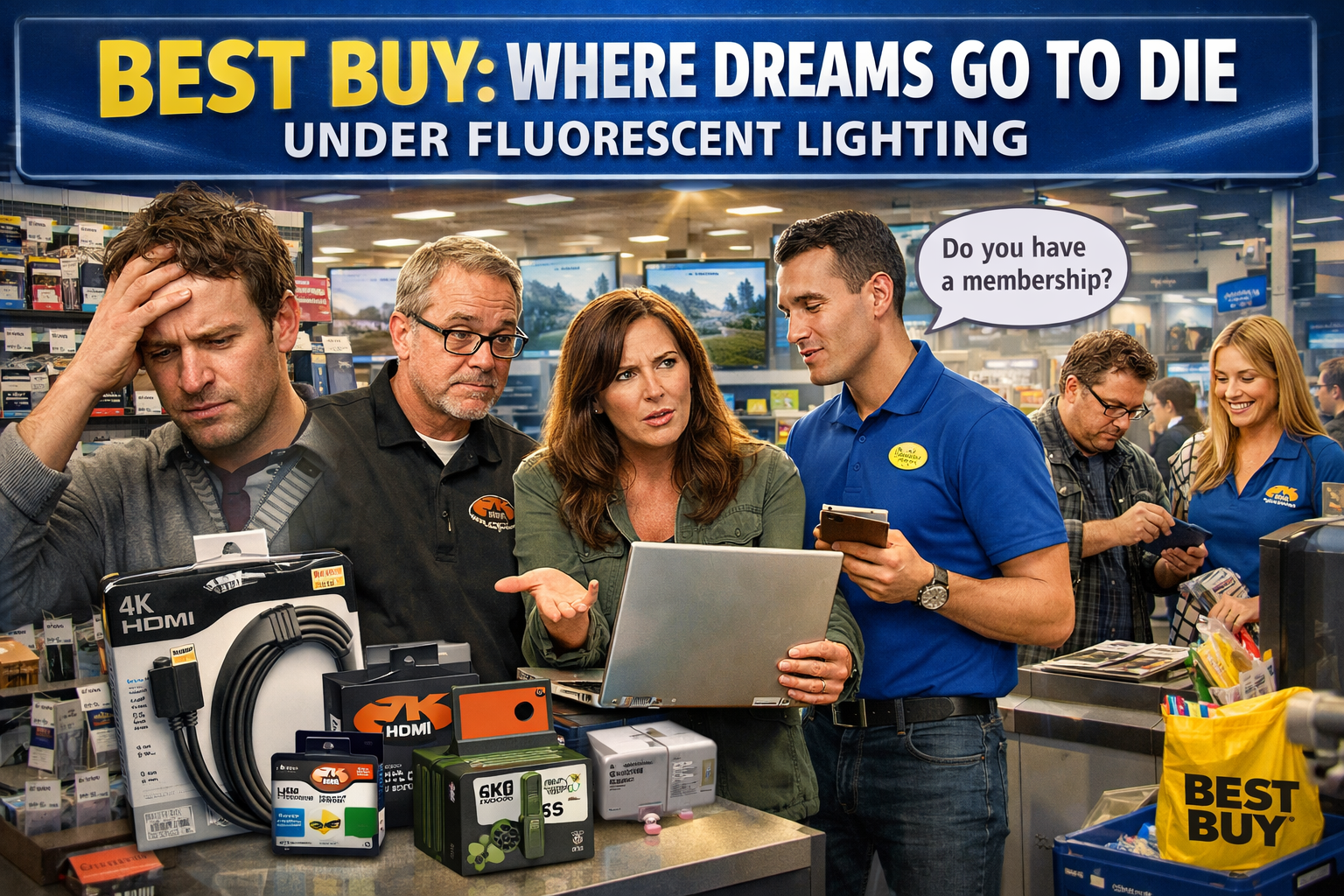
There are a few places in America that feel less like stores and more like psychological events. Like airports. Like the DMV. Like that one Target where the carts all pull slightly to the left like they’re haunted by unresolved customer complaints. And then there’s Best Buy — the retail equivalent of walking into a sci-fi movie where the robots are polite, the lighting is aggressive, and every single aisle whispers, “You don’t need this… but wouldn’t it be nice?”
Best Buy is not a store. Best Buy is an ecosystem. A habitat. A carefully curated arena where modern humans go to perform the ritual of pretending they understand technology while desperately hoping nobody asks a follow-up question.
Because in theory, you’re there for something simple. A charger. A cable. A mouse. Maybe an HDMI cord. Something tiny, harmless, and allegedly affordable. You tell yourself, “I’m just running in real quick.” You say it with the confidence of a person who has never been humbled by a locked glass case and the sudden realization that a 6-foot USB-C cable now costs the same as a small dinner for two.
And the moment you step through those automatic doors, you are greeted by a blast of cold air strong enough to preserve a mammoth, a wall of televisions showing nature documentaries in 8K so crisp you can see the deer questioning its own life choices, and the quiet panic of shoppers standing in front of printer ink like they’ve been asked to defuse a bomb.
You can smell the faint aroma of new plastic, artificial optimism, and the subtle despair of people who only came for a router but are now being asked if they’d like to protect that router with a two-year plan that covers “acts of God” but not “acts of my cat knocking it off the shelf.”
Best Buy is a place where your confidence comes to be audited.
And it will not pass.
The Entrance, or “Welcome to the Marketplace of Regret”
The first thing Best Buy does is immediately convince you that you are behind on technology. Not in a rude way — in a gentle, corporate way. Like, “Hey! So glad you’re here! Just so you know, everything you own is outdated and slightly embarrassing, and also we have a newer version of it on sale, and also the sale ends in 12 minutes, and also your current device might explode.”
You walk in holding a list. A plan. A purpose. And within thirty seconds, you’re distracted by a display that looks like NASA built a living room. A soundbar demonstration starts playing, and suddenly you’re hearing a demo of rainfall in Dolby Atmos that makes you feel like you owe the ocean an apology.
Somewhere to your left is a lineup of laptops, all slightly open, glowing like the eyes of a thousand tiny judges. The price tags are designed to look approachable, but the numbers are not. The numbers are the kind of numbers that make you whisper, “Interesting,” the way people do when they’re trying not to faint.
And then the employees. The employees are always moving. Always available in theory. Yet never near the exact item you need.
You will see three employees enthusiastically explaining gaming headsets to one teenager who is just there to touch things. You will see two employees standing next to the phone cases, chatting like philosophers debating the meaning of life. You will see someone in a blue shirt disappear behind the Geek Squad counter like they’ve entered witness protection.
But the moment you stand in front of a locked glass case containing the very thing you came for — a simple adapter that costs $34.99 because it’s apparently handcrafted by monks — suddenly you are alone.
No one is coming.
You can try the polite method. The “excuse me” method. The “I’ve been standing here with my eyebrows raised for five minutes” method.
Nothing.
And then, just when you begin to consider whether you should scale the case like a determined raccoon and free the cable yourself, an employee appears out of nowhere like a retail fairy godparent.
“Hey! What can I help you find today?”
And you say the name of the thing.
And the employee says, “Sure.”
And then the employee says the sentence that changes your life:
“Do you have a Best Buy membership?”
Now, your brain freezes.
Because you don’t know if you have a membership. You don’t know what a membership is anymore. You don’t know if you signed up in 2017 during a moment of weakness while buying a printer you still regret.
You nod like a person who has seen war.
And they say, “Great. What’s your phone number?”
And suddenly you are standing under fluorescent lights spelling out your identity like you’re trying to prove you exist to the state.
They type it in.
They look at the screen.
They pause.
And you can tell by their face that your digital footprint has disappointed them.
“No membership under that number.”
Which feels personal.
So now you have two choices:
- Pay full price, like a savage.
- Sign up for something with a name like “Best Buy Plus Ultra Prime Elite Advantage Pro Max” that will “save you money today.”
You choose the second option because you are weak, and because they said the words “save you money” in a tone that activates the same part of your brain that responds to free breadsticks.
Congratulations. You have been adopted by the Best Buy system.
The Printer Ink Aisle, aka “The Labyrinth of Human Suffering”
If you want to understand the fragility of the human spirit, stand in front of the printer ink wall at Best Buy.
Just stand there.
Watch people.
Because nothing in modern life will humble you faster than realizing your printer requires a cartridge named like a secret government file: HP 62XL Tri-Color — and you don’t know if you need XL, or if XL is a scam, or if your printer is the kind of printer that rejects non-XL cartridges out of sheer spite.
Printers are the most passive-aggressive device category ever invented. A printer will sit there silently for months. No issues. No complaints. It’s basically a decorative cube.
And then you need it one time — one time — to print a return label, a kid’s school form, or proof that you are a functioning adult, and suddenly it’s like:
“I’m out of ink.”
You say, “But you printed one page in 2023.”
And the printer says, “Correct. I am now out of ink. Forever.”
So you come to Best Buy, hopeful. You come to fix your life. And you are immediately confronted by an entire wall of small cardboard boxes arranged like a museum exhibit titled ‘How We Monetize Your Desperation.’
Each box costs a minimum of $39.99. For ink. Ink! A substance that has existed since ancient civilizations. You are paying luxury pricing for something the Romans basically used to write breakup letters.
And the best part is, even if you find what you think you need, there’s always a second question:
- Is it the black?
- Is it the color?
- Is it the combo pack?
- Is it the high yield?
- Is it the “works with your printer unless your printer is in a mood” version?
And the boxes don’t help. The boxes show a picture of a printer that looks vaguely like yours, the way a police sketch looks vaguely like a person.
So you do what any adult does in crisis: you take out your phone and start Googling frantically while standing in the aisle like you’re trying to decode an ancient language.
And because Best Buy is an immersive experience, the Wi-Fi is weak right here. Because of course it is. Because the printer ink aisle is where hope goes to buffer.
Finally, you find an employee.
“Hi, can you help me find ink for this printer?”
They look at the model number. They blink.
They say, “Yeah, it’s either this one… or that one.”
And you say, “What’s the difference?”
And they say, “The difference is… one is XL.”
That’s it. That’s the explanation. That’s the tech support.
Now you are faced with a decision that feels like a moral test:
- Buy the standard cartridge and risk your printer shaming you immediately.
- Buy the XL cartridge and feel like you’re investing in a lifestyle.
So you buy the XL. Because you are tired. Because you want peace. Because you have been defeated by a rectangle.
And as you walk away, you see someone else staring at the wall, empty-eyed, holding their phone like a flashlight in a cave.
And you want to hug them. But you don’t. Because in Best Buy, physical affection feels like it would require a protection plan.
Geek Squad, or “I Brought In a Device and Left With a New Personality”
Geek Squad is where you go when you’ve tried everything else and you are officially ready to surrender.
Geek Squad is not tech support. Geek Squad is a confessional booth with a receipt printer.
You walk up with a laptop that “just started acting weird,” which is adult code for “I clicked something I shouldn’t have and now I’m being held hostage by pop-ups that say my computer is infected with seventeen viruses and also I owe someone in Estonia $300.”
The Geek Squad employee greets you with calm professionalism. They have seen things. They have witnessed human chaos. They have been asked, “Can you fix my Wi-Fi?” by someone standing in the middle of a parking lot.
They take your device like a doctor taking a chart.
“What seems to be the issue?”
You start explaining, and about thirty seconds in you realize you sound insane.
“Well, it was fine, and then I downloaded this PDF, and then it said my storage was full, and then it asked me if I wanted to clear cache, and then I clicked yes, and now my screen is… doing that.”
You point to something. You don’t know what it is. It might be a virus. It might be your desktop background trying to escape.
The Geek Squad person nods. They do not judge you. Out loud.
They ask a few questions:
“Did you back up your data?”
“Do you have your password?”
“Do you know what operating system you’re on?”
“Do you have AppleCare?”
“Do you have our Total Tech membership?”
“Do you want to add protection?”
Every question is asked with the gentle tone of someone trying to guide you toward the truth: you are not prepared for adulthood, and you are about to pay for that.
Then comes the diagnostic.
“We can run a full diagnostic for $X.”
You say, “Okay.”
They say, “And if you want us to fix it, that will be $Y.”
You say, “Okay.”
They say, “Or you can sign up for this plan, and it covers repairs and setup and support, and you’ll save money today.”
There it is again.
Save money today.
The phrase that turns strong people into membership holders.
So you sign up. Again. Or for the first time. Or for the tenth time. You don’t know. Your financial identity is now just a series of recurring charges and regret.
And then you leave your device there, like you’re dropping off a sick pet at the vet.
They hand you a receipt and a pick-up time.
You walk away feeling oddly emotional. Because you came here with a device problem, but what you actually discovered is that your relationship with technology is basically a situationship.
It works when it wants to. It disappears when you need it. It demands money. And when it breaks, you blame yourself.
And that’s Best Buy’s true magic: it makes you feel like technology is both your responsibility and your fault, while gently upselling you on the privilege of having someone else deal with it.
Which, to be fair, is sometimes worth every penny.
FINAL THOUGHTS: The Checkout Line, Where You Accept Your Fate
Eventually you reach the checkout line with a handful of items that were never part of your original plan.
You came for a cable. You are leaving with:
- A cable
- A surge protector that looks like it could power a submarine
- Printer ink that cost the same as a car payment
- A membership you didn’t know existed
- A new appreciation for people who live off-grid
And at checkout, the cashier asks if you found everything okay.
And you want to say:
“I found myself. I found my limits. I found out HDMI cords are now luxury goods. I found out my printer is a tyrant. I found out I will say yes to anything if you phrase it as saving money today.”
But instead you smile and say, “Yep.”
Because that’s the rule in Best Buy. You don’t talk about what happened in Best Buy.
You just leave. You walk back into daylight. You squint. You breathe fresh air like someone emerging from a retail bunker.
And as you step into the parking lot, you feel something sacred:
Relief.
Until you get home, open the box, realize it’s the wrong cable, and whisper the sentence that completes the cycle:
“Okay. I’ll just run back in real quick.”