There was a time when applying for a job was a straightforward exchange between two groups of adults pretending not to be terrified of each other. You’d send in your resume, someone would read it (or at least open it long enough for the PDF to feel seen), you’d talk like normal humans about responsibilities and pay, and then—if the universe was feeling generous—you’d either get hired or get rejected in a way that didn’t require you to emotionally process it like a breakup.
In 2026, however, job searching has evolved into something far more cinematic, far more spiritual, and far more suspiciously similar to an escape room designed by people who think “culture fit” is a measurable science.
Because it’s not enough to be qualified anymore. Qualification is just the entry ticket. A baseline. A suggestion. Like having a driver’s license when you show up to drive a NASCAR race. Cute. Helpful. Not the point.
The point is endurance.
The point is whether you can survive the modern hiring funnel, which is less “process” and more “multi-level obstacle course,” where each stage asks you to prove you’re resilient, adaptable, collaborative, innovative, emotionally regulated, endlessly enthusiastic, and somehow still humble—even after you’ve typed out your entire work history into a platform that already has your resume uploaded, like you’re manually re-entering your identity for a government witness protection program.
And just when you think you’ve completed the ritual—when you’ve answered the eleven “optional” questions that were absolutely not optional—you get the email.
The email that always starts with false hope.
“We’d love to move forward…”
A phrase that feels like a warm hug until the very next line reveals the first step of their interview process is something called The Personality Labyrinth, which is either a hiring assessment or the title of a horror movie starring a mid-level recruiter and a blinking cursor.
You click the link because you’re brave, and also because your landlord doesn’t accept “the job market is weird” as payment.
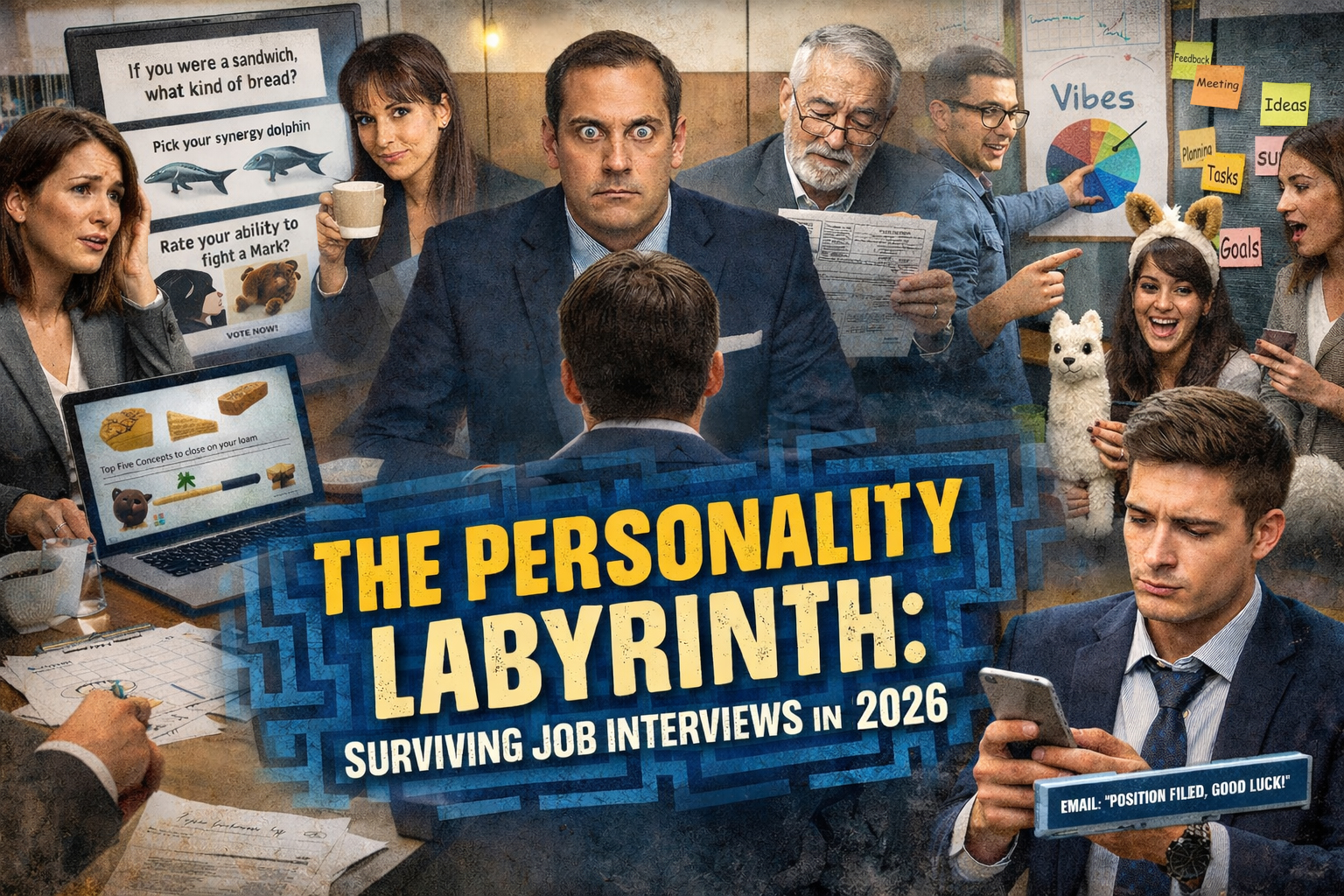
And suddenly you’re taking a quiz that asks you what kind of bread your leadership style would be, which dolphin best represents your quarterly synergy, and whether you could fight a bear on a scale from 1 to Elon Musk.
And you don’t even question it.
You just sit there, squinting at the screen, trying to decide if “sourdough” is too intense, because you don’t want to come off as difficult, but you also don’t want to pick “white bread” and accidentally communicate that your conflict resolution style is “avoidance and soft crying.”
Welcome to job hunting in 2026, where the qualifications are real, the interviews are imaginary, and the rejection emails arrive mid-sentence like a surprise tax bill.
The Personality Labyrinth (Or, How I Became a Sandwich Professionally)
It begins with optimism. It always begins with optimism.
You apply for a “normal” job with a “normal” title—something like Strategic Operations Alignment Wizard with Cross-Functional Ninja Vibes—which, yes, sounds like a role created during a corporate brainstorming session where everyone was hopped up on cold brew and unchecked confidence, but still, you’re qualified. You’ve done the work. You have receipts. You have spreadsheets. You have trauma and transferable skills.
So you apply.
You upload your resume, then retype your resume, then confirm you typed your resume correctly by answering a question that says, “Please list your last three roles,” even though they are literally on the screen in front of you like a museum exhibit titled Career History: A Collection of Corporate Surviving.
Then you get the email.
“Please complete the first step of our interview process: The Personality Labyrinth.”
And here’s the thing: the name alone is a red flag. Nobody ever calls something a labyrinth unless there’s a monster involved, and in corporate America, the monster is always either unclear expectations or a survey tool from 2009.
You click the link and enter the quiz.
The first question is something like:
“If you were a sandwich, what kind of bread would your leadership style be?”
And you stare at it, frozen, because you didn’t know your leadership style was bread-based, but now that it is, you’re panicking. Because sourdough is bold and artisanal, but might signal you’re high-maintenance. Whole wheat is reliable, but could imply you’re boring. Brioche says you’re warm and collaborative, but it also says you’re too soft to survive quarterly budgeting.
You pick something safe. You pick something middle-of-the-road. You pick the bread equivalent of “I’m a team player,” which is basically “multigrain with ambition.”
Then the quiz escalates.
“Pick a dolphin that best represents your quarterly synergy.”
Not a dolphin type. Not a dolphin mood. An actual dolphin image. One of them looks like it’s doing taxes. One looks like it’s smiling in a way that feels legally binding. One looks like it’s about to betray you in a corporate merger.
You pick the dolphin that looks the most emotionally stable, because you’re trying to communicate, “I can collaborate under pressure and I won’t flip a table when Chad from Finance says we’re pivoting.”
Then, just when you think it can’t get worse:
“Rate your ability to fight a bear on a scale from 1 to Elon Musk.”
And now you realize this wasn’t a personality quiz. This was a psychological experiment to see how far a human being will go to keep access to dental insurance.
You answer honestly—meaning, you pick something that suggests confidence without implying you’ll challenge leadership. You pick “7,” because “10” feels aggressive and “1” feels like you’ll cry in Slack.
You submit the quiz.
You pass.
And that’s the most terrifying part.
Because what exactly did you pass? What have you agreed to? What kind of workplace requires a person who can fight a bear and also pick a synergy dolphin? Are the bears part of onboarding? Is Chad a bear?
You don’t know. But you move forward. Because you’re employed by hope and sponsored by caffeine.
The Seven Person Panel Interview (Featuring Chad, the Unblinking)
The panel interview arrives like a scheduled ambush. You get the calendar invite. It says 45 minutes. It lies.
You log in early because you’re responsible and also because you’ve been trained by trauma to believe that arriving “on time” is actually arriving “ten minutes early with a backup headset.”
The screen loads.
Seven faces appear.
Seven.
Not because this is a senior executive role where you’ll be making decisions that impact entire continents. No. This is a normal job. A regular job. A job where the primary responsibilities are probably emailing, updating systems, and being blamed for things that existed before you were hired.
But still—seven people.
One of them is named Chad, and he never blinks. Not once. His eyes are open in a way that suggests he either hasn’t slept since 2018 or he’s personally powered by quarterly deliverables.
One person is very clearly reading your resume for the first time mid-interview, which is always a delight because it turns your life into live commentary.
“Oh, I didn’t realize you worked in operations.”
Yes. That’s why I’m here. That’s why we are all here. In this Zoom rectangle of fate.
Another person spills coffee and vanishes. No apology. No explanation. Just a sudden disappearance like a magician leaving the stage because the vibes turned violent.
They ask questions that sound like they were generated by an AI trained exclusively on motivational posters and therapy podcasts.
“What does productivity feel like to you emotionally?”
Productivity feels like trying to prove I deserve rent money while my soul slowly exits through my left ear, but I say, “It feels fulfilling,” because I’d like to keep advancing.
“If we gave you a blank calendar, what would you color-code first—and why?”
This is not a real question. This is a confession that your company worships Google Calendar as a god.
I answer something about prioritization, stakeholder alignment, and strategic planning, while knowing deep down the correct answer is, “I would color-code the days I’m allowed to feel like a human.”
Then they hit you with the final boss question:
“Can you describe a time you disagreed with a colleague without using vowels?”
Chad is watching. Unblinking. Judgmental. Possibly reptilian.
You do it. You answer. You smile. You laugh politely at their jokes, even when their jokes are just them saying, “We’re a family,” and expecting that to land like a comforting statement instead of a warning label.
The interview ends.
They tell you next steps.
You thank them.
You close your laptop and stare into the middle distance like a war veteran returning home, emotionally altered.
And then you get an email: “Congratulations! You’ve advanced to the next stage.”
And you should feel happy.
But you don’t.
Because you know the next stage is going to be unhinged.
It always is.
The Group Project (Or, Emotional Support Llamas and Other Corporate Crimes)
This is where the hiring process stops pretending it’s about assessing your skills and starts openly auditioning you for a reality show.
They email you: “For the next round, you’ll participate in a collaborative group exercise.”
Collaborative group exercise.
Those words should come with a prescription.
You log in and discover you’ve been placed into a group with strangers from other interview pools, which is a bold move because it’s essentially corporate speed dating, except instead of romance, you’re competing for health insurance and a manager who “values transparency” while sending ambiguous late-night Slack messages.
You find out you’re all applying for different jobs, but you’re being asked to build a fictional app for emotional support llamas using AI and synergy.
AI and synergy. The two ingredients companies add to everything now, like glitter and regret.
One person immediately announces they are “the visionary,” which is always a sign you’re about to do all the work while they narrate your effort like it’s a TED Talk.
Another person draws a pie chart labeled “vibes.”
No data. No numbers. Just vibes.
A third person keeps saying “let’s ideate” while contributing absolutely nothing except an impressive ability to talk for seven minutes without making a point.
Meanwhile, you’re trying to be helpful but not overbearing. Smart but not threatening. Collaborative but not silently furious.
Because the group project is not evaluating your ability to build an app. It’s evaluating whether you can survive forced teamwork with people who think “alignment” is something you do with your soul.
You do your best. You facilitate. You summarize. You “circle back.” You validate the visionary. You gently steer the vibe chart into something that resembles a plan.
And somehow, you survive.
You submit the final presentation, which includes a feature called “Llama Mood Tracking,” because at this point, you’re fully committed to the bit.
They thank you. They smile. They say they’ll be in touch.
And then you reach the final round.
It’s you and one other candidate.
You know this because Karen from HR accidentally CC’d you both on the “finalist congratulations” email, which is the corporate version of accidentally inviting both people you’re dating to the same dinner and pretending it’s a scheduling error.
You laugh. You cry. You take the last interview anyway.
Because what else are you going to do? Walk away when you’ve come this far? After the bread question? After the dolphin selection? After the llama app?
No. You finish.
And then it happens.
Mid-interview—mid-sentence—you get an email.
Subject: “Thank You for Applying.”
Body: “We’ve decided to go with another candidate. Best of luck!”
You are still in the interview.
You are actively answering questions while your inbox throws a chair.
You casually tell the interviewer, “Hey, small thing, I just got rejected mid-sentence. Should I hang up or finish my story about conflict resolution?”
Panic erupts. Apologies happen. Someone blames a “system glitch,” which is corporate language for “we have no idea what we’re doing, but we’d like you to remain calm.”
You nod professionally while quietly logging onto Indeed.
Because at this point, you don’t trust anything that comes from a system.
Not the calendar invite. Not the assessment. Not the dolphins.
Final Thoughts
The moral of the story is not that job interviews are hard. We already knew that. The moral is that job interviews in 2026 are becoming less about hiring and more about endurance theater.
They’re not assessing your qualifications—they’re assessing whether you can survive surrealism with a smile.
They want to know if you can be rejected in real time and still remain polite. If you can build an emotional support llama app with strangers and call it “collaboration.” If you can answer questions written by someone who thinks leadership is best expressed through bread selection.
And if you’re still doing it—still applying, still interviewing, still showing up with your resume, your humor, and your last functioning nerve—then yes.
You are a warrior in business casual.
And when you finally land that job, I hope it comes with benefits, peace, a manager who blinks, and a strict policy against surprise dolphin quizzes.
Stay strong. Stay funny.
And honestly—go ahead and draft your own rejection email now. Not because you’re negative. Because in 2026, being prepared is a soft skill, and so is emotional self-defense.