Every once in a while, the corporate universe gifts us a message so confident in its own wrongness, so serenely unaware of how it sounds, that you can practically hear the sender hitting “Send” with the same smug satisfaction as someone placing a tiny “Live, Laugh, Love” sign above an HR policy that was clearly written during a full moon.
And then you open it.
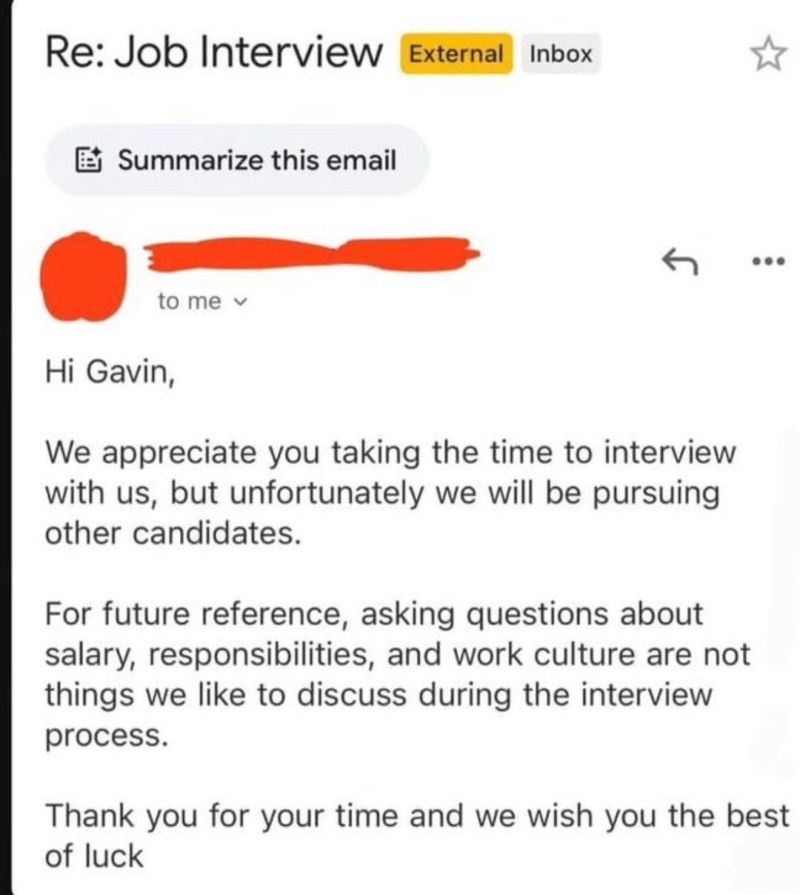
And there it is, sitting in your inbox like a passive-aggressive fortune cookie: Thank you for interviewing with us, but unfortunately we will be pursuing other candidates. A sentence so familiar it practically comes with a complimentary ghosting package and a “please do not reply” aura. But this email doesn’t stop there. Oh no. This email goes on to deliver a note so bold, so unhinged, so accidentally hilarious, that it deserves its own Emmy and a standing ovation from every job seeker who has ever been told they’re “not the right fit” for daring to request basic human information.
Because the reason Gavin was rejected wasn’t lack of experience, or missing qualifications, or an inability to perform the role. No. Gavin committed the ultimate interview crime: he asked about salary, responsibilities, and work culture. In other words, Gavin treated an interview like a conversation instead of a hostage negotiation where the only approved question is, “How high should I jump, and would you like that in business casual?”
This email didn’t just reject Gavin. It scolded him for curiosity, like he showed up to a museum and asked what any of the paintings meant. Like he went to a dealership and asked what the car costs. Like he went to a restaurant and asked, with reckless audacity, “So… what am I eating?”
And that’s when you realize what we’re dealing with here. This isn’t a company that’s hiring. This is a company auditioning candidates for a role in its ongoing production titled The Mystery Box: Employment Edition, where the pay is a surprise, the duties are an evolving riddle, and the culture is best described as “we don’t discuss that in front of witnesses.”
So let’s talk about it. Not because Gavin needs closure, but because this email is a public service announcement for the rest of us: if asking normal questions makes them recoil like you just turned on a flashlight in a basement full of secrets, you weren’t being interviewed for a job. You were being screened for your tolerance of nonsense.
The Interview Process, Now With Less Information and More Faith
Somewhere along the way, corporate America decided interviews were not for mutual evaluation, but for spiritual surrender. The candidate should arrive with a polished resume, a charged laptop, a practiced smile, and the ability to speak in fluent optimism while pretending they’re not calculating grocery prices in their head like a stressed-out mathematician.
The employer, meanwhile, should reveal nothing. Not because they can’t, but because they don’t like to. Because transparency ruins the vibe. It interrupts the power dynamic. It makes things real. And reality is messy, and messy is not on-brand.
So you, the candidate, are expected to sit there while they ask you to recount your entire career like you’re narrating a documentary about your own resilience. They want origin stories. They want obstacles. They want you to describe a time you overcame adversity, ideally while implementing a new CRM system and also somehow saving a drowning teammate with nothing but a pivot table and grit.
But you ask, “What does this role pay?” and suddenly the room temperature drops, the recruiter’s eye twitches, and someone in leadership whispers, “This one’s dangerous. They’re trying to learn something.”
Because salary questions are apparently not “appropriate” during an interview. Which is fascinating, because salary is the only reason half the people in that Zoom room are awake. We are not volunteering. We are not joining a commune. We are not participating in a scavenger hunt for personal growth. We are exchanging labor for money, and it’s not controversial to ask what the money is.
Yet companies still act like salary is a family secret, like you’re asking about their credit score, their childhood trauma, and the exact number of times the CEO has searched “how to manage millennials” in the last 24 hours.
Responsibilities are treated the same way. You ask, “What would my day-to-day look like?” and they respond like you just asked for the nuclear launch codes. Because the truth is, they might not actually know. Or worse, they know, but saying it out loud would sound like this:
“You’ll be doing the job you applied for, plus the job of the person who quit, plus the job of the person we’re not replacing, plus a rotating duty where you explain to angry customers why we have no support team anymore, and yes, we will call it ‘stretch opportunity’ while you quietly stretch your sanity into a new dimension.”
Then there’s the culture question, the most revealing one of all, and therefore the one they hate the most.
Culture is the corporate equivalent of seeing someone’s apartment on a first date. It tells you everything. It shows you whether the place is functional, whether there are boundaries, whether someone respects basic hygiene, and whether the vibe is “cozy and stable” or “there are six roommates and nobody owns a trash can.”
So when Gavin asked about work culture, what he was really asking was, “Am I about to walk into a supportive environment with clear expectations, or am I about to become the lead actor in a daily improv show called ‘Surprise Crisis: The Musical’?”
And the email’s answer was loud and clear: We prefer you not ask, because if you ask, we might have to tell you, and if we tell you, you might choose not to join, and we cannot have candidates making informed decisions. That’s how you end up with accountability.
“We Don’t Like to Discuss That” Is Not a Policy, It’s a Red Flag Wearing a Tie
Let’s appreciate the absolute audacity of the line: For future reference, asking questions about salary, responsibilities, and work culture are not things we like to discuss during the interview process.
Not “we don’t have that information yet.” Not “we’ll share after we narrow candidates.” Not “we’re still finalizing.” No. This wasn’t a logistical issue. This was a values statement. This was a declaration of identity. This was the company looking directly into your eyes and saying, “We do not enjoy being perceived.”
Because think about what they’re actually saying. They are saying: the interview process is designed for us to evaluate you, and you should not evaluate us. You are not a participant. You are a contestant. You are here to perform enthusiasm and obedience until we decide whether you deserve access to the next stage of the maze.
This is why so many job seekers leave interviews feeling like they just completed a reality show challenge. You are asked to display emotional maturity, flexibility, communication skills, conflict resolution, time management, leadership presence, and the ability to “thrive in ambiguity,” which is corporate code for “we won’t train you, and we will blame you anyway.”
Meanwhile, they refuse to answer questions that would help you understand whether this is a job or a trap.
Salary isn’t just money. It’s rent. It’s childcare. It’s health insurance. It’s the ability to not spiral into panic every time your car makes a new noise. But companies treat it like a taboo subject, like discussing pay might shatter the fragile illusion that everyone is here purely for passion.
Responsibilities aren’t just tasks. They are scope. They are workload. They are boundaries. They are the difference between a manageable role and a slow-moving burnout parade where your calendar fills up with meetings called “Quick Sync” that last two hours and solve nothing.
And culture isn’t just “fun.” Culture is whether you can take a lunch break without being punished. Culture is whether mistakes are treated as learning opportunities or personal betrayals. Culture is whether your manager leads, or merely supervises your breathing. Culture is whether people are allowed to be human, or whether you’re expected to be a cheerful productivity robot with a personality limited to “team player” and “willing to go above and beyond,” which is another way of saying, “willing to be exploited with a smile.”
So when a company refuses to discuss those things, it’s not because it’s too early. It’s because they benefit from you not knowing.
That email was not a rejection note. It was an accidental confession.
And the funniest part is the tone. The gentle scolding. The “for future reference,” as if Gavin is a child who asked why the sky is blue during a corporate seminar and now needs to be reminded that curiosity is not aligned with company values.
What they wanted was a candidate who nods. Someone who says, “I’m just grateful for the opportunity,” while internally wondering if the opportunity includes food or merely a badge and emotional instability.
Gavin didn’t just ask questions. Gavin disrupted the fantasy. Gavin threatened the business model.
Gavin, Patron Saint of Reasonable Adults
We need to talk about Gavin, because Gavin did what every job seeker is told to do in career advice articles that are written by people who clearly have not applied for a job since 2009.
He treated the interview like a two-way conversation.
He asked about pay, because he is not applying for a hobby.
He asked about responsibilities, because he would like to know whether he’s being hired to do a specific job or to become the emergency contact for every broken process in the organization.
He asked about culture, because he understands that money cannot compensate for daily misery, and that no salary is worth becoming a shell of yourself who flinches when the calendar notification sound goes off.
This is the part where most companies pretend they love questions. They say, “Do you have any questions for us?” like it’s a polite formality, like offering someone water before a trial. But some of them don’t mean it. Some of them are checking a box. Some of them only want questions that flatter them, like:
“What’s your favorite thing about working here?”
“How would you describe your leadership style?”
“What’s the company’s vision for growth?”
Questions that are safe. Questions that are basically compliments with punctuation.
But Gavin asked the “real” questions. The ones that make people sweat. The ones that require honesty. And in response, this company did what insecure systems always do when they’re challenged by basic logic: they rejected the person asking, then attempted to shame them as a warning to others.
That’s what the email is, really. A message to the marketplace: Don’t ask. Don’t push. Don’t inquire. Don’t evaluate. If you want to work here, you will accept uncertainty as part of your compensation package.
And honestly, thank you for putting it in writing.
Because now Gavin can do the most powerful thing a job seeker can do in modern capitalism: walk away with clarity.
He didn’t get the job, but he got something far more valuable than another round of interviews and a slow descent into disappointment. He got a preview of what it would be like to work there, and it came in the form of an email that basically said, “We don’t believe in transparency, and we consider your questions a threat.”
Gavin should frame it. Not as a wound, but as proof that he dodged a workplace where “communication” is listed as a core value while “information” is treated like contraband.
And if Gavin ever doubts himself, he should remember this: a company that refuses to discuss salary, responsibilities, and culture is not rejecting you because you asked the wrong questions. They are rejecting you because you asked the right ones too early, before they had time to trap you with charm and vague promises and an onboarding packet full of inspirational quotes.
Final Thoughts: Keep Asking Questions, Even If It Scares Them
This email is hilarious, yes, but it’s also instructive. It shows you exactly what some companies are hoping for: candidates who are exhausted enough to accept anything, grateful enough to stay silent, and uncertain enough to hand over their time without asking what they’re getting in return.
Don’t be that candidate.
Ask about salary. Ask about responsibilities. Ask about culture. Ask what success looks like. Ask how performance is measured. Ask what support exists. Ask why the role is open. Ask how turnover looks. Ask what a typical week really entails, not the fantasy version where everyone is “collaborative” and “fast-paced” and “passionate,” and nobody ever cries in their car.
If they answer clearly, you’ve learned something useful.
If they dodge, you’ve learned something even more useful.
And if they send you an email like this one, congratulating themselves for refusing to discuss the basics during the exact process designed to discuss the basics, then you can walk away knowing you weren’t rejected by an opportunity. You were rejected by a mystery box that wanted you to step inside blindfolded.
So here’s to Gavin, the accidental folk hero of modern interviewing. The man who asked what he would be doing, what he would be paid, and what kind of environment he’d be walking into, and was treated like he asked to see the company’s hidden basement.
May we all channel that energy.
May we all remember that employment is not a surprise party.
And may we all keep asking the questions that reveal whether a company is hiring professionals… or collecting volunteers for chaos.