
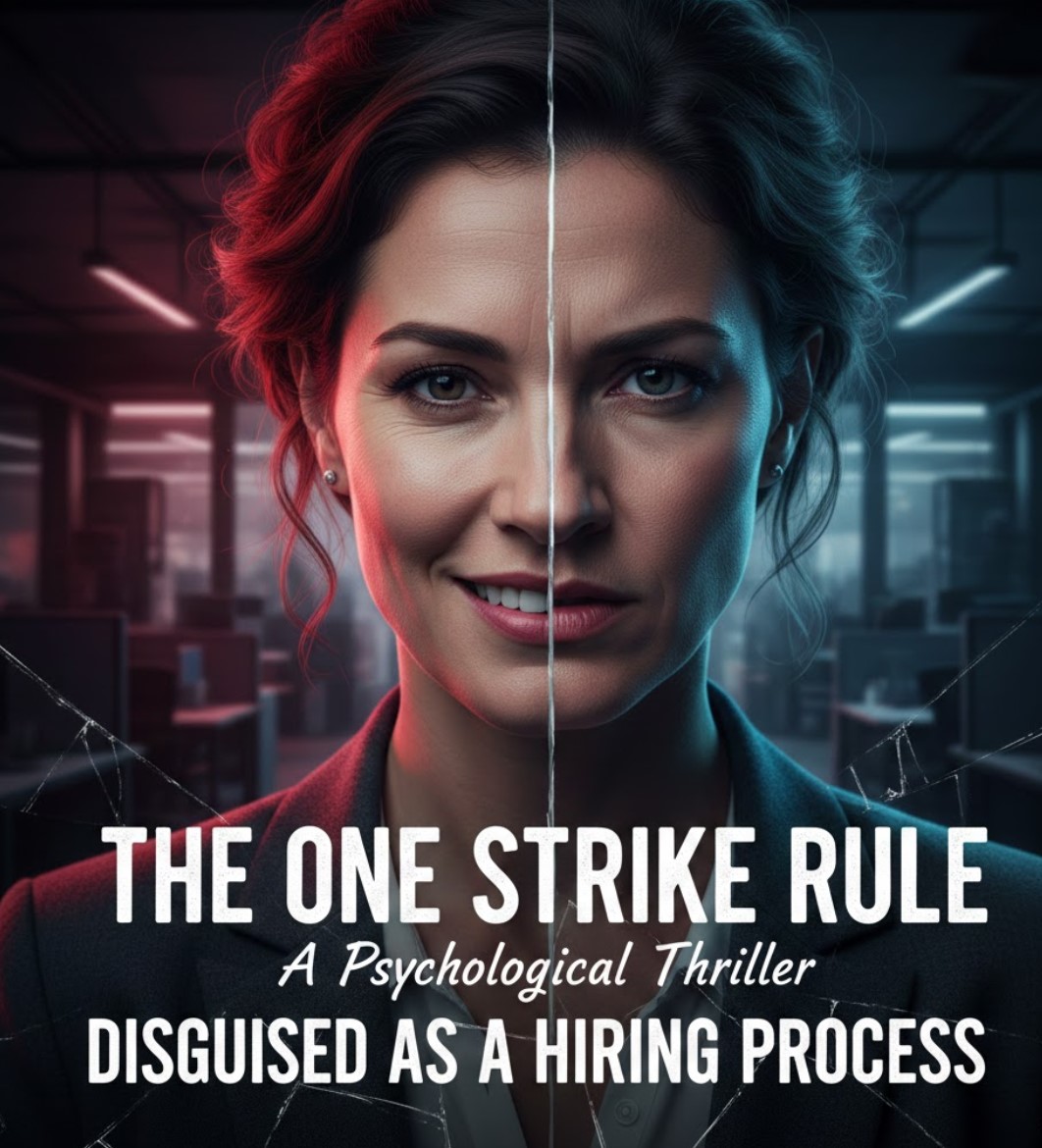
There are many features of the modern job hunt that recruiters love to discuss publicly. Transparency. Culture. Growth mindset. Feedback loops. Synergy. The idea that every candidate is “carefully considered.” These concepts are presented with the same warmth as a company-branded hoodie and the same level of realism as a stock photo of coworkers laughing at a salad.
But there is one feature of the hiring process that never makes it onto a careers page. It is never explained in onboarding documents, never acknowledged in recruiter posts, and never mentioned in those chirpy emails that begin with “Thank you so much for taking the time to meet with us.”
It is the One Strike Rule.
You don’t apply for jobs anymore. You apply for a single, fleeting moment of corporate awareness. One brief audition. One chance to be perceived as a human being before an algorithm decides whether your existence should be archived indefinitely under “we’ve seen enough.”
Once you are rejected for one role, you are no longer a candidate. You are a historical record. A previous encounter. A memory the system would prefer not to revisit. You could apply for another role tomorrow, next month, or five years from now, and the response will be the same: silence so complete it feels intentional.
And no one warns you. There is no disclaimer. No pop-up message that says, “Please note: failure to impress Chad from Product on a Wednesday at 3:00 PM may result in permanent invisibility.” You learn the rule slowly, painfully, over time, as your applications vanish into nothingness like you offended the concept of employment itself.
This is not a job market. This is a psychological experiment with a careers page.
The Interview That Determines Your Entire Future Without Your Knowledge
Every interview feels important, but not like this.
You show up prepared. You researched the company. You memorized the mission statement. You practiced answers that balance confidence with humility, ambition with teamwork, personality with professionalism. You smiled at the right moments. You asked thoughtful questions. You left thinking, “That wasn’t perfect, but it was solid.”
What you did not realize is that this was not just an interview. This was your only audition for the entire organization.
Not for the role. For the company. For all departments. For all future opportunities. For every hiring manager you will never meet. For every team you might have actually been perfect for.
Somewhere in the process, someone typed notes. Not objective ones. Vibes. “Not quite what we’re looking for.” “Good experience but didn’t wow.” “Maybe not a culture fit.” These notes were then absorbed into the ATS like ancient scripture, never to be questioned again.
You didn’t fail. You simply didn’t transcend.
And now, months later, when you apply for a different role, one that aligns better with your background, skills, and actual interests, the system remembers you. Not fondly. Just accurately enough to ensure you are never forwarded to a human being again.
This is how one conversation becomes a permanent personality assessment. This is how one Tuesday afternoon becomes a professional identity. This is how companies decide that people, unlike software, are not allowed updates.
Referrals Are Decorative Now, Like Throw Pillows or Corporate Values
There was a time when referrals meant something. A real something. A human something. A moment where someone inside the company said, “I know this person. I trust them. You should talk to them.”
Now referrals are more like a polite suggestion. A garnish. A checkbox that makes everyone feel good before nothing changes.
You can be referred by someone whose desk is physically inside the building. Someone who works with the hiring manager. Someone who has actual credibility. The system will still glance at your file, see the previous rejection, and respond with the emotional equivalent of, “We’ve already moved on.”
The referral does not override the past. It does not reset your status. It does not trigger curiosity. It simply attaches a friendly name to a record already marked as complete.
And this is where the real absurdity begins.
Companies will claim they “can’t find talent” while actively ignoring talent they have already screened, already interviewed, and already evaluated once under completely different circumstances. They will open role after role while refusing to reconsider anyone who has already passed through their system without generating fireworks.
This is how candidates turn into philosophers.
You start questioning everything. Timing. Energy. Fate. Whether your resume carries some invisible aura that repels hiring managers. Whether your answer to “Tell me about a challenge” was slightly too honest. Whether you smiled too much. Or not enough. Or whether the interviewer simply didn’t like your voice, your background wall, or the fact that you said “we” instead of “I” in 2018.
The system offers no feedback, no closure, and no explanation. Just a quiet certainty that whatever you were that day is what you will always be.
How an Algorithm Accidentally Redefined Human Potential
The most impressive thing about the One Strike Rule is how confidently it assumes that people do not change.
Skills evolve. Experience compounds. Context matters. Careers zigzag. People grow. But the ATS does not believe in any of this. It believes in snapshots. In frozen moments. In the idea that a person can be accurately summarized by a single interaction and never revisited again.
This is how motivated, capable professionals end up tailoring resumes into the void, applying to roles they are perfectly suited for, and receiving nothing in return. Not rejection. Not acknowledgment. Just the quiet understanding that they have already been judged and filed away.
The irony is brutal.
Companies complain about disengaged candidates, ghosting, and lack of loyalty, while operating a system that treats humans like expired coupons. Candidates, in turn, learn to detach emotionally, apply strategically, and expect nothing, because investing hope feels inefficient.
At some point, surviving the job hunt stops being about optimization. It becomes about endurance. About maintaining humor in a process that insists on being taken seriously while behaving like a social experiment.
You stop asking why. You start laughing. You keep going.
Final Thought: You Didn’t Miss Your Shot, the System Just Pretended You Were Done
If you’re reading this and feeling like you had one shot and somehow blew it without realizing the stakes, let me be clear.
You didn’t fail.
You encountered a system that mistakes efficiency for wisdom and permanence for insight. A system that values consistency over curiosity and history over growth. A system that believes people are static and context is irrelevant.
The One Strike Rule isn’t about your worth. It’s about a process that was never designed to understand humans in the first place.
So keep applying. Keep moving. Keep laughing when it gets absurd. And remember: if an algorithm decided you were done based on one conversation, that says far more about the algorithm than it ever could about you.
If you need me, I’ll be over here tailoring resumes, refreshing my inbox, and politely existing in a world where we apparently only get one chance to be remembered.






Thanks for sharing. I read many of your blog posts, cool, your blog is very good.
Can you be more specific about the content of your article? After reading it, I still have some doubts. Hope you can help me. https://accounts.binance.info/register/person?ref=IHJUI7TF