There was a time when interviews were physical experiences, when you shook hands with real people, sat in real chairs, and could accurately assess the mood of the room by whether someone offered you water or asked if traffic was bad. There were windows. There were clocks. There was eye contact. You left knowing, at minimum, that you had spoken to humans who occupied the same dimension.
That era is gone.
In its place, we have Zoom interviews, a medium that has quietly evolved into one of the most psychologically ambitious performance arts of our time. A format that asks you to project confidence, competence, warmth, adaptability, leadership, humility, and emotional stability into a glowing rectangle that offers nothing back except your own face and a faint echo of your voice questioning its life choices.
You do not simply attend a Zoom interview. You prepare for it like a one-person Broadway show. You log in early, because you were raised correctly and because logging in “right on time” now feels morally reckless. Camera on. Shoulders squared. Posture alert. Background curated to suggest taste, organization, and just enough personality to appear human without accidentally implying hobbies. Lighting adjusted so you look alive but not suspiciously alive. Mic tested. Neutral expression practiced, the one that says “trusted professional” and not “man being held hostage by modern employment systems.”
And then you click Join.
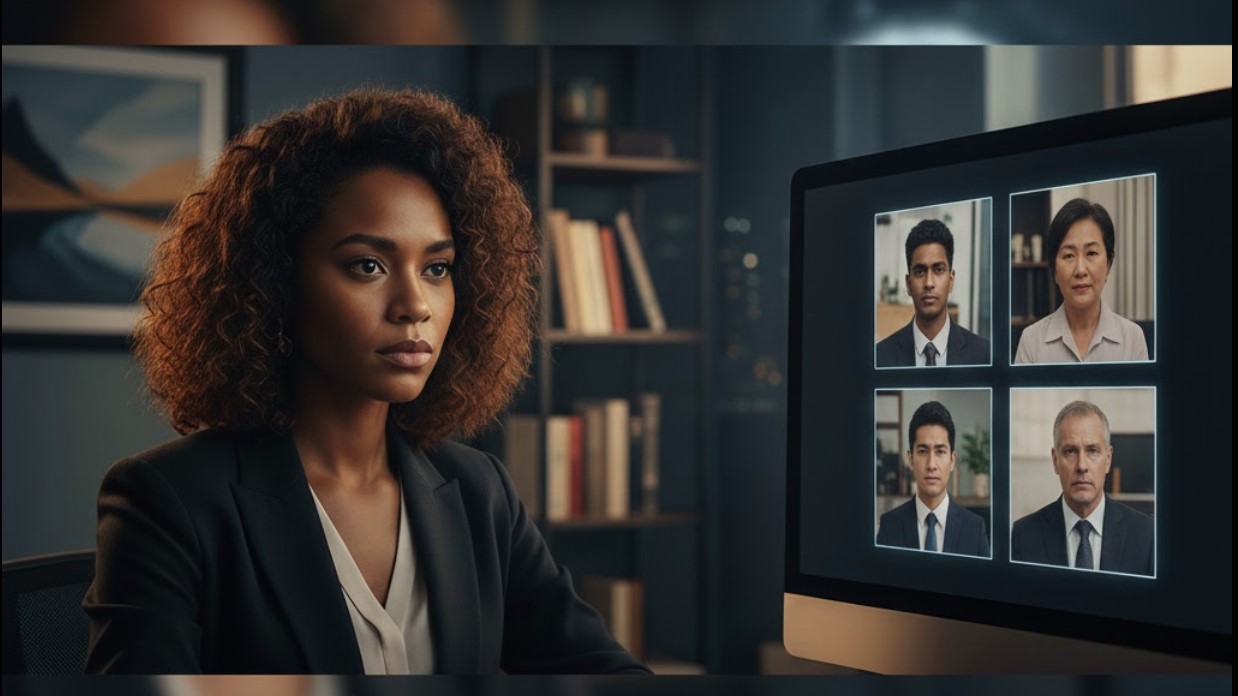
Four black squares appear. Two initials. One name that is misspelled in a way that feels personal. A disembodied voice asks, “Hi! Can you hear us?” as if speaking from inside a conference room that exists entirely in another realm.
“Yes! I can hear you,” you reply cheerfully, staring directly into your own reflection like it’s a motivational mirror.
“Great. We’ll be keeping cameras off today.”
Of course you will.
This is not an interview anymore. This is theater. Psychological endurance theater. And you, unfortunately, are the only visible cast member.
Enter the Void
The first phase of a Zoom interview is realization. The moment you understand that you are no longer participating in a conversation but delivering a monologue to an abstract concept known as “the hiring panel.”
You are visible. They are vibes.
You begin answering questions with care, pausing politely in case someone wants to jump in, only to realize you’ve been nodding thoughtfully at nothing for a full seven seconds. You nod anyway. You are polite. You are adaptable. You are nodding into the void like a professional.
Silence stretches. Someone clears their throat. This feels like applause. You treasure it.
You attempt to read the room before remembering there is no room. There is only you, your own face, and the slow awareness that you are over explaining because you cannot see anyone reacting. Are they engaged? Confused? Taking notes? Making lunch? Whispering to each other about how your background plant looks fake? You will never know.
You compensate by becoming even more articulate. You add context. You clarify assumptions. You offer examples. You are now giving a TED Talk to a Wi-Fi router named “ConferenceRoom5G.”
When someone asks, “Can you give us an example?” you deliver. Metrics. Outcomes. Lessons learned. You speak with passion while wondering if you are currently being heard by three professionals, one distracted Slack multitasker, and a laptop that has wandered off to update itself mid-sentence.
This is the stage where self-awareness peaks. You hear your own voice filling the silence and briefly wonder if this is what podcasts feel like.
The Psychological Acrobatics
Midway through the interview, the real work begins. This is where Zoom interviews stop testing qualifications and start testing endurance.
You must maintain energy without feedback. Enthusiasm without confirmation. Confidence without nods, smiles, or basic signs of life. You are selling yourself to silhouettes.
You smile strategically. You modulate your tone. You ask thoughtful questions into the darkness, fully aware that you might be speaking to someone who has temporarily muted themselves to microwave leftovers.
Occasionally, a camera flickers on.
One face appears. Startling. Like wildlife emerging unexpectedly from the brush.
You smile harder than necessary, grateful for proof of life, only for the camera to shut back off moments later, as if you imagined it. You question your sanity. Did that happen? Was that a person? Was that a test?
You continue.
Your brain begins running parallel processes. One part answers questions. Another part wonders if you’re talking too much. A third part wonders if you’re not talking enough. A fourth part is now deeply aware of how long seven seconds actually is when no one responds.
You pause, waiting for interruption. None comes. You keep going. You stop. Still nothing. You nod. You smile. You wait again. Somewhere, someone unmutes themselves and says, “Sorry, you froze for a second,” and you will never know which second, because all of time feels frozen now.
This is not a hiring process. This is an emotional obstacle course.
The Exit Monologue
By the end of the Zoom interview, you are tired in a way that cannot be explained to people who have not experienced it. You have not moved. You have not lifted anything. And yet, you are emotionally stretched, mentally drained, and spiritually unsure of what just happened.
You thank them sincerely. For their time. For the conversation. For the opportunity to speak into the darkness. You say, “Happy to answer any other questions,” despite knowing you have already given everything you had and possibly some things you didn’t plan to share.
You click Leave Meeting.
The silence afterward is deafening.
You sit there, staring at your own reflection, trying to determine whether you nailed it or simply survived it. Did you connect? Did they like you? Did anyone hear the part about your leadership philosophy, or were you delivering that to a muted room and a blinking cursor?
You replay everything immediately. The pauses. The jokes that landed nowhere. The moments you nodded at nothing. You wonder if confidence can be detected through Wi-Fi.
And then you wait.
Because that, too, is part of the theater.
Final Thoughts: Endurance Over Everything
Zoom interviews are not about skills. They are about stamina. About composure. About how well you can stay grounded while being evaluated by black squares, initials, and the faint promise of human presence.
If you can confidently sell yourself to four silent boxes, answer questions without feedback, smile into the void, and still say, “Thank you so much for the opportunity,” then congratulations.
You are not just qualified.
You are resilient.
And in today’s job market, that may be the most valuable skill of all.