
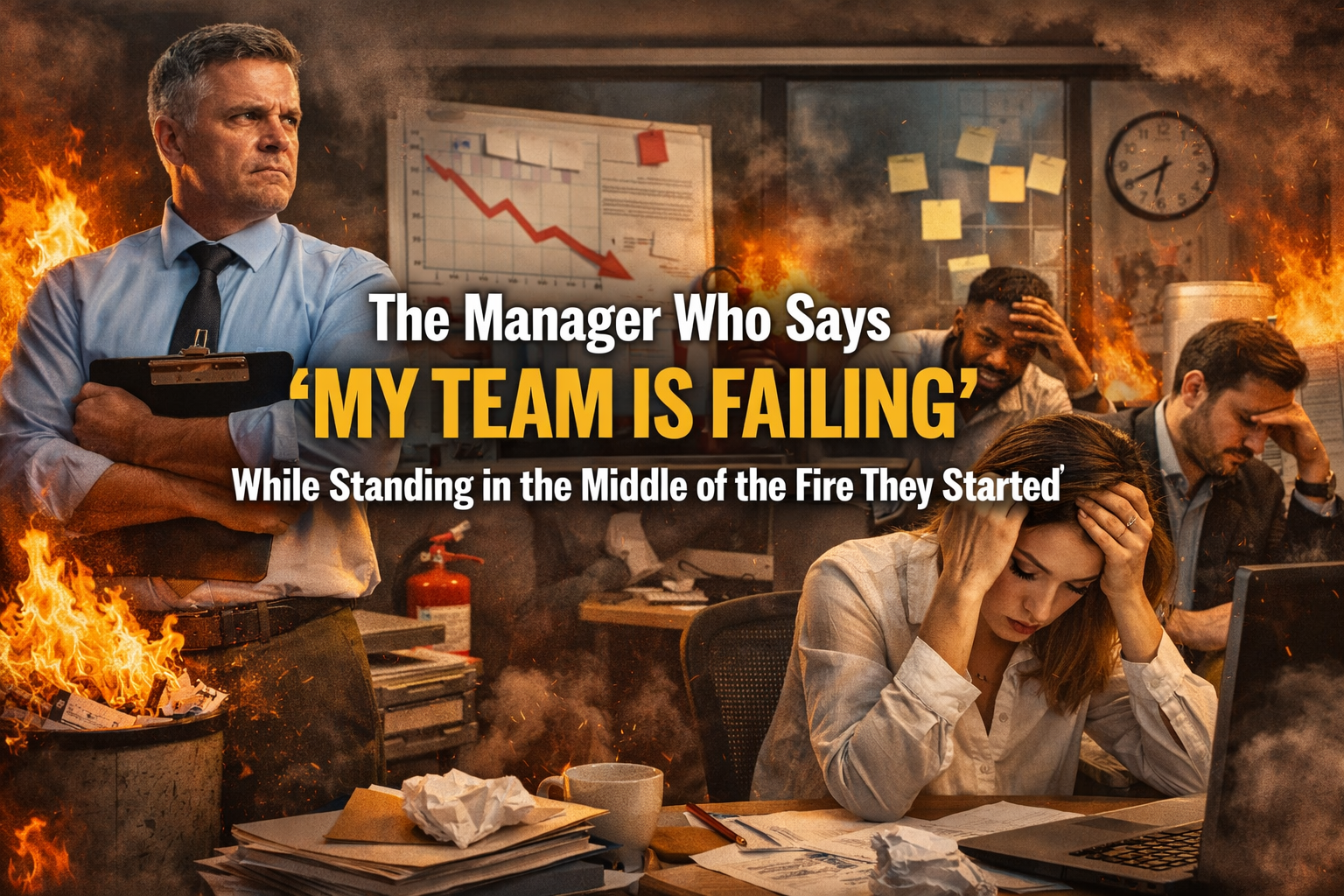
Toxic managers don’t simply oversee work. They manufacture an environment. They decide how much pressure exists, how much clarity exists, how much support exists, how safe it feels to raise a concern, how welcome it is to disagree, and how many hoops a person has to jump through to get a basic decision that could have been made in thirty seconds if ego wasn’t sitting in the chair like it pays rent.
Culture, workload, and psychological safety don’t flow from the team upward like smoke signals. They flow from the top down like gravity—quiet, constant, unavoidable. The manager sets the tone, and then the team either thrives in it or survives it.
And toxic managers are exceptional at building survival-based cultures while insisting they’re building “high performance.”
They’ll assign workloads that require three people, two miracles, and one time machine, then send a follow-up message saying, “We all need to step up.” They’ll cut resources, delay hiring, and call every gap “an opportunity for growth,” which is corporate for “we’re going to see what your nervous system can handle before it formally resigns.” They’ll say “we’re moving fast,” when what they mean is “I change my mind emotionally, and I need everyone else to treat that as strategy.”
They create chaos, then demand calm.
They create ambiguity, then punish confusion.
They create urgency, then scold stress.
They create a system where everything is due yesterday, where priorities are determined by whoever spoke to the manager last, where “quick questions” arrive at the end of the day like tiny grenades, and where planning is mostly a decorative activity people do to feel like adults in a situation that is fundamentally run on vibes.
And psychological safety—the thing that allows adults to speak honestly, ask questions, admit mistakes early, and solve problems before they become disasters—gets treated like a suspicious request. In a toxic environment, “I need clarity” is heard as “I’m challenging you.” “I’m concerned” is heard as “I’m not loyal.” “This timeline is unrealistic” is heard as “I’m not committed.” “Can we prioritize?” is heard as “I don’t want to work.”
So people adapt.
They stop raising risks because risks get them labeled.
They stop asking questions because questions get them punished.
They stop offering ideas because ideas get stolen or mocked.
They stop speaking in meetings because speaking can be used against them.
They become quiet, not because they’re disengaged, but because they’ve learned the safest way to stay employed is to be invisible.
Then, after months of this carefully crafted environment, the manager looks around at the exhausted, cautious, burnt-out humans they’ve been cultivating like a science project and declares: “This team isn’t performing.”
Of course they aren’t.
You didn’t build a team.
You built a pressure cooker and got offended when everyone started sweating.
They Have Authority (But Treat Ownership Like It’s Optional)
Here’s where the logic breaks in the funniest and most infuriating way: toxic managers love authority, but they hate ownership. They adore being “the leader” when it comes with status, control, and the final say. They love being copied on emails, being consulted, being the person whose opinion can delay work for a week because they “need to think about it.” They love being the gatekeeper. They love being the one people have to please.
But when outcomes show up—when the numbers don’t hit, the project slips, the team burns out, the turnover rises, the morale drops—they want to treat leadership like it’s a ceremonial title they wear, not a responsibility they carry.
This is the classic leadership loophole: “I’m in charge of the people, but not responsible for what happens.”
They’ll say things like, “I need you to take ownership,” which is a hilarious statement coming from someone who insists on approving everything while simultaneously refusing to make decisions.
They’ll demand accountability from the team while practicing none themselves. They’ll schedule meetings to discuss why something wasn’t done while conveniently ignoring that it wasn’t done because the team asked for direction, got silence, waited, asked again, got a vague response, then got blamed for not interpreting the vague response as a clear strategic plan.
They want the team to be “proactive,” but also want everyone to “stay in their lane,” which creates a workplace where initiative is punished and obedience is rewarded, and then everyone acts surprised when innovation dies of suffocation.
They want you to “move fast,” but also want you to get approval for every step, which is like telling someone to run a marathon while insisting they pause every mile to fill out a form in triplicate.
They want people to “be confident,” but then react to confidence like it’s disrespect. They want independent thinkers, but only the kind that think independently toward conclusions the manager already reached emotionally, silently, and without evidence.
And when a manager holds the power—budget, staffing, priorities, permissions, consequences—then blames the results on the people with the least power, what you’re watching isn’t leadership.
It’s scapegoating with a calendar invite.
If you have authority, you own the outcome. Not because it’s poetic, but because it’s literally how responsibility works. You can’t be the person who sets the direction and then claim you’re not accountable for where the ship ends up. You don’t get to be captain and passenger at the same time. You don’t get to steer into a storm and then blame the crew for getting wet.
A good leader looks at results and asks, “What do we need to change in the system?”
A toxic leader looks at results and asks, “Who can I blame without it coming back to me?”
They Model the Behavior (And Teams Mirror What Keeps Them Safe)
This is the part toxic managers never want to talk about, because it’s the part that makes everything painfully simple: teams mirror their leaders.
If the leader avoids conflict, the team learns to avoid hard truths.
If the leader communicates indirectly, the team learns to read minds.
If the leader punishes honesty, the team learns to lie politely.
If the leader is inconsistent, the team becomes anxious.
If the leader is aggressive, the team becomes quiet.
If the leader is emotionally volatile, the team becomes hypervigilant.
And if the leader’s ego is the real project, then the actual work becomes secondary to managing the leader’s feelings, which is why toxic workplaces often feel like everyone has two jobs: the one they were hired for, and the unpaid role of Emotional Support Staff for Management.
Toxic managers spread certain behaviors the way smoke spreads: slowly at first, then everywhere.
Silence becomes the safest tool. People stop raising issues because issues become personal. They stop flagging risks because risks get reframed as “complaining.” They stop pushing back because pushback gets punished. And eventually, everyone learns the unspoken rules:
- Don’t contradict the manager in public.
- Don’t bring problems without already having solved them.
- Don’t ask for clarity too many times.
- Don’t look too confident.
- Don’t shine too brightly.
- Don’t be the person who makes the manager feel exposed.
Then, because a toxic manager also controls accountability, they decide what matters based on what serves them in the moment.
What they excuse, they approve.
If they excuse missed deadlines when it’s their favorite person, they’re teaching favoritism.
If they excuse disrespect when it comes from someone “valuable,” they’re teaching that safety is conditional.
If they excuse burnout by saying, “That’s just the pace,” they’re teaching that suffering is expected.
And if they punish small mistakes publicly while ignoring systemic failures privately, they’re teaching fear.
Fear creates compliance, not excellence.
Fear creates silence, not innovation.
Fear creates survival behavior, not growth.
So the team becomes cautious. People start doing the minimum required to avoid attention. They stop taking risks. They stop speaking up. They stop caring the way they used to, not because they’re lazy, but because caring becomes a liability in a system where your effort can be used against you. The manager calls it “disengagement.” The team calls it “self-preservation.”
And then—right on schedule—the manager announces, “This team lacks accountability.”
Which is fascinating, because the only person with the power to set accountability standards is… the manager.
Teams do not rise above their leaders.
They mirror them.
So if you see avoidance, inconsistency, aggression, ego, silence, fear—look up. That’s usually where it started.
Final Thoughts: If Everyone Under You Is “The Problem,” It Might Be You Holding the Megaphone
A toxic manager will look at a struggling team and conclude that the people are broken.
A good manager will look at a struggling team and ask what’s broken in the environment.
Because leadership isn’t measured by how loudly you announce disappointment. It’s measured by what you build: the systems, the clarity, the safety, the consistency, the support, the accountability, and the trust that lets people do great work without having to spend half their week guessing what will offend you.
So when a manager says, “My team is failing,” it’s worth translating that sentence into what it often actually means:
“I set unrealistic conditions, provided limited safety and unclear direction, modeled the behavior that creates fear, controlled accountability in a way that serves my ego, and now I’m disappointed that the results are reflecting me.”
And look, nobody’s perfect. Leadership is hard. Managing humans is complex. People are messy, deadlines are real, and pressure exists.
But if you’re the one in charge, you don’t get to pretend you’re just a spectator.
You set the temperature.
You set the standards.
You set the tone.
And if everything feels heavy, chaotic, fearful, unclear, or unsafe—there’s a strong chance the team isn’t failing.
They’re adapting to the conditions you created.