
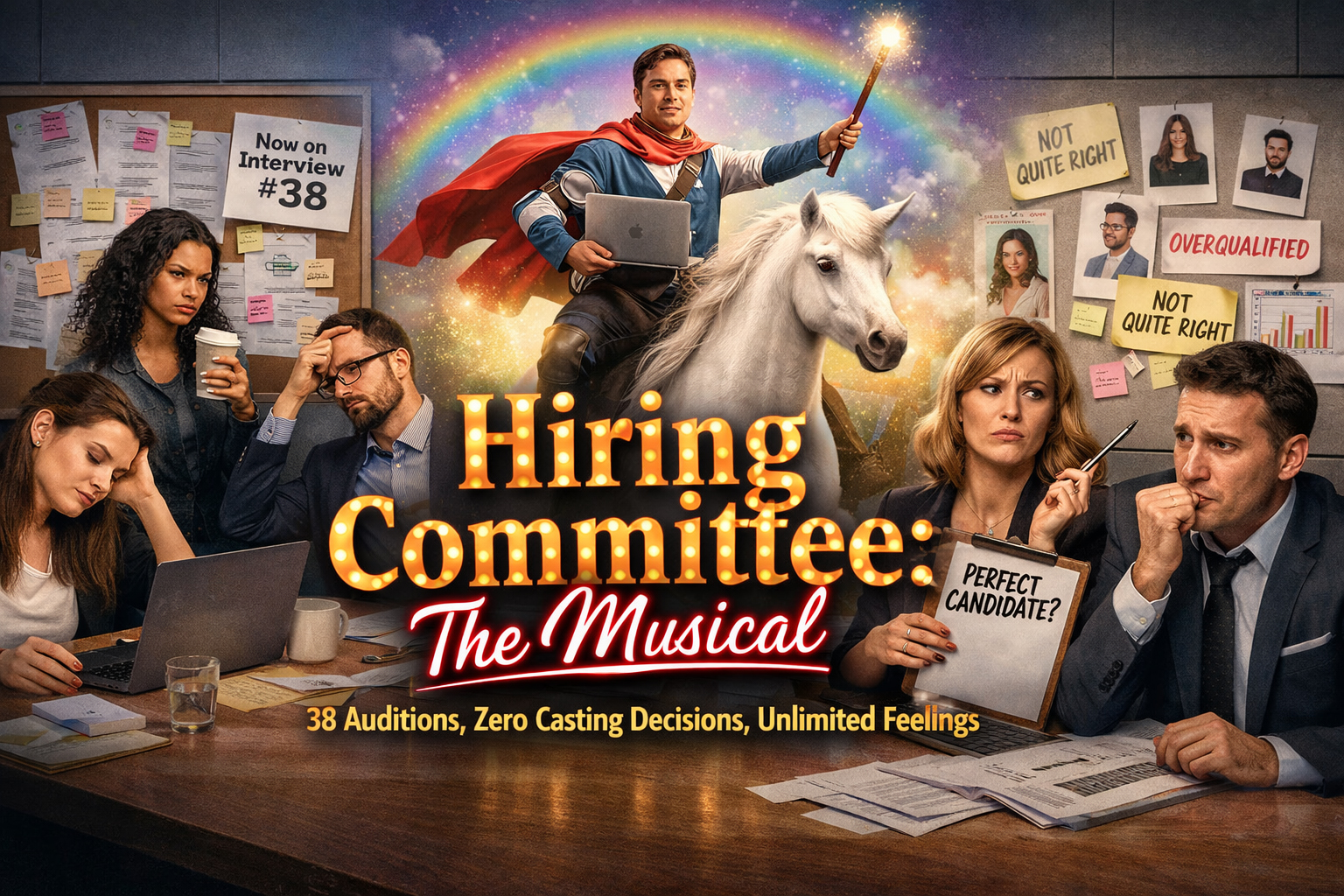
There is a very specific moment in every hiring process when the role quietly stops being a vacancy and starts being a lifestyle.
Not for the candidate. For the company.
Because at first, it’s normal. It’s innocent. It’s “We’re excited to meet people.” It’s “We’re moving quickly.” It’s “We just want to find the right fit.” And everyone nods politely, as if “fit” is a measurable unit and not a vague spiritual condition that changes depending on who slept poorly the night before.
Then the interviews start stacking.
One becomes three. Three becomes six. Six becomes “We’d love you to meet a few more stakeholders.” Stakeholders, of course, meaning anyone in the building who once saw the role’s title in a Slack channel and now feels personally responsible for the outcome, like they’re appointing a Supreme Court justice instead of hiring someone to run marketing ops and occasionally update a deck.
By interview twelve, you can feel it in the air. The shift. The moment the hiring process stops being about filling a position and becomes a long-running social experiment in professional indecision. The committee gathers like a council of anxious wizards, speaking in corporate riddles. The job description begins to glow faintly. The candidate experience becomes a cross between a reality show and a background check for a top-secret clearance you did not apply for.
And the most impressive part is how everyone involved still pretends this is normal.
They keep saying things like “We’re being thorough,” when what they mean is “We are terrified of being wrong.” They keep saying “We have high standards,” when what they mean is “We want someone who will never require leadership.” They keep saying “We want a unicorn,” when what they mean is “We want to outsource courage.”
So the role stays open. The team covers it “temporarily” for months. The pay remains unchanged. The requirements expand like a greedy PDF. And somewhere, a candidate who was more than qualified, wildly capable, and fully ready to start… accepts another offer while your committee is still debating whether their energy is “too confident” or “not confident enough.”
Because yes, someone better always exists.
Just not for you. Not anymore. Not after round eight.
The 38-Round Interview, Also Known as “We Are Afraid of Adults”
Every hiring process begins with optimism and ends with a spreadsheet that looks like it’s trying to summon a demon.
You start with a job posting that’s already doing the most. Not because the work demands it, but because the company wants to feel safe. So it lists every skill known to mankind, plus a few that were invented by someone’s cousin at a startup in 2017. The role requires ten years of experience in a tool that launched four years ago. It requires “strategic thinking” and “hands-on execution,” which is corporate for “you will do everything and we will call it leadership development.”
The candidates apply anyway, because everyone is currently applying to everything, including roles that sound like the verbal equivalent of juggling knives.
And here’s the miracle: you actually get great people.
Real people. Qualified people. People who have done the work. People who could start next week and immediately stop the internal hemorrhaging that the team has been politely calling “a fast-paced environment.”
But the committee doesn’t want great.
The committee wants certainty.
So the candidate gets screened. Then screened again. Then “introduced to the team.” Then “introduced to cross-functional partners.” Then “introduced to the person who will never work with them but has strong opinions about this role.” Then “introduced to the director who wants to make sure they can handle ambiguity,” which is a fun way of saying the company cannot commit to anything and wants the candidate to take responsibility for that.
By interview twenty, the candidate is no longer interviewing. They are being studied.
Their answers are analyzed for tone. Their tone is analyzed for confidence. Their confidence is analyzed for likability. Their likability is analyzed for “culture.” Culture, in this context, meaning “Do they make our most fragile stakeholder feel important?”
By interview thirty, you’re not hiring anymore. You’re producing a prestige documentary called Searching for Someone Better, now streaming exclusively inside your ATS, narrated by an executive who keeps saying, “We’re close,” like the role is a moon landing and not a spreadsheet with benefits.
And the entire time, the team is covering the open role “temporarily,” which is a corporate word that means:
- indefinitely
- with no additional pay
- while being asked to smile about it
- and occasionally being told this experience will “look great” on their resume
Yes. It will. Because it will eventually become their escape plan.
The Unicorn Job Description, or “We Need a Therapist Who Can Also Write SQL”
There is a reason the job description keeps changing during the process.
It’s because the role isn’t just a role anymore. It’s a container.
A container for everything the organization has refused to fix.
They aren’t hiring a person. They’re hiring an emotional support employee.
Someone who will come in and magically resolve:
- unclear priorities
- broken workflows
- passive-aggressive stakeholder politics
- “urgent” requests that are not urgent
- “alignment” meetings that exist because nobody wants to decide anything
- and a deeply unspoken fear that if the wrong person is hired, leadership might have to lead
So the job description grows.
It starts reasonable: “We need someone with experience.”
Then it becomes: “We need someone who can lead.”
Then: “We need someone who can lead and execute.”
Then: “We need someone who can lead, execute, manage stakeholders, drive transformation, handle ambiguity, communicate clearly, build dashboards, create strategy, deliver outcomes, solve the morale problem, fix the culture, reduce churn, and smile like they love it.”
At some point, the committee quietly adds requirements that aren’t skills. They’re personality traits.
“Low ego.”
“High ownership.”
“Positive attitude.”
“Can thrive in changing environments.”
Translation:
Please be competent, but not intimidating.
Please take responsibility, but don’t ask for authority.
Please fix everything, but don’t mention that it’s broken.
Please adapt to chaos and also pretend it’s a feature.
And because they’re scared, they confuse perfection with quality.
They begin eliminating candidates not for actual issues, but for microscopic vibes:
“They were strong, but I don’t know… something felt off.”
“They were great, but I didn’t feel the spark.”
“They were qualified, but are they hungry enough?”
“They were confident. Too confident.”
“They were calm. Too calm.”
At this point, the “perfect candidate” has become a mythological being who must meet the following standards:
- every skill, right now
- zero ramp-up time
- unlimited availability
- perfect chemistry with everyone
- no salary expectations
- no boundaries
- no humanity
- and the emotional intelligence of a therapist who can also code and never takes PTO
This is not a candidate.
This is a coping mechanism.
Fear in a Blazer (How “High Standards” Became an Excuse to Avoid Accountability)
Let’s say the quiet part out loud, because it’s echoing in every hiring committee meeting anyway:
Perfectionism in hiring isn’t high standards. It’s fear in a blazer.
Fear of making the wrong decision.
Fear of being blamed.
Fear of needing to coach someone.
Fear of having to commit to a direction and then defend it when it gets complicated, as all human work eventually does.
Because hiring someone means choosing.
And choosing means owning the outcome.
Which is why committees love “alignment.” Alignment is the corporate equivalent of holding hands in a circle and chanting “We’re close” while nothing changes.
It feels productive. It creates meeting notes. It produces action items. It allows everyone to say they were involved, which is very comforting when the outcome goes poorly, because now the blame can be evenly distributed like office birthday cake nobody asked for.
And here’s the tragedy: the committee thinks indecision is safer.
But indecision is not neutral.
Indecision is a decision.
It’s the decision to keep the role open.
To keep the team burning out.
To keep the workload spilling onto high performers.
To keep paying the same salary while asking for more responsibilities.
To keep losing candidates to competitors who are not “perfect,” just decisive.
And that last one is the part nobody wants to admit:
Your competitor is not hiring better than you.
They are hiring faster than your fear.
While you’re still discussing whether the candidate has “the right energy,” another company is offering them money, clarity, and a start date. They’re saying, “We trust you to grow into this,” which is how most competent adults became competent adults in the first place.
Because someone once took a chance on you, too.
They didn’t hire you because you were flawless. They hired you because you were promising, capable, and ready to learn. You became valuable after being hired, not before. You developed judgment by being allowed to practice it.
But modern hiring has decided that growth is risky, so they only want finished products. Which is adorable, considering most companies can’t even finish a meeting on time.
Final Thoughts: The Candidate You’re Waiting For Is Not Coming
The perfect candidate is a myth.
The good one in your inbox right now is real.
They are qualified. They are employed. They are articulate. They are capable. They have a life. They have options. And they are not going to orbit your indecision forever like a polite satellite.
So here’s the deal: if thirty-eight strong candidates weren’t “right,” the issue is not the talent market. The issue is that you keep redesigning the role mid-flight because you’re trying to hire your way out of discomfort, uncertainty, and leadership responsibility.
Stop turning hiring into a spiritual retreat for anxious decision-makers.
Pick the candidate who can do most of the job, learn the rest, and work with humans without needing a committee to interpret their tone.
Make a decision. Support it. Coach them. Give them what they need to succeed. Let the role become real again instead of a myth you keep feeding with new bullet points.
Because while you’re still aligning, workshopping, and asking yourselves if the vibes are right…
Your competitor has already made them an offer.
But don’t worry.
The committee feels very confident about its decision to keep deciding.