There is a stage of healing no one talks about because it’s not cinematic enough for LinkedIn, and it doesn’t come with a certificate, a wellness stipend, or a sunrise photo captioned “Choosing me.” It’s quieter than that. It’s the moment you realize you are no longer emotionally employed by your former toxic boss.
Not “over it” in the dramatic way people claim during a first date while still refreshing their ex’s Instagram stories like it’s a breaking news ticker. Not “unbothered” in the way someone says right before writing a 1,200 word rant about how unbothered they are. No. This is the real kind. The kind that shows up wearing sweatpants and a neutral nervous system.
You stop performing your former role as unpaid emotional shock absorber. You stop anticipating their moods like weather forecasts. You stop bracing for the tone shift, the passive-aggressive “quick call,” the calendar invite titled “Alignment” that actually means “confession.” You stop doing that thing where you hear a Slack notification sound in public and your body reacts like it’s a predator in the tall grass.
And then one day you notice something stunning: you can think about them without your stomach flipping into a thousand tiny origami cranes. You can pass a management book in an airport bookstore without feeling personally attacked. You can say the words “feedback session” without your soul leaving your body to go live in the woods.
That’s the peace.
It’s not joy. It’s not revenge. It’s not a montage where you run up a beach in slow motion while motivational music plays.
It’s simply the absence of their gravity.
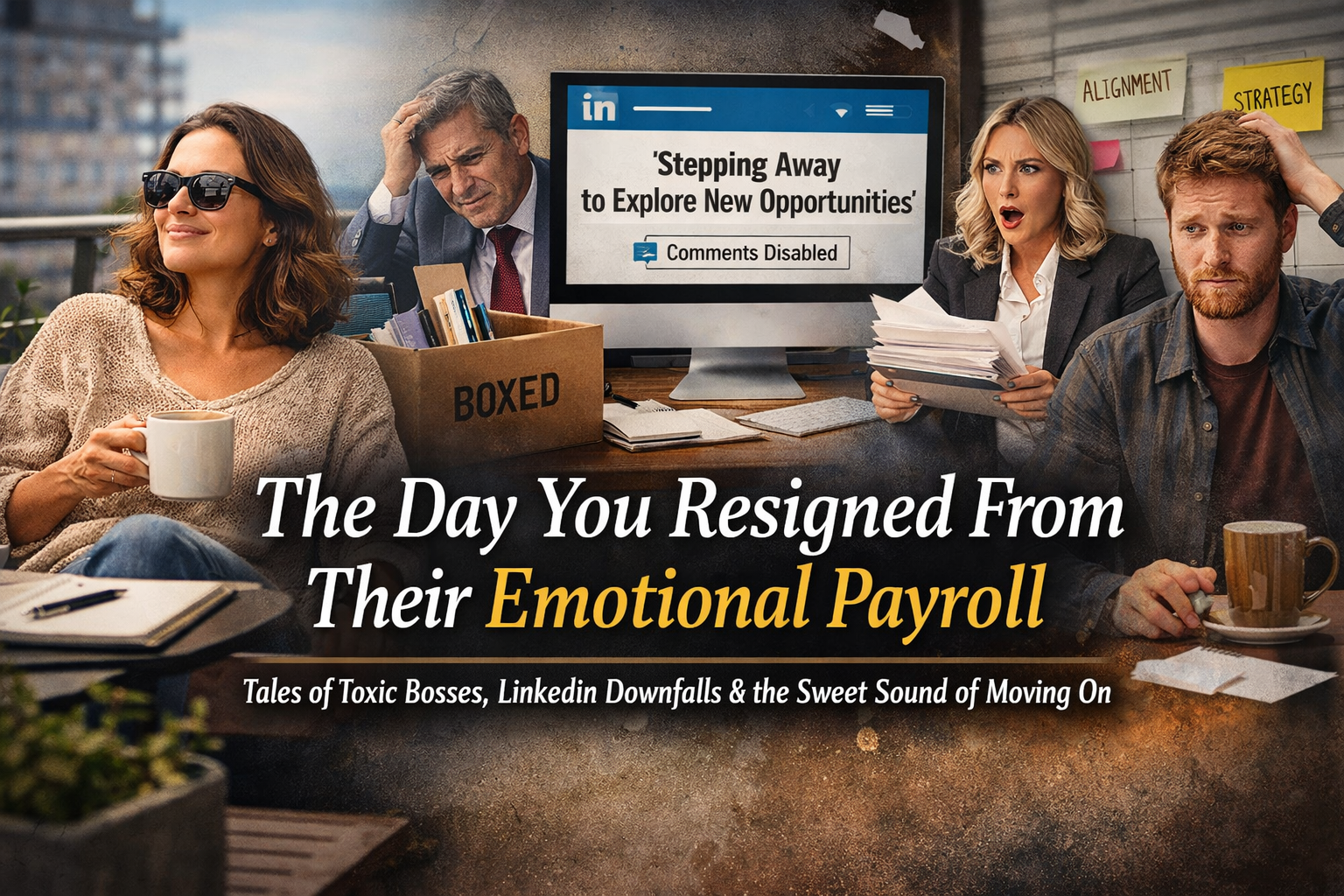
And of course, once you stop checking for updates, the universe starts delivering them anyway. Not with fireworks. With little corporate breadcrumbs. A title quietly removed. A post that reads like a hostage note written by PR and approved by Legal. Comments disabled. Engagement so low you start wondering if LinkedIn finally introduced a “mute this person for public safety” feature.
You don’t cheer. That would imply effort.
You just observe.
Hydrated. Calm. Psychologically off payroll.
And that’s when you realize: you are not watching a downfall. You are watching a slow, awkward wildlife special where the apex predator discovers the food chain has been reorganized without their consent.
The Unsubscribe Button Your Nervous System Finally Found
At first, you don’t recognize the feeling because you’re so used to operating in “high alert” mode that calm feels suspicious. Calm feels like a trap. Calm feels like the moment right before an ambush meeting where your boss says, “This is just a casual conversation,” and your pulse immediately files for overtime.
But the unsubscribe doesn’t happen all at once. It’s not a single moment of closure. It’s a series of micro-events where your brain starts to accept a new reality: the danger is not current. The threat is historical. The boss is no longer present-tense.
You catch yourself doing normal things without the background hum of dread. You send an email without reading it seventeen times for tone. You speak in meetings without pre-apologizing for having thoughts. You take lunch like a person who is allowed to consume food without proving it on a spreadsheet.
And then the truly miraculous part: you stop needing them to understand.
You stop needing them to admit anything. You stop needing them to retroactively become a reasonable person who sees the damage they caused and reacts with self-awareness instead of denial, defensiveness, and a sudden workshop titled “Building Trust Through Accountability” hosted by the least accountable human alive.
Because here’s the thing about toxic bosses: they rarely process reality. They process threats. They don’t hear feedback; they hear rebellion. They don’t interpret boundaries; they interpret disrespect. They don’t experience conflict as a solvable moment; they experience it as a personal attack on their brand.
So when you finally stop trying to be their translator, their therapist, their reputational airbag, your nervous system gets a memo:
You are no longer on-call.
And you start living like it.
Which is exactly when the universe sends the update. Not to punish them, necessarily. Just to prove something simple and extremely funny: you were not imagining the dysfunction. You were just carrying it.
LinkedIn Field Notes From the Great Corporate Disappearing Act
This is where the story gets delicious, because corporate consequences rarely arrive like a courtroom verdict. They arrive like a quiet edit.
A leadership title disappears the way a questionable tattoo disappears after enough laser treatments and denial. A “Senior Vice President of Culture” becomes “Independent Consultant.” A profile that used to scream “VISIONARY” suddenly whispers “open to opportunities.” A banner photo featuring a keynote stage is replaced with something neutral and vaguely outdoors, as if trees can absolve you.
And then there’s the post. The ceremonial one. The farewell addressed to “my network,” written in the tone of someone who absolutely did not get escorted out, thank you very much, and is definitely leaving because of their personal journey and not because HR finally noticed the exit interviews were reading like true crime.
It’s always the same ingredients:
- Gratitude that feels aggressively generic
- “After much reflection” (translation: after much insistence)
- “It’s time to step away” (translation: it’s time to stop being asked to step away)
- “I’m proud of what we accomplished” (translation: I’m proud I survived the consequences as long as I did)
- Comments that are either disabled or filled with people saying “Congrats!” with the energy of someone trying not to get subpoenaed
The funniest part isn’t even the post itself. It’s the way the algorithm reacts. You can tell when LinkedIn is unsure whether to boost it. It’s like the platform is leaning in, squinting, and asking, “Is this a success story or a warning label?”
And you’re reading it with a totally different brain now. A brain that’s not in the blast radius. A brain that can recognize the pattern without flinching. You’re not reliving the trauma; you’re witnessing the narrative gymnastics.
This is not you being vindictive. This is you watching a person try to paint a door as a ladder.
Because the toxic boss isn’t just leaving a job. They’re leaving the stage. They’re losing the audience that made their performance feel powerful. And once the audience is gone, the monologue gets weird. The voice gets louder. The slogans get more intense. The “values” get name-dropped like they’re magical spells that can reverse the plot.
They keep turning up the volume, convinced it’s a sound issue.
Not realizing the audience didn’t mute them.
They left.
When Accountability Clocks In and Finds No One to Manage
This is the part nobody prepares you for: what it looks like when consequences don’t need your participation.
For a long time, the toxic boss’s success depended on one thing you never got credit for: buffers. People who absorbed their mess. People who translated their chaos. People who smoothed over the sharp edges and called it “leadership style.” People who stayed late making their failures look like strategy.
Toxic bosses are not powered by competence. They are powered by protection.
They thrive in systems where someone is always willing to take the hit. Where fear keeps people quiet. Where exhaustion gets mislabeled as dedication. Where “high standards” are used as a moral excuse for cruelty. Where staff turnover is explained away as “not everyone can handle excellence,” instead of “everyone is escaping.”
But once you remove the buffers, something incredible happens.
Reality starts functioning.
It’s like watching a self-cleaning oven turn on after years of the smoke alarm being treated like background music. It’s loud. It’s overdue. It’s slightly alarming at first. But it is undeniably effective. The grime is not new. The only new thing is that nobody is pretending it isn’t there.
And the boss? The boss does what they always do: doubles down.
They keep scheduling meetings about alignment while systematically removing it. They host workshops on trust while auditing bathroom breaks. They call people “family” while treating them like disposable labor. They announce “open door policy” while punishing anyone who walks through it.
The confusion is the masterpiece.
They genuinely cannot understand why the same tactics aren’t working in a room that has already emptied. They still give speeches. Still drop buzzwords. Still demand loyalty like it’s a subscription service. Still shocked no one is nodding, clapping, or pretending this is inspiring instead of exhausting.
Because here’s what they never learned: intimidation is not influence. Fear is not respect. Silence is not buy-in. It’s just the sound of people quietly removing you from their emotional budget.
And once that happens, your power shrinks fast.
Not because people are cruel.
Because people are free.
Final Thoughts: The Soft Victory of Being Unreachable
The real win isn’t watching them stumble. The real win is realizing you can hear about it without your body reacting like it’s still happening to you.
You don’t need to “get them back.” You don’t need to craft a revenge narrative. You don’t need to turn their misfortune into your personality. You don’t even need to say “karma,” because you’re not summoning anything anymore.
You’re just living.
There is a very specific kind of peace that arrives when you realize you are no longer emotionally employed by your former toxic boss. When their opinions no longer feel like performance reviews carved into your nervous system. When their chaos no longer sets your day’s weather. When their voice in your head finally loses the microphone.
And yes, sometimes the universe hands you a little update. A title removed. A strategic “new chapter.” A sudden pivot into consulting. A carefully phrased departure that smells like a settlement agreement and a forced smile.
But you’re not celebrating.
You’re studying a case study.
A quiet reminder that leadership without self-awareness is just cosplay with a budget. That authority without trust is just volume. That “culture” without humanity is just branding. And that eventually, even the loudest ego has to sit in the silence it created.
So you sip your drink. You blink slowly like a person who has slept. You observe the soft unraveling of a system that once relied on you to hold it together.
And you realize the best revenge was never revenge.
It was resignation.
Not the job.
The emotional contract.
Roll credits.