
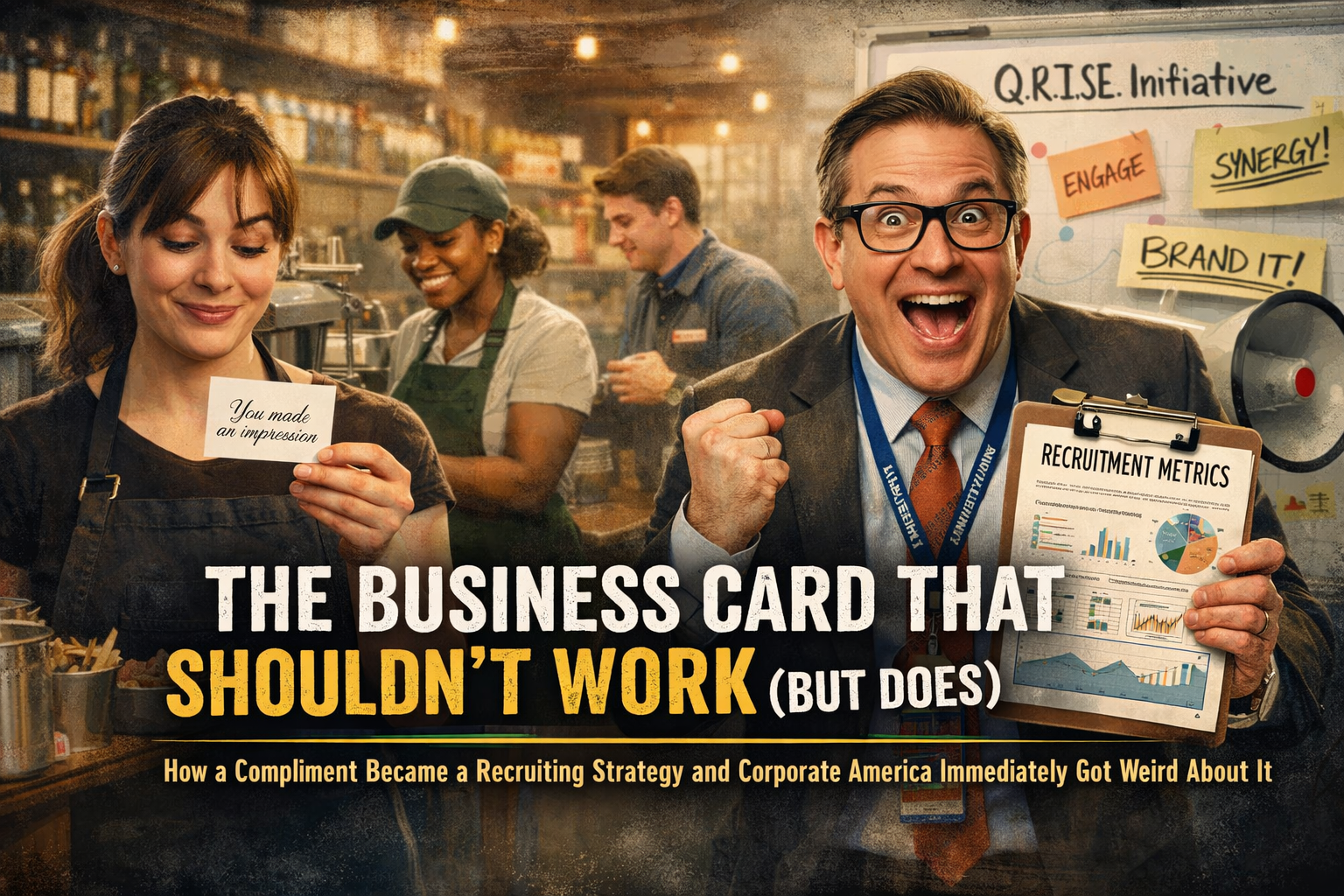
Or: How a Compliment Became a Recruiting Strategy and Corporate America Immediately Started Breathing Heavily
I read a post the other day that didn’t try to fix me.
No “five mindset shifts.” No “here’s the template.” No “comment GUIDE and I’ll DM you a PDF that looks like it was designed by a stressed-out Canva intern who hasn’t seen daylight since Q4.” It didn’t even pretend it was “just sharing in case it helps someone,” which is LinkedIn’s favorite lie, second only to “Excited to announce.”
It just dropped an idea so calm, so casually competent, so unreasonably human that it felt suspicious, like a person in a meeting saying, “What if we treated people like people,” and then disconnecting before the rest of the room could call Legal.
The idea was simple: when you see someone being genuinely excellent out in the world, you leave a small card. On the front it says, “You made an impression.” On the back there’s a QR code to your career site. That’s it. No pitch. No desperate “we’re hiring rockstars.” No urgency. Just a compliment, neatly folded into a career breadcrumb, quietly placed next to a tip jar like a benevolent little fortune cookie from the universe.
And at first glance, yes, it sounds slightly unhinged. Like a thing you’d invent after your fourth rejection email and a long stare into your coffee where you start hearing the foam whisper, “It’s not them, it’s… everyone.”
But the longer you sit with it, the more uncomfortable it gets, because it exposes the part of hiring that most companies spend millions trying to avoid admitting out loud:
The best people are not looking for you.
They are not refreshing job boards at midnight like it’s a slot machine. They are not rewriting their resume to include “cross-functional stakeholder alignment” as if it’s a real hobby. They are not whispering “culture fit” into the void and hoping the algorithm grants them mercy. They’re busy. They’re good. They’re doing the work, right now, somewhere else, with competence so steady it looks boring to anyone addicted to hype.
They are the server who runs their section like a high-stakes air traffic controller. The barista who manages a caffeine-fueled emotional collapse with the calm of a hostage negotiator. The retail worker who solves problems they didn’t create while being paid like they did. These people aren’t “passive candidates.” They’re active professionals who have simply opted out of the online carnival where everyone pretends they’re “open to work” but also “not desperate” while quietly being both.
And the worst part is this: nobody tells them they’re good at it. Not in a way that lands. Not in a way that feels real. Certainly not in a way that makes them think, “Maybe I’m worth more than this shift, this manager, this schedule, this slow drain of being taken for granted.”
Which is why the card works.
Not because it’s clever. But because it doesn’t sound like recruiting.
It sounds like recognition.
And recognition is so rare now it feels like a superpower. Or a glitch in the system. Or a scam. But the good kind of scam. The kind where you leave with your dignity intact.
Welcome to the most dangerous recruiting tactic in 2026: noticing someone.
The Talent Pool Isn’t Shallow, You’re Just Yelling Into a Puddle
Companies love describing the hiring market the way people describe the weather. Like it’s happening to them. Like they are innocent farmers staring at a dry sky.
“No one wants to work anymore,” they whisper, clutching a job posting that requires ten years of experience in software that was invented six years ago.
“The talent pool is shallow,” they announce, after offering a salary that covers rent if you live inside the office supply closet.
“We can’t find good people,” they say, after making applicants complete four interviews, two assessments, one unpaid project, and a personality quiz written by someone who believes the human spirit can be measured on a scale from “disruptive” to “collaborative.”
The problem isn’t the pool. The problem is the technique.
Most recruiting is essentially corporate fishing where everyone stands in the same overcrowded spot, casting identical lines into identical waters, using identical bait labeled “competitive benefits” which turns out to be “we have Slack” and “sometimes we do bagels.” Then they pull up the same exhausted fish and act shocked that it’s tired.
Meanwhile, the best people? They’re not in your puddle.
They’re across the street, running a team, managing customers, handling chaos, staying calm, solving problems, doing invisible work so smoothly it never makes a headline. They’re not “hard to find.” They’re just not hanging out in the places you keep shouting.
Because the modern job search funnel is not designed to attract competence. It’s designed to filter for endurance. It rewards the people who can tolerate nonsense long enough to reach the offer stage. It rewards people who can write the most convincing paragraph about “being passionate about synergy” without vomiting. It rewards those who can play the game.
But some of the best people refuse to play.
Not out of arrogance. Out of sanity.
They already have a job. They already know how draining hiring processes are. They already know the emotional tax of putting yourself out there just to get ghosted by someone named “Talent Acquisition Ninja” who posts daily about empathy.
So they stay where they are, even if it’s not perfect. Even if it’s underpaid. Even if it’s slowly eroding them.
Because at least it’s familiar.
This is where the little card becomes a weapon. A gentle one. A tiny piece of paper that quietly says: “Someone noticed you. You don’t have to throw yourself into the algorithmic meat grinder to be seen.”
That’s what companies miss. They think the barrier to hiring is information. They think candidates aren’t applying because they don’t know about the role.
No. They know.
They’re avoiding it.
Because your hiring process looks like an escape room designed by bureaucracy. Your job description reads like a hostage note. And your culture claims to be “fast-paced” in the way a house fire is fast-paced.
The card bypasses all of that. It doesn’t argue. It doesn’t persuade. It simply plants one thought in a competent person’s head:
“I might have options.”
And that thought is radioactive in the best way.
The Compliment Is the Pitch, and That’s Why It Terrifies Everyone
Here’s the part corporate America will struggle with, because it goes against everything we’ve ever been taught about conversion rates, pipelines, and how to “drive engagement.”
The compliment is the pitch.
Not the QR code. Not the career page. Not the list of openings. Not the “Join Our Talent Community” button that always feels like signing up for emails you didn’t consent to.
The pitch is: “You made an impression.”
A sentence so simple it barely qualifies as strategy. A sentence so human it doesn’t fit neatly into a dashboard. A sentence that can’t be A/B tested without immediately turning into a crime against language.
And that’s the point.
Because recruiting has become allergic to humanity. It’s become performance marketing in a suit. Everyone is optimizing. Everyone is templating. Everyone is “streamlining” the process into something so sterile that candidates stop feeling like people and start feeling like inventory.
The card does something quietly radical. It offers appreciation with no immediate demand attached.
It doesn’t say, “Apply.” It doesn’t say, “We need you.” It doesn’t even say, “We’re hiring.” It says, “I saw you.”
And being seen is rare enough that it lands like a miracle.
Think about how most people are treated at work.
They are noticed when they mess up. They are evaluated when they ask for more. They are “coached” when they’re inconvenient. They are congratulated when it benefits the company’s narrative. But they are not consistently recognized for competence in the moment, especially the kind of competence that looks like calm, reliability, professionalism, and emotional regulation.
We live in a world where chaos gets the spotlight, and steady excellence gets ignored because it doesn’t produce a crisis someone can heroically solve.
So when a person receives a card that basically says, “You’re good at what you do,” it hits a nerve.
It disorients them. It interrupts the internal story they’ve been living in, the one where they are invisible unless they are failing or overperforming.
It also does something else: it restores dignity.
Most recruiting messages arrive with an energy that feels like a vacuum. They suck. They take. They are transactional. Even when they’re polite, they’re still basically saying, “Hello, stranger. I have decided you might be useful.”
The card doesn’t ask for usefulness. It honors competence first.
That’s why defenses drop.
Because it isn’t a pitch disguised as a compliment. It’s a compliment that contains a door.
A door they can open if they want.
No pressure. No weird chase. No recruiter lurking in their inbox like a polite ghost.
Just: “If you ever want to explore something else, here’s the link.”
That’s what makes it effective. It respects the person’s autonomy. It doesn’t treat them like a resource to be acquired. It treats them like a professional who might, at some point, decide they deserve better.
Which is why I can already hear the corporate panic.
Because the moment this works, someone will want to scale it.
And scaling it is how you kill it.
The Corporate Machine Will Try to Eat This, and We Must Protect the Card With Our Lives
Nothing terrifies the modern workplace like a simple idea that works without needing a committee.
If a tactic can’t be branded, measured, and turned into a quarterly initiative with a catchy acronym, it makes leadership nervous. They start sweating in the way people sweat when they realize they can’t take credit for something.
You can already see the lifecycle.
First, one person does it quietly. They print a few cards. They hand them out like human confetti. They get a few great hires. Word spreads. People are intrigued.
Then a leader discovers it and says something like, “This is brilliant. Let’s roll it out.”
And that’s when the idea dies.
Because rollout means branding. Branding means guidelines. Guidelines mean a deck. The deck means “alignment meetings.” Alignment meetings mean someone suggests adding a tagline. Someone else suggests adding a mission statement. Someone else suggests we need a tracking mechanism to prove ROI.
And now we’re not leaving compliments.
We’re “activating a recognition-based talent acquisition campaign.”
Now there’s an acronym. Maybe it’s IMPRESS. Maybe it’s QRISE. Maybe it’s something that makes your teeth hurt, like “TalentSpark.”
Now the card says, “You made an impression,” but in the company font, surrounded by five corporate values and a faint watermark of a smiling stock photo handshake. The QR code goes to a landing page that auto-plays a video of the CEO saying, “At our company, people are our greatest asset,” while the candidate’s soul gently leaves their body.
Now managers have quotas. “You should distribute five cards per week.” Now there’s a leaderboard. Now there’s a Slack channel called #impression-moments where people post photos of themselves handing out cards like it’s community service.
And the spell breaks.
Because the entire magic of the card is that it feels like a moment. A sincere, unbranded interaction. A human acknowledging another human.
The moment you turn it into a program, it becomes just another corporate maneuver. People can smell a maneuver. Candidates can smell it from two counties away. It’s the same scent as “We’re like a family,” and it triggers the same survival instinct.
Recognition cannot be mandated.
If you force it, it becomes performative. If you measure it, it becomes fake. If you gamify it, it becomes gross. You cannot put sincerity in a KPI and expect it to remain alive.
The only way this works long-term is if it stays small. Personal. Optional. Unpolished. The kind of thing that feels like a secret.
A compliment as a doorway.
Not a campaign. Not a strategy deck. Not a branded lanyard initiative.
Just a card.
Which is exactly why it’s so threatening.
Because it proves something the hiring industry doesn’t want to say out loud:
You don’t need better job ads.
You need better human behavior.
Final Thoughts: A Quiet Card in a Loud World
The genius of the card isn’t that it’s new. It’s that it’s the opposite of what we’ve been trained to do.
Hiring has become louder and louder, like volume can compensate for a lack of trust. Companies post more. Recruiters message more. Employers “build communities.” Everyone is constantly broadcasting their needs into the internet like the internet is obligated to care.
But most people don’t respond to noise. They respond to meaning.
And meaning, in the modern workplace, is scarce.
We have somehow reached a point where basic decency feels like an innovation. Where saying “You did a good job” without attaching a demand to it feels revolutionary. Where being seen is so rare that when it happens, you remember it for months.
That’s what the card exploits, in the best possible way. It’s a tiny interruption in the usual grind. It takes someone who is used to being ignored, managed, tolerated, or taken for granted, and it gives them something else entirely: proof that their competence is visible beyond the walls of their current job.
And once someone has that proof, even just once, they start looking at their situation differently.
They start thinking, “If a stranger noticed me in ten minutes, why hasn’t my employer noticed me in ten months?”
They start thinking, “If my best work is this obvious, why am I being treated like I’m replaceable?”
They start thinking, “What else is out there?”
It doesn’t fix hiring. It exposes the truth underneath it: talent isn’t scarce. Attention is. Respect is. Human acknowledgment is.
And the reason companies “can’t find good people” isn’t because good people don’t exist. It’s because good people are busy being good, and nobody is giving them a reason to step into the noise.
This card gives them a reason without begging. It recruits without chasing. It invites without manipulating.
It’s quiet. It’s confident. It’s almost suspicious.
Which is why it works.
And which is why we all need to swear, right now, on whatever sacred object we still have left in corporate life, that we will not let anyone turn this into a branded initiative with dashboards, acronyms, and a quarterly rollout plan.
Because the moment someone names it, it becomes a thing.
The moment it becomes a thing, it becomes performative.
And the moment it becomes performative, it becomes dead.
Let it stay what it is: a human moment disguised as a business card.
The rarest kind of recruiting tactic.
One that doesn’t treat people like a pipeline.
One that treats them like a person.
If you want, I can punch this up even harder with a recurring “Corporate Initiative” villain character who keeps trying to swallow the card into a program, or I can tailor it to a specific audience (HR, hiring managers, small business owners, retail leaders) without losing the bite.