
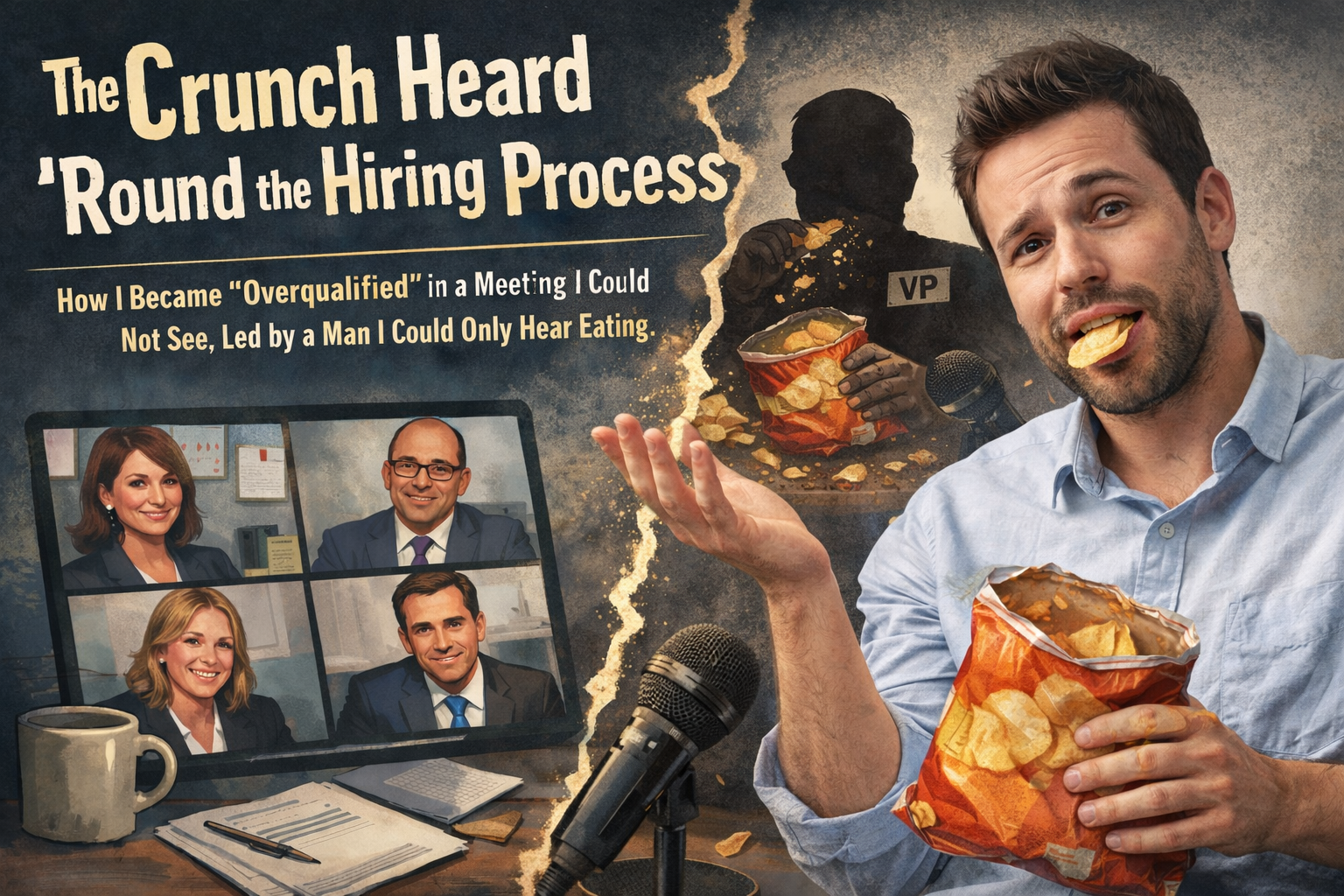
There is a very particular flavor of corporate confidence that does not come from competence, clarity, or even the basic ability to maintain eye contact with a camera you asked someone else to turn on.
It comes from deciding you have the authority to evaluate another human being’s career while remaining a black rectangle on Zoom, while also apparently treating the interview like halftime at a high school football game, where the only thing that matters is finishing your snack before you have to pretend to be a decision-maker again.
And I know this because I lived it.
A five person panel. Four cameras on. Four faces performing the classic LinkedIn expression: the polite smile that says, “I am engaged,” while the eyes say, “I am also thinking about my next meeting and the email I will send afterwards to sound like I contributed.” You know the one. Perfect lighting. Neutral background. The calculated nods. The little posture adjustments that exist solely to imply leadership.
Then there was him.
One VP. Camera off. A black rectangle with a title. “Technical difficulties,” he said, in the same tone people use when they say, “We’ll circle back,” or “We’re like a family,” or “This will just take five minutes.” Corporate language for: you will be visible, I will not, and if this feels weird, you will blame yourself for having feelings.
Technology happens, sure. Sometimes a camera fails. Sometimes a connection drops. Sometimes a person is genuinely having issues. I am not unreasonable. I am a grown adult. I understand modern work is held together with duct tape, passwords no one remembers, and a Wi-Fi signal that changes its mind every time you need it most.
But then the noises began.
Not subtle noises. Not “I am thoughtfully sipping water” noises. Not “I am quietly muting myself because I respect other humans” noises. These were commitment sounds. Crunching. Pauses. A faint rustle that suggested packaging. A rhythm that did not say, “I am listening,” but instead said, “I have snacks and I am not afraid to use them.”
It was the kind of chewing that has confidence. The kind of chewing that believes itself to be invisible because the camera is off, as if sound does not exist and microphones are not, by definition, designed to capture exactly this kind of behavior.
And there I was, answering questions with precision, restraint, and the calm professionalism of someone who knows their résumé could run this department without breaking a sweat, while a disembodied executive presence chewed rhythmically like a podcast sound effect labeled “Office Lunch, Aggressive.”
That is when I realized something important about modern hiring.
It is not always a process. Sometimes it is a performance. Sometimes it is an audition in front of a panel of people who are trying very hard to look serious while one person in charge is quietly treating your career like background noise to his snack break.
And that is how the crunch became the loudest voice in the room.
The Black Rectangle of Authority
The camera off executive is not just a person. He is a concept. He is a corporate ghost story. A floating title in the darkness, deciding your future while remaining unseen, like an old fashioned judge in a courtroom who refuses to wear pants.
He tells you he has technical difficulties, but you can feel the deeper truth in your bones: this is not about technology. This is about control. This is about the quiet power move of forcing you to show up fully while he remains an untouchable silhouette, existing only as a job title and an intermittent crunch.
The rest of the panel tries to hold the tone together, because they also feel the weirdness. You can see it in the micro expressions, the slightly too fast nodding, the “please ignore the sound of leadership eating” energy that settles into the room like a fog.
They ask questions. You answer them. You tell stories that are polished but human. You talk about results, strategy, collaboration, execution. You sprinkle the right amount of humility on top, like seasoning, because you know confidence is allowed only in measured doses, and only if you deliver it in a tone that sounds like you are apologizing for being capable.
Meanwhile, the black rectangle contributes only in the form of chewing.
Crunch. Pause. Crunch.
At one point you start to wonder if this is a test. Maybe they want to see if you can stay calm under pressure. Maybe the company has a new behavioral interview format called “Resilience Through Snack Sounds,” where the candidate must maintain composure while being judged by someone who is clearly in a committed relationship with kettle chips.
But then you realize something: no one is reacting. No one says, “Hey, can we mute?” No one says, “Do you want a minute?” No one says, “We can reschedule if you’re eating.”
Because the black rectangle is not just a participant. It is the source of authority. It is the person who can make the room adapt to his habits, rather than him adapting to the room.
And that is how corporate culture works in miniature: everyone else performs professionalism while one person quietly demonstrates what power looks like when it is unchallenged.
You keep answering questions, but part of you is now aware that you are not being evaluated by a room of equals. You are being evaluated by a hierarchy, and the top of that hierarchy is chewing loudly in the dark.
If you have ever wondered why hiring can feel dehumanizing, this is it.
Because there is something uniquely surreal about pitching your entire career to a shadow that sounds like it is eating in a movie theater.
The Overqualified Label, or, How Companies Fear Competence
Weeks later, the rejection arrives with the classic corporate tenderness that makes you want to applaud, not because it is kind, but because it is so carefully designed to feel kind.
“We decided to go in a different direction.”
Which direction, exactly? North? South? Spiritual? Emotional? The direction of panic? The direction of hiring someone’s cousin? The direction of choosing a candidate who will not ask why the VP is eating during interviews?
Then comes the explanation: you were overqualified.
Ah, yes. Overqualified. The polite way of saying, “Your competence makes us nervous.” The gentle way of saying, “You have too much context.” The corporate way of saying, “You might notice things.”
Because “overqualified” is not really about skills. It is about threat assessment.
It is an organizational immune response. A body rejecting a foreign object. Not because the object is harmful, but because it is unfamiliar, and unfamiliar things require the system to evolve.
Hiring managers love experience in theory. They love it when it shows up as bullet points they can admire from a safe distance. They love it when it exists in the abstract, like a framed quote on a wall: “We value leadership.” “We value innovation.” “We value strategic thinking.”
But when experience shows up as a person—someone who might ask, “Why is this process like this?” or “Who owns this outcome?” or “Why are we doing three meetings for a decision that could have been made last Tuesday?”—experience becomes inconvenient.
And “inconvenient” gets translated into “overqualified,” because “overqualified” makes the rejection sound like a compliment, even while it functions like a protective barrier.
It is fascinating, too, because companies are rarely afraid of being under-led.
They do not reject candidates for being “underprepared” at the executive level. They do not look at chaotic processes and say, “We should not proceed with this leadership style because it seems unqualified.” They do not pause when someone demonstrates poor judgment and say, “We need someone with less confidence and more self-awareness.”
No, no.
They only fear candidates who are “too much.”
Too sharp. Too seasoned. Too aware.
Too likely to notice that the emperor is chewing loudly and refusing to turn on his camera.
That is what “overqualified” often means: the role is not actually a role; it is a container. It is designed to be filled with someone who will fit the shape without changing the shape.
And if you are the kind of person who changes shapes—who improves processes, asks questions, raises standards, creates accountability—you are not a fit. You are a disruption.
So they send you away politely.
They tell you the direction changed.
They tell you you are too experienced.
And they expect you to absorb that like a weather report rather than what it is: a cultural confession.
When the Crunch Becomes a Prophecy
Months later, the update surfaced quietly, the way these things often do.
That same VP—the black rectangle, the crunchy ghost, the unseen judge—gone.
Fired. Removed. Exited, presumably, in the same invisible way he interviewed: camera off, microphone open, snacks nearby, consequences approaching.
And suddenly the entire experience rearranged itself in my mind like a puzzle finally finding its missing piece.
The camera-off behavior was not a one-time quirk. It was a symptom.
The audibly chewing through a candidate’s interview was not a snack problem. It was a leadership problem. It was a worldview problem. It was the kind of entitlement that convinces a person the rules are for everyone else, and that attention is something they owe only to people they fear, not to people they evaluate.
That is why the rejection was so casual. That is why the explanation was so empty. That is why the process felt like theater rather than inquiry.
Because the person at the top was not operating from curiosity or discernment. He was operating from consumption. He was taking in what he wanted, discarding what made him uncomfortable, and doing it with the casual confidence of someone who believed the room existed to accommodate him.
The irony, of course, is that organizations will tolerate this behavior right up until they cannot.
They will normalize it. They will excuse it. They will call it “strong leadership” or “high standards” or “results-driven,” even if the results are mostly fear and confusion.
And then, one day, the organization decides to go in a different direction.
The direction of not having that VP anymore.
And you look back and you realize: you were not overqualified. You were inconvenient. You represented competence that could be noticed. Experience that might ask questions. A presence that would eventually require accountability from someone who preferred to remain unseen, unheard, except for the occasional crunch.
The job did not reject you because you were not ready.
It rejected you because the system was not ready for you.
Or, more bluntly, the system was built to protect someone who was already approaching his expiration date, and you would have accelerated the timeline just by showing up.
There is a strange comfort in that.
Not because getting rejected is fun. It is not. It is annoying. It is draining. It is the professional equivalent of being told you cannot enter a building because you look like you might know where the fire exits are.
But because it reframes the story.
It stops being, “I failed.”
It becomes, “That was never built for me.”
And sometimes, if you are lucky, you get proof.
Sometimes you get confirmation in the form of a headline, a rumor, a quiet update, a leadership shakeup, a sudden vacancy.
Sometimes the black rectangle disappears.
And you realize the crunch was not background noise.
It was a warning.
Final Thoughts: Sometimes the Rejection Is the Rescue
Modern hiring has a way of making every rejection feel personal, even when it is clearly systemic. It encourages you to interrogate yourself, adjust your tone, soften your experience, shrink your confidence, sand down every sharp edge until you are professionally acceptable and emotionally quiet.
But every once in a while, life hands you a small gift.
A moment of hindsight.
A storyline that resolves itself.
The realization that sometimes rejection is not a reflection of your readiness, but of someone else’s fragility. Sometimes the job does not pass on you because you were too much.
Sometimes it passes on you because you were the wrong kind of “too much.”
The kind that notices.
The kind that improves.
The kind that asks why the camera is off and the microphone is full of chewing.
And in those moments, the sting of “overqualified” starts to fade, replaced by something calmer and sharper: gratitude that you did not end up working for the human embodiment of a black rectangle with snacks.
So yes, I was rejected.
But I also dodged the kind of leadership that treats people like background noise and calls it strategy.
And months later, when I learned he was gone, the memory that stayed with me was not the email, or the vague direction, or the performative politeness.
It was the crunch.
Because sometimes the job does not pass on you.
Sometimes it chokes on you.
And sometimes, if you are very lucky, the loudest sound in the process is not your self-doubt, but the unmistakable noise of someone eating their way toward unemployment, one crunch at a time, like a raccoon who wandered into a boardroom with snacks, unchecked authority, and absolutely no plan for what happens when the room finally notices.






Can you be more specific about the content of your article? After reading it, I still have some doubts. Hope you can help me.