
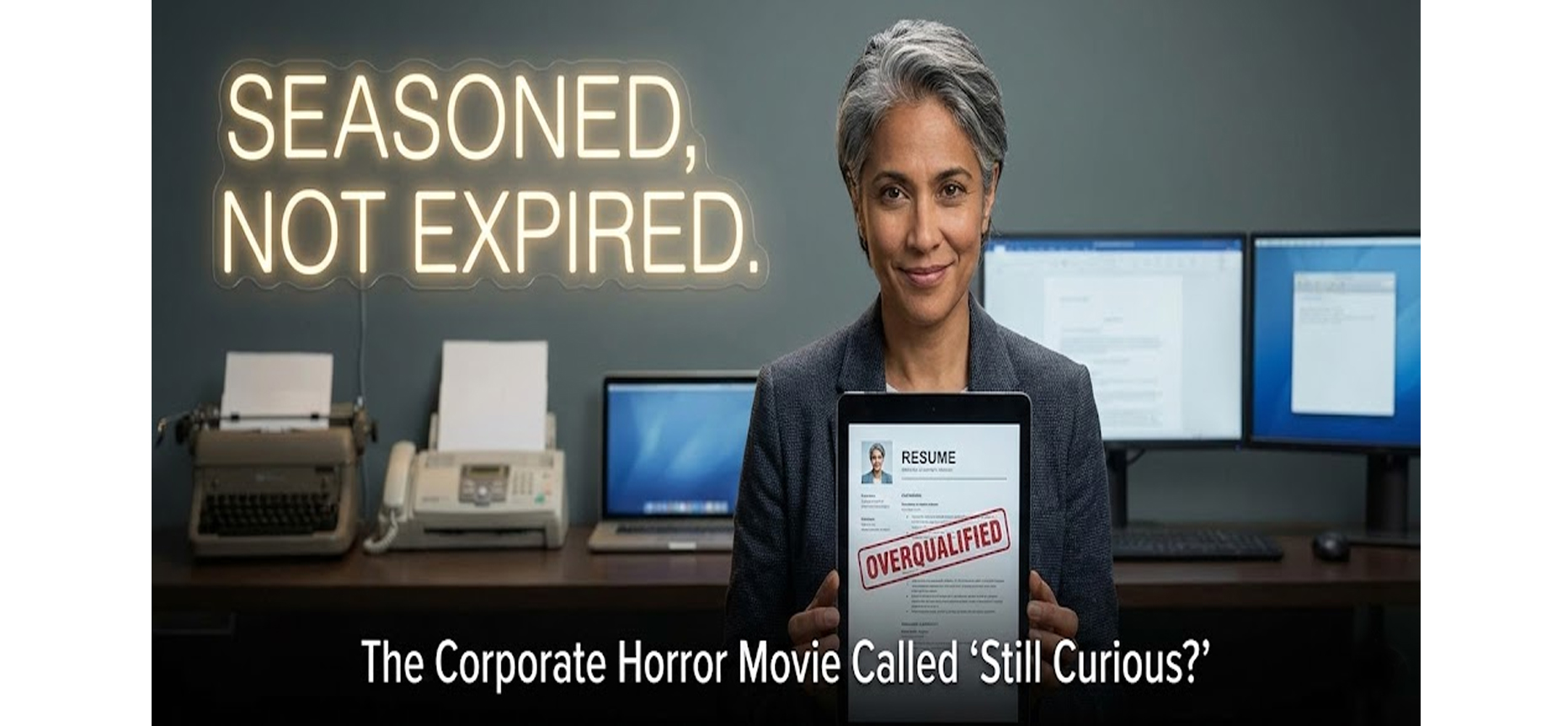
Ageism in the workplace is one of the only workplace policies that exists everywhere, gets enforced daily, and still somehow never shows up in the employee handbook. It doesn’t announce itself with a banner or a meeting invite. There’s no mandatory training titled “How to Subtly Make Someone Feel Like a Relic While Smiling Supportively.” It just… happens. Quietly. Smoothly. Like a software update you didn’t approve that removes features you still use and replaces them with a new button called “Adapt” that does absolutely nothing.
One day you’re a rising star. The next day you’re a “steady presence,” which is corporate for “we like that you’re calm, but we’re terrified you might request a fair salary and a chair that doesn’t come from a startup garage sale.” Your work didn’t change. Your output didn’t change. Your brain didn’t suddenly turn into a fax machine. The only thing that changed was that time did what time does: it kept going. And somehow, that calendar movement becomes a character flaw.
That’s the wildest part. Experience becomes suspicious without ever being incorrect. You can have twenty years of receipts, results, fixes, fires put out, systems built, chaos managed, teams coached, customers retained, strategies executed, and you’ll still get hit with the softest insult in corporate language:
“So… are you still curious?”
Curious about what, exactly? The job? The industry? Or which app I’m supposed to use to prove I’m alive?
Because “still curious” is not a question. It’s a vibe check. It’s a polite way of asking if you know where the power button is. It’s corporate ASMR for age discrimination—whispered, friendly, and deeply offensive if you know how to translate.
And if you’re in the job market, you’ve seen the shift happen in real time: your resume stops being read and starts being examined. Recruiters tilt their heads at it like you handed them a VHS tape and asked if they could play it on their MacBook. They say things like “Wow… impressive background,” the way people say “Wow… impressive ruins,” and then they follow it up with the classic question that’s never about technology:
“So are you comfortable with tech?”
Buddy. I fixed the internet back when it screamed at you. I survived MySpace layouts and Internet Explorer crashes without a helmet. Slack isn’t intimidating. Slack is email with feelings.
Still, here we are. In the age of artificial intelligence, cloud computing, and job ads that expect you to be Gandalf, a digital native, and an unpaid therapist—all for $48k and the privilege of a pizza party.
So let’s talk about it. Not in a corporate approved “awareness” way. In the real way. The funny way. The way that makes you feel seen, while also making you want to throw a LinkedIn “thought leadership” post into the sun.
The Resume Archaeology Era (Featuring the Recruiter With a Magnifying Glass)
There comes a moment in every experienced professional’s life when they realize their resume is no longer a tool. It is an artifact. It is no longer evaluated for what it says; it’s analyzed for what it implies. People don’t scan it like a hiring document. They scan it like a warning label.
“Twenty years of experience,” they whisper, like you confessed to living through the invention of fire.
And suddenly your achievements—actual achievements—become interpreted as personality defects.
Led teams? That means you’ll have opinions. Built systems? That means you’ll notice when theirs are broken. Managed crises? That means you won’t panic dramatically in meetings, and some managers rely on panic the way toddlers rely on snacks.
Then comes the greatest hits album of recruiter translations:
- “Overqualified” = “You understand what this role is supposed to be, and we’d prefer someone who doesn’t.”
- “May not be a culture fit” = “We have bean bags and we want everyone to pretend that’s compensation.”
- “Concerned you’ll get bored” = “Concerned you’ll recognize nonsense quickly and ask questions in complete sentences.”
And the technology question, my personal favorite—always arrives like a scripted scene.
“Are you comfortable with technology?”
What they mean is: “Will you expose the fact that our tech stack is three spreadsheets, a sticky note, and the memory of a person who quit last month?”
Because here’s the truth: experienced professionals aren’t scared of technology. We remember when technology was worse and still did the job. We were there when printers required ritual sacrifice. We were there when Excel errors meant you cried quietly at your desk. We were there when “the system is down” was a daily occurrence and nobody used the word “workflow,” they just suffered in silence.
This is the part younger workplaces miss: experience isn’t an old version of you.
It’s you with patches.
It’s you with upgraded instincts. You see risks before they become emergencies. You know the difference between “this is a challenge” and “this is an avoidable disaster someone is romanticizing.” You’ve lived through enough “transformations” to know that changing the font in a PowerPoint does not count as strategy.
But in resume archaeology season, those skills are interpreted as… intimidating.
Because if you’ve been around long enough to recognize patterns, you’re also around long enough to notice when leadership is just repackaging the same chaos with new branding.
And corporate hates that.
Job Ads That Want Gandalf at Intern Pay (Plus TikTok Skills and a Positive Attitude)
Job postings have become performance art. Not good performance art. The kind where you watch it and think, “This is technically happening, but it should be illegal.”
“Must have 15+ years of experience. Salary $48k. Must be energetic, digital native, thrive in fast paced chaos, and possess leadership skills.”
So you want a veteran. For entry-level pay. But with the energy of a golden retriever, the patience of a monk, and the emotional resilience of someone who has never once opened a rejection email.
And you want them to do it with a smile.
This is how you can tell a company has confused “ambition” with “delusion.” They write job requirements the way people write New Year’s resolutions: wildly optimistic, completely disconnected from reality, and guaranteed to disappoint everyone involved.
Also, what is “digital native” even supposed to mean now?
Because if you’re using Slack, Teams, Zoom, Google Workspace, Outlook, and three different platforms that all want you to verify your identity every twelve minutes, nobody is a native. We are all immigrants. We are all learning the customs. We are all trying to figure out why our login expired while we were actively logged in.
Then comes “culture fit,” the softest weapon in the corporate arsenal.
Culture fit is rarely about values. It’s about comfort. It’s about homogeneity dressed up as “vibes.” It’s the corporate version of a friend group that says, “We’re so inclusive,” while only inviting people who laugh at the exact same memes.
And sure, sometimes culture matters. You don’t want a toxic environment. You don’t want someone who treats colleagues like background characters. But culture isn’t supposed to mean “everyone is the same age, has the same hobbies, and communicates exclusively through reaction emojis.”
Culture is supposed to mean shared standards.
- We treat people with respect.
- We do good work.
- We communicate clearly.
- We don’t weaponize ambiguity.
- We don’t call burnout “passion.”
But somewhere along the way, culture became “we don’t want anyone who remembers dial-up,” because dial-up implies you’ve seen enough to stop believing in corporate fairy tales.
And that’s the real threat.
Not that you can’t learn. Not that you’re “behind.” But that you’re too seasoned to be impressed by nonsense.
Which is a problem for companies that run on nonsense like it’s a renewable energy source.
The Interview Vibe Check (Or: “Can You Handle a Younger Manager?”)
Interviews, for experienced candidates, take on a strange tone. You walk in with two decades of results and suddenly you’re not being evaluated for competence. You’re being evaluated for how threatening your competence is.
You outline your accomplishments. You talk about systems built, teams developed, problems solved, revenue saved, customers retained. You tell stories that prove you’ve been through real pressure and didn’t fold.
And then someone asks:
“But will you be okay reporting to a younger manager?”
That question is always delivered like it’s gentle. Like they’re protecting you from the trauma of youth.
Sweetheart, I have reported to people younger, older, and once to a golden retriever with a CEO badge. I have reported to managers who inspired me, managers who confused me, and managers who were essentially a LinkedIn post wearing a blazer. If the person has clarity, competence, and a plan, I don’t care if they’re 27 or 72. Give me the KPIs and the Wi-Fi password.
What they’re really asking is: “Will you accept being managed by someone who thinks experience is optional?”
And that’s where the fear lives. The unspoken corporate fear.
They assume you’ll want too much money, which is corporate for “you might understand market value.” They assume you’ll leave, which is hilarious because half of the workforce is leaving anyway. They assume you’ll retire soon, which is also hilarious because retirement now is a mythical creature, like work-life balance.
The real fear is that you won’t be easily controlled by shallow incentives.
You won’t be dazzled by “unlimited PTO” you’re discouraged from using. You won’t be impressed by a kombucha tap if the workload is abusive. You won’t accept “we’re like a family” from a place that layoffs people via calendar invite.
And you might say that out loud.
That’s why the interview shifts from “tell us about your experience” to “prove you’re still moldable.”
They don’t just want capability.
They want compliance.
But experienced professionals aren’t outdated. We’re upgraded. We come with pattern recognition. We come with context. We come with the kind of calm that only comes from surviving enough nonsense to stop reacting to it like it’s unique.
We’ve pivoted through recessions, mergers, reorgs, and software updates that promised to “change everything” and then broke everything. We’ve been laid off, rehired, restructured, “right-sized,” and “realigned,” and still show up because resilience apparently doesn’t expire. It just gets less patient.
And if that intimidates a hiring process, that’s not your problem.
That’s their management maturity showing.
Final Thoughts: Don’t Shrink. You’re Not Too Old. You’re Too Real.
If you’re job searching over forty, fifty, or sixty, stop erasing yourself.
Don’t pretend you just graduated. Don’t shave off your years like they’re a flaw. Don’t audition for youth like it’s the price of entry. Own what you’ve lived through. Own what you’ve learned. Own the gray hair if you’ve got it, because that’s wisdom with Wi-Fi.
And if you’re hiring, think bigger than age disguised as culture. Want retention? Hire people who know why things fail. Want innovation? Mix experience with energy. Breakthroughs don’t come from echo chambers of people who all discovered Slack last week.
Ageism might not announce itself, but the impact is loud. It shows up in the quiet pauses. The “still curious” questions. The forced cheerfulness. The “overqualified” label slapped on competence like it’s a hazard.
So here’s the reframe:
You’re not expired. You’re seasoned.
And every time someone says “overqualified,” remember what they really mean:
“You could do this job and our boss’s job and it scares us.”
Which is not an insult.
It’s a confession.