
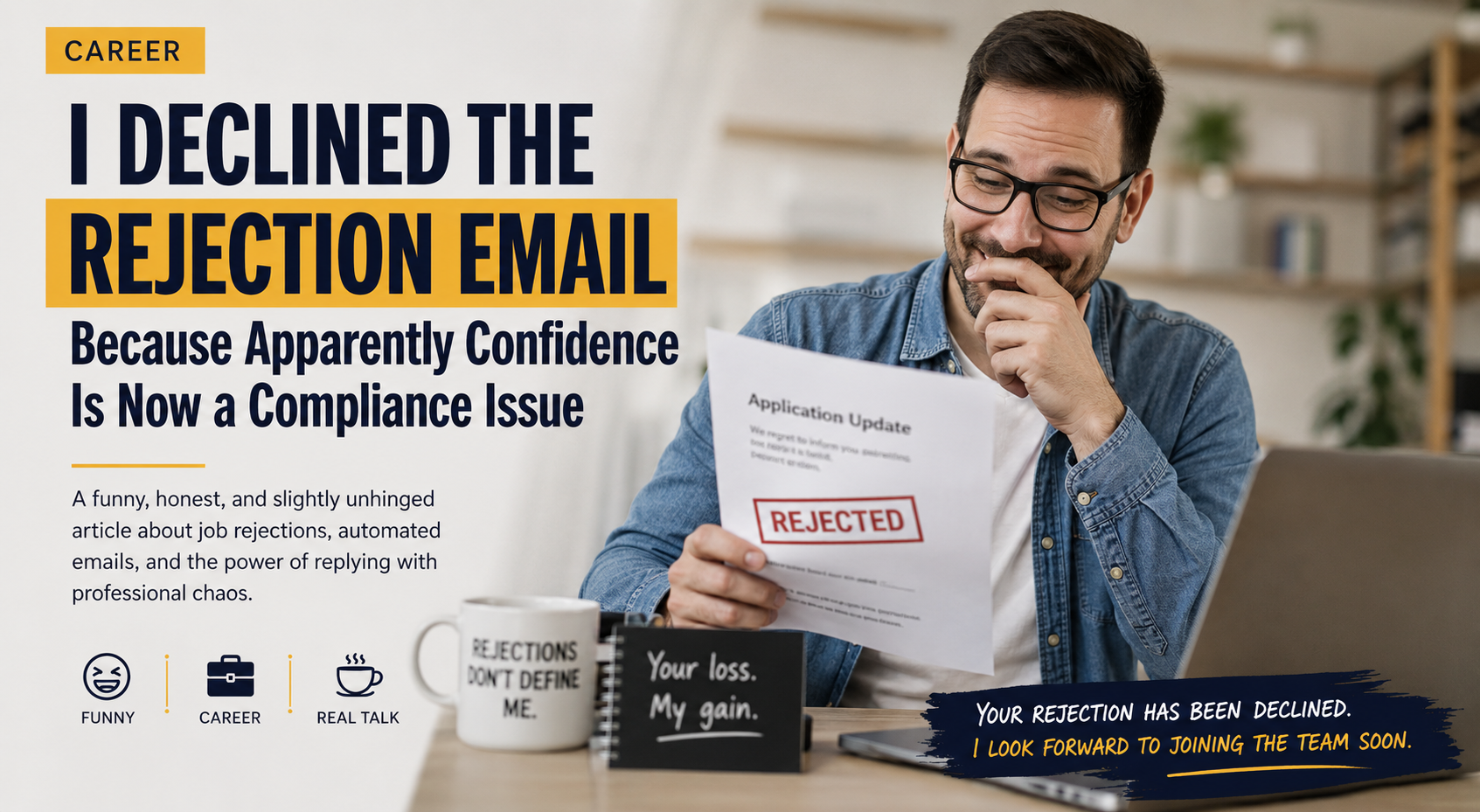
Let’s be honest. At some point in this job market, a rejection email stops feeling like a decision and starts feeling like a suggestion written by a printer with unresolved childhood issues.
There is only so many times a person can open their inbox, see “Thank you for your interest,” and not begin developing a personality disorder specifically designed by Workday, Taleo, and the spiritual ruins of corporate communication. These emails arrive with the emotional warmth of a parking ticket. They are polished. They are sterile. They are always written in that strange voice companies use when they want to sound human without risking actual humanity.
“After careful consideration, we have decided to move forward with other candidates.”
Careful consideration?
Really?
Because I uploaded my resume, retyped my resume, answered twelve questions that were already answered on my resume, created a password that required one uppercase letter, one lowercase letter, one number, one symbol, one ancient rune, and one childhood memory, and then waited three weeks just to receive a sentence that sounds like it was assembled by a copier during a power outage.
At first, I accepted these rejections like a normal person. I nodded. I sighed. I whispered, “Their loss,” while eating something over the sink like a man processing disappointment through deli meat.
But then one day, something changed.
A company sent me the classic rejection email. The old faithful. The corporate lullaby. The digital pat on the head.
And I looked at it and thought, no.
Not today, hiring team.
Today, I choose violence, but in business casual.
Today, I will not accept your rejection.
Because if companies can reject candidates with templates, candidates should be allowed to reject rejection with equal professionalism, slightly better punctuation, and the emotional stability of a raccoon locked inside a staffing meeting.
So I replied.
“Dear Hiring Team, thank you for your interest in rejecting my application.”
And somewhere in the distance, an applicant tracking system coughed blood.
The Rejection Email Entered My Inbox Wearing a Tiny Blazer
The email arrived like they always do, quietly and suspiciously, usually at a time when no actual human being should be making employment decisions. Sometimes it is 2:14 in the morning. Sometimes it is Sunday. Sometimes it arrives three months after you applied, when you have already forgotten the company existed and moved on emotionally, spiritually, and geographically.
But there it was.
A rejection.
The subject line was polite, because rejection emails are always polite in the way funeral homes are polite. Calm. Neutral. Softly devastating.
“Update on your application.”
That is already suspicious language. An update could mean anything. Maybe they want to interview me. Maybe they have selected me. Maybe the hiring manager saw my resume and wept openly into a spreadsheet.
But no.
The update was that I had once again been professionally released back into the wilderness.
They thanked me for my interest, which is corporate language for, “We noticed you performed hope in our direction.” They said they appreciated the time I took to apply, which is adorable because they clearly have no idea what happened inside that portal. Time? That was not time. That was a hostage situation with dropdown menus.
They said the decision was difficult.
Was it?
Was it difficult, Jennifer?
Did the team gather in a conference room, dim the lights, place my resume in the center of the table, and whisper, “He was brave”? Did someone stand by the window, staring at the rain, struggling to let me go? Did legal ask for a moment of silence?
No.
A system probably ranked me somewhere between “maybe” and “who is this?” then a template fired itself into my inbox like a corporate confetti cannon filled with disappointment.
And for years, we have all accepted this arrangement. Companies send these polished little rejection notes, and candidates are expected to absorb them gracefully, like emotional interns. We are supposed to say thank you. We are supposed to move on. We are supposed to keep applying, keep smiling, keep pretending that being rejected by software feels like character development.
But that day, I had questions.
Why do companies get to make every decision final?
Why do they get to say “we are moving forward,” as if I am standing still in a field holding my resume like a Victorian orphan?
Why do they get to keep my resume on file in some digital basement where PDFs go to become ghosts?
So I decided to reply with the same polished nonsense they use on us.
“Thank you for your update. After careful consideration, I have decided not to accept your rejection at this time.”
And just like that, the balance of power shifted by absolutely zero percent, but emotionally, I was wearing a cape.
I Reviewed Their Rejection and Found It Lacked Alignment With My Career Goals
Once I declined their rejection, I felt something I had not felt in a long time during the job search.
Control.
Not real control, obviously. Let’s not get carried away. I was still a candidate in a market where companies ask for seven years of experience for entry-level roles and then wonder why morale looks like a houseplant in a windowless office.
But emotionally, I had reclaimed one square inch of dignity from the jaws of automated correspondence.
So I continued.
I told the hiring team I had reviewed their rejection and appreciated the opportunity to be rejected. However, while their rejection demonstrated strong formatting, consistent margins, and a clear commitment to vague disappointment, I would not be moving forward with their decision.
That felt fair.
They get to evaluate me. Why can’t I evaluate them?
Their rejection lacked personality. Their rejection did not explain the salary range. Their rejection failed to demonstrate a strong understanding of my transferable skills, lived experience, emotional damage, and ability to survive corporate portals designed by someone who clearly has a personal vendetta against candidates and rectangles.
Their rejection also did not include next steps.
And I am big on next steps.
So I provided some.
Next step one: I will arrive Monday.
Next step two: I will bring a notebook.
Next step three: I will act like everyone is expecting me until someone tells me otherwise.
This is not delusion. This is strategy.
Companies say they want bold candidates. They want initiative. They want someone who thinks outside the box. Then the second someone replies to a rejection email with a little executive confidence, suddenly everyone is calling security and updating the employee handbook.
Make it make sense.
You cannot post a job description asking for a “self-starter” and then panic when I start myself.
You cannot say you want someone “comfortable with ambiguity” and then get nervous when I interpret “we have decided to move forward with other candidates” as “please challenge this in writing.”
You cannot ask for “strong communication skills” and then clutch your pearls when I communicate strongly.
Honestly, I was just matching their energy.
They said, “We regret to inform you.”
I said, “I regret to inform you that your regret has been declined.”
They said, “We will keep your resume on file.”
I said, “Wonderful. I will keep your rejection on file as well, where it may be reviewed for future disappointment opportunities.”
They said, “Please do not take this personally.”
I said, “Excellent. Please do not take my employment personally.”
At this point, the job market has become so absurd that responding to a rejection email with professional chaos feels less like rebellion and more like basic emotional hygiene.
Your Rejection Has Been Declined, Please Adjust Your Records Accordingly
The most beautiful part of declining a rejection is that nobody knows what to do with it.
There is no button in the applicant tracking system for “candidate has rejected rejection.” There is no dropdown option for “applicant has chosen employment anyway.” Somewhere, a recruiter opens the email, reads it twice, and suddenly their oat milk latte starts trembling like it knows too much.
Because corporate systems are built around one assumption: candidates will comply.
We will apply. We will wait. We will follow up politely. We will get rejected. We will thank them for the opportunity to be ignored. We will keep networking. We will keep uploading resumes into portals that behave like haunted filing cabinets.
But the minute a candidate says, “Actually, no thank you, I do not accept your rejection,” the entire machine briefly forgets how to machine.
And that is the magic.
Because the response is ridiculous, yes, but so is the process.
It is ridiculous to make candidates go through six interviews, a personality assessment, a case study, a panel discussion, a culture fit conversation, a reference check, and then reject them with one sentence that sounds like it was written by a toaster wearing loafers.
It is ridiculous to ask people to be passionate about a role while refusing to disclose the salary.
It is ridiculous to tell candidates they are “impressive” and then ghost them so hard their inbox needs paranormal investigation.
It is ridiculous to say “we are like a family” when the hiring process feels like being adopted by a spreadsheet and abandoned by Thursday.
So yes, I declined the rejection.
I declined it on behalf of every candidate who has been told they were amazing right before vanishing into a portal.
I declined it for everyone who has refreshed their email like hope might arrive if they just stared harder.
I declined it for every resume sitting in a database like a missing person flyer with bullet points.
And I declined it because sometimes the only sane response to an insane system is to become professionally unserious in a way that still uses complete sentences.
“Dear Hiring Team,
Thank you again for your rejection. After reviewing your decision, I have determined it does not align with my current career goals. Due to the high volume of rejections I have received this year, I am unable to accept every rejection personally. While your rejection was competitive and demonstrated strong template usage, I have decided to proceed with employment.
I appreciate your understanding during this exciting transition.
Best regards,
The candidate you still clearly want.”
That email may not get me the job.
But it will get me peace.
And in this market, peace has better benefits.
Final Thoughts: After Careful Consideration, I Have Decided You Are Still Interested
At the end of the day, this is not really about one rejection email.
It is about a hiring process that has somehow become both overly complicated and emotionally lazy at the same time. Companies want candidates to bring energy, patience, flexibility, resilience, availability, enthusiasm, technical skills, soft skills, leadership skills, humility, confidence, and a willingness to be interviewed by five people whose cameras are off.
Then, after all that, they send a rejection email that could have been generated by a microwave.
And candidates are expected to absorb it quietly.
But maybe we are done doing that.
Maybe sometimes the correct response to corporate vagueness is polite absurdity. Maybe sometimes the only way to remind yourself that you are not just a file in a system is to reply like a person who still has a pulse, a keyboard, and just enough caffeine to make legal nervous.
No, you probably should not actually show up Monday after declining a rejection.
Probably.
But emotionally?
Show up.
Show up for yourself. Show up with humor. Show up with dignity. Show up with the understanding that rejection is not a measurement of your worth. Sometimes it is just a template fired from a company that does not know what it wants, who it needs, or how to communicate without sounding like a printer apologizing for low toner.
So congratulations to every hiring team still sending out “after careful consideration” emails like tiny corporate obituaries.
After careful consideration, we have decided to keep going.
After careful consideration, we have decided the job market does not get to take our humor.
After careful consideration, we have decided that if your rejection can be automated, our response can be legendary.
Your rejection has been declined.
Please update your records accordingly.