There are moments in life when you realize you have made a decision that sounds harmless on paper but spiritually feels like stepping into a meeting where nobody has an agenda, everyone has opinions, and the conference room phone keeps breathing in the corner like it has unfinished business.
That was me at my friend’s company party.
I was not employed there. I had no badge, no Outlook calendar invite, no unresolved Slack threads, no mysterious quarterly objectives haunting my sleep. I was simply invited as a guest, which sounds pleasant until you remember that company events are never just events. They are carefully catered psychological experiments where adults in business casual clothing gather under decorative lighting to pretend they are relaxed while silently calculating who reports to whom, who is drinking too much, who is networking too aggressively, and whether the CEO’s speech is almost over or just entering its second inspirational weather system.
I arrived with the confidence of a man who did not belong there but was absolutely prepared to blend in by holding a plate and nodding at words like “strategy,” “alignment,” and “exciting opportunities ahead.” I told myself I would be normal. I would smile. I would say safe things. I would not accidentally turn the evening into a field study on corporate anthropology.
Unfortunately, I brought my personality.
That was the first mistake.
The second mistake was making eye contact with the appetizer table, because once you start asking why there are six kinds of cheese but no clear emotional support system for the crackers, the night has already begun walking barefoot through the lobby of madness.
The Appetizers Were Small, but the Corporate Energy Was Large
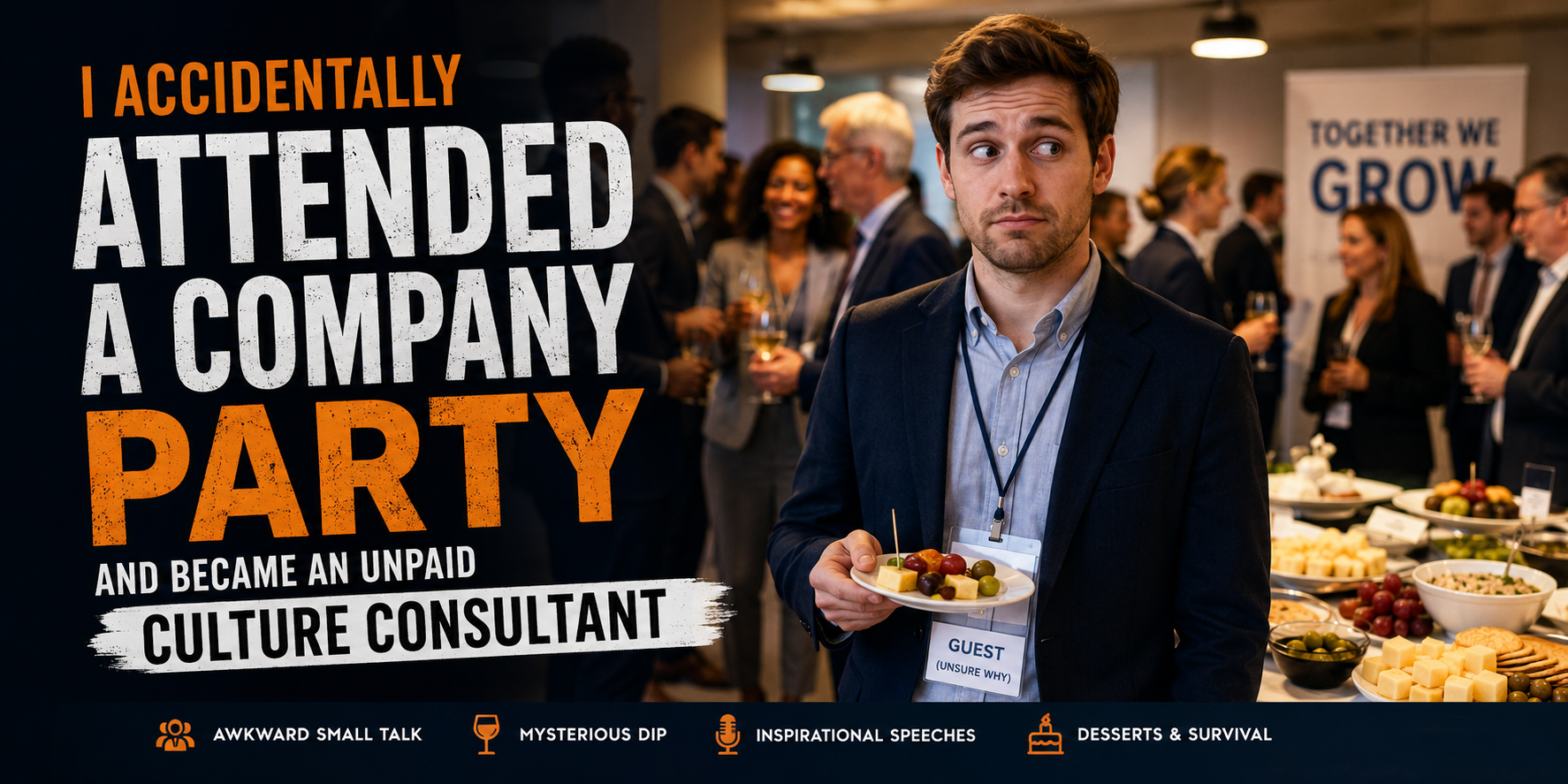
Every company party begins with food that looks like it was chosen by a committee that feared joy but approved texture. There were tiny sandwiches that required financial literacy to understand. There were crackers stacked with the precision of a legal defense. There were grapes sitting next to cheese cubes like they had been assigned to the same group project but had not spoken since orientation.
And then there was the dip.
There is always a dip.
Nobody knows what it is. Nobody asks. Everyone just hovers near it with the cautious optimism of people who have been burned before by a “house-made spread.” It had herbs sprinkled on top, which is how catering companies legally disguise uncertainty. It could have been hummus. It could have been spinach artichoke. It could have been mashed policy update. It had the texture of something that had attended leadership training and came back different.
People approached the food table like they were negotiating with it. They took one cracker, one cube of cheese, and one grape, as if HR was tracking plate weight in real time. Nobody wanted to appear too hungry, because at a company party, hunger becomes a personal brand risk. Take too much shrimp and suddenly you are “the shrimp guy.” Take too many desserts and now someone in finance is making a note for the next budget meeting.
I stood there holding a tiny plate that was clearly designed by someone who thinks dinner should be a rumor. The plate had enough room for three items and a private disappointment. I tried to arrange my food in a way that looked confident, but it is hard to look powerful while balancing a cracker, a grape, and something called whipped feta foam.
Around me, people were networking with the intensity of contestants trying to survive the final round of a business casual game show. Everyone smiled with their teeth but not their calendars. People shook hands like quarterly revenue depended on it. Someone said, “Great seeing you,” to a person they had clearly never seen before in their life. Another person said, “We should connect,” which in corporate language means, “We will never speak again, but this sounded better than silence.”
I tried to participate.
A man asked me what department I was in.
I panicked and said, “Mostly emotional support.”
He laughed, but not fully. It was the cautious laugh of someone trying to determine whether I was joking, important, or married to someone important. That is the danger of being a guest at a company party. Nobody knows your rank, so everyone treats you like you might be harmless or one introduction away from ruining their bonus.
Corporate Small Talk Is Just Weather With a Pension Plan
Once the food confusion settled, the conversations began, and I was immediately reminded that corporate small talk is not conversation. It is a series of password-protected phrases people exchange to prove they are still employable.
“How are things?”
“Busy, but good.”
“Crazy season.”
“Lots of moving pieces.”
“Can’t complain.”
Nobody says anything real. Nobody says, “I cried in my car because the dashboard froze during a client call.” Nobody says, “I have twelve meetings tomorrow and only three of them involve reality.” Nobody says, “I do not know what my boss wants anymore, and frankly, I suspect my boss does not either.”
Instead, everyone speaks in fog.
Busy, but good.
That phrase does so much heavy lifting it should have health insurance. It can mean the company is thriving. It can mean the department is collapsing. It can mean someone quit, someone got promoted, someone brought in a consultant, and the printer now requires a blood oath before scanning documents.
I met one man whose title lasted longer than some relationships. He said he was a “Senior Strategic Regional Client Solutions Experience Partner,” and I just stood there nodding like I had not just been struck by a vocabulary chandelier.
What does that mean?
No one knows.
Corporate titles have become decorative smoke machines. They sound impressive, but after a certain number of words, they stop describing a job and start describing a haunted LinkedIn profile. I wanted to ask, “But what do you actually do?” except that question is apparently considered violent at company parties. So I said, “That sounds important,” because sometimes survival is just choosing the safest lie.
Then he asked what I did.
That is always a dangerous question, because “I write sarcastic observations about the job market and corporate absurdity” sounds less like a profession and more like something HR would discuss after I left.
So I softened it.
“I write.”
He said, “Oh, like marketing?”
I said, “More like emotional damage with punctuation.”
He nodded slowly, which told me we had reached the edge of his training.
The conversations continued around me. People discussed projects without naming them. They mentioned timelines without explaining them. They talked about leadership like it was both a group of people and a weather pattern. I heard the phrase “cross-functional collaboration” three times in ten minutes and began to wonder if someone was summoning a regional vice president.
And yet, everyone knew the rules. Smile. Nod. Say “absolutely.” Laugh gently when someone mentions being buried in emails. Never admit you do not understand the acronym. There could be consequences. There is always someone nearby who has built an entire career on protecting the acronym.
The Speech Turned Into a Family Reunion With Budget Cuts
Eventually, someone tapped a microphone.
That is when the party became official.
You can always feel the emotional shift when a company event becomes a leadership ceremony. People stop eating mid-bite. Conversations fade into polite silence. Someone near the bar suddenly stands straighter, as if alcohol has been temporarily replaced by compliance.
An executive walked up, took the microphone, and began the sacred corporate ritual known as “thanking everyone while saying almost nothing specific.”
He said it had been a challenging year.
They always say that.
Nobody ever walks up and says, “Honestly, this year was weird, Brenda replied all twice, the software implementation was a controlled demolition, and half the staff survived on iced coffee and spite.” No. It was challenging. That is the approved word. Challenging is corporate for “several things caught fire, but legal said not to phrase it like that.”
Then came the phrase.
“We came together as a family.”
A family.
Every company loves calling itself a family until it is time to behave like one. Families do not usually schedule performance improvement plans before dessert. Families do not say, “Due to restructuring, we will be moving forward with other nephews.” Families may be chaotic, emotionally complicated, and occasionally too loud near the potato salad, but most families do not make you reapply for your seat at Thanksgiving through Workday.
Still, everyone clapped.
Because you have to clap.
Corporate clapping is not about agreement. It is about survival. Someone says “growth,” you clap. Someone says “innovation,” you clap. Someone says “resilience,” you clap while quietly remembering that resilience was mostly everyone answering emails at 10:47 p.m. because the project timeline was written by someone who has never met a human body.
Then came the awards.
Every company party has awards that sound heartfelt but are slightly confusing if you are not part of the ecosystem. “Most Collaborative Spirit.” “Operational Excellence Champion.” “Culture Carrier.” “Above and Beyond Award.” At one point, I expected someone to receive a trophy for “Successfully Remaining Visible During Leadership Transitions.”
People cheered. Photos were taken. Someone held a plaque like it might grant them immunity from future meetings. The executive said, “We could not have done it without you,” which is beautiful until you remember that most companies can and absolutely will try doing it without several people next quarter if the spreadsheet develops a mood.
The open bar, meanwhile, was doing more for employee engagement than any internal survey ever created.
People who had spent the first hour saying “busy, but good” were now saying things like, “Honestly, let me tell you what really happened with that rollout,” and suddenly the party became a documentary with appetizers. The jazz music kept playing softly in the background like it had signed an NDA.
By the end of the speech portion, I understood the event completely.
This was not a party.
This was a morale checkpoint with catering.
Final Thoughts: I Came, I Saw, I Pretended to Understand the Org Chart
By hour two, I had developed a full theory, and I stand by it with the confidence of a man who spent an evening observing strangers in branded fleece talk about “synergy” near a dessert table.
Company parties are not designed for fun in the normal human sense. They are designed to create the appearance of fun while everyone quietly remembers their place in the org chart. They are workplace escape rooms with shrimp, name tags, jazz, and a dessert table guarded by someone named Susan who knows exactly how many brownies were ordered and who took two.
You cannot leave too early, because then you seem disengaged.
You cannot stay too late, because then you become a story.
You cannot eat too much, drink too much, talk too much, or ask what anyone’s title actually means. You must move through the room with the calm precision of a person defusing a networking bomb. Smile here. Nod there. Laugh when someone says, “At least it’s not Monday.” Pretend the mysterious dip is normal. Pretend “culture” is something that can be measured with cupcakes and a banner near the registration table.
And yet, there was something oddly beautiful about the whole thing.
Because underneath all the corporate language, awkward lighting, executive speeches, tiny plates, careful laughter, and people pretending they are not checking emails from the bathroom, there were real humans trying to enjoy a night where nobody was asking them for a deliverable. People were tired. People were proud. People were stressed. People wanted to be seen, appreciated, promoted, remembered, and maybe handed one more drink ticket without having to explain their strategic impact.
That is the part corporate language always tries to polish until it disappears.
Behind every “busy, but good” is a person who survived another year of moving pieces.
Behind every clap is someone hoping their work mattered.
Behind every cheese cube is a silent employee wondering whether they can take the last brownie without becoming part of company folklore.
My friend asked me if I had fun.
I said absolutely.
And honestly, I did.
Not because it was a great party.
Because it was a perfect corporate safari, and I left with no badge, no performance review, no action items, and only mild suspicion that someone from HR had entered my name into a spreadsheet labeled “guest with observations.”
Which is fair.
I was observing.
But in my defense, the dip started it.