I didn’t “leave” LinkedIn so much as LinkedIn escorted me out with the soft, corporate dignity of a mall security guard who says, “Sir, we’re going to have to ask you to step outside.” One moment I was thriving in the bustling airport terminal of thought leadership—wheels-up on hot takes, gate change to synergy, boarding pass stamped “authenticity.” The next, I blinked and found myself standing curbside with my carry-on full of punchlines, watching the content planes lift off without me while a notification murmured, “Your account is under review.” Under review! As if a committee of beige cardigans and three-ring binders manifested just to interrogate my sense of humor with a flashlight and a flowchart.
Day one felt like detox. My thumb kept tapping the phantom icon where the app used to be, the way your tongue checks for a missing tooth. I tried to post a quippy observation about workplace tribalism and instead opened Facebook, which, spiritually speaking, is an attic of the internet: warm, dusty, and full of boxes labeled “Summer 2012.” The algorithm greeted me like an enthusiastic neighbor who’s been meaning to borrow a rake for seven years: “Hey, stranger! We put your high school lab partner next to a casserole recipe next to a picture of a dog that looks like a croissant. Also, your aunt would like you to play FarmVille. Again.”
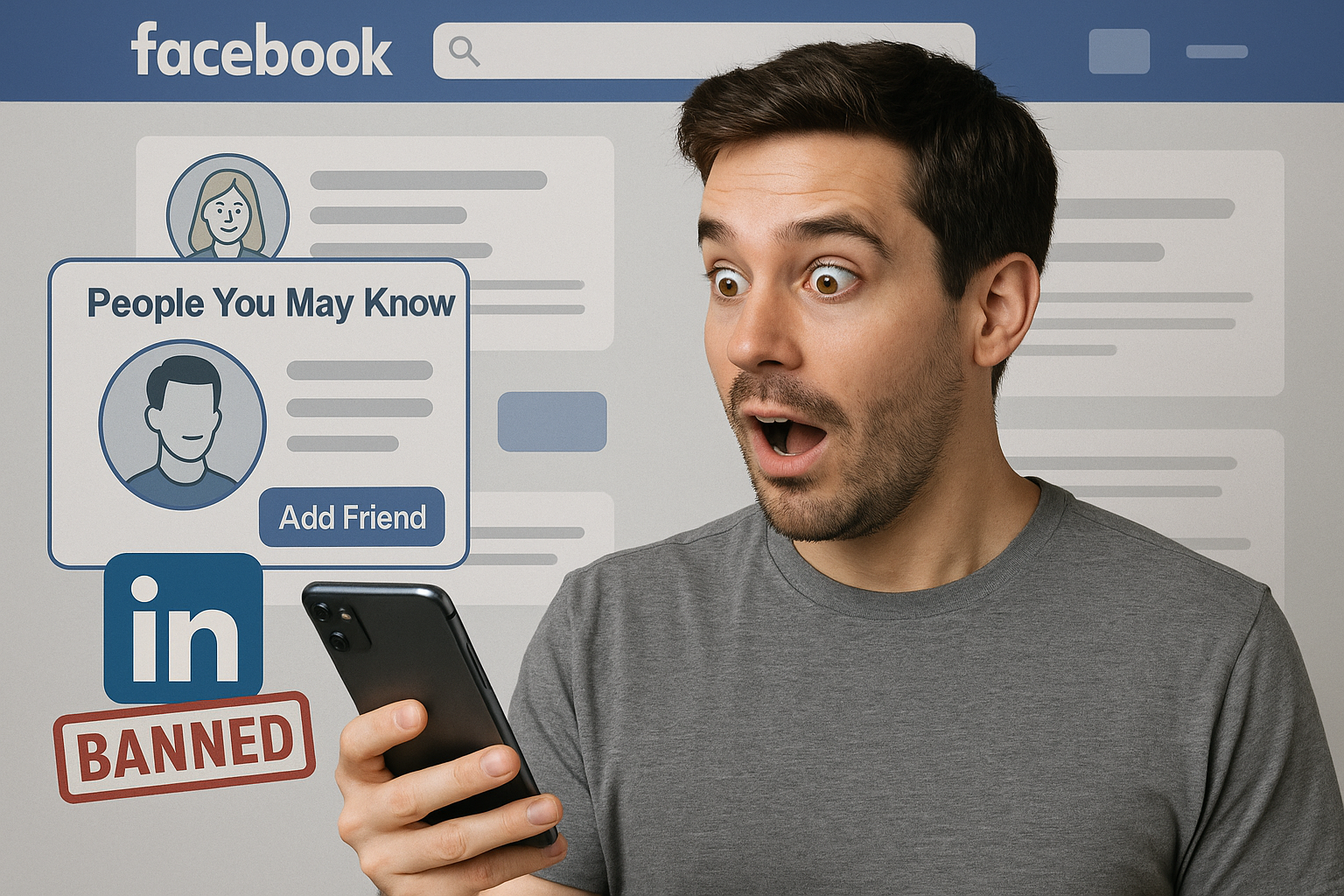
Within minutes, Facebook made a series of confident assumptions about my personality. It decided I must be in the market for: (1) a buy-sell-trade group where locals exchange haunted furniture, (2) three communities for people who collect antique butter knives, and (3) friendship with four recruiters who had ghosted me so hard on LinkedIn they could’ve been hired as special effects. Every refresh was a séance: “Do you wish to contact spirits from the other side? Press ‘Add Friend.’” The audacity. My dignity hovered over that button like a hummingbird negotiating with a wind tunnel.
Meanwhile, my brain—the part calibrated for “value-forward professional storytelling”—kept trying to write LinkedIn-shaped sentences. “Thrilled to announce…” it whispered. Facebook blinked back and said, “Darling, this is where we announce babies, divorces, and the return of pumpkin spice. Pick a lane.” When I typed “Three lessons from a platform timeout,” Facebook slipped a glitter GIF into my peripheral vision and recommended a group called “Moms Who Crochet and Also Believe in Bigfoot.” The vibe shift was biblical. On LinkedIn, we curate. On Facebook, we confess. On LinkedIn, we launch. On Facebook, we linger.
But under the sticky nostalgia and the half-finished memes, something else emerged: quiet. With no treadmill screaming “Post Daily or Perish,” I could hear my own thoughts again. Not the brand-safe thoughts, but the messy, unmarketable ones with frayed edges and inconvenient honesty. The ones that don’t need a carousel or a call-to-action. The ones that say, “Hey, what are you building that could live even if nobody clapped?” I poured another cup of coffee that tasted like a thunderstorm in the Old Testament and decided to treat this ban like an artist residency I didn’t apply for but got anyway. Welcome to my sabbatical, sponsored by the Algorithm’s Grouchy Uncle.
The Algorithm Will See You Now—Please Tilt Your Chin Down and Think About Your Choices
Facebook’s “People You May Know” is a Hall of Mirrors curated by a nosy librarian. It flings faces at you with the confidence of someone dealing tarot cards: your third cousin twice removed; a barista you once complimented on latte art; and—cue the spooky organ—Recruiter McGhosterson, who last year wrote “Let’s circle back next week!” and then circled back never. Suddenly they’re here, grinning in 4K, framed by a polite blue button that might as well read “Would you like to re-open this unresolved emotional subplot?”
I studied the grid like it contained clues to my destiny. There’s the VP who loved my post about compassionate leadership but never answered my DM. There’s the colleague who “accidentally” put my idea in a deck and called it “team-sourced.” Here’s an overlapping Venn diagram of people who adored my jokes and people who flagged my jokes. Facebook, bless its heart, doesn’t know the difference between “potential friend” and “lingering narrative arc,” so it invites everyone to the same potluck and trusts me to bring boundaries.
What Facebook does know—better than I do—is that I love a good train wreck. That’s why the feed always lands me between a deeply earnest pyramid-scheme testimonial and a dashcam video of a moose using a crosswalk. The dignity economy here is different. LinkedIn is all shop windows and carefully arranged mannequins; Facebook is a yard sale at 6 a.m. where you find a leather jacket that somehow fits and a snow globe full of someone else’s memories. I kept wanting to convert moments into “insights,” to salvage a newsletter from the debris. But the more I tried to format the chaos, the more the chaos whispered, “You don’t have to monetize me. You could just… watch.”
And then came the pings. “Hey, you okay? I can’t find you on LinkedIn.” “Did you block me?” “Did you get famous and go private?” (In that order of likelihood.) I crafted a stock reply: “I have been placed in a professional timeout for crimes against blandness.” Some laughed; a few clapped; one said, “I knew the day would come.” Redemption arc pending. The weirdest part? Without the invisible scoreboard of likes and impressions, the replies felt warmer, like sunlight without glass. People wrote in paragraphs instead of optics. We spoke like we were trying to keep each other alive.
By the end of the week, I had done the unthinkable: I did not add the recruiters. I took a screenshot, sent it to my group chat for ritual roasting, and put my phone down. Boundaries: 1. Algorithm: 0. Somewhere, a beige cardigan felt a disturbance in the Force.
Networking While in Witness Protection (Or: Using Your Phone as a Phone)
When the content conveyor belt stops, you discover which relationships were conversations and which were just synchronized scrolling. Deprived of my favorite megaphone, I tried a relic from the Before Times: I called people. It turns out that a five-minute voice call can accomplish what forty comments and a restraint order of emojis cannot. The absence of an audience makes people brave. There’s no “personal brand” performance, just two mortals trying to find a job-shaped answer to a life-shaped question.
I also began writing emails like letters, which is to say with a point of view and a soul. On LinkedIn, I’d gotten good at polite broad strokes: “Open to collaborations at the intersection of X, Y, and Z.” In email, that balloon deflated to something sharper and somehow kinder: “I help teams turn chaos into clean systems, and I make the spreadsheets pretty.” Not a manifesto—just a seat at a specific table. People responded. Not everyone. Not always. But the replies had texture, like bread you can actually chew.
Facebook, meanwhile, functioned as the town square bulletin board with thumbtacks and hope. I left a comment on a friend’s post about a community theater fundraiser; two degrees later I was on a Zoom with their friend’s friend who runs operations for a scrappy startup that needed process triage yesterday. None of this would have happened if I’d stayed inside the sterile conference room of LinkedIn, where every hallway leads to another hallway. On Facebook, the door you didn’t intend to open is usually the one with the dog and the good snacks.
Of course, I made mistakes. I posted one (1) update with LinkedIn energy—“Excited to share a new project soon”—and half my timeline congratulated me on my engagement, my pregnancy, and my book tour. Aunt Linda left seventeen heart reacts and one praying-hands emoji that looked legally binding. I deleted the post, replaced it with a photo of soup, and the algorithm exhaled in relief. Lesson learned: on Facebook, humility isn’t a tactic; it’s the house style.
But the most surprising lesson? The connections I made in this “witness protection” phase were stickier. They weren’t found by shouting into a feed; they were formed by knocking quietly and saying, “Hey, do you have ten minutes?” The meetings were shorter, the laughter was louder, and the follow-ups weren’t laced with desperation. We swapped actual favors. We remembered each other’s deadlines. We didn’t pretend to be “crushing it.” We admitted to being crushed and compared notes on un-crushing. The absence of spectacle made us useful to each other again.
The Day I Stopped Performing and Started Shipping (Even If No One Clapped)
The greatest gift of a platform ban is that you become allergic to the applause machine. Once the needle drops on silence, you can hear the question under every draft: “Is this worth writing if no one rewards me for it today?” An uncomfortable percentage of my drafts turned out to be performance art—perfectly engineered to be skimmed, saved, and forgotten. Without the dopamine faucet, I found myself reaching for bigger containers: essays that didn’t fit a carousel, projects that didn’t need a trend, experiments that wouldn’t impress anyone at first glance.
I started a folder called “Unmarketable and True.” Inside went the essays that embarrass me a little. The story about the job I didn’t get and how the rejection email sounded like it was written by a Roomba learning empathy. Notes from a day I spent in a service bay, where the wisdom of torque specs and honest labor humbled my spreadsheet brain into silence. A piece titled “Terms and Conditions of My Sanity,” in which I negotiated a ceasefire between my attention span and my ambition. None of it was tidy enough for a hook line. All of it felt like oxygen.
Shipping without a stage coach changed my standards. “Done” no longer meant “optimized for a feed.” It meant “useful to one human, maybe two.” I sent drafts directly to people who could actually use them: a leader wrestling with trust on their team, a friend turning their chaos into onboarding, a recruiter who believed in me back when belief was expensive. Instead of public applause, I got private gratitude. It didn’t light up a chart. It lit up my kitchen at midnight while I rinsed a mug and thought, “More of that.”
Do I miss LinkedIn? Unequivocally. I miss the good recruiters—yes, they exist—who tell the truth and fight for the candidate who doesn’t fit the template. I miss the random kindnesses: strangers who read to the end, left a thoughtful comment, and vanished back into their lives like benevolent raccoons. I miss the feeling that the right sentence, launched at the right hour, could stumble into the right room and change the week. When I get back, I’ll bring souvenirs from this exile: fewer buzzwords, more sentences with fingerprints; fewer “thrilled to announce,” more “here’s what I learned the hard way.”
Until then, I’ll be here in the attic with the croissant-dogs and conspiracy knitters, practicing the not-so-ancient art of shipping things that would matter even if the internet took a nap. If you need me, you’ll find me in someone’s comments cheering on a community theater, or on the world’s least strategic phone call, or quietly declining a friend request from the Ghost of Recruiters Past. The algorithm can decide whether I’m trending. I’ll decide whether I’m true. And for now, that feels like the only metric worth optimizing.
😂0😍0😢0😡0👍1👎0




I miss you on LinkedIn. I hated reinstalling FB. 😢
BUT, if it’s the only way to read my Alex-isms, I will survive the torture!
Your article helped me a lot, is there any more related content? Thanks!