
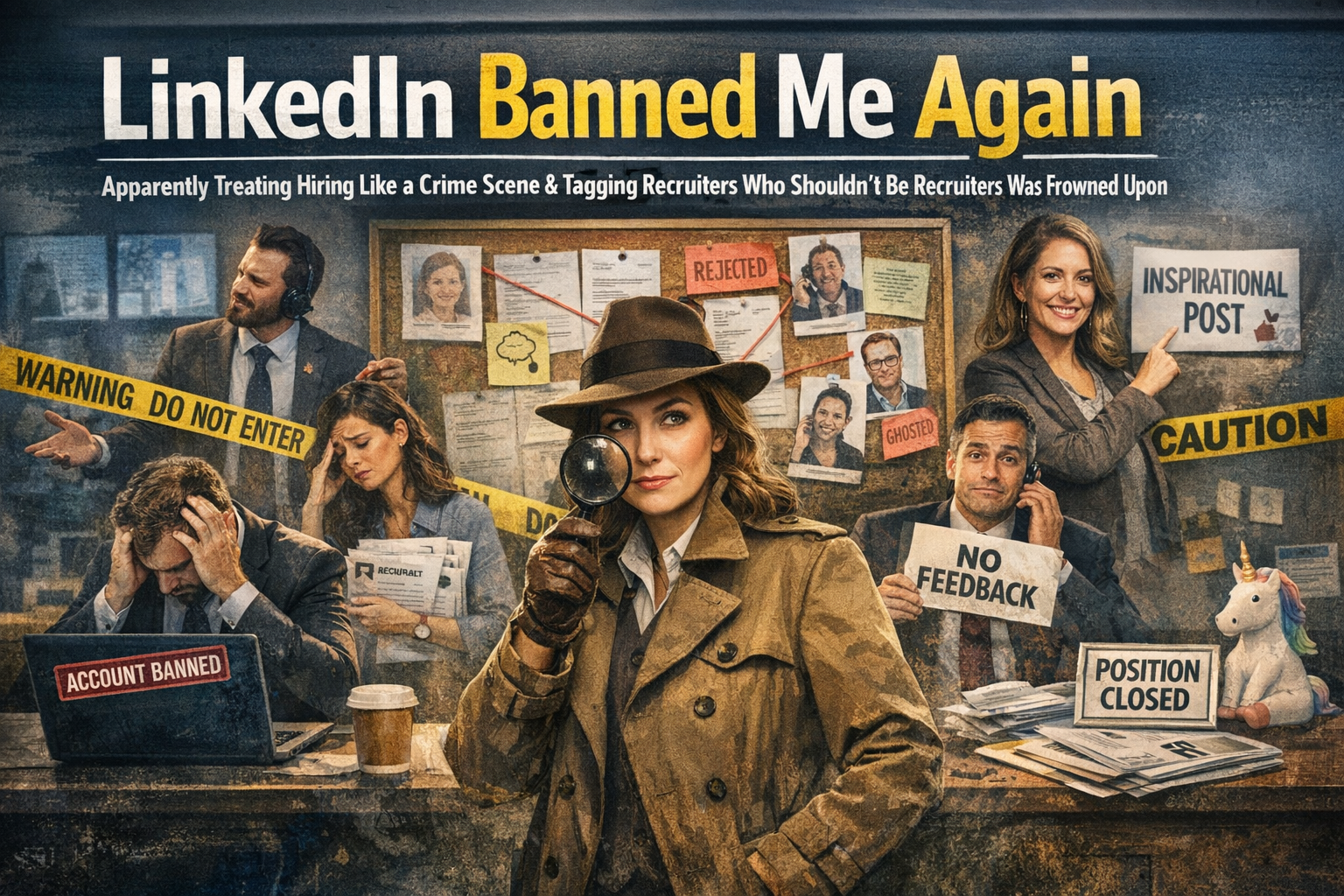
There is a very specific kind of silence that follows a LinkedIn restriction, and it is not peaceful silence, not reflective silence, not the soft silence of a man stepping away from the internet to reconnect with nature and remember what birds sound like. No. It is the kind of silence that feels administrative. Sterile. Corporate. The kind of silence that arrives wearing a badge, carrying a clipboard, and refusing to make eye contact while it escorts you out of the digital ballroom for the offense of saying something too accurate in public.
And that is what makes it so funny.
Because I did not get banned for pretending to be a guru with a ring light and a vocabulary full of weaponized optimism. I did not get banned for posting one of those emotional support carousels that says things like “You are exactly where you need to be” over a stock photo of a woman laughing at salad. I did not get banned for announcing that I am humbled, honored, excited, grateful, blessed, and deeply energized to begin a new chapter, even though that chapter is just me changing jobs and acquiring a new laptop with stricter password requirements.
I got banned, apparently, for discussing the hiring system like a man who has actually been inside it.
Which is where the comedy starts to blend so beautifully with the tragedy.
Because the modern hiring process is one of the few disasters on earth where the people enduring it are expected to describe it as growth. You are ghosted, delayed, rescheduled, misled, auto-rejected, interviewed by people who did not read your background, and occasionally forced into seven rounds of professional speed dating with a company that still ends the process by saying they have decided to move forward with candidates whose experience more closely aligns, which is corporate for “we wasted your time in a way that sounded strategic.” And yet somehow, somehow, the truly offensive act is not the dysfunction itself. It is pointing at the dysfunction while it is still smoking.
That is the part I can never get over.
A system can humiliate people at scale and still consider itself reputable. A recruiter can vanish like a Victorian child into fog and still post about candidate experience by lunchtime. A hiring manager can request a unicorn, reject a horse for being too horse-like, and then reopen the role three months later with the same desperate paragraph about seeking rock stars, change agents, and collaborative leaders who can hit the ground running but not, apparently, too confidently. And through all of this, the one thing that triggers panic is not the behavior. It is the witness.
That is where I come in, apparently, wearing the wrong outfit for a cover-up.
Because every time I tag recruiters who should not be recruiters, every time I describe a hiring process with enough specificity to make the guilty start sweating through their inspirational LinkedIn banners, every time I refuse to package obvious nonsense as a teachable moment wrapped in gratitude, the room reacts like I just kicked open the doors of a luxury hotel and started reading the health inspection report out loud in the lobby.
And yes, part of me laughs.
But part of me also feels something heavier than laughter, because behind every absurd story is a real person who needed that opportunity, believed that email, rearranged their day, rehearsed their answers, put on the blazer, fixed the lighting, calmed the nerves, and walked into a process hoping for dignity only to discover they had entered a maze designed by people who confuse chaos with selectivity. There is humor in it, absolutely, but there is grief in it too. The grief of watching professionalism be demanded from the powerless and treated as optional by the people holding the calendar invites.
So when LinkedIn bans me again, I do not experience it as a personal failure. I experience it as a tiny, hilarious confirmation that truth still has the power to make the wrong people uncomfortable.
Which means, in a strange way, the post probably worked.
The Strange Corporate Belief That Silence Is Professionalism
One of the greatest scams ever sold to working adults is the idea that silence is the same thing as professionalism. It is one of corporate America’s most elegant little magic tricks. Something terrible happens, something deeply unprofessional, sloppy, disrespectful, manipulative, or absurd, and before the dust even settles, someone appears from the beige mist to explain that the real danger here is not the event itself, but the possibility that the person harmed by it might describe it too clearly.
That is such a beautiful con.
It is elegant in the way a pickpocket is elegant. Quick hands. Calm voice. Total commitment to the act.
Because think about what this system asks from people. It asks candidates to be vulnerable on command. To tell strangers about their experience, their strengths, their setbacks, their values, their leadership style, their proudest accomplishments, and the time they faced adversity and overcame it with cross-functional collaboration and Microsoft Excel. It asks them to prepare thoughtfully, respond promptly, smile warmly, follow up graciously, and remain upbeat through delays that would qualify as emotional weather events in any normal relationship. It asks them to remain polished while being processed by organizations that sometimes operate with the urgency and coherence of a shopping cart rolling through traffic.
And then, after all that, if they dare speak honestly about what happened, someone inevitably says they should be careful.
Careful of what, exactly.
Careful not to upset the people who built a broken machine and then acted shocked when someone described the smoke. Careful not to inconvenience recruiters whose entire online identity is built around helping people, except during the moments when actual people are involved. Careful not to develop a reputation for memory, pattern recognition, or the radical personality defect of noticing that being treated poorly is, in fact, being treated poorly.
There is something so darkly funny about that expectation, because it reveals the true religion of the professional class, and it is not excellence. It is not integrity. It is not accountability. It is emotional containment. The unwritten rule is that you may suffer, but you must suffer in a way that remains aesthetically pleasing to the people who caused it.
You may be disappointed, but not too directly. Honest, but never in a way that threatens a brand. Frustrated, but only in soft-focus language approved by the Department of Public Relations and Delicate Men. You may hint. You may allude. You may post something vague enough to sound wise without identifying a single offender, like a Victorian widow speaking in metaphor near a window. But naming names, tagging the architects, describing the pattern with actual structure and sequence and consequences? That is when the room starts clutching pearls like you brought a live raccoon into a board meeting.
And the saddest part is that people internalize this.
They start believing that their pain becomes less valid the moment it becomes public. They begin editing themselves in real time, not because their story is false, but because they have been trained to fear the retaliation that often greets the truth. They turn lived experience into sanitized content. They swap honest nouns for softer synonyms. They transform disrespect into “misalignment,” deception into “an unfortunate process,” ghosting into “a communication lapse,” and complete professional nonsense into “a learning experience.”
What a masterpiece of cultural gaslighting.
Because no one tells candidates that corporations have entire departments dedicated to controlling language, shaping narratives, and minimizing damage, while the individual job seeker is expected to absorb every insult privately and still market themselves like a premium product with excellent stakeholder energy. That imbalance is not accidental. It is the design. If enough people can be convinced that speaking plainly is unprofessional, then the system never has to improve. It only has to keep punishing witnesses until everybody starts whispering.
That is why the ban feels almost symbolic.
It is not just about one post or one recruiter or one platform tantrum wrapped in policy language. It is about a larger cultural instinct to defend the appearance of professionalism over the practice of it. To protect institutions from embarrassment rather than protect people from harm. To treat exposure as aggression and dysfunction as normal so long as it arrives wearing business casual and speaking in complete sentences.
And yet, despite all that, people keep talking.
They keep sharing their stories in comments, in messages, in late-night confessions delivered with the exhausted relief of someone finally realizing they are not crazy. They tell you about the five rounds that led nowhere. The recruiter who vanished after promising feedback. The job described as remote until the final interview revealed it actually required relocation, obedience, and the emotional flexibility of a hostage negotiator. The manager who wanted someone strong, then rejected them for being too strong. The company that demanded transparency while behaving like a locked filing cabinet full of trust issues.
Those stories matter.
Not because they are dramatic, although many of them are corporate theater worthy of awards. They matter because every honest story weakens the illusion that this is all normal. Every named pattern makes it harder for the next person to gaslight themselves into thinking they are the problem. Every post that says, with clarity and heat, “This happened, and it was not okay,” becomes a small act of public sanitation in a space increasingly polluted by branding masquerading as ethics.
So no, I do not believe silence is professionalism.
I believe silence is often just fear wearing a tie.
And when that silence breaks, the people most invested in the performance always call it disruptive, because nothing sounds more disruptive than the truth in a room built for optics.
Tagging the Wrong Recruiters Is Apparently More Offensive Than Being a Bad Recruiter
There is no creature in modern professional life more protected by branding than the bad recruiter. Not the recruiter having a rough week. Not the recruiter drowning in reqs, trapped between unreasonable hiring managers and a calendar that looks like a hostage situation. I mean the truly bad recruiter. The one who treats communication like a folk tale, schedules interviews with the precision of a broken sundial, vanishes when accountability enters the chat, and still maintains a LinkedIn presence that suggests they are half talent strategist, half career angel sent down from the heavens to align destinies through empathy and talent acquisition.
That person is a marvel.
And apparently, tagging them is where society draws the line.
Not their behavior. Not the carelessness. Not the arrogance required to mishandle people’s livelihoods while still posting about candidate experience like a priest preaching water safety from inside a sinking boat. No, the unacceptable act is identifying them publicly enough that other people can connect the dots and say, “Ah. So it is not just me.”
That is when the panic sets in.
Because the professional internet can tolerate almost any degree of nonsense so long as it remains abstract. Generic outrage is fine. Broad commentary is welcome. Everyone loves a tasteful little reflection on how hiring could improve, preferably attached to a sunrise photo or a sentence about kindness. But the moment the criticism becomes searchable, traceable, and attached to a real human being with a real headline and a real habit of treating people terribly, suddenly everybody remembers the Constitution.
Now we must talk about nuance. Now we must talk about tone. Now we must talk about empathy for people whose own empathy was last seen hitchhiking out of town sometime around their third ignored follow-up email.
And what makes it funnier is how quickly the same crowd that lectures candidates about resilience becomes emotionally delicate the moment consequences drift in their direction. These are often people who can reject, ignore, delay, or mislead others without losing a wink of sleep, yet somehow consider public accountability a barbaric overreaction. They can waste your time, but you may not waste their comfort. They can bruise your confidence, but you may not bruise their reputation. They can turn a professional process into an obstacle course designed by caffeine and ego, but heaven forbid anyone place their name in the same sentence as the facts.
That reaction tells you everything.
It tells you that what they fear most is not unfair criticism, but accurate documentation. Because once a pattern is named, it becomes portable. People compare notes. Stories line up. Dates match. Tone echoes. What looked like an isolated bad experience starts revealing itself as a business model held together by branding and the assumption that candidates will blame themselves before they blame the process.
This is why tagging matters.
Not because public shaming is inherently noble. It is not. Some people absolutely weaponize the internet irresponsibly. But there is a world of difference between random mob fury and a person calmly saying, “Here is what happened, here is who did it, and here is why it matters.” That is not chaos. That is recordkeeping with WiFi.
And the emotional charge around it is revealing because it exposes the hierarchy at work. In that hierarchy, recruiters and companies are permitted to evaluate everyone, but are not especially comfortable being evaluated themselves. They can review your background, your employment history, your gaps, your phrasing, your energy, your salary expectations, your wardrobe from the chest up, and your performance during thirty minutes of small talk conducted by someone who may or may not have read your resume. But the second the candidate evaluates the process with equal specificity, the atmosphere changes from professional to medieval.
Suddenly you are dangerous.
Not because you lied. Not because you harassed anyone. Not because you invented some fantasy for clout. Dangerous because you observed. Dangerous because you remembered the timeline. Dangerous because you treated a recruiting interaction like something that happened in the real world and not inside a reputation laundering machine.
And that is where the emotion hits beneath the humor.
Because behind the jokes, behind the satire, behind the laughter of watching these people discover that public platforms are, in fact, public, there is something genuinely sad about how little room the professional world leaves for honest witness. There are people out there who have been unemployed for months, sometimes years, who are hanging on by nerves and caffeine and one more application at a time, and when they finally encounter treatment so disrespectful it crosses from frustrating into surreal, they are still expected to protect the image of the people who did it to them.
That is cruel.
It is a cruelty so normalized that many do not even recognize it anymore. They think this is simply adulthood. Just one more humiliating tax for wanting a paycheck. One more little sacrifice offered at the altar of opportunity. Be grateful, be patient, be quiet, be selected if the gods are kind.
I reject that completely.
If someone should not be a recruiter, then saying so is not the collapse of civilization. It is feedback. Brutally overdue feedback, perhaps, but feedback all the same. The professional world loves feedback when it travels downward. It loves assessments, rubrics, scorecards, development notes, improvement areas, executive presence, growth opportunities, and constructive input delivered with a smile sharpened into a blade. But when feedback travels upward or outward, when it reaches the people who hide behind process and policy while behaving like unreliable wedding guests, suddenly everyone becomes a scholar of ethics.
Please.
If the role involves dealing with human beings at vulnerable moments in their lives, then competence is not optional. Courtesy is not optional. Follow-through is not optional. Basic respect is not some premium add-on unlocked after Series B funding. It is the minimum.
So when I tag recruiters who should not be recruiters, I do not feel guilty. I feel like a public service announcement with a pulse. A little loud, perhaps. A little inconvenient for the people who prefer their dysfunction unsearchable. But fundamentally aligned with one simple belief: if you want the authority to shape people’s futures, you should also be prepared for the possibility that your conduct becomes part of your own professional record.
What a revolutionary concept. Evaluation for the evaluators.
No wonder the platform gets nervous.
Getting Banned Hurts a Little, But It Also Means the Performance Was Interrupted
I would love to tell you that getting banned again filled me with nothing but triumphant laughter, that I leaned back in my chair like a man in an action movie after delivering the perfect one-liner, completely unbothered, fully committed to the bit, spiritually moisturized by righteous indignation and dark humor. That would be a cleaner story. A stronger story. A much easier story to post.
But the truth is a little messier, which is why it matters more.
Because yes, it is funny that a platform overflowing with fake sincerity, engagement bait, personal brand theater, and leadership content written like fortune cookies for middle management somehow decides that my contribution to the problem is too much honesty with recognizable names attached. That part will never stop being absurd. It is objectively hilarious that in a sea of polished nonsense, the thing that triggers enforcement is often the person describing the sewage system.
But underneath the laugh, there is also fatigue.
Not the dramatic kind. Not the elegant, cinematic kind where a man stares out a rainy window while a piano soundtrack justifies his suffering. I mean the practical fatigue of realizing how often systems designed to reward visibility become uncomfortable when visibility is applied to them. The fatigue of watching platforms celebrate authenticity right up until authenticity leaves a mark. The fatigue of knowing that the people with the least power in these interactions are so often the ones expected to self-regulate, self-censor, self-edit, and self-erode in order to preserve the comfort of those who already move through the world with institutional padding.
And that is where the emotional weight lives for me.
Because every time this happens, I am reminded that speaking plainly comes with a cost. Not necessarily the end of the world, not exile, not some grand martyrdom narrative written by a man with too much coffee and access to punctuation, but a cost all the same. You lose momentum. You lose reach. You lose the ability to immediately answer the people messaging you to say, “That happened to me too.” You lose the little bridge between your voice and the strangers who were quietly drawing strength from hearing somebody say the quiet part loudly.
That stings.
It stings because beneath the sarcasm and all the corporate raccoon energy, I actually care. I care about the people who write me after being ghosted for the sixth time and wondering whether they are becoming invisible. I care about the professionals who spent decades building careers only to be processed by hiring systems that now treat them like expired software. I care about the person who got dressed for the Zoom, logged in early, smiled through the nerves, and then sat there alone while the meeting invitation slowly transformed from opportunity into insult.
Those people do not need another inspirational slogan.
They need witness. They need language. They need somebody willing to say that this is not just frustrating, it is corrosive. It wears people down in private. It makes capable adults question themselves. It turns optimism into strategy, then into endurance, then into a kind of weary superstition. Maybe this next recruiter will follow through. Maybe this next company actually knows what role it is hiring for. Maybe this next panel will contain at least one person who has read the resume and is not just there to ask what animal you would be if leadership were a forest.
So yes, the ban is funny. But it is also clarifying.
Because if a system responds more aggressively to exposure than to misconduct, then it is telling you exactly what it values. Not fairness. Not truth. Not repair. It values containment. It wants the mess hidden, not cleaned. It wants the candidate polished, the recruiter protected, the story blurred, the names omitted, the outrage softened until it can be repackaged as tasteful resilience content by someone with excellent lighting and a headshot that says “strategic empathy.”
And maybe that is why I keep coming back louder.
Not because I enjoy punishment. I do not. I am not collecting restrictions like loyalty points. But because every attempt to mute the conversation accidentally confirms the premise. It proves that the issue is not some isolated misunderstanding between adults. It proves that the pressure to stay quiet is systemic, cultural, and deeply woven into how professional spaces manage discomfort. The same people who tell job seekers to advocate for themselves often become visibly ill when that advocacy stops sounding grateful.
There is also, strangely, a kind of hope in it.
Not in the ban itself. There is no need to romanticize digital detention. But in the reaction around it. In the messages that appear elsewhere. In the comments from people who saw the post before it disappeared and recognized their own story inside it. In the fact that each attempt to suppress one account of the hiring circus only reveals how many more people have been standing outside the tent holding identical tickets.
That matters to me.
Because ultimately this has never just been about one recruiter, one company, one bad interaction, or one dramatic little platform timeout. It is about refusing to participate in the lie that broken systems deserve silence more than harmed people deserve language. It is about insisting that professionalism cannot just mean protecting institutions from embarrassment while individuals absorb the damage quietly. It is about telling the truth with enough clarity that someone else, somewhere, stops blaming themselves for what was always a rigged and ridiculous process.
And on the days when I am tired, when the joke feels heavier than usual, when the ban feels less like a punchline and more like one more locked door in a hallway full of them, I try to remember that interruption is still a form of impact.
If nobody noticed, nobody would bother stopping it.
That is not victory exactly, but it is evidence.
And sometimes evidence is what keeps a person going.
Final Thoughts
So yes, LinkedIn banned me again.
How devastating. How tragic. How deeply unfortunate that a platform built on professional visibility continues to have a complicated relationship with visible professionalism. Somewhere, I assume, a recruiter who once vanished for three weeks after promising feedback is now posting about grace, while I sit here in temporary digital exile like a man removed from the gala for describing the catering situation too accurately.
There are worse roles to play.
Because in the end, I would rather be inconvenient and honest than polished and complicit. I would rather risk being labeled difficult by people who mistake silence for maturity than spend my time helping them preserve a fantasy version of a hiring system that keeps chewing through human beings and calling it efficiency. I would rather write the uncomfortable post, tag the uncomfortable truth, and deal with the consequences than stand quietly on the sidelines while bad actors continue to wrap indifference in branding and call it talent strategy.
That does not mean I am never tired. I am. It does not mean I never feel the sting of it. I do. Even funny people get exhausted. Even the guy making jokes about corporate theater sometimes has to sit with the fact that the theater keeps selling tickets. But if there is any comfort in this ridiculous little cycle, it is knowing that every time the system reacts this strongly to being described, it accidentally confesses.
It confesses that truth travels.
It confesses that names matter.
It confesses that public memory is more dangerous to bad behavior than a thousand soft little posts about kindness ever will be.
And maybe that is why I keep writing.
Not because I think one article will fix it. Not because I believe every recruiter is terrible, or every company is malicious, or every hiring process is a haunted escape room run by emotionally unavailable bureaucrats. But because enough people have been mistreated in enough identical ways that staying quiet starts to feel less professional and more like participating in the cover-up.
So let them ban the account for a while.
The stories are still there. The patterns are still there. The people are still there. The broken machinery is still rattling around behind the curtain, trying to call itself innovation while candidates hold the emotional cost on their own shoulders.
And when the doors open again, I will probably walk back in exactly the same way I always do: a little funnier, a little angrier, a little more tired, and somehow still hopeful enough to keep naming what everyone else keeps trying to package as normal.
Because if telling the truth about a broken hiring system keeps getting me escorted out of the digital lobby, then at least we have finally established one thing with absolute clarity.
The problem is not that I am wrong.
The problem is that I am audible.