
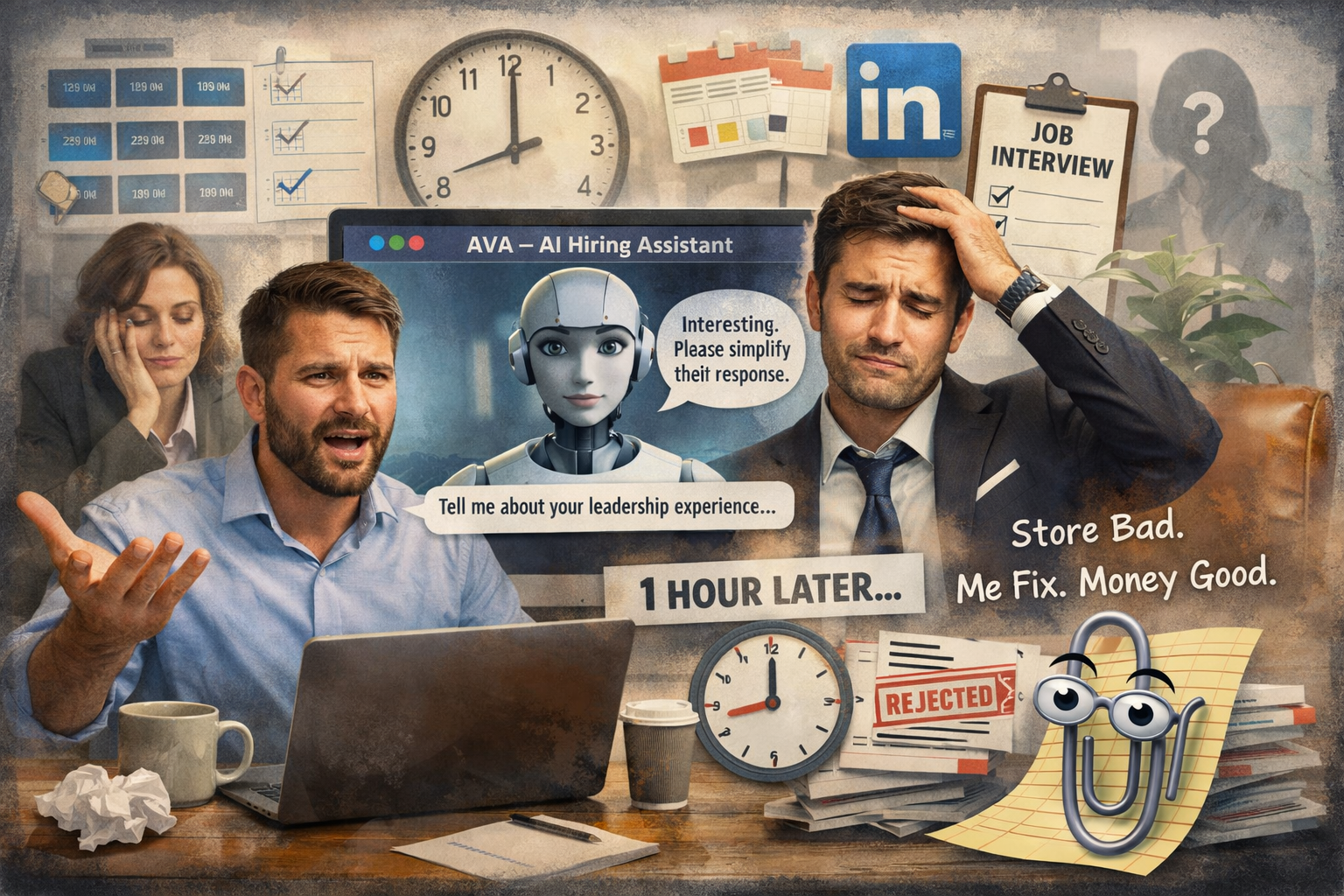
There are moments in modern life when you realize progress has taken a wrong turn, exited the highway, driven through a retention pond, and still had the confidence to send you a follow-up survey asking how likely you are to recommend the experience to a friend. This was one of those moments.
The other day I was browsing LinkedIn job postings, which is not so much a career activity as a form of emotional spelunking. You go in hoping to discover opportunity and emerge three hours later covered in psychic bat dust, wondering why every “exciting leadership role” sounds like a company has lost control of its people, its systems, and possibly a regional warehouse. Still, like every other adult participating in the modern labor market, I kept scrolling, because hope is a stubborn little raccoon and apparently mine still occasionally paws at the glass.
That is when I found a role that looked, on the surface, almost normal. The kind of posting that lures you in with mature language, broad responsibilities, and the soothing fiction that there is a competent organization somewhere behind the logo. I clicked through to the company website expecting the usual ritual: upload the resume, manually type the resume back into twelve tiny boxes like a bureaucratic trust fall, answer whether I have ever been legally known by another name, and then disappear into the applicant tracking catacombs where ambition goes to be quietly composted.
But no.
Instead, I was invited to schedule my own interview.
Immediately.
No recruiter pinging me with “Would love to connect” like a friendly ghost in business casual. No vague exchange about availability followed by a silence so complete it makes monastery life look chatty. No endless choreography between calendars, no back-and-forth emails written in that glossy corporate tone that says “warm regards” while radiating the urgency of refrigerated yogurt. Just a clean interface, open time slots, and the radical invitation to choose a moment that worked for me. I nearly wept. It felt efficient. Dangerous, certainly, because anything in hiring that feels frictionless now carries the same eerie energy as a clown standing motionless in daylight, but still, efficient.
And because the job market has emotionally conditioned us like lab animals who receive intermittent rewards from a broken pellet dispenser, I let myself believe. Maybe, I thought, some company somewhere had finally looked at the traditional hiring process and concluded that it should not resemble a hostage negotiation conducted through Outlook. Maybe they had decided that candidates are, in fact, people. Maybe they understood that professionals with years of experience do not need to be herded through seven ceremonial circles of corporate purgatory just to prove they know how to lead a team, read a P&L, and survive a calendar invite called “Quick Chat” that somehow lasts ninety minutes.
That thought, in retrospect, was adorable.
At the appointed time, I joined the Zoom interview. I sat up straight. I adjusted my expression into the familiar face every professional knows by heart: competent, engaged, warm, but not so warm that anyone mistakes your leadership background for emotional availability. I prepared for a hiring manager. A recruiter. A director. A person with a pulse, a Wi-Fi signal, and enough caffeine in their bloodstream to say, “Tell me a little about yourself,” while pretending this was not the forty-eighth interview they had done that week.
Instead, I was greeted by an AI hiring assistant.
An algorithm.
A synthetic voice wrapped in the visual styling of trust.
Not a human being. Not even a frazzled HR generalist reading from a script and trying to hide the sound of Slack notifications detonating in the background. A robot. A digital gatekeeper with the conversational charisma of a self-checkout kiosk that thinks you are stealing avocados. And somehow, by forces dark and institutional, I then spent an hour talking to it.
An hour.
Sixty full minutes of my adult life. Sixty minutes in which I, a grown professional with real experience, real judgment, and enough scar tissue from corporate America to qualify as a regional landmark, sat on Zoom explaining my career to a machine that kept asking me to simplify my answers like I was trying to teach strategic leadership to a microwave.
That was the moment I understood that hiring has not improved. It has merely upgraded its indifference.
What used to be human dysfunction now comes with cleaner branding, better lighting, and a subscription model.
Welcome to the Future, Please State Your Value in Smaller Words
The first few minutes were disorienting in the way all truly dystopian things are disorienting, because they arrive wearing the costume of convenience. The AI spoke politely. The interface was sleek. The questions sounded normal enough at first, which only made the experience more unnerving, like being mugged in a luxury hotel lobby by someone with excellent posture.
It asked me to describe my leadership experience, so I did what any experienced professional would do. I answered in full sentences. I gave context. I described scale, complexity, outcomes, the sort of things one might reasonably expect a hiring process to want from a candidate applying for a serious role. I spoke about leading teams through operational challenges, about stabilizing performance, about developing people, improving results, building accountability without turning the workplace into a medieval punishment festival. In other words, I answered like a human being speaking to what I mistakenly believed was an interview process interested in thought.
The robot did not care for this.
There was a pause, that little digital silence that feels less like reflection and more like a machine deciding whether your soul matches the barcode on the box. Then it prompted me to try again.
Not literally with the words, “Try again, but flatter the machine,” but spiritually that was absolutely the message. My answer, apparently, contained too much shape. Too much nuance. Too many connective tissues of adult thought. It wanted something flatter. Cleaner. More modular. Something that could be stacked, tagged, scored, and passed through whatever invisible linguistic meat slicer sat behind the interface deciding whether I had sufficiently performed employability.
So I answered again. Shorter this time. Simpler.
Still not quite right.
Again I was nudged, redirected, politely algorithmically herded toward a version of my own experience that would fit into the robot’s conceptual lunchbox. It wanted me to reduce years of leadership into something between a children’s book and a caveman telegram. Every time I gave it a real answer, it blinked at me with electronic disappointment, as if to say, I hear your words, but unfortunately I was trained exclusively on TED Talk captions and the LinkedIn activity feed of a man named Brent who posts “rise and grind” content over drone footage of office parks.
And that is when the degradation began.
Not the technology. That was already degraded.
I mean me.
Because the job market has taught us all a particularly ugly kind of obedience. Not healthy adaptability. Not professionalism. Obedience. The kind that makes intelligent adults betray their own instincts in hopes of getting through one more arbitrary gate. So I started simplifying. Then oversimplifying. Then simplifying the oversimplification until I no longer sounded like a leader discussing organizational change and instead sounded like a man describing fire to an alien refrigerator.
“I improved underperforming locations.”
Pause.
“I helped struggling teams get better results.”
Pause.
“Store bad. Me fix. Money good.”
At that point I was one rejected prompt away from pounding my chest and drawing quarterly trends on the wall with a stick.
And yet I persisted, because that is the true masterpiece of the modern job market: it can humiliate you in ways that would have seemed satirical ten years ago, and you will still stay seated because there might be compensation on the other side. Somewhere behind the bot, there was theoretically a company. Somewhere behind the company, a budget. Somewhere behind the budget, perhaps a paycheck. That possibility, however faint, is enough to make otherwise dignified adults perform career-themed charades for software.
The machine, naturally, never seemed embarrassed. That is one advantage technology has over humans. It lacks the decency to feel shame. A human recruiter can at least occasionally look awkward while asking you to summarize fifteen years of experience in thirty seconds or explain a resume gap caused by being alive during civilization’s recurring collapse. A robot has no such burden. It simply continues. Cheerful. Polite. Dead behind the eyes it does not have.
And there was something especially bleak about the fact that the system was clearly designed to present itself as progress. Not as a compromise. Not as a cost-saving maneuver. Not as an elaborate attempt to automate human discernment until the hiring process resembles a credit score with posture. No, this was offered as innovation. Efficiency. Streamlined candidate engagement. The whole thing wrapped in the smug language of optimization, which is corporate for “we would prefer not to pay a person to do this, and we pray you will mistake that for advancement.”
That is what gets me. Not that the technology exists. Of course it exists. We invented apps to tell us when to drink water and smart mattresses to assess whether we sleep with enough productivity. Of course someone eventually decided candidates should audition for employment by speaking to a machine trained on beige managerial fantasies. What gets me is the audacity of calling this better.
Because better would be faster response times from actual people.
Better would be fewer interview rounds.
Better would be job descriptions written by adults instead of committee-generated word soup.
Better would be companies not posting “urgent need” roles and then moving with the urgency of an injured turtle on sedatives.
But instead of fixing any of that, we have arrived at a place where candidates are expected to emotionally calibrate themselves for software, then smile about it like this is not one step away from being asked to submit blood samples directly to Outlook.
The Humiliation of Trying to Impress a Machine That Has Never Managed Anything Except Electricity
The most offensive part of the experience was not that I was interviewed by a machine. It was that at some point I genuinely wanted the machine to like me.
That is where the real tragedy lives.
Not in the technology itself, but in what the process reveals about the condition of the modern professional soul. We have all been dragged through so many broken, performative, dehumanizing hiring rituals that eventually the bar drops below dignity and keeps falling until it lands in a ravine somewhere near “Please record a one-way video explaining your greatest weakness while pretending this is normal.” Once that happens, you stop asking whether a process is absurd and start asking whether you can survive it.
So there I was, trying to do well.
Nodding thoughtfully.
Smiling when appropriate.
Answering carefully.
Pausing with the gravity of a man engaging in meaningful dialogue, even though my conversational partner was basically a haunted customer service portal wearing lip gloss. At one point I caught myself reacting to one of its prompts as though it had just offered real insight. I had the same expression one might reserve for a competent executive making a nuanced observation in a boardroom. Slight nod. Respectful concentration. Tiny squint of appreciation.
To a robot.
To software.
To an arrangement of code and confidence that had likely never managed a team, mediated conflict, coached a struggling employee, turned around a failing operation, handled a customer disaster, survived a bad quarter, or stared into the fluorescent abyss of a Monday leadership meeting while someone explained with total sincerity that the issue was not strategy but mindset.
That is when I realized something profound and deeply unflattering about the age we live in: we no longer require institutions to preserve dignity, we only require them to preserve the possibility of access. If there is even a chance that humiliation might lead to income, people will endure nearly anything. And companies know this. They know it the way casinos know where to place the lights. They know it the way streaming platforms know exactly when to auto-play the next episode so you do not have to sit with your own judgment. The job market has studied desperation and built entire workflows around it.
Which is why this robot interview did not feel like an isolated weird experience. It felt like the logical next chapter in a story that has been unfolding for years. First came the ATS systems that parse resumes with all the contextual intelligence of a decorative houseplant. Then came the eight-round interview gauntlets where every conversation is described as “a quick touch base” and somehow includes a personality test, an unpaid project, and three executives who all ask the exact same question in slightly different loafers. Then came the rise of ghosting so normalized that adults now discuss being professionally ignored with the weary resignation of villagers describing seasonal flooding. And now, naturally, we have reached the phase where the company cannot even be bothered to send a person for the first conversation. You are instead screened by software, as though employment were a nightclub and your experience needed to be evaluated by Siri’s colder cousin.
There is also something darkly hilarious about the assumptions built into these systems. The AI was not trying to understand me. It was trying to classify me. It was not listening for judgment, self-awareness, complexity, or how a human actually thinks when solving real problems in messy environments. It was listening for pattern alignment. Keyword adjacency. Language shapes it had been taught to reward. The whole experience felt less like an interview and more like being trapped in a spelling bee hosted by compliance.
And the burden, of course, was entirely mine.
The machine did not have to stretch.
I did.
The algorithm did not have to become more flexible, more human, more curious, more capable of recognizing that leadership is often expressed through stories, nuance, trade-offs, and context.
No, I had to become more machine-shaped.
I had to sand down my language. Strip out complexity. Offer smoother edges. I had to take the lived, difficult, often contradictory reality of executive work and reduce it into sentences that would not frighten the software.
That is what really unsettled me.
Because it was not just inefficient. It was symbolic. A perfect little parable for the modern workplace. The system is rigid, shallow, and incapable of handling the full range of human expression, so naturally the human is expected to become smaller.
Say less.
Simplify more.
Be clearer, but only in the approved direction.
Offer substance, but only if it scans well.
Present depth, but package it like instant oatmeal.
It is the same philosophy behind so much of corporate life now. The issue is not that the system is badly designed. The issue is that you have failed to contort yourself into a shape it can process. The performance review rubric is vague, the promotion criteria are mystical, the role expectations contradict each other, the workload is absurd, the leadership communication reads like a horoscope written by legal, but somehow the solution is always that the individual employee must adapt harder.
So yes, I sat there trying to impress a machine.
Because behind every dehumanizing process is still the oldest temptation in adult life: the hope that somewhere, if you jump through enough humiliating hoops with sufficient grace, you might finally be allowed to pay your bills in peace.
That is a powerful drug.
It can make smart people tolerate nonsense that would have sounded satirical in another era.
It can make a full-grown adult say “Thank you, that is a great question” to software that would not recognize irony if it tripped over it in a parking lot.
It can make you leave a Zoom call with an algorithm feeling not only tired, but vaguely rejected by electricity.
And let me tell you, there are few experiences more clarifying than realizing a machine has made you feel professionally needy.
Why Human Incompetence Is Suddenly Starting to Look Like a Luxury Service
By the time the interview ended, I had no clarity whatsoever about the role, the process, the decision timeline, or whether an actual person had observed any part of the hour I had just sacrificed to the gods of automation. What I did have was a profound new appreciation for all the flawed, inconsistent, gloriously inefficient humans who used to mishandle hiring in the old-fashioned way.
Because when a real recruiter is disorganized, at least there is texture.
There is history.
There is a pulse in the chaos.
A human can be late in a way that tells a story. A human can ghost you with enough personal flavor that you at least know some weak-boned decision-making took place somewhere in a cubicle under recessed lighting. A human can ask a bad interview question and then laugh awkwardly, revealing that they too are trapped in a broken ritual designed by people who think “culture fit” is a measurable science and not just a corporate séance with better shoes.
But a machine? A machine offers none of that. No embarrassment. No apology. No accidental honesty. No tiny glimpses of character. Just the smooth, dead language of process. It is bad in a way that has been polished. Soullessness with a user interface. Indifference with rounded corners.
And I did not think that would bother me as much as it did.
I have spent enough time around corporate dysfunction to understand that much of modern work is theater. Companies pretend to care deeply about people while treating them like line items with dental coverage. Recruiters pretend every role is exciting while reading the same script like a woman at a timeshare presentation who has learned not to blink. Candidates pretend they are passionately drawn to a company’s mission while privately thinking, I am here because groceries cost money and society has attached healthcare to employment like an elaborate dare.
We all know the dance.
But the dance only works because there are still humans on the floor.
Once you remove them, the whole thing becomes too honest.
That is what happened on that call. The machine stripped the experience down to its purest institutional essence: we would like information from you in a structured format, we do not especially care how this feels, and we are willing to outsource the earliest layer of judgment to a synthetic intermediary that cannot tell the difference between insight and sentence architecture. It was not even cruel. Cruelty requires a little passion. This was colder than that. It was administrative indifference at scale.
And maybe that is the future. Maybe this is where we are headed. More automation, more filters, more systems designed to process larger volumes of human beings with less actual human involvement. More candidates speaking carefully into platforms that evaluate them like sentient CAPTCHA tests. More language coaching, more algorithmic optimization, more career advice from people who say things like “tailor your narrative for machine readability” as if they are not describing a civilization-level embarrassment.
Maybe in five years every applicant will have a ring light, a keyword coach, and an AI whisperer whose sole job is to teach professionals how to sound sufficiently non-threatening to software. Maybe children in school will no longer practice public speaking for human audiences but instead learn how to answer behavioral prompts in a syntax that pleases the cloud. Maybe leadership itself will be redefined until the highest corporate virtue is not judgment, courage, or the ability to rally exhausted people through difficult conditions, but the skill of making your accomplishments legible to a digital sorting hat powered by venture capital and male optimism.
I wish that felt exaggerated.
It does not.
Because this is what happens when institutions become obsessed with scale and allergic to friction. Anything slow, messy, relational, or human gets labeled inefficient. But people are messy. Judgment is messy. Discernment is messy. Real conversation is messy. You discover things in actual dialogue that no algorithm can reliably surface, because life is full of contradiction. Great candidates are not always the smoothest talkers. Strong leaders do not always describe themselves in perfect bullet-shaped language. Wisdom often arrives sideways. Character is often visible in how someone handles complexity, not how quickly they turn a career into machine-friendly applesauce.
Yet here we are, building systems that reward compression and calling it intelligence.
And the real insult is that companies will continue presenting this as candidate-centered innovation. They will say it improves efficiency, expands access, reduces scheduling friction, accelerates pipelines, and creates a more scalable top-of-funnel experience, which is a lovely way of saying they have replaced the first date with a kiosk and expect you to call it romance.
Meanwhile, candidates will adapt because candidates always adapt. They will coach themselves to speak in crisp little algorithm snacks. They will train for synthetic interviews the way medieval peasants probably prepared taxes for kings they never met. They will do this not because it is good, but because the labor market has become such a carnival of asymmetrical power that people now accept degradation as a neutral background condition of employment.
And perhaps the bleakest comedy of all is that after an hour of this, I found myself nostalgic for ordinary recruiter nonsense. For the late arrivals. For the canned enthusiasm. For the polite ghosting. For the woman named Brittany or Heather or Linda who writes, “So great chatting!” and then disappears forever into the lavender fog of talent acquisition. Because at least in those interactions, there is another human being on the other side of the absurdity.
At least someone has blood.
At least someone can, in theory, feel bad.
That is not nothing.
In this economy, that is almost artisanal.
Final Thoughts: I Did Not Lose the Interview, Civilization Did
I left that call with no job, no insight, and no indication that anything I had said mattered in the form I had said it. But I did leave with a kind of clarity, the bitter premium clarity that comes only after an experience so ridiculous it peels the wallpaper off your illusions.
For years, we were told that technology would free us from drudgery, remove inefficiencies, and create more meaningful human interaction. Instead, what it often seems to have done is identify every place in life where a person might once have encountered another person and ask, with straight-faced horror, whether that really needs to continue. Banking became an app. Shopping became an algorithm. friendship became reacting to stories with fire emojis. And now hiring, that already miserable festival of performance and strategic self-erasure, has apparently decided that the opening act no longer requires humanity at all.
That feels significant.
Not because one robot interview ruined my faith in the future. My faith in the future was mugged years ago by password resets and self-checkout machines that call for assistance when you breathe near the bagging area. No, this feels significant because hiring is one of the few places where institutions briefly pretend to court people. Even at its most artificial, there has historically been at least a ceremonial layer of human engagement. A recruiter smiles. A manager nods. Someone asks about your background in a voice that implies your existence has been noted by the species. Strip that away, and something quietly damning is revealed. The company does not want to know you. It wants to process you.
And I know, I know, there will be people who defend this.
There are always defenders.
Men with podcasts. Women with innovation in their job titles. Consultants who say “lean into the future” with the grave confidence of people who have never once had to explain their own résumé to a suspicious appliance. They will say this is just evolution. They will say candidates need to adapt. They will say companies must handle volume, reduce bias, improve consistency, optimize workflows. And because corporate America can wrap any indignity in the language of scale, there will always be someone ready to clap like a seal in a blazer every time empathy is replaced by software.
But the problem is not adaptation. Adults can adapt to almost anything. The problem is what we are adapting to.
We are adapting to smaller and smaller spaces for humanity.
We are adapting to systems that value recognizability over reality.
We are adapting to the idea that if a machine cannot easily parse your experience, then the burden is on you to become more parseable, more flattenable, more conveniently reduced.
That is not progress. That is surrender with UX design.
And what really stays with me is not even the absurdity of the robot itself. It is the version of me I saw reflected back during that hour. The part of me that kept trying. Kept simplifying. Kept adjusting. Kept hoping that if I phrased my life just right, the machine would permit me to continue down the tunnel toward human consideration. That is the saddest and funniest part. Not that the system is ridiculous, but that it has trained all of us to endure ridiculousness with a straight face for the mere possibility of survival.
So yes, I talked to an AI hiring assistant for an hour. I explained leadership to software. I translated executive experience into language simple enough to make a kitchen appliance nod approvingly. I sat there in a collared shirt performing professionalism for an algorithm while somewhere in the background a company congratulated itself for being innovative.
And in the end, I came away with an unexpectedly tender appreciation for ordinary human failure.
Give me the disorganized recruiter.
Give me the awkward hiring manager.
Give me the overbooked director who joins late with bad lighting and a coffee the size of a birdbath.
Give me the flesh-and-blood chaos of people trying and failing to run a process like adults.
Because at least when humans mishandle hiring, there is still a chance for humor, for contradiction, for accidental honesty, for those tiny glitches of personality that remind you the world has not fully become an airport kiosk with leadership values.
At least when a real recruiter ghosts you, there is still a pulse somewhere in the story.
But when a machine interviews you, misunderstands you, and politely asks you to rephrase your existence into simpler units, the only thing left to ghost is your dignity.
And that, apparently, is the future of work: not man versus machine, but man begging machine to believe he has done a good job.
A spectacular development.
Really inspiring.
We should all be very excited.