
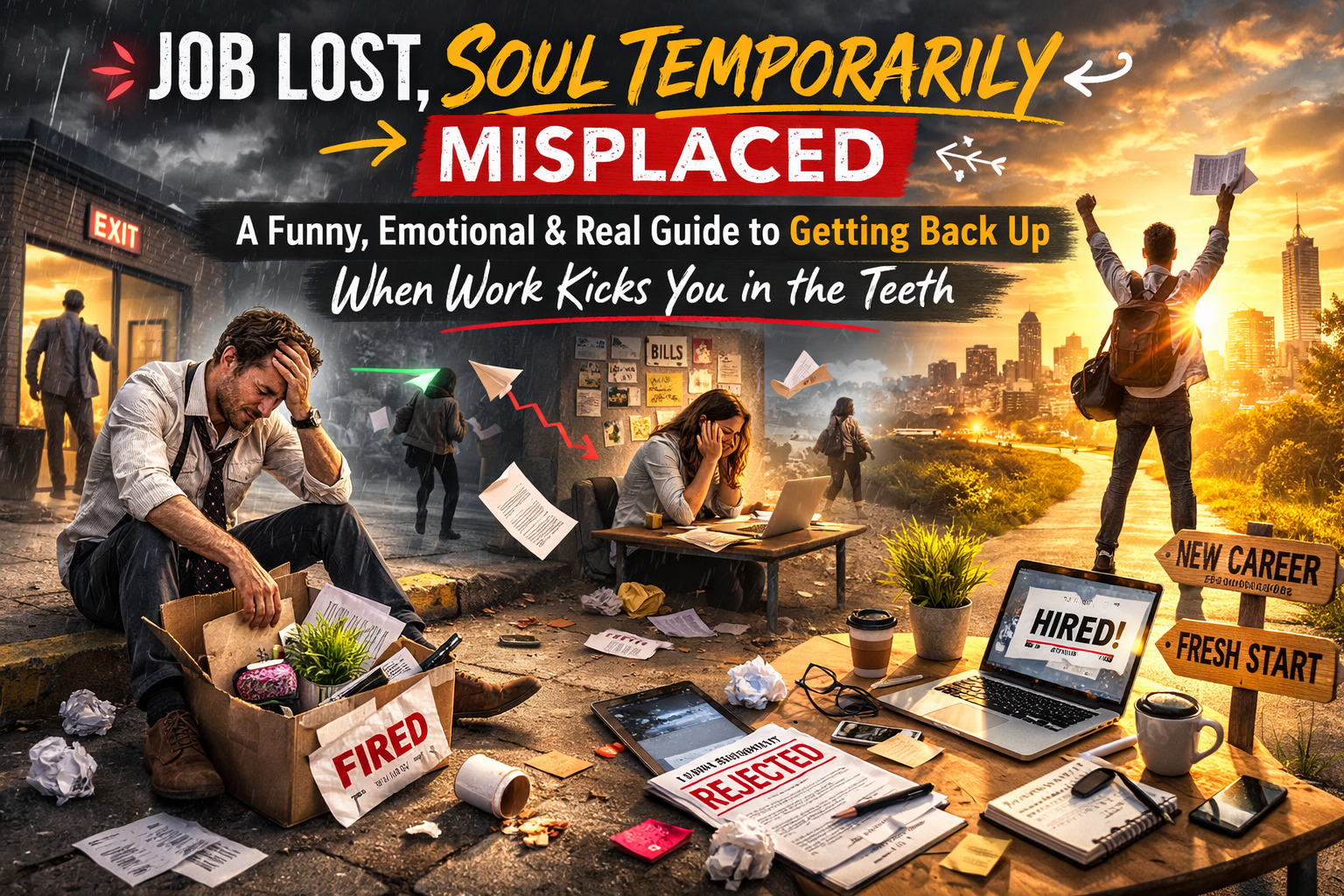
There are few experiences more disorienting than losing a job, because it is never just the loss of a paycheck, no matter how politely the email tries to frame it, no matter how many times someone in leadership says words like transition, restructuring, realignment, or strategic shift as if unemployment is simply a chic rebrand of panic. One day you are a person with a schedule, meetings you resent, passwords you forgot to update, and a deeply intimate relationship with Outlook fatigue, and the next day you are standing in your kitchen on a Tuesday morning holding a coffee like a widower at sea, wondering how a company that called you family managed to break up with you like a stranger avoiding eye contact at a gas station.
Job loss is strange because it is both deeply practical and embarrassingly emotional. Yes, there are numbers involved. Bills. Rent. Mortgage. Groceries. Insurance. The cold mechanical thud of responsibilities that do not care whether your former employer “appreciates your contributions.” But there is also the identity wound, which is the part nobody really prepares you for. Work may be exhausting, irrational, repetitive, and occasionally hosted by adults who should not be trusted with a microwave, let alone a department, but it still gives shape to your days. It gives you a role. A title. A script. A socially acceptable answer to the question, “So what do you do?” And when that disappears, even if the job was draining the life out of you like a fluorescent vampire, there is still a silence afterward that feels bigger than it should.
Because losing a job does not just affect your bank account. It messes with your confidence. It makes you revisit every meeting, every awkward exchange, every moment you should have documented more aggressively, every time someone said “great work” with the hollow energy of a man complimenting a chair. It can make smart people question their value. It can make talented people feel disposable. It can make strong people sit in sweatpants at 11:14 a.m. staring into the middle distance as if the toaster owes them answers.
And then comes the performance expected by the world around you. You are supposed to be resilient, optimistic, strategic, and somehow very inspirational about the fact that your life just got power-washed by corporate indifference. People love to tell you that one door closes and another opens, which sounds beautiful until you realize they are saying it to a person currently standing in a hallway with no shoes on, holding a severance packet and trying not to cry in front of a dog. Everybody wants your comeback story while you are still in the chapter where your confidence is being held together with caffeine, fake bravery, and the kind of positive self-talk usually reserved for injured athletes and men assembling IKEA furniture without instructions.
Still, buried under the embarrassment, fear, anger, and sudden spiritual intimacy with discount grocery stores, there is something important: losing a job is not the same thing as losing yourself. It feels that way at first. It absolutely does. It feels personal even when it is political. It feels final even when it is temporary. It feels like judgment even when it is often just dysfunction wearing a blazer. But a job is a chapter, not your entire autobiography. It is a role you played, not the whole person you are. And getting back is not about pretending you were never hurt. It is about learning how to carry the hurt without letting it write your future in permanent ink.
So let us talk honestly about it. Not in the sanitized language of motivational posters and LinkedIn sermonettes written by men who call layoffs “an exciting reset,” but in the real language of people who have had the floor disappear beneath them and still found a way to stand. Because getting back after job loss is not glamorous. It is not linear. It is not a tasteful montage with one sad song and a clean haircut. It is messy, emotional, absurd, occasionally humiliating, and often much slower than your bills would prefer. But it can also be clarifying, strengthening, and weirdly holy in the way that surviving hard things sometimes is.
This is for the people who lost a job and with it, for a little while, lost the map. This is for the people who are trying to rebuild not only income, but dignity. This is for the ones who still feel ashamed, even though they should not. This is for anyone who has been made to feel replaceable by a system that could not recognize their value if it tripped over it in the break room.
You are not finished. You are just in the rude middle.
The Day the Chair Ejected You and the Ceiling Started Asking Personal Questions
The first stage of job loss is disbelief, which is a polite word for standing there emotionally buffering while your nervous system tries to decide whether to scream, cry, laugh, throw a laptop into a pond, or simply become a decorative plant. Sometimes it happens in a meeting. Sometimes through a vague calendar invite with no agenda, which is corporate America’s version of hearing ominous music in a horror film. Sometimes through an email crafted so carefully by legal that it reads like a hostage note written by people with excellent healthcare. However it arrives, there is usually a surreal quality to it, because no matter how bad things were, the finality still lands like a body blow.
You start remembering weird details. The sound of the person’s voice. The phrase “this was not an easy decision,” which has never once comforted anyone in the history of human suffering. The way someone avoided saying your name too often, as if attachment might create liability. The awkward little kindnesses meant to make the blow feel softer. The same company that once asked for your flexibility, dedication, and emotional labor is now offering a PDF and a deadline. It is hard not to notice the contrast.
Then the humiliation tries to move in. And humiliation is a liar. It immediately begins decorating the place with false narratives. It tells you this happened because you were not enough. It tells you everyone saw this coming. It tells you your career is now a public crime scene and that every recruiter, former coworker, and random cousin with opinions can somehow smell professional failure from three zip codes away. Humiliation is incredibly dramatic, and like most dramatic things, it is not especially truthful.
What makes this stage so difficult is that job loss attacks both your reality and your rhythm. Money is now uncertain, but so is time. Your days change shape overnight. The same world that once demanded your presence now has no formal use for your Tuesday at 10 a.m., which sounds relaxing until you realize too much unstructured time is dangerous when your self-esteem is already limping. Suddenly every moment becomes vulnerable to overthinking. You can spend forty minutes revisiting one sentence your boss said three months ago and emerge from the spiral convinced you should have become a marine biologist.
This is also when other people start saying unhelpful things with loving faces. “Everything happens for a reason.” Perhaps. So do kitchen fires. “This might be a blessing in disguise.” Maybe, but right now it is still a disguise wearing steel-toed boots on your throat. “Take some time and rest.” A noble suggestion from people who are not personally acquainted with your electric bill. Well-meaning people often rush to the silver lining because your pain makes them uncomfortable, but pain that is hurried tends to ferment. You do not need a motivational slogan in this moment nearly as much as you need honesty.
And the honest truth is this: it hurts. Even when the job was bad, it hurts. Even when the boss was terrible, it hurts. Even when you were secretly hoping for escape, it hurts. Because rejection is still rejection, instability is still instability, and loss does not become painless just because part of you knows the environment was unhealthy. Sometimes losing a bad job is like getting dumped by a man you were actively trying to leave. You can know he was terrible and still sit there in emotional confusion eating cereal over the sink.
So the first thing you do to get back is not heroic. It is human. You let yourself feel it without turning it into prophecy. You grieve without building a shrine to the grief. You cry if you need to cry. You walk. You pray. You call someone safe. You say the humiliating things out loud so they do not grow claws in the dark. You write down what happened with brutal clarity, not because you need to become bitter, but because facts are grounding when shame tries to become fiction. You remind yourself that being let go is an event, not an identity.
Then you do one practical thing. Not ten. One. Update your resume. File for unemployment. Review expenses. Make a list of contacts. Clean off your desk. Save your work samples. One practical step is often the bridge between emotional collapse and forward movement. You do not need to have your whole comeback drafted by sunset. You just need proof that you are still a person capable of action.
That matters more than people realize. Because in the earliest days after job loss, momentum is medicine. Tiny momentum, yes. Embarrassingly small momentum, absolutely. But motion interrupts helplessness. Helplessness wants you frozen. It wants you identifying with the moment of loss. It wants you staring backward so long you forget there is still road in front of you. A small action says otherwise. A small action says, I am wounded, not over. I am shaken, not erased.
And perhaps most importantly, this is the moment to separate your worth from your wage. Society does a brutal job of tying human value to productivity, income, title, and professional status. We are taught to introduce ourselves through labor as though our souls came with quarterly performance reviews. So when the job disappears, many people do not just feel scared. They feel lesser. That is the deeper cruelty. But your dignity was never issued by HR. Your usefulness to the world did not begin with a login and it does not end with deactivation.
You had value before this company found you, and you will have value long after its leadership team forgets the password to the culture they claimed to care about.
The Beautifully Humiliating Middle, Where Hope Wears Sweatpants and Applies Anyway
Once the initial shock fades, you enter the middle stretch, which is where job loss stops being an event and becomes a lifestyle with deeply inconvenient hobbies. This is the season of applications, networking, résumé tailoring, fake optimism, login credentials, password resets, and enough rejection emails to qualify as a niche art installation. This is where the comeback begins, but it rarely feels cinematic. It feels repetitive. It feels personal. It feels like trying to rebuild your confidence in a marketplace that keeps asking for ten years of experience in software invented during the Obama administration.
The middle is hard because it asks for emotional endurance without much immediate reward. You apply for jobs and hear nothing. You hear from recruiters who vanish. You get interviews that feel promising and then dissolve into silence so complete it could be studied by monks. You begin to understand that modern hiring is not always a process so much as a haunted corn maze built by committees. The rules change constantly, nobody really knows who is in charge, and every turn contains a new indignity wearing business casual.
This is where many people start turning on themselves. They start reading every rejection as evidence. They revise their resume seventeen times in a week. They compare themselves to strangers online who claim to have found a dream role after “leaning into alignment,” which is wonderful for them and deeply annoying for the rest of civilization. They begin to believe that if they just become shinier, quieter, more keyword friendly, more polished, less honest, more “executive presence,” less human, more machine-readable, less visibly alive, they will finally be chosen.
And I understand that temptation. Truly. Because rejection creates the urge to shape-shift. You start thinking maybe the answer is to become professionally scentless. A candidate with no sharp edges, no history, no opinions, no scars, no signs of having ever been disappointed by reality. But that road is dangerous. There is a difference between being strategic and disappearing yourself. One gets you clearer opportunities. The other gets you hired into rooms where you will eventually suffocate.
Getting back after job loss is not just about finding another job as fast as possible. It is about finding your footing while the world keeps testing whether you still believe in your own value. That is the real work of the middle. Not merely sending applications, but resisting the slow corrosion of self-trust. Because every ignored message, every awkward panel interview, every “we went with another candidate” arrives with the potential to become internalized. Not because it is true, but because repetition is persuasive. Even lies start to sound convincing when delivered in volume.
So this chapter of recovery requires both tactics and discipline.
Practically, you need structure. Not because structure solves pain, but because it keeps pain from colonizing the whole day. Wake up at a time that respects your humanity. Get dressed, even if only slightly. Move your body. Apply with intention, not desperation sprayed blindly across the internet like confetti at a funeral. Reach out to real people where possible. Keep a spreadsheet if that helps. Track roles. Follow up. Learn the market. Improve your materials. Practice your stories. Build examples that prove what you can do. Take breaks before your nervous system files a workplace complaint against you.
But emotionally, you also need boundaries. Do not let job searching become the sole witness of your life. You are still allowed joy while unemployed. You are still allowed laughter, rest, friendship, music, church, sunlight, books, long drives, bad television, and moments that do not somehow need to become content for your recovery narrative. Despair thrives in monotony. So does shame. You must feed yourself more than applications.
And then there is the absurd dignity of persistence. Not fake positivity. Not inspirational nonsense printed in cursive over a mountain. Persistence. The kind that says I do not currently feel powerful, but I am still moving. I do not currently feel chosen, but I am still showing up. I do not currently have evidence that this will work quickly, but I refuse to crown this chapter as the end of my story. That kind of persistence is holy because it costs something. It is not glamorous from the inside. It is made of repetition, fatigue, disappointment, and little acts of courage nobody applauds in real time.
There will be days when you feel ridiculous. Days when you update your resume again and think, if one more stranger tells me to “highlight transferable skills,” I may become transferable to prison. Days when you reread your own achievements just to remember you were once competent before the algorithm began evaluating you like damaged produce. Days when you are too tired to hope in bright colors, so you hope in grayscale. That still counts.
And while we are here, let us say something important: getting back after job loss may also require mourning the fantasy. Not just the job itself, but the imagined future attached to it. The promotion you thought might come. The stability you assumed would last. The version of adulthood that looked cleaner in your head. Sometimes what hurts most is not the work you lost, but the future you were building around it. You may need to grieve that honestly before you can recognize what new doors are actually worth walking through.
Because one hidden gift of job loss, rude and expensive as it is, is revelation. It exposes what you tolerated too long. It clarifies what kind of leadership you no longer wish to serve under. It teaches you the difference between a title and a life. It can make you braver about asking harder questions, spotting red flags faster, and recognizing that not every opportunity deserves access to your peace. Pain is an ugly teacher, but it is often precise.
So keep going. Not because every day will feel hopeful. It will not. But because the middle is not where you live forever. The middle is where you learn stamina. It is where you stop begging the past to explain itself and start quietly preparing for the day something new finally says yes.
How to Rebuild a Life Without Letting Bitterness Become the Interior Decor
Eventually, if you keep moving, something shifts. Not always suddenly. Usually not dramatically. But little by little, you become less identified with the loss and more invested in the rebuild. You start speaking about what happened without feeling like your throat is full of gravel. Your confidence returns in fragments. A conversation goes well. A contact responds. A skill sharpens. An opportunity appears that feels less like panic and more like possibility. You are not fully “back” yet, whatever that means, but you are no longer standing in the ashes introducing yourself as smoke.
This stage matters because recovery is not only about employment. It is about who you become while rebuilding. A person can get another job and still carry the emotional architecture of the last wound into every new room. Suspicion. Hypervigilance. Overproving. Apologizing too much. Distrusting praise. Accepting bad treatment early because fear says at least this is safer than being without work again. That is why healing matters. Not in a vague scented-candle way, but in a very practical one. Hurt people often negotiate from panic. Healed people negotiate from clarity.
And clarity is one of the greatest forms of getting back.
Maybe getting back means returning to the same field with stronger boundaries and sharper discernment. Maybe it means changing industries entirely because the old one cost too much of your spirit. Maybe it means taking something temporary while you build toward something better. Maybe it means discovering that what looked like a career collapse was actually a forced confrontation with the fact that you had outgrown a version of life you were too tired or too scared to leave voluntarily.
Whatever the form, the rebuilding process asks an uncomfortable question: now that the old structure is gone, what do you want to build on purpose?
That question is difficult because for many people, survival has been so loud there was no room to ask what they actually wanted. They just kept going. Kept performing. Kept tolerating. Kept cashing checks from places that were slowly making them smaller. Job loss interrupts that pattern with all the grace of a brick through a window, but interruption is still interruption. It gives you the awful privilege of seeing your life more clearly.
This is where bitterness tries to seduce you, of course. And bitterness is seductive because it feels intelligent. It tells you cynicism is wisdom. It tells you caring is foolishness. It tells you the only safe posture is detachment sharpened into contempt. After enough disappointment, that message can sound very reasonable. But bitterness is expensive furniture for the soul. It takes up too much room and never really matches anything. You can survive disappointment without building your identity around being disappointed.
That does not mean becoming naïve again. God no. It does not mean pretending the system is fair, recruiters are always thoughtful, leaders are all competent, or effort automatically guarantees reward. That would not be healing. That would be delusion with a motivational podcast. It means learning how to remain open without becoming gullible, hopeful without becoming fragile, and wise without becoming cold.
Part of getting back is learning to tell the story differently. Not falsely. Not as though everything happened for magical reasons and every wound arrived gift-wrapped by destiny. But with ownership. Instead of, “I was discarded and that proved I was nothing,” the story becomes, “I was hurt, but I kept moving.” Instead of, “That company ended me,” it becomes, “That chapter ended, and I am still here.” Narrative matters because identity follows story. If you only describe yourself through damage, you will begin to live as if damage is your truest name.
And please understand, rebuilding confidence does not require waiting until you feel fully confident. Confidence often returns by evidence, not by mood. You apply while scared. You interview while discouraged. You speak clearly even if your stomach is rehearsing for a collapse. You keep promises to yourself. You finish small tasks. You remember old strengths by using them again. Action introduces you back to yourself.
It also helps to look beyond employment as the only measure of progress. Did you handle your finances more wisely than you thought you could? Progress. Did you survive emotionally brutal weeks and still remain kind? Progress. Did you finally admit you were exhausted and ask for help? Progress. Did you learn what environments break you and what environments let you breathe? Progress. A comeback is not just the moment someone hires you. It is the slow restoration of self-respect, stability, and trust in your own ability to survive what you hoped you would never face.
And when a new door opens, whether sooner than expected or much later than feels fair, enter it with memory but not chains. Let the past inform you, not imprison you. Ask better questions. Watch how people communicate. Notice whether “culture” is something they practice or merely print in a PowerPoint. Respect your intuition. Do not confuse desperation with destiny. A paycheck matters. Of course it matters. But peace matters too. Sanity matters. Leadership matters. The daily quality of your life matters. You are not weak for wanting more than employment. You are wise for wanting work that does not slowly erase your face from the inside.
Getting back is not about becoming the person you were before. It is often about becoming someone deeper, clearer, more discerning, and less willing to trade dignity for access.
That is not failure. That is transformation with paperwork.
Final Thoughts: The Comeback Rarely Arrives Looking Like Revenge, and Thank God for That
When people imagine getting back after job loss, they often picture the dramatic ending. The triumphant update. The new title. The salary jump. The day you post something tasteful and powerful that makes old coworkers quietly choke on their lunchtime regret. And to be fair, there is something delicious about the fantasy. I support a healthy amount of private vindication. But in real life, the comeback is usually quieter at first.
It looks like getting out of bed when there is no office expecting you.
It looks like refusing to let one company narrate your value.
It looks like updating a resume while your heart still hurts.
It looks like saying no to shame, even when shame keeps showing up uninvited with charts.
It looks like making a phone call, sending another application, taking a walk, asking for help, trying again, resting on purpose, and trying again after that.
The comeback is not just external. It is internal. It is the moment you stop asking a broken system for permission to believe in yourself. It is the day your own voice starts sounding more trustworthy than the rejection. It is the moment you realize you survived something that once felt unsurvivable, and although you would not have chosen it, it taught you that your life is sturdier than the structures that failed you.
You may still have hard days. You may still flinch at certain phrases. You may still carry anger. Some of that is normal. Some of that may take time. But do not mistake scar tissue for weakness. Scar tissue is evidence of healing. It means the wound did not get the final word.
And maybe that is the real lesson beneath all the resumes, interviews, rejection emails, and anxious budget spreadsheets. You are more than your most recent loss. You are more than the company that let you go. More than the manager who did not see you. More than the quarter in which numbers mattered more than names. More than the silence that followed your application. More than the season that made you question everything.
You are still here.
Still capable. Still valuable. Still needed. Still becoming.
So grieve honestly. Rebuild slowly. Laugh when you can, because humor is often how dignity keeps breathing in absurd situations. Rest when needed. Fight cynicism with truth. Fight shame with facts. Fight despair with movement, however small. And when the world tries to reduce you to one professional disappointment, have the audacity to remain a whole human being anyway.
Lose the job, maybe.
Lose the title, temporarily.
Lose the schedule, yes.
Lose the illusion that companies always reward loyalty, absolutely.
But do not lose yourself.
That is the one thing this story cannot afford.
And the beautiful thing, the infuriating thing, the holy and hilarious thing, is that even after all of it, after the meetings and the fear and the sad little emails that say “we appreciate your contributions” like they are sending flowers to a career crime scene, people still rise. They still rebuild. They still find work, meaning, confidence, laughter, and purpose again. They still create a life after the collapse. Not because it is easy. Not because they were untouched. But because the human spirit is stubborn, and sometimes the most rebellious thing a wounded person can do is continue.
That may not feel glamorous today.
But it is how comeback stories begin.